The Yellow Rose of Schoona

A poignant tale of love, loss, and thralldom embellished with romance as tales often are, this story was published over a century ago in The Calhoun County Monitor-Herald.

In the cold, dreary winter of 1852, just after the organization of Calhoun County, quite a number of citizens of Spring and Brushy Creeks were sitting in a rude log cabin by the roadside, where John McCord kept a store, lightly stocked with the necessities of life, discussing the new county and squirting tobacco on the old, rickety stove. Bob Brown, the Postmaster, (for there had recently been established at this place a post office called Banner), came around and stood in the door. Snow and sleet were falling thick and fast and the cold north wind howled through the towering pines and drifted snow against the rude fences. All nature seemed at war–and the howling storm quelled the spirit of those pioneers, who were acquainted with trouble and knew danger and privations.

“The coldest day I ever felt,” said Bob. “Everything outside is freezing.”

While the men were buttoning up their coats, preparatory to breasting the storm en route to their homes, Bob looked eastward along the road and saw a lone woman trudging through the snow storm, coming in the direction of the store. She soon appeared at the door and asked permission to warm at the fire. The gentlemen gallantly gave way and tendered her a seat near the stove.

“Bad weather to be out,” remarked McCord, the merchant. “Quite unpleasant,” replied the woman in soft, sweet voice. She was well and comfortably clad, and had in her hand a well filled grip. She was tall and well formed, with a handsome figure and soft, appealing eyes. Her hair was long, dark and wavy, and her skin was a soft yellow–not quite as dark as the Indian. Her features were animated and her countenance sparkled with every change of expression. Her step, quick and elastic; voice, soft and musical; her language, pure and faultless English and her age about 22 years. The men soon started for home through the drifting storm, and left McCord, Brown and Sid Brantley and the woman still clustered about the stove. The able, big-hearted Brantley asked the woman how it happened that she was caught out in the storm, and where she was going in all this bad weather.

After some hesitation, she answered in a low, musical voice, “I am part Indian and I am making my way to the Indian Nation, where my tribe, the Chickasaws, went in 1836. I was then a small girl living with my grandmother. My mother, a Chickasaw died when I was a baby. My father, a white man, went with the tribe. My grandmother, being very old, was left with me. After grandmother died, I was taken by a nice family of whites, who gave me a home, taught me the art of dressmaking and educated me. But I could not forget my brothers and sisters in the Indian Nation and at last resolved at every hazard, to make my way to them. I have no money or friends that I can call upon for assistance, so I am trying to make my way afoot.”

Her simple story touched Mr. Brantley’s heart, and he cordially invited her to his nearby home. She, with some hesitation, accepted his generous invitation and accompanied him home, where she remained until the storm was over. In conversation, on the way home, Brantley asked her name. She modestly answered, “Bombazelle McAllister”. She was introduced to the family and assured that she could make her home with them until the weather settled. She was assigned a room with Brantley’s oldest daughter. The next day was still cold and blustery and the ladies were confined to their rooms. The stranger soon became familiar with the family. Miss Brantley had a nice new dress pattern she was preparing to make up. Bombazelle examined the goods with great care and suggested how it should be designed. Sissy was delighted. Bombazelle took her measure–a thing heretofore unknown in these wild woods–and she assisted in making the dress. The family was delighted with the attractive design and the gracious fit of the dress. Hence the news spread rapidly throughout the neighborhood that a marvelous designer and dressmaker was stopping at Sid Brantley’s–and the blushing lassies in all the region gathered ’round to have Bombazelle cut and fashion their dresses. She moved from home to home as her services were requested, and at night, occupied rooms and beds with the young ladies of the community.

The snow storm had passed, but Bombazelle remained, kept busy cutting out and making dresses. She was well paid and was kindly received by every family. She was ready and willing to give the young ladies instructions in cutting materials and in dressmaking. She was a fine talker and a lovely girl, her color rather dark, but being part Indian, this was understood. She soon became the Belle of Banner, and the boys called her “The Yellow Rose of Schoona”, and she received the attention of all the nice young men in the neighborhood. John McCord fell desperately in love with Bombazelle, and after a spirited contest with the young swains about Banner, won her heart. McCord was, as the term was known in those far-off days, “well-off”. He had a good house, servants and quite a number of Negro slaves. The couple was married at Brantley’s home, Esquire John Hankins making the happy couple man and wife. There was quite a gathering at the wedding, and, as was the custom, all who wished, were privileged to kiss the bride, as did some of the girls and women present.

The springtime in all its beauty was rapidly approaching. The dogwoods were budding, the birds were all a-twitter and the geese were flying north to their faraway homes. Bombazelle was happy in the home of John McCord. She had a husband who was a leader in the young county and was loved and admired by everyone. She also had Old Sylvia, her trusted servant, and her flock of boys and girls, to attend to her every want. She kept a close eye on the servants, and they had to “toe the mark”. She had her rooms well furnished, wore wonderful clothes, and kept everything about the place in “apple pie” order. Every servant jumped when she spoke, for she was a firm mistress, and ran the house with energy and ability. McCord, too, was happy with his beautiful wife and his elegantly arranged home. The “Yellow Rose” was happy and excited because she was the leader in style and fashion in the whole county. She was constantly sought out and consulted about dresses and was a close friend to the young belles for miles around.

Spring opened in all its glory. The whippoorwills sang at evening, the sun smiled all day on the new fields, just wrested from the primeval forests, and the birds and animals made love in the swamps and endless forests. Late one afternoon, a fine looking gentleman was seen riding a splendid blooded horse into Banner. Mrs. McCord (Bombazelle) observed him–and, in consternation, made it convenient to disappear at once. The traveler alighted and entered the saddle shop owned by J. Brown, and after passing the compliments of the season, inquired if there had been seen in that place a woman who had disappeared. He gave an accurate description of Mrs. McCord. Bob hesitated, looked wise and gave an evasive answer. Night was approaching, so the stranger asked if there was a house of entertainment in town. Brown directed him to Mr. Arnold’s home, just west of town. He made his business known to Mr. Arnold, and said he had traced the woman to Banner–and that she was his Negro house servant and seamstress–and that she had run away from the family home at Aberdeen, Mississippi. Arnold repeated to him the story of Bombazelle’s appearance, her captivation of the community and her marriage to John McCord months before.

“That’s my Negro,” said the stranger, “she is almost white in appearance and is very smart.”

It is hardly necessary to add that the people of Banner were stirred up and greatly excited by his revelation. The belles and beaus were crestfallen. The girls who had entertained and associated with Bombazelle were dumbfounded. The idea of having so cordially entertained this servant in their homes was humiliating. And the young men who had called upon Bombazelle and sought her hand were shocked beyond expression while the older men, who had so fondly kissed the yellow blushing bride, were punched in the ribs by their wives for having embraced the woman in their presence. But the “Yellow Rose”! Where was she? McAllister (the stranger) could not find her anywhere. She had suddenly and mysteriously disappeared. McCord was wild and miserable. His happiness was swept away in the wrinkling of an eye. Dispirited and troubled, he stood about, wondering what to do! His wife, with his knowledge, had been secreted in a cabin on Schoona, there to await the issue. McCord was a good man, law-abiding and honest, yet he did not know but that McAllister was a fraud.

McAllister posted off to Hartford (the community now known as Oldtown, which was the county seat at that time), here he learned that the marriage certificate had been issued to John McCord and Bombazelle McAllister, and that it had been returned by Esq. Hankins. He at once instituted suit against John McCord and his securities, for marrying a Negro, contrary to the laws of the State of Mississippi. McCord’s friends were in close consultation all day, devising ways and means to extricate McCord from his dilemma. Brantley, with a keen eye to business, also went to Hartford, and there met McAllister. Brantley, being always a friend for anyone in distress, had a long interview with McAllister, and induced him to suspend legal proceedings until he could see McCord, assuring him that it was a fraud practiced on McCord, and McCord truly believed that she was part Indian, but had never dreamed that she was a runaway slave–and that she would be found and returned to McAllister. Old Sylvia was the happiest Negro in the county. She and her children clapped their hands at being relieved of such a hard head mistress.

Brantley returned to McAllister that afternoon, after having a long talk with McCord and Brown, entertained him that night and promised him that Bombazelle would be forthcoming in the morning. So, in the morning, bright and early, “The Yellow Rose of Schoona” fondly embraced Mr. McCord, bid him an affectionate farewell, and promptly reported to her master, and they departed for Aberdeen.

Editor’s Note: [1972] In the 1940’s, Dr. W. A. Evans of Aberdeen researched The Monitor Herald story of Bombazelle McAllister in the county courthouse records at Aberdeen. He found advertisements by the man McAllister, giving notice that his slave Bombazelle had run away. After McAllister took her back to Aberdeen, he sold her at once, as she had given trouble before. The money paid for Bombazelle went into the building of a new McAllister home, located in the city of Aberdeen. Dr. Evans reported that no further evidence of Bombazelle exists after she was sold.

Daddy at the Movies

Jess Jr. was an expressive soul with little reserve, a candor celebrated by many, but trying for my mother. It was especially difficult when they went to the movies, since my father’s tastes in films ran to maudlin melodramas.

She said he would hear about these movies from a slew of waitresses, secretaries, and beauticians-–Daddy never passed a beauty parlor without going in; he said it caught the girls at a disadvantage-–who kept him up with the latest Hollywood tear-jerkers. He’d drag her to see films such as Peyton Place–“It’s bad Faulkner!”)–Hush, Hush, Sweet Charlotte (Daddy had a lot to say about the legal issues in that one)–and Madame X. During the courtroom scene, he said loudly for the entire theater to hear: “My God, can you imagine what she must be going through!?”

Mother simply stared with resignation at the screen, studiously avoiding chilling glances. Some scenes reduced Daddy to great heaving sobs, like when they had to pull Susan Kohner off Juanita Moore’s coffin at the end of Imitation of Life. His only child to inherit this sense of cinematic drama was my sister, Cindy, who bolted out of a Memphis theater during The Snow Queen screaming, “She’s gonna get me!” half-way down Union Avenue.

Sardine Salad

Take Port Clydes in oil, drain, drizzle with lemon juice and salt, and put them in the refrigerator to chill. Serve with gherkins, celery, onions, and boiled/pickled eggs. Dill toast is wonderful, but rye Melba will suffice, and saltines will do any time at all.


Disaster Relief

Mix a fifth of light rum with a fifth of dark rum, 2 cups lime juice, 2 cups orange juice, 1 quart passion fruit juice, and a cup of simple syrup. Serve over crushed ice.  Keep a pour spout bottle of grenadine near the ice bucket, and don’t worry about garnishes unless you want to pick orange rinds and toothpicks out of the couch cushions.

Home to the Flowers

The most evocative personal memoir to come out of Calhoun County, Mississippi, Home to the Flowers is described as an “anecdotal history” in Lives of Mississippi Authors, 1817-1967, and though it’s certainly populated with folk tales—some of them quite earthy—Smith’s account of his life in the area during the first two decades of the 20th century is a lyrical, poignant, and altogether the detailed observations of an educated man living in a quasi-frontier setting.

Tilmon Henry Smith, son of Tilmon Holley and Fannie Hawkins Smith, was born in 1883 in Yalobusha County, Mississippi. He received his M.D. from the University of Tennessee in 1915, and began practicing medicine in neighboring Calhoun County, that same year. He moved to New London, Ohio in 1922 where he remained until his death in 1969. His memoir, Home to the Flowers was published privately in 1964.

When Smith was six, the family moved to Pittsboro, where his father was postmaster before becoming pastor of a church in Ellzey, where they built a home, he remembers his mother surrounded with flowers, particularly roses. Young Smith attended the school there, which was established by brothers W.T. and B.G. Lowery and T.C. Lowery, who later founded Blue Mountain College. When still a boy, he and his brother started a brick manufacturing business and built the J.D. Richards store in Vardaman, which is still standing. Smith moved to Vardaman in 1901 after his father’s death. He was still in the brick business, but he also worked on Mississippi river barges and as a logger in Yazoo County to help support the family. He attended Meridian Medical College, and graduated from the University of Tennessee Medical School after a short stint in the Chicago School of Medicine. He served as the health inspector for Calhoun County throughout World War I and beyond.

Here he recounts the struggles of the people of Calhoun in the early decades of the 20th century against typhoid and the devastating influenza epidemic of 1918:

One must realize the primitiveness of our existence to understand. These people had no indoor water supply or toilet facilities. Water was secured from a well in the yard, or a spring or a creed–often a quarter of a mile away. Toilet facilities were at best an outdoor privy in the back yard. Many times, during this period, my first duty upon arriving at the patient’s home was to bring buckets of water from the spring and remove the offal from another bucket beside the bed.

This time of trial and ordeal gave me an abiding faith in people. They exhibited gallantry far beyond the call of duty. Some people had a mysterious resistance to the flue germ. A dozen people would be stricken down around them and they would nurse and care for them all. When this group was reasonably comfortable and cared for, they would walk to miles to minister to other friends or relatives who had no well person to look after them. Some people cut and ran. They used all sorts of low excuses, but it came down to the fact that they were overwhelmed by the solid fear of death. I was continuously amazed by those who really had the sand, as well as those who did not. There were so many heroes and heroines in this terrible tragedy that all cannot possibly be mentioned, but some of my expected friends let me and themselves down, as well as their dependents. I do not remember this with bitterness or condemnation, but with pity.

During the epidemic the community drunk, faced with adversity, found himself and became one of the noblest men of my acquaintance. He sobered up for the first time in years and walked the roads giving help to all in need. It was not unusual to find him carrying water to the sick in one community, and a day later he would be ten miles away cutting wood to warm another family, both of which had probably ignored him in the past. It was just as astounding to find a logging camp lady of the evening bending over the sickbed, tending the sick with all the tenderness of a Florence Nightingale. My dear old mother always referred to her in a disdainful manner as a scarlet woman. I thanked God for this scarlet woman, and learned again that nobility of the soul is sometimes lodged in strange places.

Compromise Cake

One of my friends who has an eye out for old community cookbooks at rummage sales, flea markets, and thrift shops ran upon a Christmas Sampler from the girls of Ladies’ Night Out at the First Baptist Church of Florence, Mississippi. Therein I found a recipe for compromise cake, not just any old compromise cake, mind you, but “THE COMPROMISE CAKE.”

The recipe just stopped me in my tracks; just what kind of compromise does this cake represent? Given the zeitgeist I suspected some sort of quasi-political origin such as a traditional dessert for such a Southern political–a barbecue or fish fry–but when I passed the recipe around on social media for clues, a friend, upon seeing the applesauce ingredient, pointed out that apple cakes were traditionally served at hillbilly weddings back in the day, so maybe the compromise is between the groom cake and the bride cake.

That’s how I learned about apple stack cakes, which mountain housewives made from apples they’d dry for the winter. Pieces of apples were threaded onto strings and hung in the rafters or in a special outbuilding that had a small kiln inside for drying fruit and other foods. Dried apples were cooked with water and sweetening into a thick, fragrant sauce. The layers were made with sorghum, applesauce, and flour, thin and crisp, really more like a big cookie than a cake.

Stories were told about poor mountain brides who could not afford a wedding cake and were gifted with stack-cake layers donated by friends and family members. The layers were brought to the wedding, stacked and cut on the spot; the more layers, the more popular the bride. Stack cakes usually had at least five layers and most people believed there should be an odd number for luck. I’m sure someone had a stack or two ready in case things didn’t add up right.

The catch is that because of the dryness of the layers, a stack cake–at any height–must sit for at least two days. Given that time, the moisture from the apples–and more often than not the applesauce between–softens the layers a bit, melding the flavors and making the cake moist and delectable. Cutting into a stack cake as soon as it is assembled is a disservice to the cake and the cooks.

My theory that the cake was intended to go with the couple on their honeymoon in case things got out of hand was gently debunked by Elizabeth Carter, who said, “You’ve told a lovely story about apple stack cakes that is very true, but you missed the point of the Compromise Cake. My mother (who recently—2022–passed away at the age of 91 and I discussed this more than once.”

“My grandmother, aunts, and my mom all make an applesauce fruit cake that contains lots of assorted fruit and nuts, and no eggs. It’s very moist, but only bakes successfully if you put in the required cups of fruit & nut mixture.”

Elizabeth also remembers a newspaper article “back in the 1960s or 70s” about The Compromise Cake that retold the story from an elderly couple.”

“It seems the young bride tried to make the Applesauce Fruit cake their first Christmas but it didn’t go well and her husband didn’t want all the fruit. So to please her new husband they “compromised”, she only put in what fruit and nuts he liked, and added more ingredients as normal cake would have, and it baked just fine.”

Another correspondent, Kate, wrote, “I am going through my recipe box and just came across The Compromise Cake recipe. It is in my hand, and I believe I wrote it more than 50 years ago. The recipe is exactly as you have written with one exception: my recipe includes 2 Tablespoons of cocoa. I do not recall ever making the recipe, but vaguely recall having eaten it somewhere and having been impressed with it, copied the recipe.”

Here’s the recipe from the Ladies’ Night Out from the First Baptist Church of Florence, Mississippi.

The Compromise Cake

1 1/2 c. applesauce
1 c. raisins
1 c. chopped pecans
1 1/3 c. sugar
2 c. cake flour
1/2 tsp. salt
1/2 tsp. cinnamon
1/2 tsp. nutmeg
1/2 tsp. cloves
1 1/2 tsp. baking soda
1 c. chopped dates
1/2 c. shortening
2 eggs
1 tsp. vanilla

Lightly oil and flour a 10-inch tube pan; refrigerate. Combine applesauce and soda; set aside. Mix raisins, dates, and pecans; set aside. Whip shortening with sugar, add eggs one at a time, beating well after each addition. Combine flour and spices; add 1/2 cup flour mixture to raisin mixture. Gradually mix very well remaining flour with shortening. Add applesauce and fruit/nuts mix. Stir in vanilla. Spoon batter into prepared pan. Bake at 350 degrees for an hour, or until toothpick dry. Cool thoroughly before removing.

Kenneth Tobey: A Love Letter from Mykki

by Mykki Newton

Kenneth Tobey appeared in hundreds of feature films and television shows of almost every genre, but to Monster Kids he is best remembered as the romantic figure of a career military man who never backed down from a monster fight.

I guess I should explain what a “Monster Kid” is to those not familiar with the term.  A Monster Kid is someone who grew up watching classic science fiction and horror movies produced prior to 1970. Many Monster Kid’s first exposure to Frankenstein, Dracula, the Wolf Man, the Mummy, and all the Cold War creatures representing our fear of the nuclear bomb and communism came from late night local television. At that time, every television market had a “Creature Feature” movie program with its own unique host.

Now back to Kenneth Tobey and a 1985 interview from my archives. With his leather flight-slash-monster fighting jacket, Kenneth Tobey tangled with a giant carrot creature from outer space at the North Pole, the radioactive Rhedosaurus that stomped through Lower Manhattan, and a nuclear-powered octopus that crushed the Golden Gate Bridge.

In 1949, Tobey had a bit part in I Was a Male War Bride and director Howard Hawks saw something he liked in the 32-year old actor. Hawks cast him as Captain Patrick Hendry, United States Air Force and the lead in The Thing from Another World (1951), but first Tobey had to impress studio boss Howard Hughes.

“I got a call when I came in slightly tipsy one night about 2 in the morning and the caller said, ‘Mr. Hughes wants to meet you,’” Tobey recalls. “I told the caller I’d be in first thing Monday morning, but the caller said, ‘No. No. No. No. Mr. Hughes wants to meet you right now.’ So, I drove over to his bungalow and met him. You can’t turn down Howard Hughes.”

Kenneth Tobey wielding an axe in “The Thing

The Thing from Another World and The Man from Planet X both went into general release on April 27, 1951. Both films mark the first-time people on Earth fought invading space aliens in an American feature film. The Man from Planet X is somewhat adorable in its simplicity and comic book visuals, but The Thing from Another World is terrifying and sophisticated even today.

Going into the 19-week shoot, Tobey said he thought it was just another adventure film. The Thing from Another World turned out to be far more than just an adventure film. It was ground-breaking cinema thanks in large part to the over-lapping dialog which brought a tense pace and sense of reality to the film.

“I’m going to take a little credit for that and give Howard Hawks a great deal of credit for using it,” Tobey said. “I had just come from the stage in New York and on the stage we overlap, so I automatically did that because I hadn’t done many pictures. Hawks liked it and got the whole cast to do it and we had a lot of fun doing that.”

The box office success of The Thing from Another World made Kenneth Tobey a gainfully employed film actor and a reliable frequent fighter of giant movie monsters. However, his next venture into science fiction was not the starring role. That spot was already taken by the title character, The Beast from 20,000 Fathoms (1953). Before there was Godzilla, there was Rhedosaurus, the Beast from 20,000 Fathoms…although he actually came from deep in the ice of the Arctic Circle during a nuclear bomb test dubbed “Operation Experiment.” Maybe it isn’t the most original title for a government operation or an experiment, but Kenneth Tobey is there to do his duty for his country. This time he is Colonel Jack Evans, United States Army and the monster is classic Ray Harryhausen stop motion animation. It is one of the first films to tap into our Cold War fear of nuclear annihilation.

“Ray Harryhausen is the best. Some of the movements of the giant brontosaurus…uh, whatever the hell it was, looked very real,” Tobey said. In science fiction pictures with monsters and things like that, the most important thing is for the actors to believe that that’s a creature. The audience will take the actor’s word for it. If the actor is truly scared or takes the creature seriously, then the audience will.”

Kenneth Tobey (center) gets a love scene

Tobey would again face a Harryhausen creation in 1955 when It Came from Beneath the Sea. “It” being a gigantic octopus driven from its natural habitat and food supply by hydrogen bomb tests. This time Kenneth Tobey crosses over into his third branch of the military. He is Commander Pete Mathews, captain of a nuclear submarine and traditional 1950s American male who doesn’t understand “these modern women these days.” While the giant radioactive octopus is wrapping its tentacles around the Golden Gate Bridge, Commander Mathews is trying to wrap his big paws around Professor Lesley Joyce (Faith Domergue) of Harvard University.

“I liked It Came from Beneath the Sea because I had love scenes and I had a longer part than in Beast from 20,000 Fathoms and I starred in it,” Tobey said.

Before the end of the 1950s, Kenneth Tobey would fight one more sci-fi monster…a pill-popping vampire in The Vampire (1957) of course, and once again Tobey was in an innovative, albeit low budget film. Unlike previous movie vampires created by pure evil, the devil, a bat, or a bite from Count Dracula, this vampire was created by science out of control and playing God. It was another common fear in our new Nuclear Age and a new kind of Kenneth Tobey, Monster Fighter. He is now a civilian, somewhat anyway. He is Sheriff Buck Donnelly of “Any Small Town, U.S.A.”, and he’s got a grotesque blood-sucker terrorizing his county.

Tobey’s talents shifted to television late in 1957 when he starred as the co-owner of a helicopter charter service in the series Whirlybirds until 1960. It was a major success worldwide and remained in syndication for decades. There was even a reunion of sorts with the Thing. Tobey was a guest actor on a 1960 episode of Gunsmoke starring James Arness who played the giant carrot creature from outer space in 1951.

Tobey (far left) in “Airplane!”

Throughout the 1970s and 80s, Tobey would pop-up in small supporting roles in some of the biggest box office hits. Including Billy Jack (1971), Airplane! (1980), The Howling (1981), Gremlins (1984), Gremlins 2: The New Batch (1990), and Big Top Pee-wee (1988). He even tried to kill the real-life, somewhat mythical giant figure of legendary Tennessee lawman Buford Pusser in the original Walking Tall (1973).

Kenneth Tobey passed away in 2002 and didn’t live to see his final film released. It was film done on a bet to see if director Ted Newsom could produce a movie for $2,500. It began shooting as an 8mm film in 1984 and switched to videotape in the 1990s. It was finally released straight to DVD in 2005 as The Naked Monster, a spoof/tribute to the classic sci-fi horror films of the 50s. Kenneth Tobey reprised his role as Captain Patrick Hendry from The Thing from Another World. For the last time, Kenneth Tobey would don his leather flight-slash-monster fighting jacket. It is a film only Monster Kids will understand and appreciate.

“I enjoy acting,” Tobey said. “Whatever the genre is, I love it. Of all the science fiction films I’ve done, The Thing is my favorite because it brought me the most fame and I’ve gotten my last 10 parts because of The Thing, which was 30 years ago.”

Mykki Newton is a grown-up “Monster Kid”, a connoisseur of cinema schlock and a retired videographer/editor at the Meek School of Journalism and New Media at the University of Mississippi.

Refrigerator Pickles

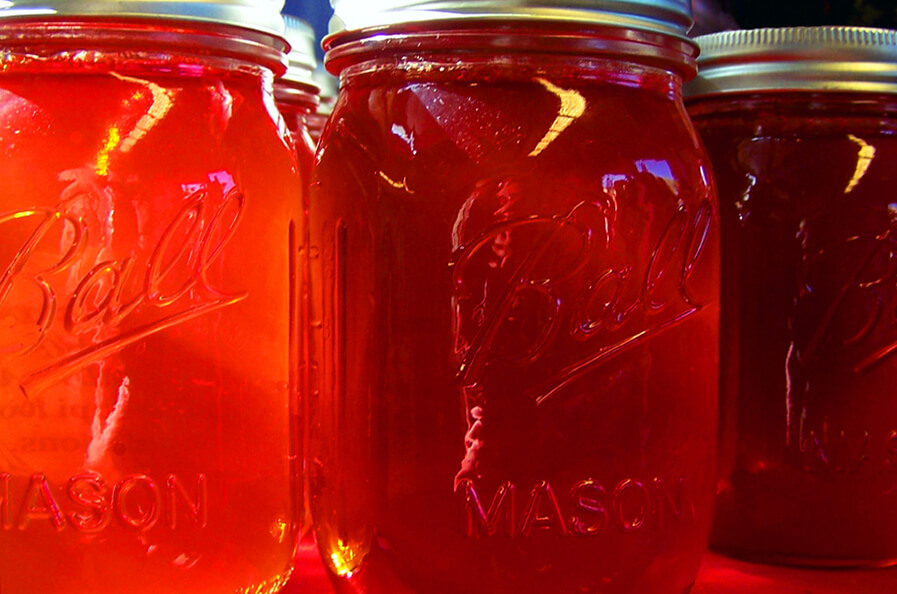
Chances are you know a master canner who owes their vast and celebrated successes to a procedural mojo that carries with it an annoying smidge of smugness. These domestic deities take justifiable pride in their product. At any county fair, you’ll find home canned goods with an astonishing range and degree of artisanship.  Competition is psychotic. Fortunately for us mere mortals, there’s a quick, delicious alternative to the sort of home canning that requires humongous pots and hubris. All you need for refrigerator pickles are a jar or two, running water, and a refrigerator.

Supermarket vegetables are unsuitable. Pack 6 cups sliced cucumbers and 1 cup sliced onion into quart jars. Heat a cup of vinegar with a cup of sugar, and a tablespoon of salt. I like a little black pepper. Pour over cucumber mix. Cool, cover, and refrigerate for a couple of days before serving. These will keep for a week or so.

Down at Hippy Dick’s

“Jack,” I said, “I’ve been reading this article about honky-tonks . . . “
“You shouldn’t read things like that,” he said, turning his head from a football game to growl at me. “It always gets me in trouble.”

Jack is my first cousin, a really great guy and the only friend I have in the family. We’ve seen one another through thick and thin. I helped him back up on his feet out of a really bad marriage, and he rescued me from a crack house in Atlanta. We take care of each other, Jack and I do, but lately he’s been feeling like he’s doing all the work, which isn’t fair of him at all. For one thing, I’m always the designated driver, and if it weren’t for me, his jeans would look like denim accordions.

“What’s that place you always go to? ‘Hippy Dick’s’?
I could hear Jack groan all the way in the kitchen. “No!” he said.
“You said it had a juke box?”
“It doesn’t have any ABBA on it!”
“Pool tables?”
“You can’t play mahjong on a pool table!”
“Pickled eggs, pigs’ feet and jerky?”
“No! Sushi!”
“Jack,” I said, “Be fair.
I heard a long sigh. “What are you wearing?” he asked.
“I thought khakis and a button-up Oxford, hushpuppies . . .”

Jack held his hand up. “If you go in there looking like a reject from Rush Week at Ole Miss, you’re going to end up in the Yalobusha River with a trot line tied around your feet.”

So I left the house wearing jeans, flannel, a pair of Jack’s old boots and a cap that said “Embry’s Bait Shop” with a Marine insignia. At least he let me pick out which of his flannel shirts to wear.
“Lucky for you pink don’t look good on me,” he said. Jack’s got a weird sense of humor.

Hippy Dick’s was on the side of a long winding road that twisted through the backwaters of a nearby reservoir. It had big a gravel parking lot that Jack said the county kept up because Dick was the supervisor’s second cousin. It had a neon sign on top that said DICKS and a bait shop on the side.

The bar had a big mirror behind it, and two television screens; a large one near the back wall, which seemed continually tuned to ESPN, the other, smaller one, set up near one end of the bar tuned to “E!” with a bucket of iced beer on a towel in front of it. The jukebox was blaring out Faith Hill. It was crowded, about forty people. You had the sports guys crowded around a big screen television, about a dozen guys playing pool and a little more than that bellied up to the bar.

Jack ordered our drinks: a Miller Lite for him, an O’Doul’s for me. “He’s driving,” Jack explained to the bartender, a drop-dead gorgeous ginger with a gambler’s spade beard.

“Is this your date?” he asked Jack with a wink.
“Rick, this is my cousin Andy,” Jack said. Rick reached a muscular arm over the bar, smiled and shook my hand. I couldn’t help but giggle. Jack punched me in the arm and dragged me over to a table.

“You’re going to get my ass kicked if you don’t straighten up. Why don’t you sit here and not fluff your hair ?”
“Now I’m going to have to go to the men’s room to look at my hair.”
“Make sure that’s all you look at,” he said.

Having checked in the rear view mirror before I got out of the car, I knew my hair looked fine, so I wandered over to the jukebox. Sure enough, there wasn’t any ABBA, but a couple of tunes did stand out: “YMCA”, “Don’t You Want Me, Baby?” and two tunes by Madonna. I saw Jack looking at me from the corner of my eye, played it safe and picked out Reba. I was just straightening up when this woman at the bar said,  “Yeah, he gave me a little rock and a little cock!”

Naturally, I froze, but nobody else seemed to notice. I turned to look at her. She was in her mid-30s, brunette, big tits, freckled cleavage. I turned to Jack, who shrugged and took aim on the three ball for a side pocket.

“Hey, you at the jukebox!” she said. “Come here!”
Jack miscued and stood up, glaring at me. I just shrugged at him, turned to the lady at the bar, smiled and walked up to her.
“Are you Jack’s cousin?”
“Yes, I am,” I said. “His momma is my daddy’s big sister.”
“Well, y’all sure do look alike,” she said. “Just handsome as you can be!” She laid her hand on my arm. “I just want you to know that song you played is my favorite one in the whole, wide world.”
“’Little Rock’”?
“Yes, honey. And do you know why?”
“No, why?”
“Because my husband had a little cock, and he gave me a little rock.”
“That would piss anybody off,” I said.

I heard someone behind me choke on a beer, but I paid no attention, went to the other end of the bar and asked for a refill. Rick obliged with a stunning smile, but before I could thank him, a guy on a stool next to me poked me in the ribs.

I turned and found myself facing a rakish  blond wearing a Saints jersey. “I like them jeans you got on,” he said. “What size you wear?”
“Uh, on a good day, a 32,” I said.
“I used to be fat, too,” he said, and before I could protest, he said, “But I got on that Atkins diet. You know, the one that Ozzie’s wife is always doin’ ads for.”
“I’m not fat!”
“Oh, I didn’t think I was either, but you got this here,” and he patted my stomach and started rubbing on it. “Nice little beer belly …”
He let his hand linger a little too long. “Yeah, well, that’s mostly pizza,” I said, shifting away.
“Hey, I like pizza, too, but I really like them bratwursts,” he said, with what can only be interpreted as a leer.

“ANDEE!” Jack’s voice thundered across the bar. “You’re UP!”
I certainly was. “Be right there!” I said over my shoulder. “I’ve got to go,” I said to the dirt road d’Artagnan.
“Maybe you can come over for a brat sometime,” he said.
“Sure!” I caught Rick smiling at me in the mirror.

Jack soon decided it was time to go. He’d lost forty bucks at pool and Lady Little Rock had her hand glued to his arm. I was ready to go myself. As we were driving off, Jack asked me if I had a good time.
“I sure did,” I said. “Rick gave me his phone number.”