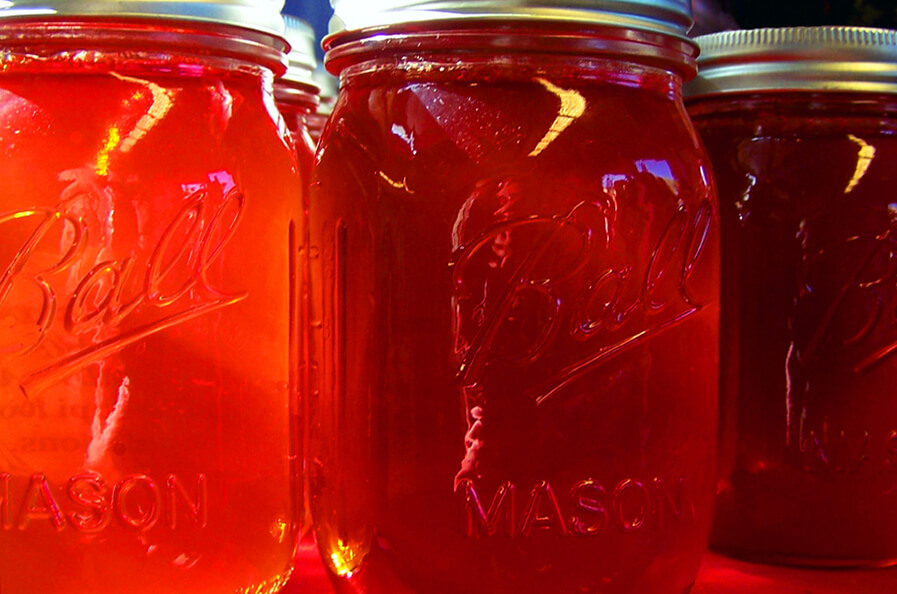
Summer Vegetable Soup

The deli at our local grocery serves a wonderful vegetable soup that they discontinue for the summer, since “nobody eats soup when the weather is hot.” Well, you know what? Yes, they do. We’ve enjoyed summer vegetable soups for centuries in the South, and rightly so, since our gardens are the finest on the planet.

My recipe starts with two quarts diced canned tomatoes and juice. If you’re lucky, you’ll know an industrious gardener who cans summer tomatoes, and you will have their red gold in your larder. If not, Contadina will suffice. Sauté one large diced white onion with three or four diced ribs of celery and two cloves minced garlic in just enough vegetable oil to coat. Pour this into the tomato mix. To this add water to cover by an inch–I like to add V-8 as well–along with a cup or so of sliced, rinsed okra.

Find something industrious and enlightening to do for a half-hour or until the onions and okra have surrendered to the mélange. This is a savory base for beautiful vegetable soups throughout the season. Fresh peas and beans, even green beans, should be parboiled until tender, as should wax potatoes, but squash can be diced and added raw. As to herbs, I’m frugal; a pinch of thyme and a smidgen of basil do just fine. Add salt and pepper with care. And yes, you can serve this warm or chilled.

Roast New Potatoes

Parboil potatoes  until just done, pat dry, and toss in oil with black pepper, minced garlic, and salt. Bake at 350 in a heavy pan, tossing occasionally, until coated and tender through. Great with grilled meats.

Fresh Pimentos with Cheese

Before bells became the most popular mild pepper, everyone grew pimentos. These beautiful, thick-walled peppers work well in dishes across the main board. For this recipe, we used both green and red fruit. Halve and seed fresh pimentos. For two cups shredded sharp cheddar cheese use about a half a cup of diced peppers lightly sauteed in scant oil. Use enough mayonnaise to just moisten, a bit of granulated garlic, and chopped scallions or shallots. Salt to taste.

Eggs Birmingham

This old egg-and-bread dish goes by many names. At my childhood table, it was known as eggs-in-a-basket. Later I found it was hens-in-a-nest, toad-in-the-hole by Brits, and one version simply called egg toast. But when I published a recipe for eggs-in-a-basket some time ago, Mississippi actress Susan McPhail pointed out that, “Tennessee Williams calls them ‘Eggs Birmingham’ in Baby Doll.”

Well, I’ll be damned (I thought). You’d think growing up less than 200 miles from Birmingham (Alabama), I’d know of eggs Birmingham; moreover, you’d think a Southern food writer with a degree in literature would have found this blip on his radar decades ago. But no. Fortunately, I happen to know a lot of people—like Susan—who are smarter than I am, which is bruising to my self-esteem, but provides me with some assurance of being well-informed, or at least the comforting illusion thereof.

Baby Doll (1956), produced and directed by Elia Kazan and starring Carroll Baker, Karl Malden and Eli Wallach, was shot on location at the Burrus House near Benoit, Mississippi, which at that time was in a state of considerable decay. Williams wrote the script, which was nominated for Best Adapted Screenplay (Kazan claimed in his autobiography that Williams was only “half-heartedly” involved in the screenplay), drawing from his previous works 27 Wagons Full of Cotton, a 1946 one-act play that Williams referred to as “a Mississippi Delta comedy, and The Long Stay Cut Short, or, The Unsatisfactory Supper, a moving short drama about the turning out of an old servant, published in 1946 along with 4 other one-act plays in American Blues: Five Short Plays.

In 27 Wagons Full of Cotton, Jake, a middle-aged, shady cotton gin owner with antiquated equipment burns down the mill of the Syndicate Plantation, a rival in the cotton business where Silva Vicarro serves as Superintendent. Vicarro, who knows what happened but cannot prove it, gets revenge by raping Jake’s young and voluptuous but childlike and naïve wife Flora.

The Long Stay Cut Short, or, The Unsatisfactory Supper, depicts the story of Archie Lee and his Baby Doll Meighan (parallels of Jake and Flora in 27 Wagons Full of Cotton) who are reluctantly providing a home to Aunt Rose, an elderly relation who has been passed around among the family to house. An “unsatisfactory supper” cooked by Aunt Rose, who neglected to light the burner under the greens she’d put on the stove earlier. She offers to make eggs Birmingham to appease him.

ARCHIE LEE. What is eggs Birmingham?
 AUNT ROSE. Why, eggs Birmingham was Baby Doll’s daddy’s pet dish.
 ARCHIE LEE. That don’t answer my question.
 AUNT ROSE. (As though confiding a secret.) I’ll tell you how to pre- pare them.
 ARCHIE LEE. I don’t care how you prepare them, I just want to know what they are.
 AUNT ROSE. (Reasonably.) Well, Son, I can’t say what they are without telling how to prepare them. You cut some bread-slices and take the centers out of them. You put the bread-slices in a skillet with butter. Then into each cut-out center you drop one egg and on top of the eggs you put the cut-out centers.
 . . .
 ARCHIE LEE. (Roughly, his back still turned.) I don’t want Eggs Bir- mingham.
 BABY DOLL. He don’t want Eggs Birmingham and neither do I. But while we are talking, Aunt Rose-well-Archie Lee’s wondered and I’ve been wondering, too. . .
 AUNT ROSE. About what, Baby Doll?
 BABY DOLL. Well, as to whether or not you’ve—made any plans.
 AUNT ROSE. Plans?
 BABY DOLL. Yes, plans.
 AUNT ROSE. What kind of plans, Baby Doll?
 BABY DOLL. Why, plans for the future, Aunt Rose.

Rose, in despair, with characteristically Williamsian pathos, rushes to the yard to gather roses in an approaching storm: The blue dusk deepens to purpleand purple to black and the roar comes on with the force of a locomotive as AUNT ROSE’S figure is pushed toward the rose-bush.

In Baby Doll, “Aunt Rose Comfort” offers to make Archie Lee (Karl Malden) “my Eggs Birmingham” when he rejects her undercooked greens. Vaccaro (Wallach) offers to hire her to cook for him in her home and make eggs Birmingham for him there, a much more humane fate for Rose, but a move designed to needle Archie Lee, who asks, “Anything else around here you wanta take with yuh, Vacarro?” insinuating Baby Doll herself.


Homemade Sno-Cones

Bring to boil one cup of water, stir in one and a half cups sugar and a package of Kool-Aid. I like banana. Cool and refrigerate. A few drops of vanilla or almond extract–depending on the flavor–and a jigger or so of rum are suggested options. The syrup will thicken as it cools. Pour over finely crushed or shaved ice. Serve immediately.

Vanilla Lemonade

Juice and peel a lemon. Stir a cup of white sugar into a cup of water, add the lemon peel, and bring to a boil. Reduce heat, add a tablespoon of vanilla extract or two vanilla beans, and simmer for a minute or two.  Stir into six cups of water with the strained lemon juice.  Chill before serving.

Kennedy’s Salsa Cruda

“You will find this sauce on Mexican tables at any time of day, for it goes well with breakfast eggs, with roasted or broiled meats at lunchtime, or tacos at evening, and there are people who put a spoonful of it into their frijoles de olla. It is marvelously crunchy and refreshing served just with tortillas. The Sinaloa version calls for some scallions and lime juice in place of the onions and water, and the Yucatecan version substitutes Seville orange juice for the water.

Finely dice fresh ripe tomatoes, onion, and serrano peppers with seeds in equal amounts. Mix well with fresh chopped cilantro, add liquid and salt to taste. Although this can be made up to three hours ahead, it is best made at almost the last minute, for it soon loses its crispness and the coriander its sharp flavor.”

A Guerilla Garden in Mississippi

Until we begin colonizing the moon and Mars—and eventually we will—this big blue marble is all we’ve got. Some smart person with a lot of time on his hands took what figures he could find about arable land on the planet and figured out that if there were an allotment, for now at least, everybody on the planet would get about one acre of land.

But there is no allotment; most people don’t have any land, and the people who own the most land aren’t gardeners or farmer or even people. Most land is owned by governments and corporations.


Sometime near the end of the first World War, Winston Churchill, who was minister of munitions at the time, told the soldier-poet Siegfried Sassoon, who was opposed to the conflict, that war was the natural occupation of mankind. Sassoon asked him if he was sure about that, so Churchill said, “Well, war—and gardening.” Churchill, a wealthy aristocrat, had plenty of land at Chartwell for gardens. They’re still maintained today.


But the rest of us don’t, and this is where war and gardening meet. I say this is a solution for urban emptiness, and that’s the way I see it. Guerrilla gardening is one solution for the inevitable barrenness and ugliness of urban, even suburban and ofttimes rural existence.


Simply put, guerrilla gardening is the illicit cultivation of someone else’s land. That guy is my brother. In spirit. That logo of the hand holding the rose is the symbol of the Democratic Socialists of America, a movement that many people have compared to Roosevelt’s “New Deal” and Johnson’s “Great Society”, but more like Eugene Debs’ Socialist Party of America which in 1912 received 6% of the presidential vote. “Guerrilla” itself means “little war” and was coined to describe the Spanish resistance fighters against Napoleon’s troops during the Peninsular War of 1807-1814. This is Goya’s Los fusilamientos del tres de mayo (“The Shootings of May Third”) painted in 1808.


Che Guevara was as militant as we get, but even he admitted that, “It is tractor and tank at the same time breaking down the walls of the great estates…” Latino cultures across the western hemisphere have adopted guerrilla gardening tactics. Some of you may have seen The Milagro Beanfield War, a 1988 American directed by Robert Redford based on a novel by John Nichols. The film is about one man’s struggle as he defends his small beanfield and his community against much larger business and state political interests I’ll bet you never thought you’d see Mao in a cotton patch, but there he is. Mao—oddly reflective of Churchill—said, “There is no profound difference between the farmer and the soldier.”


In America, our most famous guerrilla gardener was a nut named John Chapman who became known as Johnny Appleseed. This guy is an icon now, but he was actually a religious nut who planted apples that were only good for making hard cider and applejack. Then we have Lady Bird, who perpetuated the spirit of guerrilla gardening, but was about as far from a guerrilla gardener you can get. If you were married to LBJ, you could damn near get away with anything.


But the true founder, the mother of what we know of as guerrilla gardening, the woman who coined the phrase is Liz Christy. In 1973, she spearheaded the creation of the Bowery Houston Community Farm Garden, working with the Green Guerillas, a community activist group who improved abandoned open spaces and worked to establish community gardens in New York City. Between 1974 and 1981 she hosted the “Grow Your Own” radio program in New York City, covering such topics as urban forestry, community gardens, community design and planning, and the environment.


Here’s the garden’s beginning. Looks like a typical trashy lot in any city. Jackson has hundreds of them right downtown.


And here’s a view of the garden almost fifty years later. The Liz Christy Bowery Houston Garden is the first and oldest community garden in New York city. Located at the corner of the Bowery and Houston Street in Manhattan and running across to 2nd Avenue.


When Richard Reynolds began planting flowers secretly at night outside his tower block in South London he had no idea he was part of a growing global movement committed to combating the forces of neglect, land shortage and apathy towards public spaces. But his blog GuerrillaGardening.org attracted other guerrillas from around the world to share their experiences of the horticultural front line with him and become a focal point for guerrilla gardeners everywhere.


His book, On Guerrilla Gardening is a lively colorful treatise about why people illicitly cultivate land and how to do it. Now it’s an international movement. This is a screenshot of the organization’s homepage. The site includes a lot of information you’ll find in the book as well as updates on happenings around the globe and lots of news and photos.


And then we have Jackson. These are some shots I took downtown, and they look the same now, except the King Edward has been cleaned up.


In 2009, I began a garden on a deserted street corner in Jackson. Here’s what it looked like in the beginning.


And here’s what it looked like in 2022, before I had to leave Jackson.


I really want to emphasize that I did all this work myself, with very little help, not to brag so much as to warn you that undertaking a project like this takes a lot of dedication. I also didn’t have a car, and certainly don’t have much money. About the fifth year, I began getting pass-along plants from others, and that was a constant source of joy as well as fellowship. I got pots and other sorts of containers, bamboo stakes and other stuff, but I’ve made it a point of never soliciting anything unless it’s for a particular project, like the cast-off poinsettias and Easter lilies or used hummingbird feeders.

The corner garden has since been destroyed and there’s nothing I could have done to save it. But for a while, something wonderful happened. There’s so much more that can be said, but this will do. Now, get out there and find a place to take action. Make something beautiful.

Frank Hains

On July 15, 1975, Jackson was stunned by the brutal murder of a man whose cultural contributions to the city still reverberate.

Frank Woodruff Hains, Jr. was born July 7, 1926 in Wood County, West Virginia. After graduating from Marietta College in Ohio and serving two years in the military, Hains began a radio career that took him to Vicksburg, Mississippi, where he became active in both the Vicksburg Little Theater and the Jackson Little Theater.

A few years later he moved to Jackson, beginning his twenty-year career with the Jackson Daily News as literary critic and champion of the arts. He remained active in the Jackson Little Theater and was one of the founders of New Stage Theater in 1966.

In addition to his position at the Jackson Daily News, through his work as actor, director, and set designer for the local theaters as well as his contributions to the New York Times, Hains helped high schools and colleges in the area with their productions. In 1958 he received the National Pop Wagner Award for work with young people, and in 1970 the Mississippi Authority for Educational Television presented him with its Distinguished Public Service Award.

Hains was savagely beaten to death by a drifter from Indiana who had come to work in a blood bank near the offices of The Jackson Daily News and The Clarion Ledger. Two weeks later, this memorial written by his close friend Eudora Welty appeared in the combined Sunday Clarion-Ledger and Jackson Daily News (27 July 1975):

IN MEMORIUM

For all his years with us, Frank Hains wrote on the arts with perception and clarity, with wit and force of mind. And that mind was first-rate — informed, uncommonly quick and sensitive, keenly responsive. But Frank did more than write well on the arts. He cared. And he worked, worked, worked for their furtherance in this city and state. He was a doer and a maker and a giver. Talented and versatile to a rare degree, he lived with the arts, in their thick.

So it was by his own nature as a man as well as in the whole intent of his work that he was a positive critic, and never a defeating one. The professional standards he set for art, and kept, himself, as a critic, were impeccable and even austere. At the same time he was the kindest, most chivalrous defender of the amateur. And it was not only the amateurs — it was not artists at all — who knew this well: his busy life, as he went about his work and its throng of attendant interests, was made up of thousands of unrecorded kindnesses.

I speak as one working in the arts — and only one, of a very great number indeed — who came to know at first hand, and well, what ever-present perception and insight, warmth of sympathy, and care for the true meaning, Frank in his own work brought to a work of theirs. The many things he has done in behalf of my own books I wouldn’t be able to even count; his dramatic productions of my stories are among the proudest and happiest events of my working life. He was a dear and admired friend for twenty years.

Frank gave many young talents their first hope, sometimes their first chance, and I am sure he never could have let any talent down. He didn’t let any of us down, but was our constant and benevolent and thoroughgoing supporter, a refresher of our spirits, a celebrator along with us of what we all alike, in the best ways we were able, were devoting our lives to.

What his work contributed — the great sum — had an authority of a kind all its own. I wonder if it might not have had a double source: his lifelong enchantment with the world of art, and an unusual gift for communicating his pleasure in it to the rest of us. Plus the blessed wish to do it.

We are grateful.

(Hains was buried in Big Tygart Cemetery, Rockport, WV)

Engel on Welty

Jackson native Lehman Engel (1910-82) was a composer and conductor of Broadway musicals, television and film. Engel worked as musical director for the St. Louis Municipal Opera for a number of years before moving to New York to conduct on Broadway. He won 6 Tony Awards, and was nominated for 4 more. Among other works, Engel wrote The American Musical Theatre: A Consideration, the first book to discuss in detail the writing of a Broadway musical, the elements that went into it, and the art of adapting plays into musicals. He also founded the BMI (Broadcast Music, Inc.) Lehman Engel Musical Theatre Workshop, a two-year educational program that has been called “the premier incubator for Broadway In his captivating autobiography, This Bright Day (Macmillan: 1973), Engel provides an endearing profile of his friendship with Eudora Welty.

It’s strange how people in a small town know each other, speak in passing and not really know one another at all. Although I had met Eudora Welty in Jackson before either of us went away to school, it was not until several years later in New York, when a group of Jacksonians were there each simultaneously pursuing various schoolings, that we had first real contacts. Eudora was at Columbia along with Dolly Wells and Frank Lyell, who had first introduced me to Eudora in the Livingstone Park Lake. I was at Julliard. We changed to meet here and there. I think it was at Norma and Herschell Brickell’s (also from Jackson) where all of us, including Nash Burger, whose father used to play cards with my father, often went.

Each summer all of us went home to swelter, and there the threads grew stronger. There were about five such summers before I began staying on in New York, with work to occupy and to pay me. But at home, Frank, Eudora, Hubert Creekmore, and I used to meet at Eudora’s, and we formed the Night-Blooming Cereus Club, the total membership of which sat up to see the glorious white flower with the yellow feathery center bloom. The morning after, it looked like a swan with a broken neck. Those summers are jumbled together in my memory. During on of them Eudora did some letter-writing for me. Perhaps it was at another time that she took many snapshots. Several of them are among the best any photographer ever took of me. I have one of Eudora, we really invented “camp”, sitting in a tree, a Spanish shawl around her shoulders and on her face an uncharacteristic expression of world-be disdain.

With the passing of time, many things happened to us separately, and we seized every opportunity to communicate and to be together. On my visits to see my family perhaps twice a year—and more often in my parents’ failing days—Eudora was, as she is today, always available whenever it is possible for me to get away from family and family friends. To insure our being together to talk without interruption, she usually picks me up in her car—never a fancy one—and takes me for a ride just anywhere away from everybody else. At her house or mine while my mother was still alive, or at any of my cousins’, Eudora always enjoyed her bourbon and I my scotch.

She has endured a great deal. Her father died many years ago, but her mother lingered in poor health for some years. When finally it became necessary for Eudora to put her in a nursing home in Yazoo City, more than an hour’s drive from Jackson, Eudora drove to see her nearly every day. During those days she developed the habit of starting her work at 5 a.m. so tht she could spend several hours of writing without interruption. She still retains that habit. Very shortly before her mother died, Eudora’s two brothers—both married and each living in his own house—died within days of each other. I have seldom heard her refer to any of this, and what suffering she experienced she kept as her very own.

She is selfless, simple, timid, unworldly, and dedicated to her work. She has had every possible honor and success heaped on her, but nothing has ever changed her lifestyle or her nature. She lives in Jackson—the only place where she feels comfortable—travels when it is necessary only on trains (if possible), and speaks so quietly as to be often in audible. She lives in her parents’ house, which is very nice and devoid of any fanciness. It has two stories made of dark-red-to-purple bricks, and Eudora lives as she prefers—alone. The front yard has large pine trees and the house is surrounded by japonicas (camellias) of all kinds and colors. Behind the house there is a lovely garden containing more camellias and gardenias. The garden is no longer as well manicured as it once was, but I imagine Eudora prefers it that way. Now devoid of family responsibilities, she works consistently and hard. As she prefers never to discuss her work-in-progress, I seldom ask her what she is doing.

If I have given any notion that, like Emily Dickinson, Eudora is a recluse, let me assure you that she is not. She has many old friends, all of whom respect her privacy, and everyone in Jackson is deeply proud of her distinguished achievements.

LEFT: I snapped this picture of Eudora Welty with her camera. Frank Lyell was the Señor; Eudora, the unwitting inventor of camp, was herself above it all. RIGHT: Taken on a summer vacation in Jackson by Eudora Welty. I was about twenty.