Willadean’s Spoon Bread

Willadean Monahan and her twin sister Geraldean used to perform on the local radio shows in north Mississippi back in the 1950s. They could sing up a storm, but the act never went anywhere. In time they both married and settled down, Geraldean in Kosciusko and Willadean in Como, where I became her neighbor. Panola County gets mighty cold in a deep winter, and when the north wind came whipping down on us like a blue devil, Willadean would call us up and say, “Y’all come on over and get some of this spoon bread to keep you warm. You know I make the best in the world!” And she did.

Preheat oven to 400. Sift 1 cup cornmeal into 2 cups of lightly salted boiling water. Lower the heat and stir vigorously to a stiff gruel. Remove from heat and mix in a cup of cold milk or cream–this is best done with a whip. Add 2 well-beaten eggs and 2 tablespoons melted butter. (I’m sure she added a little vanilla, and though she swore she didn’t, I’m just gonna put that out there.) Blend until very smooth and ladle into a heated, well-oiled 8-in. baking dish. Willadean used a skillet, which gives a nice crust. Bake until firm in the middle and nicely browned, about 40 minutes, less if you’re using cast iron. Serve hot from the oven with molasses or honey.

Howard Mitcham, Bourdain’s Mississippi Mentor

One of Anthony Bourdain’s last works is an introduction to Howard Mitcham’s Provincetown Seafood Cookbook, originally published in 1975. In this tribute, Bourdain calls Mitcham’s cookbook “one of the most influential of my life.” Dan Simon, founder and publisher of Seven Stories Press said he and his team approached Bourdain because they knew that he was “an admirer of Mitcham.” Bourdain’s culinary career started in the early 1970s in Provincetown, where Mitcham was already a legend. “He was just so terrific,” Simon said. “I think he loved the gusto with which Howard lived his life and cooked and brought it all together.”

A writer, a scholar and an artist as well as the foremost chef of note from Mississippi, Howard Mitcham was a brilliant, stone-deaf, hard-drinking bohemian, raconteur and bon vivant who knew and corresponded with the great and near-great. A name chef during what Bourdain himself called “the early happy days before the glamorization of chefs”, a historian and an artist as well, we should remember Mitcham with gusto. His Provincetown Seafood Cookbook stands loud, proud and without a smidgeon of pretension alongside any cookbook written in the past century, a robust ragout of food, people, art and lore.

Mitcham nurtured, cultivated and matured his sprawling genius in the rich enclaves of Provincetown and New Orleans. For decades he was a spectacular bird of passage, summering on Cape Cod, wintering in the French Quarter and coming home to Montgomery County, Mississippi at times. His books trumpet a passion for seafood; his writings on oysters and clams, shrimp and fish seem to pant with restraint. Mitcham wants you to partake of everything he knows and loves with the same gusto he does in hearty sentences that growl with gruff humor and wry authority. “People think I’m sort of coo-coo to publish my trade secrets and recipes,” he wrote, “but to me good food is like love, it should be given as wide a distribution as possible.”

James Howard Mitcham, Jr. was born in Winona, Mississippi on June 11, 1917. His father, a house painter, died when he was a year old. His mother moved to Vicksburg to find work, leaving the infant Howard with her parents on their watermelon farm on Sawmill Road. At sixteen Mitcham became deaf from nerve damage resulting from spinal meningitis. For the rest of his life, Mitcham spoke with a thick, booming Southern accent, but used sign language and notes to abet his frequent incoherency. He grew up loving jazz, a love silence didn’t kill. “The last song he ever heard was Billie Holiday’s ‘Am I Blue?’”, his daughter Sabina said. “Whenever he’d sing it, it would just break my heart. At his birthdays he would place his hand on the bell of a sax to get the beat.”

Mitcham attended Greenville High School with lifelong friend Shelby Foote as well as Walker Percy. After graduating high school, Mitcham moved to Vicksburg to live with his mother and began attending Louisiana State University as an art student, and at some point, in the late 1940s, Mitcham moved to Greenwich Village in New York City, where he ran an art gallery. What quirk of fate or fortune that first took Mitcham from his home in the Deep South to the distant shores of Cape Cod is a matter rich for speculation, but he claims to have made his first visit there as early as 1948. Thereafter Mitcham divided his years between New Orleans and Provincetown.

His abounding love for Provincetown bore prodigious fruit in 1975 with the publication of The Provincetown Seafood Cookbook, an unsurpassed ode to a food, a place and a people. Bourdain, who worked in Provincetown during the mid-1970s when he was attending (of all places) Vassar, knew Mitcham and in his Kitchen Confidential writes that “Howard was the sole ‘name chef’ in town.”

“To us, Howard was a juju man, an oracle who spoke in tongues,” Bourdain wrote. “He could be seen most nights after work, holding up the fishermen’s bars or lurching about town, shouting incomprehensibly (he liked to sing as well). Though drunk most of the time and difficult to understand, Howard was a revered elder statesman of Cape cod cookery, a respected chef of a very busy restaurant and the author of two very highly regarded cookbooks: The Provincetown Seafood Cookbook and Creole Gumbo and All That Jazz—two volumes I still refer to, and which were hugely influential for me and my budding culinary peers of the time.”

“He had wild, unruly white hair, a gin-blossomed face, a boozer’s gut and he wore the short-sleeved-snap-button shirt of a dishwasher. Totally without pretension, both he and his books were fascinating depositories of recipes, recollections, history, folklore and illustrations, drawing on his abiding love for the humble, working-class ethnic food of the area. His signature dish was haddock amandine, and people would drive for hours from Boston to sample it.”

“We might not have understood Howard, but we understood his books, and while it was hard to reconcile his public behavior with the wry, musical and lovingly informative tone of his writings, we knew enough to respect the man for what he knew and for what he could do. We saw someone who loved food, not just the life of the cook. Howard showed us how to cook for ourselves, for the pure pleasure of eating, not just for the tourist hordes. Howard showed us that there was hope for us as cooks. That food could be a calling. That the stuff itself was something we could actually be proud of, a reason to live.”

Collards at Tara

Fiction writers  concern themselves more  with the turmoil of the human condition (often theirs) than what’s on the table like the rest of us, but it’s inevitable that you’ll find food in many important novels; food is, after all, essential of existence itself.

Margaret Mitchell was born to an upper-class home in Atlanta at the turn of the last century, and her family roots sank deep into antebellum Georgia. Given the social dynamics of her upbringing, she was certainly well-informed when it came to that period’s Southern table, so we shouldn’t be at all surprised to find a notable description of an antebellum spread in Gone with the Wind.

When Ashley came home from the war for Christmas, the table was still graced with Aunt Pittypat’s Sèvres, but the only things to eat were sweet potatoes–a perennial staple of hardship from any quarter–and a skinny rooster Uncle Peter had put out of its misery, Scarlett remembered Tara’s groaning boards:

There were apples, yams, peanuts and milk on the table at Tara but never enough of even this primitive fare. A the sight of them, three times a day, her memory would rush back to the old days, the meals of the old days, the candle-lit table and the food perfuming the air. How careless they had been of food then, what prodigal waste! Rolls, corn muffins, biscuit and waffles, dripping butter, all at one meal. Ham at one end of the table and fried chicken at the other, collards swimming richly in pot liquor iridescent with grease, snap beans in mountains on brightly flowered porcelain, fried squash, stewed okra, carrots in cream sauce thick enough to cut. And three desserts, so everyone might have his choice, chocolate layer cake, vanilla blanc mange and pound cake topped with sweet whipped cream. The memory of those savory meals had the power to bring tears to her eyes as death and war had failed to do, the power to turn her ever-gnawing stomach from rumbling emptiness to nausea.

While most of these dishes seem apt for a wealthy, socially prominent Georgia plantation meal in the 1830’s, some people (admittedly me among them) might find the presence of collards in a porcelain tureen jarring because I’m such a stuck-up redneck, but stewed collards fit on the table in any damn thing that will hold them.

Dirty Rice

A bone of contention with dirty rice comes between those who cook the rice with the meats and vegetables and those who cook them separately and mix them with seasonings before serving. I belong to the cook-separately-and-mix faction. I do the same with jambalayas. I’ve been called to the carpet for that more than once, but I stood my ground. I like the texture better.

Most recipes call for rice with chicken livers and/or gizzards. Some people use ground meat or game; onions and peppers typically round out the dish. First cook your gizzards. You can go to the trouble of trimming the membranes if you want, but I’ve found that if you stew gizzards for a very long time they’re going to end up as tender as can be, easy to mince, and the resulting broth is a thing of beauty. Sauté trimmed livers with a little garlic and minced white onion until just done through. Add chopped meats to cooked rice with whatever sautéed vegetables you like with a little oil to moisten. Season to taste. I like an Italian herbal blend with black pepper. Keep warm in a covered container, and add chopped green onion before plating.

Pride and Potatoes

One day as a boy, a friend and I dared to enter his father’s tool shed, where among implements such as hammers, saws, screwdrivers, and girly magazines, we found a cabinet stocked with canned potato soup. When I asked why his daddy kept potato soup next to his chop saw, he said, “Momma won’t let him have it in the house.”

I was puzzled at the time, but now I understand. You see, a man’s house may be his castle, but his tool shed is his home, a sanctuary for the masculine spirit and as inviolate to intrusion as a nunnery. A man may keep things there which have no place in the house, even something as seemingly innocuous as potato soup.

Potato soup is neither good nor bad in itself; like Prince Hal, it is poor only in the company it keeps, and as is the case for so many of our foods, its company is often poverty itself. Memories of hard times survived among the men and women of my parents’ generation; after the hard years had ended and victory in the Good War made them members of the most affluent society on earth, they found themselves living in a world that stretched far beyond the dirt roads many grew up on, and they were obliged to learn the difficult lessons a newly-acquired middle-class life required of them.

For many, that meant ridding themselves of aspects of their lives that in this new world were not quite picture-perfect. Potato soup, to my friend’s mother, was not part of her perfect picture; it was Depression food, something people ate when they were poor and down on their luck. Now that they lived in town in a new brick house, had two cars in the garage, and she was secretary of the Twentieth-Century Club, potato soup —so simple, so basic, so very good—had been banished.

Others hearkened back, as my friend’s father did, to those days when a family’s existence was dependent upon making do. They also remembered—even as they trod the carpeted floors of the air-conditioned homes where their difficult children were growing into strangers in their midst—the foods they knew and loved, even if it were biscuits folded over a piece of fried streak-`o-lean they took to school, red-rind cheese and saltines from the store down the road, or chicken and dumplings made to stretch an old hen between ten people.

The foods you love best are often those of your childhood, and my friend’s father found the warmth of potato soup irresistible. I can still conjure up an image of this man sitting out in his shed and opening a can of soup, heating it on a little electric eye, eating it and thinking about his own Momma standing at her wood stove in a pair of old slippers, her hair limp with sweat and tied up with a penny piece of ribbon, cooking the only thing she had to cook—potatoes—into a soup for her family. I can also imagine this man reminiscing upon this while his wife teetered around the kitchen in high heels, her hair lacquered into a $5 hair-do she had redone twice a week cooking store-bought stuff on an electric range.

His wife herself probably remembered her Momma in much the same way as her husband did his, but for my friend’s mother it was a bitter memory, and her efforts to obliterate that—to her mind painful—image of poverty extended to those around her. Bound and determined to eradicate whatever she felt was coarse or common about her and others, she sacrificed upon the altar of her misguided pride the very foods that she secretly loved and learned to make at her mother’s side.

Daisy Duke Can’t Cook

Making quick breads is such a basic culinary skill that at one time those persistent legions of people who spend their time minding other people’s business sniffed their disapproval of a newly-wed husband’s bride by saying, “He married a woman who can’t even make biscuits.”

This specific example of cattiness carries with it a tacit understanding that mister didn’t marry his missus because she was a domestic diva, but for prurient reasons which were grounds for disapproval among matrons who could cook up a storm yet were inept or unwilling in arts which keep a man from taking up what was then referred to as “light housekeeping” with another woman.

Those were more genteel times. Nowadays, of course, those same people would just say he hooked up with a slut and be done with it, but there’s something to be said for polite prevarication: What it lacks in forthrightness is more than made up for in vicious subtlety.

Believe it or not, being able to cook was once a commodity on the marriage market, so much so that disgruntled husbands who settled for less than a buxom bimbo comforted themselves and others like them (honest, hardworking men, every one of them) by claiming that the cooking lasted longer than the loving. And while that might be true, there’s still something to be said for marrying a total tramp-in-training; after all, that’s what mothers-in-law are for.

Like many short bread recipes, the one for biscuits is more technique than ingredients. Getting the biscuits to rise well is key, and if you don’t follow a reasonable procedure, you’re going to end up throwing away a pan of hockey pucks. Biscuits shouldn’t be worked a lot; excess kneading makes the dough so dense that it won’t rise. Biscuits should also be cut out quickly while the dough is cool, and with a clean, sharp edge that will not pinch. Crowding the biscuits a bit also helps them to rise, but if you get them too close together the centers won’t bake through. Also make sure the oven is hot (450/475) before you put them on a rack in the upper third of the oven.

So, for all you floozies out there who need a bonus the morning after, here’s how to make biscuits. And if you don’t carry a skillet with you, well, you’re on your own.

Buttermilk Biscuits

Take two cups of self-rising flour and sift in dry a scant teaspoon of baking soda. Work thoroughly into this about 1/3 a cup of cold vegetable shortening. Mix with the fingers until it has an almost granular texture. Working quickly, stir in enough cold buttermilk (about a cup) to make a sticky dough. Throw dough on a generously-floured surface, sprinkle with a scant more flour and roll out very thick, almost half an inch, and cut into biscuits. Again, work quickly so that the dough stays cool(ish). Place biscuits just touching in a lightly greased skillet and pop them on the top rack of a hot oven for about a quarter an hour. You want them golden-brown and fragrant; brush lightly with butter while still hot and serve immediately.

Pearl Potatoes

Wash and clean two pounds very small potatoes. Blot dry, toss with oil seasoned with three cloves minced garlic and a tablespoon each of onion powder, salt, and pepper. Spread in a deep pan and roast at 350, stirring every five minutes or so until the larger ones are soft through. Toss with a light vinaigrette before serving.

Stuffed Peppers

Select mild thick-skin peppers that are globular rather than oblong, slice off the top, and remove whites and seeds; a lot of people parboil the peppers, but don’t. For a stuffing mixture, use a 50/50 blend of rice/meat or beans in a light tomato sauce seasoned with black pepper, sage, and basil. Crowd into a casserole, baste with more sauce and place in a medium (300) oven until peppers are cooked through. Baste again with sauce, top with dry white cheese and toast.

Dixie Kim Chee

Wash fresh turnips with greens well and shake dry. Peel roots and cut into chunks or wedges. Chop leaves and stems coarsely. Toss roots and greens with minced garlic, spring onions cut on the bias, and kosher salt. Let this sit for about half an hour, then sprinkle with a heaping teaspoon of ground cayenne pepper, red pepper flakes, or chopped fresh hot peppers for punch.

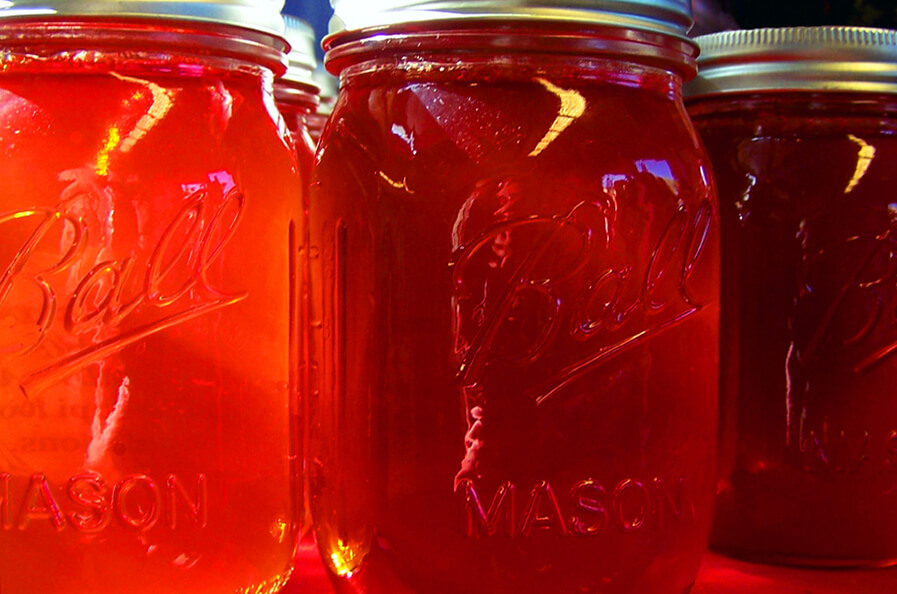
Toss again, then stuff mixture into clean glass jars, topping off with liquid from the bowl. Seal jars tightly, and set them in a cool dark place. In a few days, check to see if it’s fermenting; look for bubbles.  If bubbling, open the jar very carefully over a sink to let a little bit of the gas escape. Take care; if you’re rash about opening the jar, you might end up covered in juice. (This, children, is the the voice of experience speaking.) Reseal the jar, and let it sit for another day or so. Repeat the gas release and refrigerate for a week before serving.

Our Appalachian Table

Travis Milton, a native of Russell County, Virginia, high in the Alleghenys, became a chef on the East Coast. In 2010, at a New York restaurant, Milton was part of a group planning dishes that would “tell about who we are.” He wondered aloud about sourcing leather britches and greasy-backs, a type of beans common in mountain gardens.

The following afternoon, the head chef slapped a copy of Ernest Matthew Mickler’s White Trash Cooking onto Milton’s station. “He got in my face,” says Milton, “and started barking, ‘If this is what you wanna do in my kitchen then you can get the fuck out!’”

Having White Trash Cooking slammed in his face was a turning point. To overcome the stereotypes, Milton realized, he’d need to be able to tell the story of Appalachian food, but writing on the region’s cuisine was mostly focused on single mothers dressing up SPAM in a sugary sauce and other relatively recent ways that Appalachian cooks respond to the poverty that is, for most, coal’s legacy in Appalachia.

Then in 2016, Ronni Lundy published Victuals: An Appalachian Journey, with Recipes. Her work won the James Beard Foundation Book of the Year and Best Book, American Cooking awards. In Victuals, Lundy claims that European settlers adopted native Cherokee foods almost wholesale. Wild game, wild herbs and greens, nuts, and berries augmented produce from small gardens of beans, corn, and squash using the “Three Sisters” method.

Appalachians let animals range freely, keeping prized breeds adapted to the landscape. Settlers raised pigs on acorns, berries, and chestnuts, which produced the famous hams of Virginia, Kentucky and Tennessee. After the Civil War decimated the region, residents of isolated Appalachia embraced their gardening traditions, developing thousands of hybridized varieties of apples and pears, squash, tomatoes, collard greens, and other foodstuffs.

While Victuals established a benchmark, the font and source for Appalachian food writing is The Foxfire Book of Appalachian Cookery: Regional Memorabilia and Recipes. First published in 1984, Appalachian Cookery has little resemblance to any other publication involving Southern foods.

The Foxfire Project was the brain-child of Eliot Wigginton, a man from West Virginia who received an advanced education in the north and began teaching at a rural school in northeastern Georgia during the late 1960s. Called “foxfire” after a will-o’-the-wisp in mountain woods, his students collected folklore and customs in a series of oral histories that were first published in a 1972 anthology. Many more editions have followed as well as other volumes documenting Appalachian culture.

According to the text, some of the research and the photographic essays included in Appalachian Cookery were gathered for previous Foxfire books but were not selected for inclusion into an earlier volume. Appalachian Cookery stands out as the most complete and comprehensive record we have of the food, cooking and home life of southern Appalachia in early to mid-20th century. Most of the recipes are very simple; pound cake has four ingredients in equal measure. The book is also a primer on how to use homegrown or wild-gathered foods.

Appalachian Cookery opens a door to a world far away from arugula and alien to star anise, a world where cooking was simple but not coarse, having a balance and symmetry all its own, dictated by the lessons of long-ago voices set in concert with the rhythm of the seasons. For those of us from the upland South, these are our roots.

CRY-BABY COOKIES

Cream 1 cup plus 2 tablespoons shortening with an equal amount of sugar. Add one cup molasses and two beaten eggs. Sift together 4 ¾ cups plain flour with 1 tablespoon baking powder, 1 teaspoon salt and 1 ½ teaspoons soda. Then combine with 2 cups grated coconut, 2 cups chopped walnuts and 1 ½ cups raisins. Add dry ingredients alternately with 1 cup milk to creamed egg mixture. Drop by spoonfuls onto a greased baking sheet. Bake in a moderate (350) oven for 10 minutes. YIELD: approx. 7 dozen cookies.