
Blue Angel

A Southern Gallimaufry
In 1931, William Faulkner published his first collection of short stories, These 13, which in addition to some of his most acclaimed and frequently anthologized stories—“A Rose for Emily”, “That Evening Sun,” and “Dry September”—included “Divorce in Naples”, Faulkner’s most overt portrayal of homosexuality.
Faulkner had already broached the theme in the intimacy between Quentin Compson and his Harvard roommate Shreve McCannon in The Sound and the Fury (1929), and Jenny and Patricia as well as the openly gay lesbian Eva Wiseman in Mosquitoes (1927). He’d expand his depiction of Quentin and Shreve and introduce a parallel relationship with Henry Sutpen and Charles Bon in Absalom, Absalom! (1936).
Simply put, the story depicts the relationship between two sailors, George (“Greek, big and black, a full head taller than Carl”) and the younger Carl (“with his round yellow head and his round eyes, looking like a sophisticated baby”).
‘THEY CAME INTO THE SHIP together at Galveston, George carrying a portable victrola and a small parcel wrapped in paper bearing the imprint of a well-known ten-cent store, and Carl carrying two bulging imitation leather bags that looked like they might weigh forty pounds apiece. George appropriated two berths, one above the other like a Pullman section, cursing Carl in a harsh, concatenant voice a little overburred with v’s and r’s and ordering him about like a nigger, while Carl stowed their effects away with the meticulousness of an old maid, producing from one of the bags a stack of freshly laundered drill serving jackets that must have numbered a dozen.
For the next thirty-four days (he was the messboy) he wore a fresh one for each meal in the saloon, and there were always two or three recently washed ones drying under the poop awning. And for thirty-four evenings, after the galley was closed, we watched the two of them in pants and undershirts, dancing to the victrola on the after well deck above a hold full of Texas cotton and Georgia resin. They had only one record for the machine and it had a crack in it, and each time the needle clucked George would stamp on the deck. I don’t think that either one of them was aware that he did it.’
One night Carl disappears. George, frantic, fails to find him. When Carl returns after three days, he reveals that he has been with a woman, and George kicks him out of their berth only to discover later, after their reconciliation, that Carl was too naive to have sexual congress with the woman, and
“ …two weeks later we were watching him and George dancing again in their undershirts after supper on the after well deck while the victrola lifted its fatuous and reiterant ego against the waxing moon and the ship snored and hissed through the long seas off Hatteras.’
Most of Faulkner’s examinations of same-sex desire focus on men; Faulkner had close relations with many homosexual writers and artists, including his townsman and fellow writer Stark Young and his childhood friend Ben Wasson as well as William Alexander Percy and Lyle Saxon. It goes without saying that while living in New Orleans he doubtless knew many others.
The story draws most directly on Faulkner’s experiences with William Spratling, a down-on-his-knees New Orleans fairy, in sailing to Europe on the West Ivis beginning July 7, 1925 and to Genoa on August 2, where after landing they celebrated their arrival by going drinking with the ship’s officers. The drinking bout turned into a brawl with “pimps and prostitutes”, after which Spratling was arrested and thrown into an Italian prison where during the night he had a “homosexual encounter”. (Rape is of course implied, but then again we don’t have any evidence that the encounter wasn’t consensual.) This event in Genoa provided the kernel for the story, and Faulkner himself was heard to joke at one point that he was jealous of Spratling.
With “Divorce in Naples” Faulkner presents an unmistakably gay male relationship fraught with stereotypical dynamics brushed with innocence and infused with our hunger for love.

This recipe comes from The Jackson Cookbook (1970), a wonderful addition to any kitchen library. The dish is a classic old-school fricasee–-rich, with a sublime aroma–-characteristic of the–admittedly bourgeois–haute cuisine fashionable in hotels such as the King Edward in the middle of the 20th century.
I used boneless thighs skewered and lightly floured (no drenching beforehand) with salt and pepper, early yellow onions, and a mixture of fresh and dried thyme. Bread the chicken lightly and brown in butter; use a medium heat to keep the butter from burning. Wilt thickly-sliced onions in butter before topping the chicken with more of the herb mix and butter. Bake in a medium (350) oven for about an hour. Baste once, twice is better.

For Jackson, Mississippi the Civil War was catastrophic, but by the 1880s, the city had begun to rebuild and slowly piece itself together along two main two axes, Capitol and State Streets.
The Pearl River provided then as it does now a natural barrier to expansion to the east, so that the city grew west along Capitol behind the bluff and north along State following the bluff. The southwesterly course of the floodplain largely prevented significant development on South State Street beyond its parallel to the divergence of the Illinois Central and Gulf & Ship Island Railroads, yet inevitably attempts were made, paramount among them the hamlet that became Duttoville.
Located south of Porter and on either side of Gallatin adjacent to the Illinois Central Railroad, Duttoville was named for Father Louis Anthony (Luigi Antonio) Dutto, one of the most fascinating figures in the ecclesiastical history of Mississippi. Dutto was born in the commune of Boves in Italy’s Piedmont region and educated at Brignole-Sale, a pontifical college in Genoa. A very learned man, Dutto was the author of The Life of Bartolome de las Cassas (published posthumously; 1902). He was ordained for the Diocese of Natchez before he was 24 years old and arrived in Jackson on August 25, 1875 to assist Fr. Picherit in attending the surrounding missions. Dutto succeeded Picherit as pastor in 1885.

According to an anecdotal biography written in 1932 by Rev. P.H. Keenen, a personal friend, “Father Dutto was a great financier, having special aptitude in this line. He was sought as adviser in matters financial by young businessmen, and his advice, when followed, usually brought success, and often wealth. . . . He himself acquired much property. On the missions he seldom asked his people for funds—he gave instead of asking. His business acumen enabled him to do this.”
In 1886, Fr. Dutto bought land in what was then the southwestern portion of the city, which, according to the account given by McCain in The Story of Jackson, “he divided into lots on which homes were erected and gardens cultivated by certain Catholics who had to come to the city to engage in commercial and agricultural pursuits. This section is still known as Duttoville.”
By another account (Jackson Daily News, May 30, 1979 p. 15A) Dutto acquired the property in 1891 from F.A. and Mary F. Wolfe, J.W. Langley all along Gallatin Street and the I.C.R.R. and the G.&S.I. Railroad and the “Muh (pronounced as the pronoun “me”) Estate, “vast acres” of land just outside the city limits, Dutto sold lots to working class people who could not pay taxes on simple homes, including many Italian immigrants (likely the “certain Catholics” referenced above). The area soon became a thriving community with a planing mill, brickyard and other enterprises that provided work for residents, and many worked in Jackson proper. Anticipating annexation by Jackson the settlers incorporated in 1903.

The original Duttoville was bounded on the north by Town Creek, the east by the Pearl River with the Illinois Central and Gulf & Ship Island railroads to the west. Later the village expanded west of he railroad tracks to Terry Road. The first (and only) mayor was J.R. Root; aldermen were W.L. Porter, Joe Karese and Will Muh; J.E. Robinson was town marshal, and J.W Langley was city clerk. We’re told a small jail was built but “never occupied”.
When Jackson first attempted to incorporate Duttoville, the tiny village put up a fight. The Duttovillers went to court and fought the incorporation and won. The city of Jackson appealed, and after two years, while the case was still pending in court, the citizens of Duttoville and Mayor Hemmingway of Jackson made a compromise.
The city agreed to extend water, lights, telephone, a fire station, police protection, a grammar school (George School) and other amenities. But the area continued to be called by its original name, which in time became corrupted into “Doodleville” or “Dooleyville” both used well into the mid-20th century as a popular though derisive term for the part of town bordered by Battlefield Park on the south, Terry Road on the West, Hooker Street on the north and South Gallatin on the East, all well west of the original settlement.
Belhaven resident Wilfred Cunningham, who grew up on Farish Street, remembers going to Doodleville as a very young man. “This was in the late Forties, and I was in my early teens. Anything south of Capitol Street on Farish Street we considered Doodleville,”
“The area was much more depressed than North Farish. I seem to remember the roads weren’t paved, the streets were graveled, I thought we lived poorly on Farish, but Dooley was a lot more run down.” Cunningham said.
“The houses were row houses, shotgun houses like we had on Farish. People from Doodleville would come to Farish where we had the ice cream parlors, the stores, the clubs, and the Alamo. There wasn’t any industry of any kind there for jobs, so most of the people worked in north Jackson.”
“For some reason I was always told not to let the sun go down on me there. I never ran into such a problem, but I always got the impression that there was a gang of some kind that kept Doodleville for people who lived here and weren’t friendly to outsiders.”
Jackson bluesmen Cary Lee Simmons and Bubba Brown composed the “Doodleville Blues” in the 1930s, and it was a local hit, getting lots of laughs when Simmons performed it for his friends in Jackson. He made a recording in 1967, which you can listen to here.
I got a girl in the Bamas, I got on that lived out on Bailey Hill.
I got a girl in the Bamas, and I got one that lived out on Bailey Hill.
But don’t none of them suit me like that one
I got down in Doodleville
The womens on Farish Street shakes until they can’t be still.
I said, the womens on Farish Street shakes until they can’t be still.
But they cannot sake like those gals
Live down here in Doodleville
Turn your lamp down low. Somebody done shot poor Bud, Buddy Will.
Turn your lamp down low. Somebody done shot Buddy Will.
I told him to stay off Mill Street and get him a gal in Doodleville.
I won’t have a gal on Farish Street,
Wouldn’t speak to one that lived on Mill.
I won’t have a gal on Farish Street,
Wouldn’t speak to one that lived on Mill.
‘Cause the next woman I got, she got to live in Doodleville.
They got the meat from the slaughterhouse
And the wood from Grimm Stage Mill.
They got the meat from the slaughterhouse
And the wood from Grimm Stage Mill.
And if you want to live easy, get you a girl in Doodleville.
Spoken: I got a secret for you though.
It’s a mad dog out, and boys, it ain’t been killed.
It’s a mad dog out, and boys, it ain’t been killed.
And you better be careful, careful, careful
how you doodle in Doodleville.
Duttoville decays, as shades of dreams do..


During V.S. Naipaul’s visit to Mississippi in 1988, he grew obsessed with rednecks, coming to see them as the “unlikely descendants” of a mythical construct he called a “frontiersman”. Naipaul himself considered Mississippi—somewhat paradoxically, from a native’s point of view—as both the heartland of the South and a state at the very periphery of culture and civilization itself, which could be considered a rather brash observation from a native of Trinidad. It’s tempting to speculate on what Welty herself might have thought of Naipaul questioning her about rednecks, but upon reflection, who better to ask than the woman who wrote “Where Is the Voice Coming From?” in June, 1963.
And it was of the redneck, the unlikely descendant of the frontiersman, that I talked to Eudora Welty when I went to call on her. I had arrived early, and could clearly be seen through her uncurtained front window. But I was nervous of knocking too soon.
So for a while we waited below the big, dripping trees in the gloom after rain, she behind her window at the end of her wet front garden, I in the car. And when I felt the time was suitable I walked up to the wet path to her front door. On the door, in her strong writing, was a note asking people not to bring any more books for her to sign. She wanted to save as much of her energy as possible now for her work. I knocked; and she opened, like someone waiting to do just that. She was extraordinarily familiar from her photographs
The frontier was so much in her stories: a fact I had only just begun to appreciate. And she was willing to talk of the frontiersman character.
“He’s not a villain. But there’s a whole side of him that’s cunning. Sometimes it goes over the line and he becomes an outright scoundrel. The blacks never lived in that part of the state. They came over to work on the plantations. Most of the rednecks grew up without black people, and yet they hate them. That’s where all the bad things originate—that’s the appeal they make. Rednecks worked in sawmills and things like that. And they had small farms. They are all fiercely proud. They dictate the politics of the state. They take their excitement—in those small towns—when the politicians and evangelists come. Scare everybody, outwit everybody, beat everybody, kill everybody—that’s the frontiersman’s mentality.”
I told her the story that (a previous interviewee) had heard as a child about the rednecks to the south of the town where she had spent her summers: the story of traveling salesmen who had been roughed up and hitched to a plow and made to plow a field. She had said that this story had come down from the past; and I had thought of it as a romantic story of the wickedness of times past, an exaggerated story about people living without law. But Eudora Welty took the story seriously. She said, “I can believe the story about the salesmen. I’ve heard about punishing people by making them plow farms.”
We talked about Mississippi and its reputation.
“At the time of the troubles many people passed through and called on me. They wanted me to confirm what they thought. And all of them thought I lived in a state of terror. ‘Aren’t you scared of them all the time?’ A young man came and said that he had been told that a Mr. So-and-So, who was a terrible racist, owned all of Jackson, all the banks and hotels, and that he was doing terrible things to black people. It was a fantasy. It wasn’t true. The violence here is not nearly as frightening as the Northern—urban—brand.”
A frontier state, limited culturally—had that been hard for her as a writer, and as a woman writer? The richness of a writer depends to some extent on the society he or she writes about.
She said: “There is a lot behind it, the life of the state. There is the great variety of the peoples who came and settled the different sections. There is a great awareness of that as you get older—you see what things have stemmed from. The great thing taught me here as a writer is a sense of continuity. In a place that hasn’t changed much you get to know the generations. You can see the whole narrative of a town’s history or a family’s history.”
[V.S. Naipaul A Turn in the South (1989), pp. 213-14)

Bobbie Gentry was born Roberta Lee Streeter July 27, 1944, on her paternal grandparents’ farm near Mantee, Mississippi. Her father, Robert H. Streeter, lived in Greenwood, Mississippi, where she attended school. Gentry moved to Arcadia, California at age thirteen to live with her mother and stepfather. They relocated to Palm Springs two years later, where Bobbie graduated from Palm Springs High School. She changed her name to Gentry after seeing the 1952 film Ruby Gentry, starring Jennifer Jones and Charlton Heston. Gentry briefly attended UCLA and the Los Angeles Conservatory of Music, then drifted between secretarial and nightclub jobs and eventually found herself in Las Vegas working as a showgirl.
 Gentry approached Capitol Records in early 1967 with two tunes, “Ode to Billie Joe” and “Mississippi Delta,” which she recorded. “Mississippi Delta” was made the B-side, and despite its lengthy four minutes and thirteen seconds, “Ode to Billy Joe,” the featured song. The recording was released on July 10 and became an immediate hit. By the end of summer 1967, “Ode to Billie Joe” had climbed to the number one position on all three major American music charts–Billboard, Cashbox, and Record World. The album was No. 1 on the US Billboard Top LP’s chart, the only album to displace the Beatles’ Sgt. Pepper’s Lonely Hearts Club Band from its 15-week reign at the top of the chart. It also peaked at No. 1 on the US Billboard Hot Country Albums chart and at No. 5 on the US Billboard Top Selling R&B Albums chart.
“The burning question of the day,” wrote Jackson Daily News arts editor Frank Hains, “is not how to un-snarl ourselves from Vietnam or how to un-uppity H. Rap Brown…. It’s what did Billie Joe and that girl throw off the Tallahatchie Bridge.”
“People are trying to read social comment into the song, but none is intended,” Gentry said at the time. The song was simply about human indifference. And she wasn’t even protesting indifference in “Billie Joe,” just describing it. “I’m not so sure indifference isn’t a good thing,” she said. “If we were all totally affected by tragedy, we’d be afraid to go anywhere or do anything.”
Gentry insisted that the “Ode to Billie Joe” narrative, despite its perceived genuineness and its use of actual place-names, was “not true;” however, she conceded that, of all the bridges spanning the Tallahatchie River, she referred in her song to the one just outside Greenwood. She also said that Choctaw Ridge was also located in Leflore County, she noted, near the former home of “Greenwood LeFlore (sic).” Print media outside the South commented on both the song and Gentry’s authenticity. Newsweek called her “a true daughter of the Mississippi Delta who can vividly evoke its pace and poetry and smells and style.” Time reported that “Ode to Billie Joe” was “based on (Gentry’s) recollection of life around Greenwood, Miss.,” and that “millions of puzzled Americans coast to coast [were ready to start dragging] the Tallahatchie.”
Gentry appeared on the most popular variety shows (the Smothers Brothers, Ed Sullivan, Bob Hope, Perry Como, and Carol Burnett) and piloted a BBC series that had some success in other countries. Eventually, Gentry’s fame subsided. She married renowned casino owner William Harrah in late 1969; news reports focused on the couple’s thirty-year age difference and on the bride’s $150,000 pear-shaped diamond ring. The marriage lasted four months.
Gentry eventually signed away rights for both a film adaptation and novelization–as well as, apparently, a change in spelling–of “Ode to Billy Joe.” When they both appeared in 1976, nine years after the hit single, they were extremely popular. The book, issued exclusively in paperback by Dell, enjoyed over a dozen print runs that year, and the movie grossed over $10.4 million, placing it fifteenth in earnings among films released in the U.S. in 1976.
 The film premiered in Jackson, Mississippi, with much hoopla on June 3, the anniversary of Billy Joe’s swan dive. Mississippi governor Cliff Finch proclaimed it “Bobbie Gentry Day,” and Lieutenant Evelyn Gandy presided over a dedication ceremony at one particular bridge over the Tallahatchie, which Boxoffice magazine claimed was designated as “the official Billy Joe McAllister leap site.”
The picture opened as well in 550 theaters across the South, followed by national distribution. The concern with specifying the exact date and the precise site of Billy Joe’s demise ironically eclipsed the questionable truthfulness of the story. Janet Maslin pointed out in Newsweek that, though the beginning of the film included a title explaining it was shot on location in the Mississippi Delta, “where this story actually took place,” the final frames contained the standard disclaimer that all individuals and incidents depicted were fictitious.
Most reviews and promotional materials stressed the film’s perceived authenticity and its successful evocation of setting. Most of this was due largely to the producer-director. Max Baer, Jr. Born in 1937, in Oakland, California, Baer was best known for his role as the lumpish Jethro in the popular television series, “The Beverly Hillbillies.” New Englander Herman Raucher was chosen to write the screenplay and novel. The characters Baer and Raucher created were certainly not “free of cliché,” as Variety asserted. These figures were nothing more than a confusing crowd of Southern stereotypes, and the place depictions were just a mishmash of rural images. Robbie Benson and Glynnis O’Connor played the young leads, Billy Joe and Bobbie Lee, with awkward accents, and though the film was set in the Mississippi Delta, which has a majority black population, the film had not one African American character. Most surprising, for a film based on a song, the music also was displaced; when characters attended a jamboree, they were treated not to Delta blues but rather to upcountry bluegrass.
For all its awkwardness, the film did give a reason for his suicide, one which dredges up a toxic stereotype, as Vito Russo puts it in The Celluloid Closet, of gays “falling victim to their own inherently villainous sexuality.”. After an unsuccessful attempt at intercourse, Bobbie Lee tries to assure Billy Joe that “it’s alright,” but he insists: “It ain’t alright. I ain’t alright. Bobbie Lee, I have been with a man, did you hear me?— which is a sin against nature, a sin against God. I don’t know how I could have done it, I swear.”
Was this reason for Billy Joe’s suicide, the resolution to the question unanswered by “Ode to Billy Joe,” the invention of Herman Raucher, or was the character of Billy Joe McAllister somehow based in reality? Herman Raucher confided in a Jackson Daily News reporter that “the song’s lyric is not quite all fiction. We’ve got an odd combination of fact and fiction in it.”
Gentry’s final public appearance was at the Academy of Country Music Awards on April 30, 1982. Since that time, she has not recorded, performed or been interviewed. On May 14, 2012, BBC Radio 2 in the UK broadcast a documentary titled Whatever Happened to Bobbie Gentry? presented by country music artist Rosanne Cash. One 2016 news report stated that Gentry lives near Memphis, Tennessee, but according to another, she lives in Los Angeles.

Eloquence and concision are rare in academic writers, but Suzanne Marrs achieves it with aplomb in her passage about Eudora’s gay circle of the ‘30s.
Though she would join the Junior League in deference to her friends who were already members, Eudora’s interests were rather different and her circle of friends more wide-ranging. Four young men were particularly important to her, and all were iconoclastic sorts. Nash Burger had returned to Jackson from the University of the South and had become a teacher at Central High School, Lehman Engel summered in Jackson while he was studying at Juilliard, Hubert Creekmore was back in residence after attending the Yale School of Drama, and Frank Lyell visited during his summer vacations from Princeton.
During summers of the early thirties, the group gathered frequently at the Welty house to drink and talk and laugh and listen to music—literature and the theater and the New York scene filled their conversations, and they loved hearing both classical music and jazz. They also engaged in activities that Lehman eventually labeled “camp.” When Jackson ladies, for instance, advertised that their night-blooming cereuses would be in flower on a given night and invited one and all to witness the annual bloomings, Eudora and her friends attended.
They went on to name themselves the Night-Blooming Cereus Club and took as their motto a slightly altered line from a Rudy Vallee song: “Don’t take it cereus (sic), Life’s too mysterious.” Years later, in The Golden Apples, Eudora would use the “naked, luminous, complicated flower” as an emblem of life’s beauty and its fragility, and she would have a character repeat what one Jackson lady had said about the cereus bloom, “Tomorrow it’ll look like a wrung chicken’s neck.”
But at the time, none of the Night-Blooming Cereus Club members anticipated such symbolic implications of their activities. For them the cereus was and remained an emblem of good fellowship, of the pleasure imaginative individuals could share if they embraced the world around them.

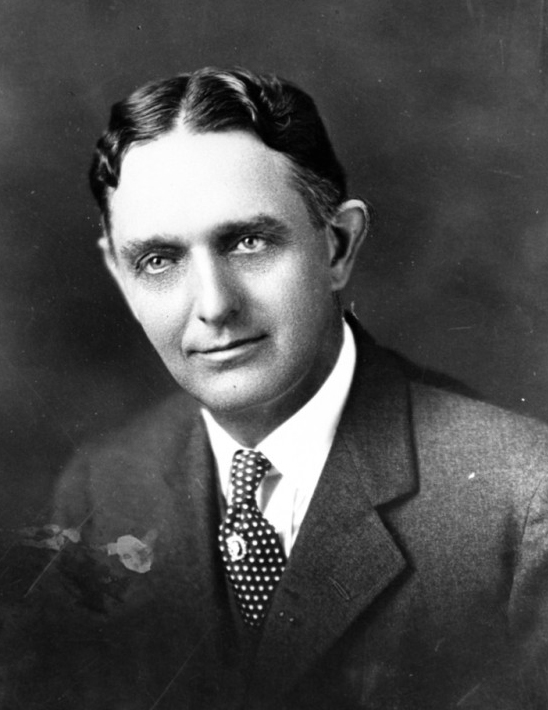 Dennis Herron Murphree (1886-1949) of Pittsboro, Mississippi has the singular distinction of serving twice as governor of Mississippi without ever being elected to office. He was twice elected to the lieutenant governorship, once in 1923 and again in 1939. In each instance, he succeeded the governor who died in office and completed the term of his predecessor. In March 1927, he became Governor of Mississippi after the death of incumbent Henry L. Whitfield and served for about ten months until Theodore G. Bilbo, who defeated Murphree in the Democratic Party primary by 10,000 votes, was sworn into office in January 1928. With the death of Gov. Paul B. Johnson, Sr. in December 1943, Murphree finished out the three weeks left in Johnson’s term, serving until the swearing in of Thomas L. Bailey in January 1944.
According to historian James M. Young, Murphree wrote/compiled his county history in 1928 but that it wasn’t actually published until sometime later. “Some references I’ve seen show the publication date as ‘unknown’ and some show 1948. I remember that The Monitor-Herald published it (in installments, I think) at least two times, and I suspect that the first time was in 1948 and that copies in the form of a book were also made at that time. The last chapter of Murphree’s history deals with the organization of Bruce and the last paragraph in the history is the one I sent you (the following text; jly) concerning the roads out of the new town of Bruce. Murphree’s version consists of 16 chapters. The first 5 or so (short chapters) were written by him, and then a section covering 1852-1876 which had been written by Judge J.S. Ryan was inserted. This was followed by a section consisting of a long letter covering the legislative creation of the county, written by Judge J.A. Orr (who introduced the bill in the legislature). A section covering the period 1875-1900 was written by Thomas Martin Murphree (Dennis Herron Murphree’s father) followed that, and the final section was written by Dennis Murphree and was titled “History of Calhoun County from 1900 to 1928”. The Orr, Ryan, and T.M, Murphree sections are heavy with who got elected to office. Dennis Murphree’s section has some of that as well but also lots of more interesting stuff; for example, he has a fairly detailed account of the murder of Robert Lee Crawford, Papaw Young’s brother-in-law, in the yard of the T.W. Young house across from the church at Ellzey. The section written by Thomas Martin Murphree was published by The Calhoun Monitor (in Pittsboro) at the end of the summer of 1904. 500 copies of the “booklets” (as Dennis Murphree called them) were printed and sold for 25 cents each.”
In order to tell the story of the “Skuna Valley Railroad” and the new town of Bruce, in Calhoun County, Mississippi, it will be necessary for me to go a long way back as to make the proper beginning.
 It was, I think, in the year 1901, that a very smart, shrewd old Michigan lawyer first came into Calhoun County. His name was Roger W. Butterfield. Mr. Butterfield had watched the huge white pine forests of Northern Michigan fall relentlessly under the lumbermen’s saws and axes, and he realized that timber would sometime be a real item of value, and so having some money to invest, he looked about over the country for some places where timber could be bought cheaply and in bountiful supply. Somehow, he chose the South and Calhoun County, Mississippi as the base for his operations and investments. He sent several men of his own force into the county seeking to buy land and timber, employed Attorney J. L. Johnson at Pittsboro as his local attorney and then hired Andy J. Bounds of the Bounds neighborhood and one of the county’s best citizens to represent him as land buyer and local representative.
These people immediately entered on a land and timber buying campaign which lasted several years. They took their time, looked about, located land which was not expensive and which was covered with fine timber and then made the purchase. They did not seek to link up all the tracts, although naturally they preferred to buy in a block as much as possible. In the main, however, they avoided buying any in cultivation. They bought large acreage in the Schoona River Valley, and they bought many tracts in the hills. Most of their purchases, however, were north of a line which might have been drawn east and west through the center of the county. When finished the Butterfields owned some twenty-five thousand acres of timbered lands in Calhoun County and some three thousand in Yalobusha with a small amount in Lafayette and Pontotoc Counties. The average price paid for these lands was approximately $2.50 per acre.
 It would be a real treat for members of the younger generation to see today the giant trees which made up a large part of the growth on these Butterfield lands. In the river and creek valleys the huge forked leaf white oak trees grew often fifty feet from the root to where the first limb appeared, and several feet across the base. Other hardwoods grew in like size and great abundance. In the hills, the old “virgin” pines dotted the hillsides and they too were a sight to behold, because they grew so tall, so straight, so uniform and with only a small cluster of limbs in the very top. On the hillsides too as in the valleys, grew every specie of hardwood likewise in great abundance. Until the coming of the Butterfields, these trees were valueless on the market. In fact, the first time in my life I ever knew about timber of any kind being sold was when some stave workers came into Schoona Valley near where we lived at Oldtown and paid $1.00 per tree for huge over cup and white oak trees several feet through, provided these trees would “split” after being cut down, meaning that provided they could easily be split up into staves six feet long. If the tree did not split well, they simply abandoned the log and went away leaving these huge logs, the kind which became almost priceless in later years, to rot where they fell.
I well remember that during the winter of 1902-3, Mr. Butterfield sent a young lawyer and a young lady who was an expert clerk, though not a lawyer, down from Michigan and they spent the winter in the old courthouse making abstracts of the land which Butterfield had up to that time purchased. These two people were a source of much amusement to the young people of that date, with their, to us, Northern accent, quaint expressions, unusual customs, etc. I am sure that on their part, they found us even more amusing. Time passed, and Roger W. Butterfield went the way of all mankind, but his heirs held on to the Calhoun County lands and timber and each year paid their taxes regularly, while from time to time, a few more acres were bought and added to their holdings. Along about 1920, however, these owners began to feel the urge to sell and dispose of their property. This was probably because timber prices had advanced to such an extent that they could secure a huge profit on their original investment; and, second, because with the cutting of canals in the rivers and creeks and the issuance of bonds for roads, schools, etc., their Calhoun county taxes, which in the beginning had been practically nothing, began to be a heavy burden.
 I have related how that over all the long years, it had been the dream of the people in Pittsboro and the Northern section of the county that someday they would see the building of a railroad into that section. Along about 1921, it became known that the Butterfield interests would sell their holdings in Calhoun, and hope began to be revived as to the possibilities of a railroad being built out into our section in order to carry the timber. It will be remembered that this was in the days when the huge log trucks powered by gasoline and used over concrete roads were utterly unknown in our section. Much discussion was had between various citizens and firms seeking some plan to accomplish the result desired. Acting on instructions from an organization of Calhoun County business men, a meeting was arranged whereby representatives would go to Chicago and there meet with Mr. Markham, President of the Illinois Central Railroad, and seek to interest him and his railroad in the idea of building a short line of railroad either from Coffeeville or Bryant out to Pittsboro. Mr. H. H. Creekmore of Water Valley, a native Calhoun citizen, Mr. Jim L. Johnson and I were chosen by our people as their representatives on the proposed trip. This I remember it was in 1922.
Agreeable to plan, we three went to Chicago and had a lengthy and friendly session with Mr. Markham. We found him very sympathetic to the proposal. Naturally so, since it would mean an immense amount of tonnage to be hauled by the Illinois Central Railroad after it had been brought out to their main line. However, Mr. Markham would not agree to undertake the building of the short line.  He promised that IF we could get some timber manufacturer or sawmill company to buy the Butterfield tract and the railroad right of way and do the grading for the new railway, the Illinois Central would furnish the steel rails for the road and when finished would also furnish the locomotives and box cars to use on the new railway on a very long time sale plan with a low interest rate. Our people were very well pleased with the report of the Committee, and then began an effort to try to interest some timber company or manufacturer in buying the timber and building the railway. This kind of effort went along over a period of two or three years. I remember that on my own personal expense and with the consent of the Butterfield folks, I placed an advertisement costing a neat sum in the Manufacturers Record of Baltimore, briefly outlining this situation. I had a number of replies and furnished each with quite a bit of information. I had nothing to do with the making of the deal between the Bruce Company and the Butterfield heirs when the timber we have been talking about finally passed out of the Butterfield hands. I have always thought, however, that it was easily possible that all the planning, talking, advertising and publicity which I and others in Calhoun County had been doing, had something to do with bringing this matter to the attention of the Bruce Company folks and therefore the ultimate result.
 Anyway, about 1924 or early 1925, the Bruce Company of Memphis, Tenn., purchased outright all of the Butterfield holdings in Calhoun and adjoining counties. Soon thereafter it began to noised around that their plans included the building of a standard gauge, common carrier railroad, from Bryant’s Spur, located four miles south of Coffeeville on the Illinois Central Railroad, up the Schoona Valley to the neighborhood of the old town of Pittsboro. In my service as Lieutenant Governor, I was often called on to serve as Acting Governor on those occasions when the Governor left the state. On one of these occasions, for me a very happy coincidence, Attorneys H. H. Creekmore and N. I. Stone, came to the Governor’s office, bringing with them the proposed Charter of Incorporation of the “Schoona Valley Railroad.”
 The Attorney General of the state, who was Hon. Rush Knox, himself a native son of Calhoun county, but at that time a citizen of Chickasaw, approved this charter and at ten o’clock A.M. on the 1st day of June 1925, as Acting Governor of Mississippi, it was my sincere pleasure to sign the Charter for this railroad for which along with many other Calhoun folks I had worked for and hoped for so long. I pause long enough to say that later on, by amendment, the name of the railroad was changed from “Schoona Valley” to “Skuna Valley”. This, I think came as a result of effort made by Will C. Bryant, who had always claimed that “Skuna” was the proper way to spell the name of the Valley. Personally, I think “Schoona” is correct, because all of the old records, manuscripts, etc., which I ever saw in Calhoun County spelled it that way. Slowly the new railroad was built, and during the year 1926, progress was made in laying off and planning the new town. The name decided upon for it was “Bruce” because of the fact that the Bruce Lumber Company of Memphis, Tenn., was the force behind the plan.
Governor Whitfield became ill during the summer of 1926 and spent almost all the rest of the year in a hospital in Memphis. So I was very busily engaged during the period acting as Governor during his absence. It is my recollection that in such capacity I also signed the Charter for the new town, but of this I am not positive. Anyway they named one of the streets in the new town for me, for which I have always been grateful. Governor Whitfield returned to Jackson in February, but rapidly grew worse and died on the 18th day of March 1927.  After the Constitution, I succeeded him, and on taking the oath of office became the 35th man in our state’s history to be Governor of Mississippi. It has not been my intention at any time to clutter up these pages with stories of my various political campaigns. I will say again, however, that Calhoun County people have never failed me, and I have carried the county by a large majority in each and every race that I made. This has always been a source of much pride and gratitude to me. By force of circumstances, I was “pitchforked” into the race for Governor in 1927. I had not planned to run, and felt always that I would be defeated but after Governor Whitfield’s death, it became necessary that I run or forever be branded as one who was afraid to try. In July 1927 my Calhoun County Campaign Committee planned a huge barbecue and political picnic for me and chose as the spot for this great gathering the location of the brand new town of Bruce. I think that it was on July 4 1927. The location was what is now the public square at Bruce, which at that time was only an old field with only one or two houses. Thousands of people from all over the state attended, and it was truly an enthusiastic and heartwarming affair. This was the very first public gathering ever held in Bruce, Mississippi.
The new town of Bruce grew rapidly. Besides the huge Bruce Company mill, several other timber manufacturing plants were established there. A number of people from over the county moved in and set up various lines of business. Too, there was in influx of immigration from several of the northeastern counties of the state, particularly from Tishomingo and Alcorn counties. These new people settled largely in the Bruce area and many of them still remain in that section. Another thing which contributed to the growth of the new town was the policy adopted by the Bruce Company of selling off its valley lands as soon as they cut the timber. The land bought at a reasonable price was immediately opened up for cultivation so that now, for miles up and down the Schoona Valley, where I had as a boy hunted for squirrels, turkeys, etc., there flourished the finest farms in the country. New roads began to be projected: one going east toward Houlka out of Bruce, another west down the Schoona valley toward Coffeeville; another toward Water Valley. Neither of these roads has been fully improved as deserved, but all hope that they will be in good time. Laying out of these roads had an odd effect on the old time traveler who returned to view the section. Oftentimes he found himself “lost” in a neighborhood or area where in former years he was absolutely familiar.

(Photos courtesy of the Calhoun County Mississippi Historical and Genealogical Society, Timber: A Photographic History of Mississippi Forestry, by James E. Fickle, and msrailroads.com)
Widely acknowledged as the precursor of Memorial Day, observance of a Decoration Day began shortly after the end of hostilities in the Civil War, when citizens began decorating the graves of fallen soldiers. Many cities claim to be home of this observance, including Waterloo, NY, Boalsburg, PA, Carbondale, IL, Columbus, GA, and much closer to home, Columbus, Mississippi.
 In their 2014 book, The Genesis of the Memorial Day Holiday, Dr. Richard Gardiner and Daniel Bellware state that according to the Veteran’s Administration, at least 25 cities across America claim to have originated the Memorial Day holiday. While numerous historians feel that the true history may never be known, this book rejects that claim and explores the factual history of the holiday and shows that most of the better-known stories are mere myths and local legends.
That being said, Jackson, Mississippi offers substantial proof that the first Decoration Day was held on April 26, 1865 in the historic cemetery in downtown Jackson now known as Greenwood.
As the story goes, citizens of the Confederacy were well aware of the strategic importance of Appomattox; those in Jackson, Mississippi were already shaken by the fall of Richmond on Apr. 4, 1865, and news of Grant’s victory reached Governor Charles Clark some days later. In her diary his daughter recalled the telegram being passed around: “Yes, it was all over. Lee had surrendered at Appomattox! Like a thunderbolt it fell on all of us. We were stunned. I remember feeling astonishment that we were not all dead.” 
Many if not most were already resigned to defeat and were shocked by the assassination of Lincoln less than a week later, so it was a somber group that assembled on Tuesday evening, April 25 at The Oaks, home of former Jackson mayor James Boyd on North Jefferson Street. Just before midnight two couriers arrived with the news that Confederate Lieutenant General Richard Taylor and Union Major General E.R.S. Canby had agreed to a truce in Meridian, darkening the mood. Among them was Sue Langdon Adams, a Missouri native and niece of Mississippi’s Senator Robert Adams. A nurse, Sue had infiltrated Union lines bringing medical supplies back for Confederate forces and informing Confederate authorities of Union troop deployments.
When the news of the truce came, Sue was reading Plutarch’s Lives, where it’s mentioned that the graves of fallen soldiers were adorned with wreathes of laurel. Fearing that the reoccupation of Jackson was imminent, s he tore out a blank page and penned an appeal to the women of Jackson to gather the next day at the city cemetery at two in the afternoon and adorn the graves of fallen soldiers with flowers. One of the young couriers took the note and raced to the office of the newspaper, Mississippian, just in time for it to be printed in the next morning’s edition.
The next day, a large group of citizens gathered in the cemetery soon every soldier’s grave was covered with floral designs of every kind. Troops led by Colonel McFarland marched through the cemetery as their band played Handel’s “Dead March” from Saul. As Adams moved through the rows of graves, she saw some that were unadorned and asked why there were no flowers on them. Told they were the graves of Union soldiers, she replied, “I will garland them with my pink roses for mothers and sisters sobbed prayers over them as they marched away. Maybe they fell in the riven flags in the battle of West Jackson.”
Adams later moved to California and married a Judge Vaughan. She died in Arlington, Virginia in 1911 and is buried in the Mount Olivet United Methodist Cemetery there. Her memorial efforts were acknowledged in an inscription on a monument which was unveiled on the Jackson Capitol Green in 1891:
“It recks not where their bodies lie,
By bloody hillside, plain or river,
Their names are bright on Fame’s proud sky,
Their deeds of valor live forever.”
Decoration Day Originated in Jackson, Miss. April 26th 1865
By Sue Landon Vaughan
 Text by Cecile Wardlaw, based on research by Peter Miazza