Lieutenant Commander (later Admiral) Leonard H. McCoy, M.D, chief medical officer aboard the USS Enterprise (NCC-1701), was born in Atlanta, Georgia, Earth, in 2227 to Mr. and Mrs. David McCoy. He enrolled at the University of Mississippi in 2245. That year, an interplanetary gymnastics competition was hosted by the University of Mississippi and held at the Menlo T. Hodgkiss Memorial Gymnasium on the Oxford campus, where he met the Tr’i’ll Emony Dax, who was visiting Earth to judge the competition. According to Dax, McCoy “had the hands of a surgeon.”
McCoy enrolled at the University of Mississippi Medical School in 2249. While in medical school, McCoy and his friends often substituted real drinking glasses with tricklers at parties. (What fun.) He graduated in 2253. McCoy met his future wife Pamela Branch at Ole Miss when she suffered brain-freeze from an ice cream cone. Branch wore white at the wedding ceremony and adopted the last name McCoy. She divorced him in 2255 because their professions kept them apart. In the divorce, she acquired a house on Mars, six cars, and a valuable Vulcan painting along with custody of their daughter, Joanna. McCoy told Kirk that the divorce left him nothing but bones. Shortly afterwards, McCoy enrolled in Starfleet Academy.
During his famously quoted expedition in search of Livingston, Stanley also said, “If we run out of food, we’ll eat bananas.”
Sir Henry’s flippant dismissal of this vital foodstuff in lieu of boiled beef sums up the Brit empiricist mind; millennia before Stanley’s split second of Victorian condescension, bananas had been a staple in Asia since Homo erectus. While European versions of the Expulsion have Eve offering up an apple (probably a Winesap; the Granny Smith is theologically impossible) as the principle instrument of temptation, many African, Asian and Oceanic interpretations depict Adam as succumbing to a nice banana instead (Eve had a rough cut, why not Adam?). These accounts also describe our primal DNA donors as masking their shame with banana leaves, which makes far more sense to me than that fig drag, even for Eve.
Before Chiquita and other mega-growers began shipping bananas in chemically sterilized bunches, stores would impale whole untreated stalks on ceiling hooks to ripen. Given the number of nooks and crannies in these masses of vegetation, it’s unsurprising that the occasional tropical creature would piggy-back its way across the Gulf of Mexico into the rural South. My grandfather Jess kept a small country store that supported an endless series of banana stalks from the Cockrell Banana Company in Tupelo on a hook from the ceiling as well as any number of worthless relatives and other such riff-raff from the cash box under the counter. Jess checked out produce before he put it up for sale, and occasionally he’d discover some sort of exotic fauna cowering deep amid the bananas.
He’d usually find a spider big enough to scare the bejesus out of any little old lady getting a couple of bananas for pudding to take to a homecoming. These he fed he to the chickens, but once, to his great delight, he found a small boa and kept it in a glass gallon jar with some hay in the bottom for everyone to ogle before he he sent it to the University of Mississippi, where it enjoyed a long, happy career as a desensitizing agent for people with snake phobias.
He once told a slacker cousin that he could get a snake into Ole Miss, “But I can’t get your ignorant ass into a decent barber school.”
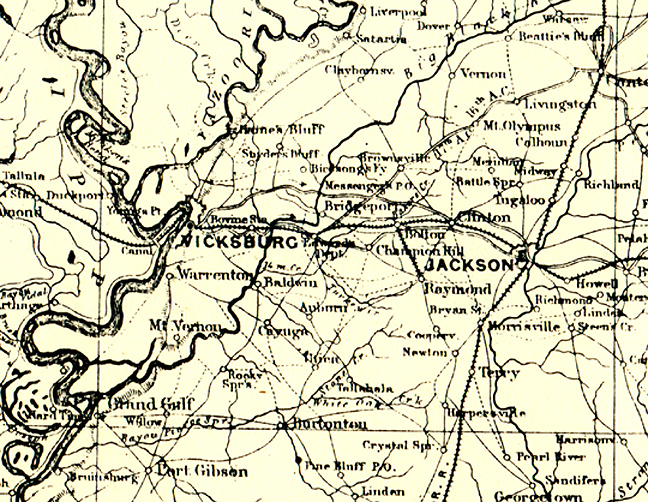
In the spring of 1863, the war dividing the nation focused on Vicksburg. Lincoln told his civilian and military leaders, “Vicksburg is the key!” Confederate President Davis was of the same mind: “Vicksburg is the nail head that holds the South’s two halves together.” In Confederate hands, Vicksburg blocked Union navigation down the Mississippi and allowed communications and reinforcements from Confederates to the west. The natural defenses of the city were ideal, earning its nickname of the Gibraltar of the South.
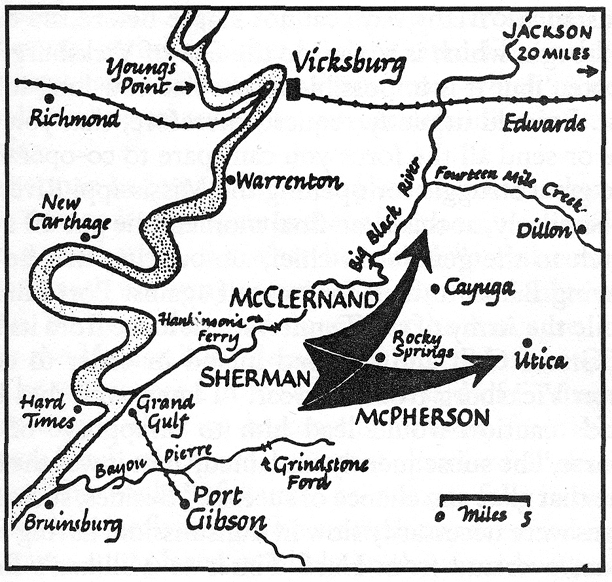
Frustrated in his former attempts to take Vicksburg, the Battle of Port Gibson (May 1) gave Union General Ulysses S. Grant a much-needed foothold on the eastern bank of the Mississippi south of the city, but Grant needed a base north of Vicksburg that could be supplied via the river from Memphis and Port Hudson to subdue the stronghold.
Grant’s Confederate opponent in the campaign, General John C. Pemberton, was of the same mind: “To take Vicksburg, to control the valley of the Mississippi, to sever the Confederacy, to ruin our cause, a base upon the eastern bank immediately above (Vicksburg) was absolutely necessary.” Pemberton admitted that such a move on the part of Federal troops “might destroy Jackson and ravage the country”, but “that was a comparatively small matter.” Though Jackson had the only secure railhead east of Vicksburg, a vital connection to the rest of the Confederacy, Pemberton, a Pennsylvanian who had taken up rebel arms, thought little of Mississippi’s capital city on the Pearl in comparison to his vital command on the Mississippi.
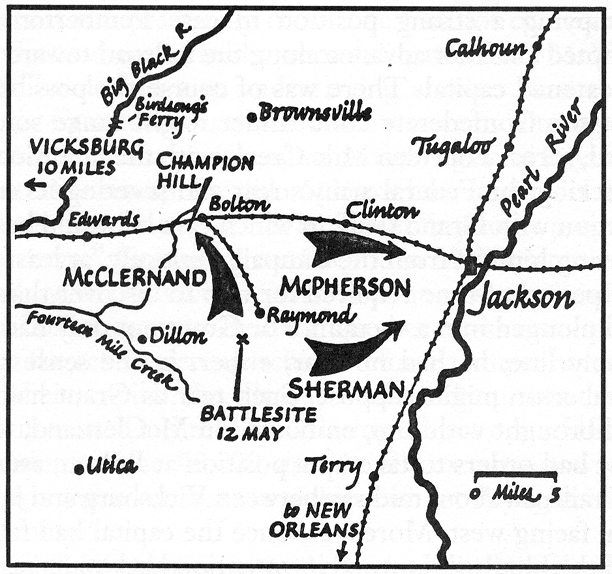
To secure this hypothetically crucial base above Vicksburg, Grant, along with his trusted lieutenant William T. Sherman, moved the Army of the Tennessee to the northeast, and on May 12 headquartered his troops at Dillon Plantation some 6 miles west of Raymond. About sundown, as the camp was settling in to its evening routine, an excited courier drove his lathered horse into camp and poured out the news that Federal troops under Maj. Gen. James B. McPherson’s XVII Corps had encountered a large Confederate force commanded by Brig. Gen John Gregg at Raymond, defeating it after a savage battle. “When the news reached me of McPherson’s victory at Raymond,” Grant later wrote, “I decided at once to turn the whole column towards Jackson and capture that place without delay.”
At first little more than a dot on a map in the mind of the great Union captain, Jackson now came into focus for Grant as a military objective. He had become convinced that Confederate forces assembling in or near Jackson might be stronger than he had initially supposed, and he had reports of reinforcements pouring into the city, including Gen. Joseph E. Johnston, the Confederate commander of the Department of Tennessee and Mississippi. Johnston was widely respected by his troops, fellow officers and even President Davis, with whom he had an acrimonious relationship.
These reports put at risk Grant’s proposed crossing of the Big Black near Edwards, a move designed to bring his troops north of Vicksburg, since it would leave a potentially strong army commanded by a reputedly able general on his rear flank. He now saw more clearly the city’s value as a communication and transport center through which supplies of men and war materials could be funneled to Vicksburg. In addition, destroying Jackson, which also had some importance as a manufacturing center (mostly of cloth), would cripple the state’s ability to supply the rebel army. It’s reasonable to assume that Grant would also be aware of the impact on morale that the capture of the capital city of Mississippi, the home state of President Jefferson Davis, would have on the Confederacy as a whole.
Grant was confident that he could take Jackson then swing his forces back to the west before Pemberton took notice. It was an audacious ploy; by this move to the northeast of Port Gibson, Grant had cut himself loose from his base, but the Northern general had learned to provision his troops as they marched, taking what they needed from the farms and villages they encountered, and the Union army found plenty to sustain their progress. Because the city was reputedly heavily fortified, he decided to strike with his entire army, 10 divisions, some 40,000 men. Grant positioned McPherson to the north and Sherman to the south of his eastern advance towards Jackson, positioning Gen. John A. McClernand on the western flank, facing any possible attack from Pemberton’s troops in Vicksburg.
Jackson, at the outbreak of the war, had a population of 3,191 (Vicksburg had 4,591 and Natchez, the most prosperous city in the state, 6,612.) The city’s arsenal had been destroyed in a disastrous explosion the previous November; Confederate troops stationed there for its defense numbered some 6,000. Well before the final advance of Federal forces, the city seemed to have resigned itself to subjugation. As early as May 2, Pemberton (ever the fatalist) telegraphed Governor J.J. Pettus, advising him to remove the state archives from the capital. By May 6, people began leaving Jackson. The Mobile Register and Advertiser reported, “The trains for the interior are crowded with non-combatants, and the sidewalks blocked up with cases, barrels, old fashioned trunks and chests, which look antiquated enough to have come out of Noah’s Ark.”
By the time Johnston arrived to take command of the city’s defense on the 13th, all who had the means to escape the city had done so, and the Confederate commander’s assessment of his chances to save Jackson could not have been buoyed by the then funereal aspect of the beleaguered capital. Johnston knew his situation was dire; Pemberton had refused his request for reinforcements from Vicksburg the previous week, and the additional troops promised by his superiors had yet to arrive. Johnston was met in Jackson by Gen. Gregg, who was forced to retreat to Jackson with his 3,000 soldiers after the fierce encounter at Raymond. Faced with a two-pronged Union attack by able commanders leading some 25,000 troops and with no time to organize any reasonable defense, Johnston, a seasoned general and career solider, retreated to the northeast.
On May 14, Union forces advanced towards Jackson in a deluge turning roads that had choked them with dust for weeks into trenches of shin-deep mud. After two short skirmishes lasting less than four hours, Grant’s troops entered a silent Jackson under a pouring rain. The Battle of Jackson, such as it was, had ended. Rails and bridges were destroyed, factories put to fire. Vicksburg’s artery to the east was cut; in less than two months, the Confederate Gibraltar would fall into Union hands. Jackson, abandoned by its defenders and occupied by a hostile army, was looted and burned by soldiers and civilians alike for the first of four times, bitterly earning its nickname: Chimneyville.
During the heyday of Prohibition, the speakeasy districts of New York and Chicago became dazzling gathering places, filled with music, dance, and drink–as well as a few bullets, mind you–as did similar areas in the South, notably Beale Street in Memphis and the French Quarter in New Orleans, which doesn’t shut down for any damned thing. In Jackson, Mississippi, it was the Gold Coast. Also known as East Jackson or even “’cross the river”, the Gold Coast comprised the area of Rankin County directly over the Woodrow Wilson Bridge at the end of South Jefferson Street. Though barely two square miles, its infamy was nation-wide.
In 1939, H.L. Mencken’s The American Mercury, published a rollicking account of the Gold Coast, “Hooch and Homicide in Mississippi”, by Craddock Goins. “There is no coast except the hog-wallows of the river banks,” Goins wrote, “but plenty of gold courses those banks to the pockets of the most brazen clique of cutthroats and bootleggers that ever defied the law.” Goins cites Pat Hudson as the first to see the possibilities of lucrative gambling near the junction of the two federal highways (Hwys. 80 and 49) across the river from Jackson where before then there were only gas stations, hot dog stands and liquor peddlers. Then San Seaney began selling branded liquor at his place, The Jeep, which soon became a headquarters for wholesale illegal booze.
Others sprang up like mushrooms. The sheriff of Rankin County did his best to restore some semblance of law, but as soon as he cleaned out one den of iniquity another opened. Not only that, he was severely beaten and hospitalized for two weeks after one raid, and he simply bided his time until his term ran out. Goins reported that whites and blacks were often together under the same roof then, albeit shooting craps and whiskey on the opposite sides of a thin partition. This lawlessness did not pass unnoticed in the nearby state capitol. Governor Hugh White, who in December of 1936 ordered National Guard troops into a business on the Pearl owned by one Guysell McPhail. Liquor was seized as evidence that the place should be shut down, but a Rankin County chancellor later dismissed the case, ruling that the evidence had been illegally obtained and at any rate the local authorities, not the governor, should handle law enforcement. The Mississippi Supreme Court later overruled the decision, but by that time liquor was flowing and dice were rolling again.
In the late 40s, a thriving black nightclub culture was in place. Places like the Blue Peacock, the Stamps Hotel (the only hotel in Mississippi that catered to Negros) with its famous Off-Beat Room, The Blue Flame, the Travelers Home and others, where national jazz and blues acts performed. These establishments ran advertisements in The Jackson Advocate, including one that offered a special bus from Farish and Hamilton. By 1946, Rankin county was paying the highest black market tax in the state., but these high times came to a crashing end one hot day in August of 1946, when Seaney and Constable Norris Overby met at place called the Shady Rest and gunned each other down. Others had been killed, of course—often that big-ass catfish you hooked turned out to be someone you hadn’t seen in a while—but this double homicide so inflamed public opinion that illegal operations never dared be so blatant. In the 50s, black businesses withered in the backlash against Brown vs. Board of Education, and the Gold Coast became dominated by a white gangster named “Big Red” Hydrick, who brought area as securely under his suzerainty as a corrupt satrap. Red’s little kingdom withered with urban sprawl.
Beale Street is back–sort of–and the French Quarter will–Dieu merci!–always be the French Quarter, but the Pearl’s Gold Coast is gone, lost in a little enclave under the interstate, a puzzle of gravel, asphalt, and weathered walls.
Sometime in 2018, I began working on a profile of Charlotte Capers, and in the course of my research was fortunate enough to get an interview with Elbert Hilliard.. The interview was held on March 21, 2019 in a conference room on the second floor of the William F. Winter Building in Jackson, Mississippi. Also present was De’niecechsi Leyton, Head of Reference Services at the Mississippi Department of Archives and History. Though the purpose of my interview was to gather information about Mr. Hilliard’s brilliant predecessor, Charlotte Capers, Hilliard spoke of many other things, most notably about his outstanding career as a historian and director of MDAH.
* * * * *
I think Miss Capers shares what a lot of people share, is that once you’re gone, then you tend to be forgotten to a degree, plus the fact that, I hate to say it, but probably the vast majority of citizens don’t do a very good job of keeping up with history of studying history of remembering people in the past. Now, of course, when you say, Miss Welty, that’s different. She was a prolific author, yet Miss Capers, had she had the time, probably could have written books that we would still be reading today. As you’ve already stated, she was a very capable talented writer and very capable and talented person.
I did not meet Miss Capers until the spring of 1959, when I was at Mississippi State in graduate school studying history. And truthfully, I had never heard of the Mississippi Department of Archives & History until I was in graduate school. Sadly, though (the Department) has grown, and we have a wonderful publicity department, you con probably walk down the street here outside, go down a few blocks and ask someone how to get to the Department of Archives & History, we may or may not get an accurate answer.
But getting back to Miss Capers, that was when I met her in the spring of 1959. Probably the first time that I heard her name mentioned was in a conversation I had with Dr. John K. Bettersworth. He was head of the Department of History at Mississippi State when I was in graduate school, and I’ll always be indebted to him because he took a chance with me and approved a graduate assistantship for me. Clara and I were married on August 3, 1958, and we went up there the 1st of September, 1958.
After Christmas, when we got to the second semester there, we started thinking about jobs, and apparently Mr. Bettersworth was thinking the same thing. He came by my desk are there in Lee Hall, second floor, and I told him we were going to be contacting the top school districts in Mississippi. He said, “You also ought to contact Charlotte Capers at Archives & History.” By that time, I think I was smart enough, having been told by Dr. Glover Moore about the Department of Archives & History, I put two and two together and concluded that she was the director. Of course, he said “Charlotte Capers”, and here I am, eighty-two years old, and she’ll always be “Miss Capers” to me. I loved Miss Capers.
I did contact her, I can’t remember the specific dates, came down to Jackson and met with her in her office in the War Memorial Building. You went in the front door, you turned left, and then you made the first left, this north wing of the War Memorial Building was the Archives & History Department. They had just initiated or were in the process of initiating the restoration of the Old Capitol. That was a crucial moment in Miss Capers’ life, because here she is, Director of the Department of Archives & History, and as you noted earlier, it was a very small department with a very, very small staff, probably at that time less than 10 people, I can go back and check that, but I think it’s right. Years later, after I came into the department, we became very close and she would tell me stories. One day she told me her telephone rang, and the conversation went something like this:
“Charlotte? This is J.P.” (Gov. Coleman; they had been in school together at Ole Miss.) “Charlotte, the building commission just met.” (Back then, Jesse, the governor was the ex officio chair of the building commission, and when I say “ex officio”, depending on the nature and the personality of the governor, he was the chairman of the building commission. And that was the case with Gov. Coleman, because he was a strong, forceful leader, and fortunately he was very interested in history.) “And we have voted to restore the Old Capitol, to become the state historical museum, and we also voted to have you be responsible for doing it.” This was probably early 1959. (cf.: https://npgallery.nps.gov/NRHP/GetAsset/NRHP/69000087_text) They started restoration work in 1959.
She said, “Elbert, I almost collapsed of apoplexy there on the spur of the moment.”
Well, you can imagine. Here is a lady who, as I said, in this small department, had nobody to help her on this. They’re not allocating any extra funds for staff people for Archives & History, so she had had no former experience in museum work, and certainly not museum planning or restoration details. She had high blood pressure as well!
So she took than on, and she was smart enough to know she needed to contact the top people, so she contacted the top people, so she contacted the American Association of Museums and the National Park Service and got some experts to give her guidance and advice. Well, as the process went along there, one of the things she recognized was that the museum needed to have written policies outlining the purpose of the museum and the scope of the collections because what had happened was that the museum function of the Department of Archives & History had been started back in the very early days by Dr. Dunbar Rowland, who was the first director.
Dr. Rowland had started the museum over in the first floor over on the first floor of what we call the New Capitol. Archives & History had moved from the Old Capitol to the New Capitol in 1903; Archives & History was founded in 1902, started out in the Old Capitol, and then was moved to the New Capitol in 1903. I’m sure he planned it that way, but he cited the fact that he was the last person—he was very proud of the fact—the last person to leave the Old Capitol. He then began to call for its preservation as a shrine—that was his word for it—to Mississippi history. He sent out that call in 1903, and it took a long time to be answered. That’s the way we do things in Mississippi.
After he (Rowland) became director, he began to assemble a museum collection. The approach that he took was common to most entities back then that were involved in museum work which was that they collected virtually everything that was old and unique and different. There were no written policies. That led to the department acquiring many historical artifacts but it also led to the department acquiring a number of artifacts that had nothing to do with Mississippi whatsoever. For example, there was an artifact associated with Lafayette’s visit to Natchez in 1825, there were all sorts of Civil War swords and pistols and so on, some of them belonged to prominent people. Then you had things with no connection, for example the hair from the mane of Stonewall Jackson, who never set foot in Mississippi. There were bricks from Independence Hall in Philadelphia. There were a pair of size 21 boots worn by a Negro soldier in 1901.
And then perhaps the most acclaimed one was the Egyptian mummy. And that’s a story in itself related to Miss Capers and me as well. As the years went by, if you were to conduct a poll of the museum there in the New Capitol and asked them what was their favorite artifact, they would have chosen the Egyptian mummy. They lined up to see the Egyptian mummy. Miss Capers told me that as a child they would skate through the New Capitol; they lived a few blocks away.
Anyway, this is what she inherited, that and the fact also that there had never been an official curator of the museum. The department was just so small. Dr. McCain succeeded Dr. Rowland, and Dr. McCain went off to war twice, so the museum was just sort of frozen in time then. I forgot to tell you also that Miss Capers had this great sense of humor and—this was after I’d been there and worked with her for a while—she told me some of the things that I’ve told you there about the museum collection. She said that the practice (viz: to collect virtually everything, jly) had been under Dr. Rowland, and it had probably been majorly curtailed under Dr. McCain and her, but Miss Capers said that one day a couple appeared in her office there in the War Memorial when she was director, and they said they had something to donate.
She asked, “What is it?” And they said, “A stump.” “A stump?” “Yes, ma’am, a stump.” “Well,” Capers asked, “What is the historical significance of the stump?” She said they looked at her straight in the eye and said, without hesitation, that it was the stump on which Adam and Eve sat in the Garden of Eden. “Oh,” Capers said. “Well, where did y’all find the stump.” Again without hesitation, they replied, “Madison County.” Of course, those of us who live in Madison County have always felt that we live in the Garden of Eden. But I asked, “Miss Capers, what did you do?” “Well,” Capers said, “Dr. McCain told me never to alienate anyone, so I accepted the stump, and after a proper passage of time, I had it burned.”
So that was the type of thing she had to deal with, and as I said there was no curator, there were no professional museum standards, there was no catalogue system, so when I came with the department in July of 1965—I’ll catch up with that later on—what I found when I got involved with the state historical museum in the Old Capitol that they had instigated a professional cataloguing system. Now, what predated that was simply somebody years ago back in the early 1900s had simply gone to the exhibit cases, looked at the exhibit cases, saw what was in there, probably with a typed or handwritten label, had written that down and produced a page-by-page typescript that listed each artifact.
So here it gets to be 1960 or thereabouts and that’s what Miss Capers was dealing with was to get a professional curator on board who could then train the staff to catalogue the collection, which involved having a bound accession book, a catalogue number for each artifact which was entered and put on each artifact with indelible ink and sealed appropriately. That had to be done and then you had cards, object and donor cards so that you could find things in case someone came in and said, “Years ago, Great-great Grandaddy did this, do you have this?” What problems would develop from time-to-time was that in the early days prior to the restoration of the Old Capitol, there were no contracts of gifts that people signs, so Miss Capers had to start that, composing a contract stating that the donors were giving these items with no limiting restrictions or conditions. They became the property of the Department of Archives & History. Anyhow, she deserves credit for doing the research, recognizing what had to be done to have a professional museum, and getting the staff to implement that.
As I said, the first time I met her was in the spring of 1959, and I came in, of course I was a little nervous, since I’d never met her. That was not the first time I’d come to the Department of Archives & History; the first time would have been in the early fall of 1958 to do research on my thesis, a biography of Fielding Wright. That was my first visit, and of course I was impressed with the department, but the first thing they told me was that Gov. Wright’s papers had burned in his law office in Rolling Fork. That was a disappointment, so I had to find a way to get enough material to put together the thesis. I did not meet her on that occasion. So here I am coming back in the spring of ’59, and told her that Dr. Bettersworth recommended I come and talk with her. Now, it helped that Dr. Bettersworth was on the Board of Trustees of the Department of Archives & History. That kind of gave me an entrée. She said that she was interested in talking with me, but that she did not have a position at that particular time.
Back then, the state was on a legislative biennium, meaning that the legislature only met every two years. Of course, they’d have special sessions as needed, but they only dealt with the budget every two years. She said that they had a request before the legislature for a position, but added that they did not know how that was going to turn out, so they’d have to wait and see. Well, here Clare and I are, Clare had taught a year before we married, so she had a little money saved up. I was getting $100 a month teaching two classes at MSU, American Civilization survey courses, and so I knew that we couldn’t take a chance on waiting to see if this position would open.
So I sent letters to the top three (paying) school districts in Mississippi at that time: Jackson, Natchez and Meridian. I heard back from Meridian and Natchez, didn’t hear from Jackson. I never did get my nerve up, years later when I got to know Kirby Walker, kidding him about missing out on such a talented young man. I loved Dr. Walker. He was a delightful gentleman. Anyway, being in Starkville, the first appointment we made was in Meridian, then we’d go on to Natchez. In Meridian, I interviewed with Dr. Ivy. Now, this tells you something else about schools at that time. We’ve named the top three (sadly no longer the top three), but the difference is, who is interviewing us? The superintendent. This tells you that back then superintendents were hands-on managers.
Dr. Ivy was a very learned and erudite gentleman, held in high esteem in education circles in Mississippi, but when you started meeting and talking with him you quickly came to know that he knew that he was erudite and scholarly and held in high esteem. Dr. Ivy said that he would take us under consideration. So we went to Natchez, which I was familiar with because my sisters had worked there. Clare hated the smell of the paper mills. The superintendent was Mr. D.G. McLaurin. He had asked the president of the school board, Mr. Brent Foreman, a prominent attorney, to meet with us. Now, when you met with Mr. McLaurin, as opposed to Mr. Ivy, you realized you were in the presence of a servant/leader and a very special gentleman. I don’t know if you’ve ever been with Gov. Winter, but when you’re with Gov. Winter, you know you’re in the presence of a servant/leader and you feel comfortable. When Mr. McLaurin finished interviewing us, he asked Clare what she thought about Natchez and Clare, being one who always says exactly what she thinks, she didn’t have to work with the legislature, said, “Well, it’s a beautiful city, and the historical architecture is magnificent. But that odor is terrible.” I though to myself, well, we’ve blown it now, but he just smiled and said, “Well, down here we think it smells like money.”
So spontaneously, he offered us contracts for her to teach at the institute school and for me to teach at Washington High School. We were running out of money, so we singed the contracts. We came back to Starkville, and about a month later the telephone rang and who would it be but Miss Capers. She said, “Mr. Hilliard, I’m just checking back with you and wanted you to know that the legislature has approved a budget, we have a new position and I was wondering if you were interested in coming with us. I said, “Miss Capers, I am greatly interested in coming with the Department of Archives & History, particularly in working with you, but we have signed contracts with the Adams County school system.”
Well, this was 1959, back when contracts meant something. It wasn’t long after that when Paul Dietzel, who was at LSU, broke his contract, and that kicked off a great furor, but nowadays things have changed completely, and nowadays contracts don’t mean anything. So I told her I felt obligated to honor that contract, and she responded that she understood, to stay in touch and down the road if I was still interested in coming, to get back in touch with her.
There I am in 1959, and at that point I’m concentrating on finishing my master’s, getting to teach, and then my high school coach and history teacher had come that year from Anguilla to Madison/Ridgeland to be the principal. He was my first hero, and he started working on me to come teach and coach basketball and baseball there for him. I tactfully declined at first, but as time went on—as I said he was a hero of mine and I loved basketball and baseball part—we agreed to do that. I had to tell Mr. McLaurin that spring, and he wanted me to stay and to go into administration. I just wanted to follow this dream I had of teaching and coaching. So we came to Madison/Ridgeland, that would have been around the first of June in 1960. There were about 700 people in Madison, about 1100 people in Ridgeland. And those were five wonderful years. It was a different era altogether.
In the late winter of 1964, I began to wonder what to do with my life and what all was happening with the school system, so I sat down and wrote Miss Capers, “wondering if you might remember me” or words to that effect, and enclosed an updated resume. A few days pass, here comes an envelope with the Department of Archives & History letter head on it, “Dr. Mr. Hilliard, I am in receipt of your letter and am interested in your working with us, however the updated resume you mentioned was not enclosed.” Fortunately, she didn’t hold that against me, and scheduled a meeting. She grilled me thoroughly, and it was just luck that I had written at a time that she had just gotten a new position that she called Curator of History, who would serve not only as the curator of history but also as the administrator of the State Historical (Old Capitol) Museum.
She said that the person she had hired to come onboard to guide the development of the museum, Robert S. Nietzel—I guess the ‘S’ was for Stewart, since people would call him ‘Stew’—was an archaeologist, that he was very talented and that she wouldn’t have been able to get the museum going without his help and leadership. He is an interesting gentleman, she said, but that he’d just “burned out on me”. She said that she wanted me to go over there and motivate him. She said that he had excavated the Grand Village of the Natchez Indians with a National Science Foundation grant, that he’d supposed to have written a report on that which he had not done, and that he had not finished the exhibit on the Natchez that he was supposed to do.
I’m hearing her tell me all this, and then she asked me what my salary was at Madison/Ridgeland. I told her it was $5300. She offered me the job at $5400. Years later, after I’d worked with her for a while, I asked her if she remembered what she’d offered me and told her I’d often thought that I should have looked her straight in the eye and asked her &7800. She said, “That wouldn’t have done you any good, I wasn’t making that much myself.” I’m guessing in all likelihood that as a female agency head, perhaps at that time the only agency head, I’ve not researched that. If she was not the first, she was one of. Miss Cook was there, but anyhow, what with her being a lady her salary might not have been as good if she had been a man. She said, “I am literally exhausted.” The museum opened in June 1961. (She was 52.) She said that the Board had agreed to give her the summer off, that she was taking an Aegean cruise and would be back in September. She said, “You will come in when I’m gone and will start work July 1. I am going to start you here in the Archives and will ask Laura (Drake Siderfield) Harrell to train you.” (Sister of John Siderfield).
Laura was a diminutive, beautiful lady, the research assistant, and she was also what we would call today the managing editor of The Journal of Mississippi History. She started out in the basement of the War Memorial Building in one of those big old double desks that dated back to Dunbar Rowland’s era. It was piled up through the sky; I used to tell her she trained me how to pile up a desk. I was fortunate in having her because she was kind, and helpful. One day, she gave me a letter and said, “Elbert, I just don’t have time to work on this.” It was from a 92-year old lawyer up on Canton named Herman Dean seeking information on the Treaty of Hobukintoopa, which I was unfamiliar with though I knew many others. So she referred me to The American State Papers on Indian Affairs and Clarence Carter’s papers. Back then life moved at a slower pace, so I was able to work my way through that, to pick up clues until finally I could document that Hobukintoopa was the Indian name for Ft. St. Stephens on the lower Tombigbee.
I wrote it all up and showed Miss Harrell, sent that to Mr. Dean. I didn’t hear back. But when Miss Capers came back to the office in September, she called me into the office to talk with her, and she reaches in her desk, pulls out a letter and reads, “Dear Miss Capers, In all my years of legal research, I have never seen anything surpassing that done by your young Mr. Hilliard.” Bless Mr. Dean’s heart, he got me off to a good start, and Miss Capers said, “Elbert, you’re going over to the Old Capitol now, and take over there.”
Fortunately Mr. Nietzel was gracious enough not to be resentful of this young man who knew absolutely nothing coming in. He and I had a good relationship over the years and after he left the department, Dr. McLemore was director, I got him to come in and head up another excavation of the Grand Village when we were developing it as a state historical site.
Elbert Hilliard (seated) with William Winter in the State Archives, Oct. 2003. Photo courtesy of Chris Goodwin
Given the vast and unpredictable foibles of human nature, the genetic integrity of any bloodline can be compromised in the blink of an eye by an errant member, giving rise to such comments as, “Well, her great uncle’s hair was sort of red,” or “That’s what comes from dropping acid before you’re twelve.”
Surnames, however, being legal entities, provide us with a generally reliable genealogical signpost. I am a Yancey. For reasons as yet undiscovered, my grandfather Jess, one of ten children, dropped the “e” in the customary spelling of his surname. What’s more perplexing is that his siblings, all nine of them, adopted the spelling, so all my nearest name relatives are Yancys. When I asked a surviving sister of his why Jess, Sr. changed the spelling, she said, “He just did!” and looked at me daring me to say something so I didn’t because I was raised right and knew better.
The Yancey family surname hails by most accounts from Wales and in this country is most often found in the southeast, where many of its most distinguished members have lived. Foremost among these is William Lowndes Yancey, U.S. Senator from Alabama, the most vociferous “fire eater” whom some credit with no less than the provocation and perpetuation of the Confederacy itself. It just so happens that my great-great grandfather Yancey was from Alabama as well, and while my relation to the Great Secessionist is vague, many Alabama Yanceys joined others who fled the despoiled post-bellum soil of the prostrate South for Brazil. Called “confederados”, these refugees from Yankee rule still pay a distracted homage to the Old South, certainly more for the tourist trade than any significant degree of allegiance to its ideals.
One of these days after my ship comes in, I’m going to hold a family reunion, and I’m going to invite every damn Yancey in Brazil. We’ll have the most bodacious dinner on the grounds you’ve ever seen.
That Faulkner wrote about the Kentucky Derby for Sports Illustrated should come as no surprise, nor that his essay “Kentucky: May: Saturday” is not only about what happened on May 7, 1955, but a masterly examination of the Derby as a quintessential American event and of the sport of kings itself.
The assignment was his second from the fledgling Sports Illustrated (founded by Henry Luce the previous August), his first being an exercise in dissonant apposition. That January Faulkner attended his first hockey game, one between the Montreal Canadiens and the New York Rangers, and in “An Innocent at Rinkside” wrote: “It was filled with motion, speed. … discorded and inconsequent, bizarre and paradoxical, like the frantic darting of the weightless bugs which run on the surface of stagnant pools”. The poetry of hockey eluded the Mississippian.
James Street, the Mississippi minister-turned-journalist-turned novelist, was given the original 1955 Derby assignment, but Street died the September before the race. Sports Illustrated offered Faulkner $2000 plus a week’s expenses, including a $100-a-day chauffeured limousine; the kicker was a $500 bonus if the piece turned out to be as exceptional as they hoped from the Southern Nobelist. No fool he, Faulkner accepted immediately and after a trip to New York in April and the first days of May, he left the city for Louisville, where his publisher Don Klopfer sent him a note to the Brown Hotel informing him that he had won the Pulitzer Prize for A Fable.
“It’s an easy 500 bucks for you,” Klopfer write, “and we’re all mighty pleased, although I don’t suppose you give a damn.” On the contrary, Faulkner, who considered A Fable his masterpiece, was quite pleased and those visiting the handsome, nattily-attired writer in his suite found him puffing on a briarwood pipe, smiling.
Far from rinkside in Madison Gardens, at Churchill Downs Faulkner was in his element; his father Murry had been a livery-stable owner in Oxford, he enjoyed riding as well as fox hunting and he had a fine eye for horseflesh. In an interview with The Courier-Journal, Faulkner reflected, “It’s interesting that you have tried to train blood and flesh to the perfection of a machine but that it’s still blood and flesh.”
During his stay in Louisville Faulkner was accompanied by SI’s turf writer Whiney Tower, who was instructed “to try to see that our guest did not become so preoccupied with the available whiskey that he neglected his assignment.” To ensure against that seemingly likely possibility, Faulkner was to turn over 300 words each evening of their weeklong stay in Louisville for Tower to wire via Western Union to New York.
Tower, a legend in his own right and the nephew of Lexington horse-farm owner C.V. Whitney, found Faulkner to be “thoroughly professional”. “His knowledge of horses and their bloodlines went way back,” Tower wrote, “and I think the best part of his week may have been the day we skipped away from Louisville to visit farms in Lexington.
At Claiborne Farm, he was very much taken with Nasrullah, later to become one of the all-time great stallions, and sire of, among others, Bold Ruler, another champion sire. But no horse he saw in Lexington that long day entranced Faulkner nearly so much as a beautiful gray, Mahmoud, an Epsom Derby winner, then 22 years old and galloping effortlessly in his paddock at the C.V. Whitney farm. On the way back to Louisville, Faulkner napped, but near Frankfort, he awoke suddenly, nostrils twitching above his mustache. “He sat straight up, rolled down his window and inhaled deeply,” Tower wrote. “‘I thought so!’ he exclaimed. ‘I don’t mistake that smell. There’s a distillery damn close to here.’”
As race day approached, Faulkner became more fascinated by the activity at Churchill Downs. Before his first trip to the press box, Tower wrote, Faulkner “asked in an excited schoolboyish way” whether he might meet acclaimed sportswriter Red Smith. The two proceeded to handicap the day’s races. Tower noted that Smith “relied mostly on past performance” in determining his bets, while Faulkner favored the conformation of each horse.
“Kentucky: May: Saturday” ran in the May 16, 1955 issue of Sports Illustrated. Written in five parts to accentuate the build-up of tension and excitement that exploded in the two-minute race that had drawn over a hundred thousand people from all over the world, the essay was not so much about the race itself as a—somewhat rambling; it is Faulkner, after all—meditation on what the Derby means, a piece so subjective that Faulkner didn’t even mention how “Swaps”, ridden by Bill Shoemaker, had held the lead from the start and won despite a thrilling challenge from “Nashua”.
“THREE DAYS BEFORE”, framed the event in historical perspective: “This saw Boone: the bluegrass, the virgin land rolling westward wave by dense wave from the Allegheny gaps, unmarked then, teeming with deer and buffalo about the salt licks and the limestone springs whose water in time would make the fine bourbon whiskey; and the wild men too — the red men and the white ones too who had to be a little wild also to endure and survive and so mark the wilderness with the proofs of their tough survival — Boonesborough, Owenstown, Harrod’s and Harbuck’s Stations; Kentucky: the dark and bloody ground.” He linked this past history with his own present: “And knew Stephen Foster and the brick mansion of his song; no longer the dark and bloody ground of memory now, but already my old Kentucky: home.”
“TWO DAYS BEFORE”, he turned to the race: “Even from just passing the stables, you carry with you the smell of liniment and ammonia and straw — the strong quiet aroma of horses. And even before we reach the track we can hear horses — the light hard rapid thud of hooves mounting into crescendo and already fading rapidly on. And now in the gray early light we can see them, in couples and groups at canter or hand-gallop under the exercise boys. Then one alone, at once furious and solitary, going full out, breezed, the rider hunched forward, excrescent and precarious, not of the horse but simply (for the instant) with it, in the conventional posture of speed — and who knows, perhaps the two of them, man and horse both: the animal dreaming, hoping that for that moment at least it looked like Whirlaway or Citation, the boy for that moment at least that he was indistinguishable from Arcaro or Earl Sande, perhaps feeling already across his knees the scented sweep of the victorious garland.”
“ONE DAY BEFORE” looked back to former races: “It rained last night; the gray air is still moist and filled with a kind of luminousness, lambence, as if each droplet held in airy suspension still its molecule of light, so that the statue which dominated the scene at all times anyway now seems to hold dominion over the air itself like a dim sun, until, looming and gigantic over us, it looks like gold — the golden effigy of the golden horse, ‘Big Red’ to the Negro groom who loved him and did not outlive him very long, Big Red’s effigy of course, looking out with the calm pride of the old manly warrior kings, over the land where his get still gambol as infants, until the Saturday afternoon moment when they too will wear the mat of roses in the flash and glare of magnesium; not just his own effigy, but symbol too of all the long recorded line from Aristides through the Whirlaways and Count Fleets and Gallant Foxes and Citations: epiphany and apotheosis of the horse.”
“THE DAY” began ruminating about the horse, which once moved man’s body and goods, but now moved only his money. Food-supplying animals would, he prophesied, eventually become obsolete, but not horses, since they provide mankind with “something deep and profound in his emotional nature and need, a sublimation, a transference: man with his admiration for speed and strength, physical power far beyond what he himself is capable of, projects his own desire for physical supremacy, victory, onto the agent—the baseball or football team, the prize fighter. Only the horse race is more universal…”
“4:29 P.M.” is emotionally drained, an analytic response to spent anticipation: “We who watched have seen too much… we must turn away now for a little time, even if only to assimilate, get used to living with, what we have seen and experienced.” He focused on the dispersal of the crowds and the disgruntlement of the losing backers. “And so on. So it is not the Day after all, it is only the eighty-first one.”
Fannye Cook was a pioneer environmentalist who championed the protection and preservation of Mississippi’s rich natural environment. She led the campaign to create the Mississippi Department of Wildlife, Fisheries, and Parks, and its educational and research arm, the Mississippi Museum of Natural Science.
Fannye Addine Cook was born in Crystal Springs, Mississippi on July 19, 1889. By that time, Mississippi like most of the South was catastrophically denuded of the great virgin forests that stretched from east Texas to tidewater Virginia. In A Turn in the South, V.S. Naipaul spoke with a woman in Jackson who said, “When I was a little girl—say in 1915—they were still clearing (the forests). They would go and chop around these mighty oaks and they would then die and they would cut them. When they were going to clear out a field they would kill the trees. I never paid any attention to it. It was what they did.”
As James Cummins notes in his Preface, “the blackland prairie of eastern Mississippi had been cultivated to less than one percent of its former size, “White-tailed deer, Louisiana black bear, American alligator, wood duck, and other species were nearly eliminated by lawless exploitation. Streams and rivers were choked with eroding soil. The idea of caring for the land and its community of inhabitants, what writer and ecologist Aldo Leopold called a ‘land ethic,’ had not taken hold in Mississippi.”
That this biography of Fannye includes in its first few pages the following vivid documentation of passenger pigeons in Mississippi strikes a strong, graceful and resounding note against a bleak lack of consideration for the natural world. The passenger pigeon was once the most abundant bird, perhaps even the most abundant vertebrate, on the planet. Audubon once watched a flock pass overhead for three days and estimated that at times more than 300 million pigeons flew by him each hour.
But these birds were slaughtered unmercifully during the 19th century, and after a description of one massacre, Audubon wrote, “Persons unacquainted with these birds might naturally conclude that such dreadful havoc would soon put an end to the species. But I have satisfied myself, by long observation, that nothing but the gradual diminution of our forests can accomplish their decrease, as they not unfrequently quadruple their numbers yearly, and always at least double it.”
From this perspective, these numbers seem incredulously inflated, yet as the slaughters continued and the forests fell–particularly the great beech woods of the Ohio Valley–the passenger pigeon declined in number with proportionate rapidity, and their extinction was sealed by the death of the last known member of the species, a female named Martha (after the first First Lady) that died on September 1, 1914 at the Cincinnati Zoo.
Though many of Cook’s specimens at the old Jefferson Street museum were destroyed by water during the 1979 Jackson flood, her documents and other materials form the core of the 18,000-volume library in the Mississippi Museum of Natural Science. It was there I sought information about the last passenger pigeons in Mississippi. A long-time librarian at the Mississippi Museum of Natural Science, Mary Stripling, provided me with this information concerning passenger pigeons in Mississippi.
“Jesse,” Mary wrote, “You are grasping at straws looking for the last one sighted in Mississippi.” She then cited several primary resources for more information, and also gave me the last sight records in their collection, adding that they appear to be handwritten by Miss Cook herself.
Year: 1848;Observer: T. J. Pierce; Place: Brookhaven – Bayou Pierre. “One fall the pigeons came one afternoon by the thousands. There were so many and they were so thick the sun could not be seen and they darkened the sky. They flew low, many of them only 10 or 12 feet, so low that they could be knocked down with brush. They settled in the trees just on edge of grandfather’s farm and weighted them down. Many men and boys went out and shot them to eat — meat dark about like guinea. Only this one time were they seen there.”
Year : 1878;Observer: G. M. Cook; Place: Copiah County – Utica. “Still a good many pigeons in Pearl River swamp and on hills. Daddy killed several at one shot out of a flock of about 20 in the top of a big pine tree over 100 ft. high (short leaf pine). In 1858 very large flocks so large and so low that Daddy and other school kids would run thru them with arms spread. The birds moved out of their way just far enough to keep from getting caught by the children.”
Undoubtedly straggling bands of passenger pigeons survived in Mississippi for perhaps a decade afterwards but were likely exterminated well before the turn of the century. Yes, I was grasping at straws, but I knew where to look for the information I needed about the natural world in the state of Mississippi and thanks to Fannye Cook I found it. Whether you’re a hunter, a hiker or just someone loves Mississippi, buy this book, support local conservation groups, and care for your share of the planet, and remember Fannye when you’re out in the Mississippi wilds.
When I was a boy, I won an essay contest sponsored by the local library committee in my hometown in the north Mississippi hills. The speaker at the awards presentation was a lady from some literary society in the Delta.
This woman just radiated dignity and graciousness from the top of her pill-box hat cum veil to the bottoms of her sensibly modest heels. She even wore little white cotton gloves with mother-of-pearl buttons. The ladies on our library committee were just undone by this exotic creature (the local women’s apparel store sold out of teeny-tiny white cotton gloves the very next morning).
Being a brash thirteen years old, I was totally unimpressed; I just wanted to grab my $25 check and dash, but I had to sing for my supper by sitting through (poorly) selected passages from Lanterns on the Levee. Somehow, I don’t think our girls—who, I’ll remind you, played a big hand in the literary life of our little town—were listening; they had only one thing on their mind: “What all’s she got in that purse?”
But I listened, and as I did, it slowly dawned on me that this lady was proselytizing; she had set her beady, be-vailed hat towards bringing the gilded prose of Percy to us heathen hill folk with the flattest, longest, most drawn-out vowels possible with all the fervency of Luther bearing a hammer.
My Aunt Robbie Rae made me stay for the reception (cookies and Kool-Aid with a discreet splash of Evan Williams for everyone but me). The grande dame, to my mind, seemed just a tad bit patronizing to the other ladies. (They didn’t notice, of course; they were too busy pumping the old girl for the best places in Memphis to shop.) As our august speaker left, she came up to congratulate me, and even though I was as tall as she was, she patted me on the head.
To me that bit of petty patting summed up her whole attitude. By the time she left I was ready to lead the next revolt of the rednecks. I would have been willing enough to dismiss this exhibition of arrogance as an individual aberration until I met others from the Delta.
You see, I was so ignorant: I didn’t know that the Delta was as close to the celestial as geography gets and that its denizens were canonized at birth. I did not know that my forehead automatically slopes when I mention that I am from Calhoun County.
But now I know better; I know to speak of the Delta—”DAY-uhL-Tuh”–with some degree of acquiescence, and have come to acknowledge the exclusivity (if not quite the quasi/semi/demi divinity) of its children, many of whom (I hastens to add) I love with all my heart. Occasionally I slip and call them Bourbons, but they think that’s a slur on their thirst rather than their politics.