
Most state flags were adopted between 1893 and World War I. Texas is an exception, her flag a holdover from the Republic of Texas (1836-46), but the Lone Star was itself adopted from an earlier flag, the Bonnie Blue flag of the Republic of West Florida.  After a failed rebellion against Spain in 1802, American settlers in the coastal South revolted successfully in 1810. The Republic of West Florida was organized, a constitution adopted, officials were elected and application was made to President Madison for admission to the Union. Madison declared the republic a part of the Louisiana Purchase and ordered Louisiana Governor Claiborne to take possession. The Republic of West Florida’s flag had a blue background bearing a single white star that in time became known as the Bonnie Blue Flag. This flag flew over Baton Rouge, Pass Christian and Pascagoula for a short time and reappeared as the Lone Star in the flag of Texas.
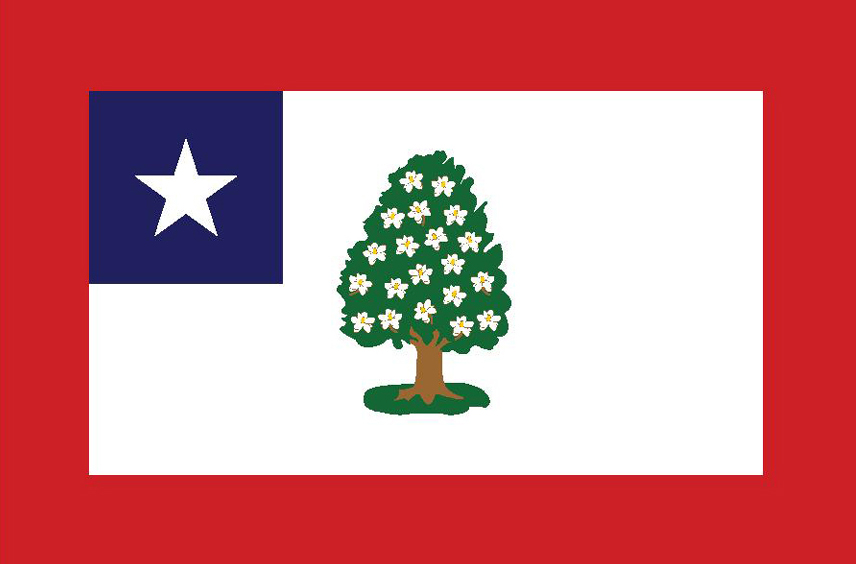
When Mississippi seceded from the Union on January 9, 1861, the Bonnie Blue was widely recognized as the unofficial flag of the Confederacy; it was raised over Ft. Sumter as well as the capitol building in Jackson. On January 26, Mississippi officially adopted a state flag which included a canton with the Bonnie Blue star and a magnolia tree in a white center field with a red border. This flag, usually depicted without the red border but with a red bar on the right, is now widely known as the Magnolia Flag. The Bonnie Blue remains an icon of the Confederacy, an image that while lesser-known in our day was just as emblematic as the battle flag to contemporaries. Take note that Scarlett and Rhett had their daughter baptized as “Eugenia Victoria Butler”, but she was called “Bonnie Blue”.
 In November 1861 the Confederacy adopted an official flag, the “Stars and Bars”, a flag so closely resembling the Union flag that in the Battle of Manassas in July, 1861, Confederate forces fired on their own troops.
 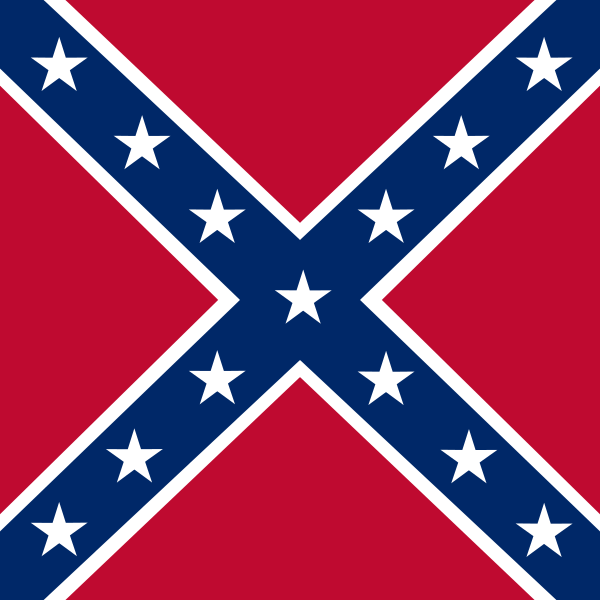 General Beauregard, commander of the Army of Northern Virginia, decided that a change must be made and in cooperation with General Johnston and Quartermaster General Cabell, they issued a flag designed by William Porcher Miles, a broad blue saltire on a red field, bordered with white and emblazoned with thirteen five-pointed stars. This design became known as the battle flag, and was later incorporated in flags adopted by the Confederacy in 1863 and 1865.
 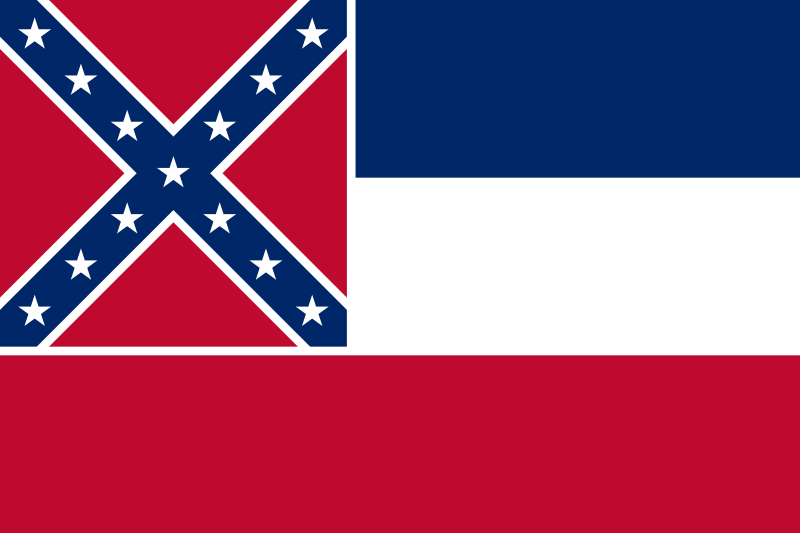 The Magnolia Flag remained in use as the state flag of Mississippi until 1894, when a new one with the Confederate battle flag in the canton and a field of blue, white and red bars was adopted by the Mississippi Legislature. The only change since then has been the addition of a white border separating the canton from the blue and red bars; the original specifications were vague, and the flag was made in versions with and without the border until Governor Fordice issued an executive order requiring its use in 1995.
In 2000, the Supreme Court of Mississippi ruled that state legislation in 1906 had repealed the adoption of the flag in 1894, so what was considered to be the official flag was only so through “custom and usage”. Governor Musgrove appointed an independent commission that developed a design replacing the Confederate battle flag with a blue canton containing 20 stars representing Mississippi’s status as the 20th state admitted to the Union. 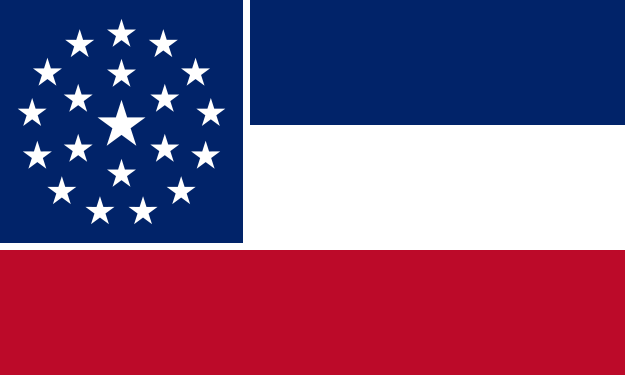 The proposed flag, with the exception of a single undistinguished star in the inner circle of six signifying the state’s membership in the Confederacy among five other sovereign nations (the others representing France, the Republic of Mississippi, Spain, the United Kingdom and the United States), had no outstanding symbolic reference to the Confederate States of America. On April 17, 2001, a non-binding state referendum to change the flag was put before Mississippi voters. The new design was defeated in a vote of 64% (488,630 votes) to 36% (267,812).


