Keshia’s Pool Table
Red and Sammy on Farish
Happy Valentine’s Day from the Sheriff
The Necessity of Lying
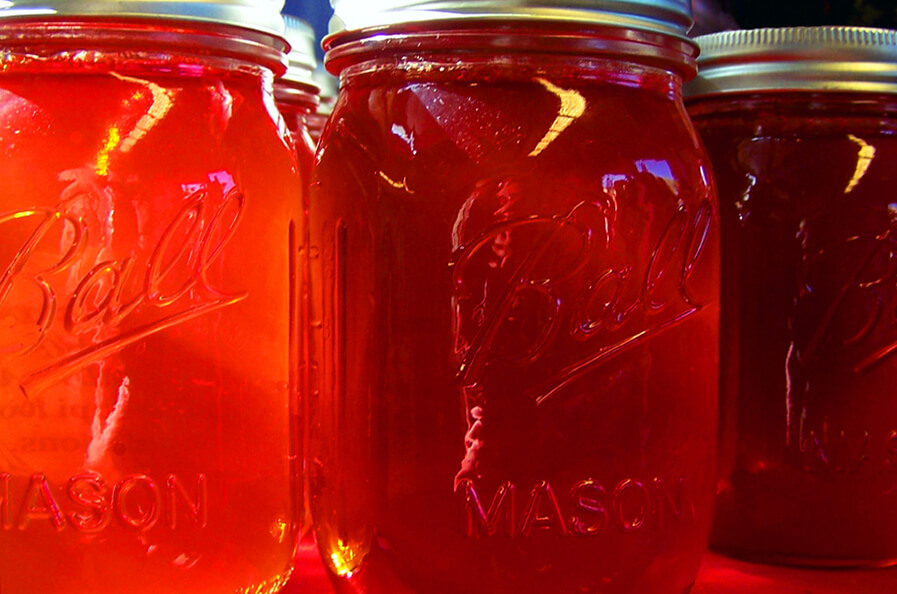
Sister’s Green Tomato Pickles
Calhoun County in the 1830s: Settling the Wilderness
This is another section (Chapter 3) of Mississippi governor and Calhoun County native David H. Murphree’s History of Calhoun County, which was published circa 1948. What’s riveting about this portion is an eye-witness account of the settlement of the land, descriptions now-vanished plants and animals, the people and provisions. Notes providing additional historical and genealogical information by James M. Young.
I wish that I might have had an opportunity to see the virgin country the greeted the eye of the first settlers in what is now Calhoun County, Mississippi. It must have been a beautiful sight. It was my privilege to have had a first-hand description of this land from Miss Elizabeth Enochs, who was the sister of my mother’s mother, and who came with a caravan from Tennessee as a girl of eighteen, not so awfully long after the Indians left. She said that it had been the practice of the Indians for many years to burn the woods each fall, so that there were few thickets; that therefore standing on one hilltop, you could see a man or a deer moving through the trees even to the next one; that the trees were all large in size and tall in the extreme.
She described the time of their arrival in May, when the wild flowers were blooming everywhere in profusion and indescribably beautiful. “Switch” cane or short growth cane was to be found in all the valleys, and through these beautiful woods moved herds of deer, sometimes thirty or forty in a drove. Wild turkeys were everywhere and without much fear of man. Wild pigeons (passenger pigeons) according to “Aunt Bet” came at times in such immense droves as to absolutely darken the skies; when they alighted on the trees they did so in such great numbers that the branches often broke.
There was “bear sign” where these huge animals had reached high up on the tree trunks and scratched, sharpening their claws everywhere, and at night the wild scream of a panther sounding like
a woman in keen distress was often heard, making the children hug the camp fires and their mothers shudder with uneasy fear. Small game like rabbits, quail, and squirrels were so numerous as to attract no attention whatever when sighted and so easily killed that the hunters refused to shoot at one single target, but waited to get two or more of the animals together so that they might be killed with one shot. The streams were all crystal-clear and huge fish could be easily seen drifting with the current or darting swiftly to seize some luckless worm or insect that had fallen in the water.
It was to such country that there came in the early 1830s a stream of pioneer men and women in covered mule or ox wagons, driving their cattle and other livestock, with a plow or so swung behind. These covered wagons were usually called “tarheel” wagons because the axles were wooden and must have every few miles an application of tar or some other kind of lubricant to keep them rolling.
My father said you could hear them squeaking for miles. Bows of splits made from heart white oak were bent over the wagon high enough that a person could stand up inside and over the bows was stretched tightly a piece of tenting or “wagon sheet” treated to repel the rain. There was an opening at the front end and also the back, and inside these immigrants carried everything that they could store which they felt would be necessary in the wild new land. Of course, the “Tennessee Rifle” was a very necessary piece of equipment and most of them had in addition a long single barrel shotgun with which to keep the pot filled with the small game above mentioned.
Naturally here and there one of them brought with him his old time violin or “fiddle” as it was better known, and these instruments were from time to time brought into use at the “log rollings”, “corn shuckings” and “house raisings” which were so popular in the early days.
Too, in addition to the well-worn copy of the family Bible, which each and every family brought and on whose pages were inscribed the names, date of birth, etc., of all the children as well as the dates of death of members of the family, a number of these folks brought with them copies of a peculiar book. It was the old “Sacred Harp” song book. These books were different in makeup from all other books, in that they were very wide in page width and narrow in page depth. The notes were differently shaped from other music notes. Singing in the Sacred Harp goes back for hundreds of years and even today many people who learned to love this music as they grew up feel that it is the most beautiful of all music.
An old fashioned black wash pot, made of iron, standing on three short legs, was also part of the necessary equipment and this pot was used for many, many things. In it the clothes were boiled for the weekly wash. Soap was made in this pot; hominy was also made in it;
likewise water for the Saturday night scrub was oftentimes heated in it. When the hogs were killed in the fall, the lard was cooked in this pot. There were few kitchen utensils. An old fashioned oven with a heavy lid was one. In it bread was often baked and potatoes too. It too had many uses. Beds were usually homemade after the immigrants arrived. The “corded” bedstead was most popular. It was a four poster bed, with rope or cords stretched back and forth across from one side to the other and from one end to the other. On this was laid the “corn shuck” mattress, which as its name implies, was made from the husks or shucks from corn. For real luxury a feather bed made from feathers or down plucked from live geese and stuffed into a “tick” was laid on top of the shuck mattress. People slept on feather beds in even hottest summer time. The women brought a few seeds of flowers, sometimes if the season was right, a shrub itself, to reset in their new homes in the wild new country. The old spinning wheel was another piece of standard equipment for without it there would have been no thread for knitting socks and stocking, and likewise no thread to be use on the old hand looms for weaving for the clothes for the entire family.
Notes: It is positive that almost all of the first inhabitants of what is now Calhoun County came down the famous old Natchez Trace. (1) They came from the Tennessee-Carolina country. Crossing the Tennessee River near Corinth, then on down the Natchez Trace to Old Houlka where the Indian Agency was formerly located, spreading out over the section to the west, along the various creeks which ran into the Schoona and the Yalobusha rivers. In the beginning, these settlers did not open and clear the river bottom lands very much. They cleared the rolling hill sides and the creek bottoms. Their dwellings were built on high hills, often just where a spring bubbled out from under the hill below.
Of course, a number of these first inhabitants came from Alabama and Georgia. These came by way of Aberdeen, Columbus etc. However, the great majority of these first settlers came as stated above from Tennessee and the Carolinas. Governor Murphree says “it is positive”
that almost all of the first inhabitants came down the Natchez Trace. However (probably after someone proofread what he had written and provided him comments to the contrary), he retracted that a bit and said “Of course, a number of these first inhabitants came from Alabama and Georgia…” In fact, many of the first settlers of Calhoun County came from Alabama into north Mississippi. The Murphree family itself came over from Alabama. Martin Murphree, DHM’s grandfather and David Murphree, DHM’s great grandfather, came from Alabama. As the Murphree Genealogical Association data states: “David Murphree remained in Tennessee about a decade. By 1818, however, records show that he was a Justice of the Peace in Blount County, Alabama and the same in Walker County in 1820. The David Murphree family is enumerated in the 1830 census of Walker County where the families of his sons Roland J., Ransom, and Samuel M. Murphree are also enumerated along with his son-in-law William Barton.
The Treaty of Dancing Rabbit Creek in 1830 opened Choctaw Nation land in north Mississippi and the Treaty of Pontotoc a few years later opened Chickasaw Nation land as well.
For the next few years after the treaties, there was a great migration into the Yalobusha-Chickasaw area of north Mississippi. About 1835-1836 David Murphree and his wife Jemima, who were then about ages 72 and 63 gathered up their children, in-laws, and grandchildren, and with their neighbors — the Brashers, Collums, Lantrips, and Browns — made their way into Mississippi in a wagon train pulled by oxen, some 30 wagons all told. They apparently crossed the Tombigbee River at Cotton Gin Port near Amory and made their way into Chickasaw County and to the Indian agency at Old Houlka. From there, they spread out over the area to the west along the various creeks and rivers. Many of the early settlements were located on or near abandoned Indian villages.
According to one of David’s descendants, the late Jackson MS attorney Dale H. McKibben, the family first landed at Airmount, which was in the Choctaw Cession. When Chickasaw Cession lands became available about three years later,
some of the families moved eastward from previous Choctaw lands to Chickasaw lands. Two of David’s sons’ families, Martin and Ransom Murphree, split off from the rest and moved eastward into the Rocky Mount/Oldtown area which was in Chickasaw County at first but became Calhoun County when that county was formed. Airmount and Rocky Mount are about 15 miles apart as the crow flies. Airmount is on the north side of the river which has come to be known as the “Skuna”, while Rocky Mount is on the south side. Travel between the two was arduous, especially during the winter time or in flood times, and remained so until relatively recent times. “ JMY
L’homme avec la caméra
Doe’s Eat Place
Jesse Houston: Chef on the Half Shell
We had a little oyster bar at Parlor Market. That’s how I met Craig Noone; we worked at an oyster bar in Stephan Pyles’ flagship, so with the tiny oyster bar in Parlor Market I got to see how Jackson feels about seafood and oysters. That planted a seed, and when I was leaving City Grocery in Oxford, I decided that Jackson would be a good spot for an oyster bar.
Since the oyster bar is the heart of Saltine, we keep the rest of the menu very seafood-centric, and being in the South, we keep the menu Southern-rooted. Then again being who I am, I like to keep things fresh and creative, to push the envelope. It’s a challenge with this concept because being in Jackson I think we get a little more of the old school mentality here towards Southern seafood, whereas at the Parlor Market, even though it was very much Southern-rooted, it was from the get-go known as a place where you could go and get an off-the-cuff creative meal. Here there’s a bit of resistance to that, so catfish, po’boys, the oysters, the wood-fired oysters, the redfish on the half shell are our top-selling dishes. The more creative dishes are harder to sell. We have an Asian influence in the calamari dishes, which is an ode to Paul Qui, who I got the opportunity to work with while I was at culinary school at the Le Cordon Bleu in Austin. He does a Brussels sprouts dish he’s very famous for that has the same kind of sauce with herbs, mint, cilantro and cabbage. The oysters Lafitte I would say is the most New Orleans-style dish we have, and we put that together while on a trip to Lafitte, Louisiana to fish for redfish, using what we had around us.
We went into a little crawfish shack, ordered a couple of pounds, peeled them ourselves and put some on the oysters we had on the grill at the fishing camp. Then we have the white Alabama barbecue sauce, once again playing up Southern dishes. The citrus butter with coriander is a nod to a lot of the garlic butter oysters you’ll find at places such as Drago’s, but a lot brighter and more floral.
This summer when we opened the oyster market was very bad. It certainly wasn’t the prime season for Gulf oysters by any means, and due to different regulations in Louisiana that seek to control the quality of oysters, the only ones that could leave the state were those harvested on refrigerated boats. The oysters go straight from the water into refrigeration and from those boats into a refrigerated facility or on a refrigerated truck to Jackson. That’s a huge expense. There aren’t a lot of people who do that, so we had many customers who were upset because we didn’t have Gulf oysters. When we opened, our oysters were sourced from Virginia other places on the east coast. They were very inconsistent in size, people only wanted the big ones, so it was a struggle. But as the temperatures went down, the oysters have become more available, and we no longer have that issue. We have them coming in literally every single day. I probably get anywhere from eight to twelve sacks of Gulf oysters a day, almost a thousand oysters that we go through, and we get probably another twelve to eighteen hundred from other parts of the country: the Pacific Northwest, Virginia, Massachusetts, New York, all over.
Almost all oysters these days are farm-raised, but oysters out of out of the Gulf are still wild. Even though most of the wild oysters along the east coast were eradicated back in the 1800s, and they introduced new species, some of which were invasive and killed off the native populations, you can still get wild oysters from the Gulf. I’ve heard of some great oyster farm programs in the Gulf as well. Derek Emerson was sharing some great stuff with me the other day; he and Chris Hastings were talking about these oysters off Dauphin Island that are grown in baskets that tumble in the surf, which give the oysters a great shape and salinity, and have almost no mud or dirt because they aren’t on the bottom. The other day a supplier out of Birmingham offered me some oysters called “Bama Beauties”. They were sold out at the time, and they were expensive; they were (my cost) a dollar an oyster, and I’d have to be selling them at almost $3.50, the same price I’d ask for a really high-end Pacific oyster. More gourmet Gulf oysters are starting to pop up, but the challenge will be getting people who are used to $1 or $1.50 oysters from Mississippi or Alabama to buy them.
I never considered opening anywhere but Fondren. This is where I spend all of my free time; this is where my friends seem to gather, where I run into people I love. I thought with all the other great restaurants, we could create a wonderful restaurant scene here. Of course, there already was, but I wanted to jump into the middle of it. Duling Hall wasn’t my first choice, though when I first moved to Jackson, before the Parlor Market opened, Craig took us to Duling Hall, and I walked over to the space that is now Joan Hawkins Interiors and
thought it would make an awesome restaurant. Fast-forward to last year when I was looking for spaces, I was actually looking for a house, so I looked on State Street and Mitchell Avenue, but we just couldn’t make anything work. I talked to realtor Mike Peters and told him I wasn’t totally committed to a house, and he walked me through this space. With all the original brick, windows and floors, it just came together, I couldn’t be happier, and I can’t imagine it anywhere else.
I put this restaurant in the hipster capitol of Jackson, and I anticipated my friends and younger people, but I have more of an older demographic. It’s really mixed. I do get some people from out-of-town due to the great articles in “Southern Living” and “Garden & Guns”, but for the most part it’s really different from my expectations. I’ve thought about how the restaurant will evolve a lot. Things are still up in the air as we try to keep the house packed and discover what will drive people in to build our lunch business and early weekend business. The craft beers have really picked up more than I thought it would before we opened. It was always going to be a bar that focused on craft beers. We have thirty-one draughts. At first wine and cocktails were ahead in the mix, but soon the craft beers began outselling them. So we’re pushing that envelope and advocating the craft beer scene in Mississippi, which has growth spurts as well as growing pains.
The creative food is where I feed myself, it’s what I enjoy doing and why I love being a chef, but I have to ask myself if it’s right for here. Whereas I used to be able to put anything I wanted in front of people at Parlor Market, people would try it because it sounded interesting and love it and embrace it, that’s a struggle here. It’s a learning curve on the floor and in the kitchen, and though because of the long hours I work it feels like I’ve been here for five years already, we’ve only been open for six months. I have to keep reminding myself that.