
Mississippi Capitol Dome in Fog

A Southern Gallimaufry
It was Willie Wallace–a jovial man with the presence of Jove himself–who started me out on the gumbo thing.
Willie was from somewhere down on the Coast, where of course he grew up eating gumbo, whereas in north Mississippi, the only gumbo I’d had was out of a red-and-white can. Willie was a big supporter of the Bean Blossom Bistro and he spent time there helping out. I remember vividly the day when Willie was hunkered down in a corner peeling potatoes, and Carol and I were talking about soups. I think I was the one to mention a gumbo–mea culpa–and I started talking about how I’d make it and Willie looked up at me with a twinkle in his eye and said, “So how did you say you did your roux?” Well, I tried to bluff my way through, but it was all of about ten seconds before Carol and Willie both started howling, Out of this incident grew a determination to learn how to make a distinguished gumbo. I think I’ve succeeded, too. This recipe makes lots and lots
Thanks, Willie.
To begin the gumbo, make about a half cup of roux ( I use a “beer bottle” roux) toss in about three chopped white onions, two chopped bell peppers, and a half a bunch of celery chopped, leaves and all. Stir until the mixture has cooled slightly and the vegetables are coated. Then add a quart of warm stock. though you’ll find disagreement on this point, chicken stock in various strengths–full for chicken and sausage, weak for seafood–works just fine, dammit. Stir this mixture vigorously until the roux has been assimilated and the mixture begins to thicken. Transfer to a heavy six to eight quart pot, add another quart of the stock and put the pot over a low flame with a buster and stir frequently.
After this mixture has begun to thicken, add another quart of stock, three tablespoons of minced garlic, and another chopped onion. Let this mixture cook until the onions begin falling apart. Then add one pound canned diced tomatoes and a pound of frozen okra–thawed, sliced and rinsed okra. At this point, add about three heaping tablespoons of dried basil, fresh or dried chopped parsley, a bunch of chopped green onions, two tablespoons of leaf thyme, and a tablespoon each of oregano, black pepper, white pepper, and a teaspoon of cayenne. Blend this very well and adjust your liquid. Leave on low heat for an hour or so, then off the heat and cover.
Take about two pounds of small shrimp (20-25 ct.), and sauté with olive oil and garlic (I tend to have a heavy hand with the garlic; use your own discretion). Add the shrimp to the gumbo mixture. Take about a dozen small (3-5 oz.) catfish fillets (you can use any non-oily fish, but where I come from catfish is good and plentiful). Cut them into one inch chunks and poach until just done. Add to the gumbo mixture along with two dozen poached oysters.
Bring back up to heat, being extremely careful not to scorch the bottom of the pot. (I can’t emphasize the importance of using a flame buster.) If the gumbo seems too thick, add a little more liquid. Adjust your salt and pepper. Serve over rice with a bare sprinkling of filé powder, To make a chicken gumbo, use a full-flavored chicken stock, omit the tomatoes and add a tablespoon of sage to the spice mixture. You can add sausage to either the seafood or the chicken gumbo, but I prefer it in the chicken. In either case, blanch the sausage first so it won’t get too greasy.
This is my gumbo. It’s a good one because it follows precepts; know the rules before you break them. With time and presence of mind, you will find your own.

In January, 2010, a book written and illustrated by a man who lived and worked in Mississippi sold for a record-setting $11.4 million in a Sotheby auction; another copy of the same work sold for $9.7 million this year. Fred Smith, owner of Choctaw Books in Jackson, says he wouldn’t be at all surprised if there weren’t still a folio of Birds of America in Natchez, where Audubon lived in 1832.
“He would have known people down there,” Fred says, “And Natchez had more millionaires per capita than anywhere in the country before the war, so they certainly could have afforded to subscribe to the book.” Smith knows, since he has spent over a quarter of a century dealing with collectors, estates and institutions as a buyer, seller and appraiser of books, manuscripts and documents of every description, but primarily works about or related to Mississippi, the South and the Civil War; in short, every aspect of our multi-faceted regional history. As a result, he has become a one-man institution in and of himself, the go-to man for anyone in (or out) of the state wanting a set, subset or full collection of volumes of pages you’re unlikely to find at Books-a-Million or Barnes & Noble.
John Evans, owner of Lemuria Books in Jackson, has known Smith for over thirty years; he calls Fred a compadre, and after reflecting back to the times when they’d alert one another to a shifty customer, says, “A great used book seller is there to provide information you can’t find anywhere else. Oh, you can google a book on some obscure moonshiner in the Delta, but Fred’s going to tell you if you really need that book at all, and if you’re lucky, he’ll know of a book you ought to have instead of that one. Fred’s father Frank knew the past seventy-five years of the culture of Mississippi, and he handed that down to his son Fred.”
Frank E. Smith was a managing editor of the Greenwood Morning Star, served as an aide to Senator John Stennis, as a member of the Mississippi state senate, in the U.S. Congress, and as a director of the Tennessee Valley Authority. He and Fred began thinking about opening a business in the 1970s. “We figured the state needed a used bookstore. Our literary culture was so important that someone needed to make them available for people here to own and to treasure,” Smith says. “The goal was that we’d pull together an inventory and open up a store in 1983. Then my aunt, who had an antique store in Vicksburg where we’d place books to see how they’d sell, had an accident and had to close her store. All of a sudden, we had a lot of nice furniture. When we opened up, we were half antiques and half books.”
“That first year, Eudora Welty bought a piece of furniture for $700,” Fred remembers. “Now, selling a few books here and there is one thing, but that was by far my biggest sale. I wanted to keep the check, but the furniture was not mine, so I had to go ahead and cash it. Years later, I did two appraisals for Miss Welty, one on the letter that Faulkner had written to her and another on some other correspondence. I called up her lawyer, Carl Black, and asked him if it would be alright to keep one of the checks (for $250) and he said that she’d never know. I kept the check.”
“I don’t always make people happy,” Fred says, though it’s hard to imagine, since Fred has a jovial, Dickensian presence, the proprietor of a modern-day curiosity shop, an unpretentious clapboard building at 926 North Street in Jackson’s Belhaven Heights neighborhood that’s chock-a-block with books, maps and manuscripts. But Fred, because of his unique knowledge and sincere appreciation of Mississippi’s history, literature and bibliographic legacy, is also the premier appraiser of the state’s books, manuscripts, maps and other assorted documents, making him a unique denizen of Mississippi’s bibliophilic Parnassus.
“My job as an independent appraiser is to put a value that I consider to be valid on materials I’m asked to consider. Most of what I do is for tax purposes because people are donating materials for tax breaks. But a lot of folks think their stuff is worth a lot of money just because it’s theirs, and that’s not necessarily the case. I have done many appraisals over the years, and have not been called into question on any of them; people know to call me.”
Hugh McCormick, who started McCormick’s Book Inn in Greenville in 1965, said, “I admire Fred a lot. As far as I know, he’s the only person who occupies the sort of role he does in the Tri-state area. People who come to Fred are looking for something very specific, very hard to find, and more often than not, he’s the only one who knows what they’re asking for.”
Cham Trotter says that when he first began collecting Old Miss yearbooks, Fred was the first person he thought of going to for help. “I’m a Civil War buff, so I had been in Fred’s store before. Ole Miss started publishing yearbooks in 1897; what I had in mind to do was to have a yearbook from each decade. I had several yearbooks from when I was in school from the Sixties and Seventies, from my parents who went to school there in the Forties, from my grandfather, who was business manager at Ole Miss in the Thirties and a few from when he had been a student there around 1909.”
“But I walked in Choctaw Books one day and Fred had boxes and boxes of Ole Miss annuals from the Thirties, Forties, Fifties, even up into the Seventies and Eighties. The family of Dean Frank Moak had given these yearbooks to Fred on consignment. So I decided to try and get one from every year. I got even more from Fred over the years, and now I have a full set.”
John Evans, who has every reason to know, says that the preponderance of the internet spells the end of the used book business as we know it. “The used book seller could come back, but I think we’re going to go through a void before that happens. When Fred’s business goes away, you’re not going to have someone to rush in and start another store like Choctaw Books the next day.”

This article, written well over a decade ago, contains information that still has relevance as what was once called the LeFleur Lakes project has been resurrected once again by proponents under the name of the Pearl River Revitalization Project.
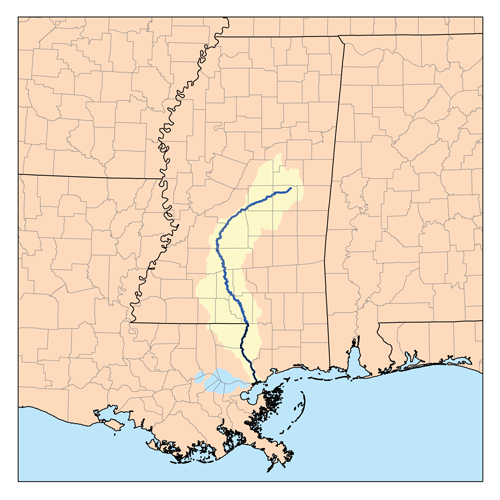 The Pearl River makes her way from a confluence of sloughy waters in the very heart of Mississippi to the marshy outskirts of the Gulf of Mexico in a graceful 500-mile arc. Lacking the majesty of the Mississippi, the cachet of the Yazoo or the utility of the Tombigbee, the Pearl is often cast as a poor relation; but she has played a significant role in Mississippi history, not the least of which has been putting Jackson on the map. In 1821, state commissioners decided that there was no desirable location within the required 20-mile limits of the geographic center of the state for the new seat of government, so they recommended a site “above the floods” of the Pearl River. In their report to the Legislature, the commissioners recommended the location of the new capital on LeFleur’s Bluff. They also suggested that the town should be laid out in President Jefferson’s design, a checker-board plan that stretched no more than a mile westward from the crest of the bluff where the new capital building would stand.
Initially, the Pearl River served the city as one of its earliest routes to and from civilization. The 1830s were a high water mark in the role of the river as a resource and a reason for the city, but by 1845, rail traffic had been established, and then roads rolled in from all quarters of the compass. Gradually the river fell into abeyance as a platform of commerce for the burgeoning city. But soon the Pearl came to assume a different economic role in the history of Jackson; the bluff could no longer accommodate all of its citizens and buildings began to be erected upon the floodplain. Flooding along the Pearl River in the Jackson area has been a problem since the beginning of the city, but it has been especially noticeable since development has spread into the floodplain. Since then, the river and its urban tributaries have flooded different areas on a periodic basis. Major floods have been classified by their severity according to the frequency at which they are estimated to occur. The 1979 flood has been called a 100-year floodplain event. The 1983 flood was a 50-year event. And the 1991 flood was a 10-year event. It should not pass without notice that all three of these events occurred within a 12-year period.

Ironically enough, given this catastrophe of riches in terms of water, area leaders were discussing the problems of an adequate drinking water supply for Jackson as early as 1926. One of these leaders was State Senator Mitchell Robinson who succeeded in obtaining a flood control and navigability study from the U.S. Army Corps of Engineers. The study proved unfavorable, but Robinson was persistent. Some dismissed his idea of a dam north of Jackson on the Pearl to provide water and recreation for the city as “Mitch’s ditch,” others warmed to the idea. By 1955, Jackson’s water consumption had increased in excess of five times the rate of 1935 and pollution in the Pearl was a mounting problem. The labyrinth of legal and legislative problems and other obstacles that stood in the way of the construction of the Ross Barnett Reservoir are history now, and the reservoir is a pivotal element in the life of the city. But the Reservoir never was really designed for flood control; it was primarily constructed to create a water supply and to provide recreation. Despite that, the reservoir, because of its very nature as an impoundment of water, plays a crucial role in flood control in the lower river basin. According to Kenneth Griffin, general manager of the Pearl River Valley Water Supply District, the Ross Barnett Reservoir presents special problems in that area.
“One of the challenges, and one of the reasons this reservoir is so difficult to manage for flood control is that you have a huge watershed for this size river, this size of control structure,” Griffin said. “Regrettably, even with perfect hindsight, all you can do is to handle something like a 15- or 20-year event, depending upon when it comes. Certainly you can’t handle a hundred-hear or five-hundred year event,” Griffin added. “1979 was a really terrible flood, and we managed that one with very little in the way of rain gauges and stream gauges. We had manual rain gauges, cooperators that would simply call in the precipitation and we did not have any sophisticated software at that time. And even then, I think the people did a very good job, came very close to doing the best job possible.”
Local attorney Joe Kerley adds this footnote to the construction of the reservoir. “My Dad worked with the US Department of Agriculture, and was involved in the Rivers and Harbors organization. He attended meetings regarding the US Corps of Engineers and other federal and state entities involved in planning the reservoir. Our state could not fund a structure that would adequately control flooding. However, federal funds could have been provided so that the dam would be multi-purpose: flood prevention, drinking water and recreational. However, to obtain federal funding, the reservoir would have to be accessible to all citizens, black and white. Our legislature, as typical of the times, would not agree, and declined federal funding.
“Dad was livid about this,” Kerley said. “He saw the writing on the wall at that time and was sure the reservoir would ultimately accessible to all. There were many discussions about this at home in Hattiesburg, and with like-minded friends. But the legislature would not allow the federal funding, and this many decades we are still trying to figure out how to protect Jackson from the Pearl floods and the inadequate dam at the Rez.”
But even in the case of reservoirs that are designed to control flooding, the use of impoundments for this purpose has been discredited because of their downstream (and upstream) impact. Flood control reservoirs are set at a specific area in a drainage system to control flooding in an immediate area, but reservoirs impact rivers both above and below their dams. The LeFleur Lakes project is such an impoundment proposal intended to solve the flooding problems in the Jackson area in such a manner that “the attractiveness and growth potential of the metropolitan area would also be enhanced.” The proposal states that flood levels would be permanently lowered in the Jackson-to-Byram area by providing a better flow course for the passage of water and by reducing the rate of flow in the river and envisions the creation of a vital new waterfront district for the Jackson Metropolitan area.
Under the LeFleur Lakes proposal, large amounts of sand from beneath the numerous railroad and highway structures south of downtown Jackson would be excavated. This would be needed in order to provide the proper flow course through this area of the river. The study proposal maintains that existing levees and bridges presently block the river’s flow and back water up into Jackson homes and businesses. To accommodate the excavated material, the Flowood levee would be moved to the east and the dredged material would then be put in the middle of the newly formed lake. This would create a 600-acre island opposite downtown Jackson. North of Lakeland the dredged material would be placed on the east side of the newly formed lake. The newly-created land, an artificial island in the middle of the Pearl near where an extended High Street would stretch, would be accessed by bridges and by constructing interchanges of parkways and city streets over it and along the entire length of the 3000 acre lake. The LeFleur Lakes proposal states that “many roads and bridges are needed at this time to alleviate the metropolitan area’s traffic congestion,” and that both the traffic and flooding problems can be solved simultaneously and at less cost than plans for previous flood control, roads and bridges. The proposal also says that all the structures that flooded in the 1979 flood should be protected from another 100-year flood by the new lake and the improved reservoir discharge procedure. Additionally, the plan would provide that surveying be conducted in order to determine what structures exist in the various flood prone areas that would not be protected from a so-called 100-year flood. If any structures exist that need protection, auxiliary plans would be considered and, if warranted, additional protection would be extended to those structures.
The LeFleur Lakes plan would accelerate the flow course for the river by removing the trees from the very lowest level of the river floodplain (the river bottom land). This level would then be lowered another 5 feet with dredges and other earth-moving equipment, and then the entire 11-mile river course opposite Jackson would be made into a permanent lake. This lake would be necessary to prevent the redistribution of sand and silt and to prevent the regrowth of trees in the river flow course. Naturally, the Ross Barnett Reservoir would play a key role in the project’s success. According to Griffin, “The LeFleur Lakes plan includes two components. Obviously, the lakes themselves are proposed. But the other half of the plan involves some major operational plans in how the (current) reservoir is operated, specifically how the gates are operated.” LeFleur Lakes admits to other drawbacks, as well. For instance, under the proposal, levels in the Ross Barnett Reservoir, on two or three occasions each year, over a period of a day and a half, will fall one foot then rise again to their original level. According to the original Two Lakes website (now defunct), “Once every 25 years they (“Reservoir people”) would be warned to untie moorings and move boats because the level will be taken down below 295 feet. On the positive side, they would enjoy an extra one half to one foot of water in their boat slips” and “would be compensated by knowing that two thousand of their neighbors will never have to worry about their homes and businesses flooding again.” In addition, metal buildings at very low elevations would not be protected from another 1979 flood, but they would be compensated by “having protection from a 100-year flood on structures that probably will not last 100 years.” People who own land and camps on the river south of Jackson would experience “one or two” river bottom floods that they would not have had otherwise, but they would be compensated by the assurance that the new reservoir would have the capacity to take one foot of elevation off of every major flood that could occur in the area. “One foot off of the 1979 flood would have prevented much of the flooding that these people’s neighbors suffered in 1979.”
Supporters of LeFleur Lakes cite the need some sort of flood control and the availability of direct funding for a local agency to undertake the project. Federal commitment to flood control in the Jackson area does exist; otherwise the Corps would not have sought funding for a more thorough and inclusive system of levees, a proposal now called the Comprehensive Levee System of 1996. In April, 1988 the Pearl River Basin Development District asked the Corps of Engineers to initiate alternative flood control studies. The Corps received authorization and funding in February 1989. Federal funds were used for the reconnaissance study which was completed in June 1990. The District agreed to serve as local sponsor for the study for the Jackson Metro area, which took 54 months to complete and cost $3 million. The District provided one-half of this amount in cash and in-kind contributions. A feasibility cost-sharing agreement was signed in September 1991, and feasibility studies were initiated in October of the same year.
The Pearl River Feasibility Flood Control Study (a.k.a. the Comprehensive Levee Plan) was completed by the Corps of Engineers in February 1996. The Corps recommended the construction of 21 miles of new levees at a cost of $122 million. The local sponsor would be required to provide $38 million for the acquisition of land, easements, rights-of-way, relocations and disposal areas. Legislation enabling the Pearl River Basin Development District to serve as the local sponsor for the Flood Control Project was defeated in the 1995 and 1996 sessions of the Mississippi Legislature. The plan also included $30 million worth of recreation amenities and improvements, most of which would have been cost shared. Even before then, in 1984, the Corps also proposed a dry dam that would catch heavy flows from extreme rainfall events in the upper basin, events similar to those which caused the ’79 and ’83 floods. Called the Shoccoe Dam to be installed near Carthage, it was planned at a cost of $80.1 million ($24 million shared). It was identified by the Corps of Engineers as the most comprehensive flood control project for the Pearl Basin. But in October, 1984, the Mississippi House of Representatives defeated a bill authorizing the District to serve as the local sponsor for Shoccoe. Local opposition killed the funding measure, but many people still consider Shoccoe to be the best plan for flood control in the middle reaches of the Pearl.
Everybody has their favorite proposals. “As far as we know, the Comprehensive Levee System (proposed by the Corps) is still viable, but we’ll have to evaluate it again,” Walker said. “We will have to see if the levee alignment is still in place, and we’ll have to see if any development has gotten in the alignment and we’ll have to adjust it.”
“What we’re looking at are the levees and LeFleur Lakes. It’s probable that LeFleur Lakes might turn out different than what it is now. The final result might be some combination of lakes and the levee system. We have several of what we call milestones that we’ll reach as we go through the study. We’ll discuss these with the sponsors, since these will be decision points where we’ll decide whether we need to go forward or not. If we get to the point that something showed up as a “show-stopper,” we would have to evaluate with the Levee Board at that time whether we want to proceed with that plan or do something else. But we could not proceed without them being agreeable to that. There is a consensus that something needs to be done, but the question is what the plan is on how to control it. Public opinion is such that something is needed to control flooding, but we don’t know what the plan is. As to other proposals, as we go through the process, a sponsor will have to sponsor a study for other alternatives. With the proper sponsorship, other plans could be submitted.”
* * * * * * * * * *
The Pearl River Basin covers an area of about 7,800 square miles, comprising about 16 per cent of the state as a whole. From Neshoba County, the river flows southwesterly, eventually forming the boundary between Louisiana and Mississippi in the southern part of the basin and discharging into the Gulf of Mexico just north of New Orleans. Before the Pearl reaches the Gulf from Jackson, it still traverses some two hundred plus miles, and the lands along the lower river have already felt the impacts of impoundment and flood control in the Jackson Metro area. One of the most serious effects is that of bank erosion, which has been a crucial and continual problem since the development of the state. Andrew Whitehurst, a wildlife ecologist with the Mississippi Museum of Natural Science, is the author of the newly-published Mississippi Streamside Handbook, available as a free download from the Mississippi Department of Wildlife, Fisheries and Parks website. Whitehurst said that rivers are able to carry a great amount of sediment. But when a stream goes into a reservoir, it slows down and the energy of the water is dissipated. Much of the suspended material it carries drops out, and the water leaves the reservoir sediment-starved.
“A normal river will gather a suspended load from its bed and from whatever flows in from its tributaries and through normal bank erosion and moving sand bars around,” Whitehurst said. “Our river (the Pearl) is altered. The fact that the discharges can be abruptly stopped after a flood event makes the levels go up and down, so the banks become saturated during floods and when the water is quickly shut off and the level of the river channel drops, the banks can slough or heave.” Whitehurst points out that there are three well-known diadromous (migratory salt-to-freshwater) species that will be impacted by the dams: the American eel, the Alabama shad and the Gulf sturgeon. The maritime connection of the Pearl is another crucial element when flood control anywhere along the river is under consideration, since the wetlands that lie near the mouth of the Pearl are important to the seafood industries along the central Gulf. In a public hearing in Biloxi on March 11, coastal residents expressed concerns that LeFleur Lakes would damage the Coast, especially in terms of the area’s seafood industry. Gulf citizens were particularly worried that the project would reduce the amount of fresh water flowing into the Mississippi Sound, degrading its oyster beds and shrimp population. Lauren Thompson, of the Mississippi Department of Marine Resources, said, “Our concern is with reduced or increased salinity as well as with sediment and nutrient transport down the Pearl River. The reduced flow of nutrients and sediments down the Pearl can change the environmental conditions in the Mississippi Sound, affecting salinity and water quality.
“So it could have a negative impact on oysters, shrimp, blue crabs and finfish. Oysters, which can’t move, have a narrow salinity band. If the salinity is too high, predators come in; if the salinity is too low, the oysters close up, and if they stay closed for an extended period of time, they die.” Since the Pearl empties into the Gulf just north of New Orleans, the State of Louisiana is also keeping an eye on flood control along the river, as it will impact their seafood industry as well as salinity levels in LakePontchartrain.

Apart from the Reservoir, flood control in the Jackson area is also managed by a system of levees built by the Corps of Engineers in the 1960s. These levees serve as buffers for the floodwaters and also funnel the flood downstream. Aside from emergency situations, the levees are largely maintained by local interests. Periodic inspections of maintenance are made by personnel from the U.S. Army Corps of Engineers and from local levee and drainage districts, in this case the Rankin Hinds Pearl River Flood and Drainage Control District, also known locally as the Levee Board. This board has been given broad powers to deal with flood control along the Pearl River in Rankin and Hinds Counties. The board is made up of the mayors of Richland, Pearl, Jackson and Flowood as well as the head of the Mississippi Development Authority, Leland Speed, in his role as representative of the Mississippi State Fair Commission. Robert Stockett Jr. represents Hinds County, and the chair, Billy Orr, represents Rankin County. The board itself is funded by the Boards of Supervisors of Rankin and Hinds Counties.
There are fourteen miles of levees in the Jackson area that protect flood lands in Flowood, practically all of Pearl and those in Richland. They also protect those lands below the bluff around the fairgrounds on the Hinds County side of the river. The levee board has taxing power on property that is protected by the levees. If you own a business or property that is protected by a levee, then you are taxed by the Board to help pay for the maintenance of the levees as well as pump maintenance and levee patrols during flood times. The tax revenue brought in by the Board totals less than a half million dollars. The Corps and the Levee Board have agreed to initiate a three-year, $2.8 million feasibility study that will be limited to updating the cost of the 1996 levee plan and a complete analysis of the LeFleur Lakes Plan. “We don’t have a set schedule for reviewing the progress of the analysis,” Orr said, “We have other things to do, but the Corps will be on it daily and we’ll keep up with it very often. We do keep up to date on it, and it is our responsibility to make sure it goes right. Whatever the requirements are as these studies go along, we will meet as often as necessary.” Orr said that they follow the Corps’s recommendations in matters of maintaining the levees and that while some people might claim that they are more partial to one flood control plan over the other, “We will be partial to LeFleur Lakes only when it has been studied and it has been proven that it can do the job.”
The decision to put the LeFleur Lakes Plan in the hands of the Levee Board was made by the three county governments of Rankin, Hinds and Madison Counties as well as the governing bodies of eleven cities in the three county areas. Purportedly, they will expand the district and build some version of the project. The levees will be incorporated into the LeFleur Lakes strategy, since the levees were part of the original “Two Lakes” plan. According to Gary Walker, project manager for the Corps of Engineers, “The EIS (environment impact statement) draft (for LeFleur Lakes) is scheduled for October, 2005 and it will take about six months after that for the final. The recommendation will be a joint process between us and the sponsor,” Walker said. “It will be a plan we both can agree on, it will be a joint recommendation between us and the Rankin-Hinds Pearl River Flood and Drainage Control District. We’re doing a full evaluation and the study will determine how we assess the project. We’re not going to make any pre-determined notions. The study will speak for itself.”
As to alternatives to LeFleur Lakes and the comprehensive levee plans, no others are under consideration, since Walker said that the Corps can’t recommend anything without a sponsor. But “assuming we went through the process and found a feasible plan and a sponsor, yes, we could approve (an alternative).”
“People ask how long it will be before a flood control plan will be put into place,” Orr said. “But we don’t know how long it will take. The study itself is going to take two and a half years. After that, it would be left up to funds that are available, and this project (LeFleur Lakes) is big. Now, it might not come to anything, because environmental concerns might knock it down or something else like public sentiment or lack of funding might come into play. The only thing I can say is that this board would like for the LeFleur Lakes project to be a reality if it does the job in controlling flooding. The only thing we’re interested in is flooding. Economic development and all the other factors do not interest us. Our job is flood control, and if this project does not meet the required specifications, it will be gone. I’m sure there’s room for modification,” Orr said. “With all the study and money going into this, we hope something will come out of it that will work. The only thing for sure is that Rankin and Hinds Counties need some flood control assistance somewhere. I was head of the Fair Commission in 1979 during the Easter Flood and we lost over $2.5 million, and that’s a lot of money.”
* * * * * * * * * *
In the final analysis, until people begin to perceive of the Pearl as a resource rather than as an obstacle, LeFleur Lakes, or some similar project involving development along the river that will control flooding and perhaps create revenue, will continue to receive a lot of support in the Jackson Metro area. But we do have other choices. Metro Jackson can either preserve the riverfront with options that have the potential to appeal to a younger, more aggressive entrepreneurial population while continuing to promote more downtown development, or the city can align itself with political and business leaders who seek to develop the riverfront at great expense and create a new district that will in all likelihood fail within the next decade or so, benefiting nobody save those who developed (or dredged up) the property in the first place. Supporters say the LeFleur Lakes idea is just a different approach from the levees, one which has the economic development and recreational components that levees just don’t have. They also cite the support of local governments, state agencies and the congressional delegation. John McGowan, the Jackson entrepreneur who originally conceived of the LeFleur Lakes (then called Two Lakes) plan, declined to comment on the evaluation in a telephone interview and deferred comments on the project to the Levee Board.
Detractors of LeFleur Lakes tend to focus on the negative environmental impact the project will have, but not necessarily in the sense that it will endanger already threatened species of wildlife. These detractors cite numerous studies showing that in addition to education and other quality-of-life issues, aesthetics and recreation are important to young entrepreneurs, especially younger business owners who are looking to relocate. They point out that LeFleur Lakes is going to destroy the wetlands and natural resources that are in the corridor, the same resources that in other parts of the country, smaller urban areas use to provide green space for recreational opportunities that appeal to people oriented towards activities carried out in natural settings, like hiking, biking, jogging and nature viewing.

These critics feel that the LeFleur Lakes project is simply not progressive enough and does not address the changing demographics and mindset of the 21st century South. In this context, the controversy surrounding LeFleur Lakes becomes a conflict of perception about the way Jackson should move, about the best venues that the city can take in order to become a more vibrant community rather than a battle between tree cutters and tree huggers. As an alternative to both LeFleur Lakes and the comprehensive levee system (which unlike LeFleur Lakes included green space facilities), proponents of green space, who include local businessmen as well as conservationists, are proposing a greenway that will transform what is now a denuded floodplain into an area that will feature hiking, biking and jogging trails, parks with sports fields and playgrounds, a scenic river corridor for boating as well as wilderness areas. Jackson geologist Dan Hill is among those who maintain that the greenway proposal has the potential to increase city revenue by attracting young professionals and entrepreneurs who look for such things as aesthetics and outdoor recreational activities when seeking to relocate. “The Levee Board has denuded the area between the levees to improve the convenience of the flood waters out of the flood zone,” Hill said. “The Levee Board maintains the levees and the floodways such as the areas at Lakeland and I-20. They clear the floodways rather than do any aesthetic features and it’s ugly.”
“When you clear the trees away from the river, there are no roots to hold the banks,” Hill said. “The reason they clear the trees is that those trees and vegetation create a drag on the water going through, so what they do is straighten up and dredge the channel as it has been along I-55. That improves the passage of water. One of the things that the Mississippi Department of Wildlife, Fisheries and Parks didn’t like was the clearings in the 1996 plan, which would have increased the number of clearings. It’s ugly; it looks like a moonscape going across I-20. And this creates a negative impression about Jackson.”
The greenway proposal is problematic because it can’t control flooding along the river and has limited appeal for those who are unaccustomed to more nature-oriented forms of activity (biking, hiking, kayaking, etc.) and are more acclimated to the hustle and bustle of a more people-oriented environment; shopping malls, for instance. But the environmental issues are still crucial. Water quality is a primary concern. According to Jackson businessman Jerry Litton, “If you look at the area that will be draining into LeFleur Lakes and look at the trash and debris that flushes from the city every time we have a rain, that is what the water in those lakes is going to look like.”
“Debris will collect on the edges of the lake, or collect on drifts that are out in the open or on the edges of the (proposed) island,” Litton said. “It’s going to be there, and somebody’s going to have to float around in a boat in a net and dredge it out, all of the stuff that comes down from the spillway itself, plus what flushes out of the creeks in the city.” Nonpoint pollution is also a consideration. Nonpoint pollution is source pollution, or “polluted runoff,” created when rain, irrigation and other water sources run over the land, picking up pollutants and transporting them to local water bodies. You’re going to hold water there in a large volume, and you’re going to have all the nonpoint pollutants that come from the city. Nonpoint sources are parking lots and roadways and fields. Then what about all the motor oil, paint and paint thinners that people won’t take the time to take to the toxic waste centers? It’s being poured down storm drains.”
Hill agrees. “The shallowness of the proposed reservoirs (LeFleur Lakes) is such that water temperature is going to heat up and that’s going to affect water quality. Not only that, but when they impound the lake they’re going to flood one landfill that I know of, and there’s probably a second landfill. I found out when they tore down the old Baptist hospital, they put the asbestos from that in a fill that would be flooded.” Sewer mains are another concern for the LeFleur Lakes project. Broken sewer mains would flow directly into the lake from the city. One such sewer is the West Main Intercept, which drains north Jackson and travels through the floodway. The construction of a lake in the floodplain opposite Jackson would put that sewer main underneath the lake itself. Environmental issues aside, when it comes to local sentiment, the LeFleur Lakes proposal appeals to a genuine need for the people of Jackson to feel as if they are living in a vibrant, growing community that is making changes and improvements. In addition to the attractions of proposed flood control and potential economic benefits, LeFleur Lakes has come to represent an alternative to apparently ineffective downtown development. Granted, LeFleur Lakes appeals more to the outlying metro area than it does to the city itself; on the surface, the project has much greater appeal for those sections of Ridgeland, Hinds and Rankin Counties between the spillway and Byram, but it still has its supporters in the city itself, not the least of which is former Jackson mayor Harvey Johnson Jr.
“The continuing flooding we experience nearly every year undeniably demonstrates that we very much need a comprehensive flood protection plan,” Johnson said. “As a member of the Rankin-Hinds Levee Board, I work closely with mayors from Rankin County and other board members to address ongoing flood control measures.”
“The public has rallied around the LeFleur Lakes project as an alternative to levees. The City of Jackson has gone on record as being in support of the LeFleur Lakes project, and we continue to work closely with federal, state and other local authorities to come up with the right answer to solve our problems with floods. We will continue to evaluate the LeFleur Lakes proposal as it evolves while we decide the best ways to provide flood control,” Johnson added.
“The problem with any development on the Pearl is hydraulics,” Litton adds. “Up to 1959 – 60 the river mostly only rose up to 28 or so feet crest. After the resevoir was built and levees it has gone up to 43 or so feet. Problem with this is it does not go up appreciably in the upper and lower reach as it does here. Why? Levees, reservoir, urban development and the unknow fact, the Pearl has a fifty or so mile long crest when it gets up. Check the data or the 79 floor. From the dam to about Rockport the crest was almost flat at 43 feet. Oddity, no sir, it is the hydrological sequence of hard bottom, forest shouldered edges, a narrow girth and the necessity for the river to get up this high to push the water through.”
But according to Matthew Dalbey, assistant professor in the Department of Urban and Regional Planning at Jackson State University, “From a physical planning point or perspective, when you have an interstate between a new development project and downtown, I don’t see how that is going to help downtown. As a matter of fact, I think it’s going to make downtown dead. It’s just too big of a separation; it’s just like any other type of leap-frog development or urban sprawl. The people who argue for this will say that any new development within the boundaries of the city will provide a positive economic impact, but the issue remains that the new development will be separate from the old development. It will kill downtown because of the separation. I think that there’s a tendency to support new development by local people, so for instance you can get a premium rate for something new whether it’s strategically located or not. In other words, there’s nothing new downtown, so people aren’t investing downtown, but take the Fondren Corner building; it’s a redone building in an area that had formerly been in decline,” Dalbey said. “But the new investment in that place has been such that they can get a premium on the rents there. As a matter of fact, Fondren is in a rebound, and people like being there.”
Of course, it’s questionable whether LeFleur Lakes, or any such new development district will improve the local economy. Some people are of the opinion that the city has extended itself already and that further development is superfluous; after all, the state economy is drawing back, consolidating itself and trimming edges, so it makes sense that the capital city should follow suit. Under scrutiny, LeFleur Lakes appears to be an antiquated development concept that creates more problems both in Jackson and downstream than it solves. Jackson deserves a solution to flooding that is effective and progressive, one that focuses on enduring issues rather than quick-fix alternatives. We need protect ourselves, but we need to take care of our river, too; after all, she’s why we’re here in the first place.
Until we begin colonizing the moon and Mars—and eventually we will—this big blue marble is all we’ve got. Some smart person with a lot of time on his hands took what figures he could find about arable land on the planet and figured out that if there were an allotment, for now at least, everybody on the planet would get about one acre of land.
But there is no allotment; most people don’t have any land, and the people who own the most land aren’t gardeners or farmer or even people. Most land is owned by governments and corporations.

Sometime near the end of the first World War, Winston Churchill, who was minister of munitions at the time, told the soldier-poet Siegfried Sassoon, who was opposed to the conflict, that war was the natural occupation of mankind. Sassoon asked him if he was sure about that, so Churchill said, “Well, war—and gardening.” Churchill, a wealthy aristocrat, had plenty of land at Chartwell for gardens. They’re still maintained today.
But the rest of us don’t, and this is where war and gardening meet. I say this is a solution for urban emptiness, and that’s the way I see it. Guerrilla gardening is one solution for the inevitable barrenness and ugliness of urban, even suburban and ofttimes rural existence.

Simply put, guerrilla gardening is the illicit cultivation of someone else’s land. That guy is my brother. In spirit. That logo of the hand holding the rose is the symbol of the Democratic Socialists of America, a movement that many people have compared to Roosevelt’s “New Deal” and Johnson’s “Great Society”, but more like Eugene Debs’ Socialist Party of America which in 1912 received 6% of the presidential vote. “Guerrilla” itself means “little war” and was coined to describe the Spanish resistance fighters against Napoleon’s troops during the Peninsular War of 1807-1814. This is Goya’s Los fusilamientos del tres de mayo (“The Shootings of May Third”) painted in 1808.

Che Guevara was as militant as we get, but even he admitted that, “It is tractor and tank at the same time breaking down the walls of the great estates…” Latino cultures across the western hemisphere have adopted guerrilla gardening tactics. Some of you may have seen The Milagro Beanfield War, a 1988 American directed by Robert Redford based on a novel by John Nichols. The film is about one man’s struggle as he defends his small beanfield and his community against much larger business and state political interests I’ll bet you never thought you’d see Mao in a cotton patch, but there he is. Mao—oddly reflective of Churchill—said, “There is no profound difference between the farmer and the soldier.”

In America, our most famous guerrilla gardener was a nut named John Chapman who became known as Johnny Appleseed. This guy is an icon now, but he was actually a religious nut who planted apples that were only good for making hard cider and applejack. Then we have Lady Bird, who perpetuated the spirit of guerrilla gardening, but was about as far from a guerrilla gardener you can get. If you were married to LBJ, you could damn near get away with anything.

But the true founder, the mother of what we know of as guerrilla gardening, the woman who coined the phrase is Liz Christy. In 1973, she spearheaded the creation of the Bowery Houston Community Farm Garden, working with the Green Guerillas, a community activist group who improved abandoned open spaces and worked to establish community gardens in New York City. Between 1974 and 1981 she hosted the “Grow Your Own” radio program in New York City, covering such topics as urban forestry, community gardens, community design and planning, and the environment.

Here’s the garden’s beginning. Looks like a typical trashy lot in any city. Jackson has hundreds of them right downtown.

And here’s a view of the garden almost fifty years later. The Liz Christy Bowery Houston Garden is the first and oldest community garden in New York city. Located at the corner of the Bowery and Houston Street in Manhattan and running across to 2nd Avenue.

When Richard Reynolds began planting flowers secretly at night outside his tower block in South London he had no idea he was part of a growing global movement committed to combating the forces of neglect, land shortage and apathy towards public spaces. But his blog GuerrillaGardening.org attracted other guerrillas from around the world to share their experiences of the horticultural front line with him and become a focal point for guerrilla gardeners everywhere.

His book, On Guerrilla Gardening is a lively colorful treatise about why people illicitly cultivate land and how to do it. Now it’s an international movement. This is a screenshot of the organization’s homepage. The site includes a lot of information you’ll find in the book as well as updates on happenings around the globe and lots of news and photos.

And then we have Jackson. These are some shots I took downtown, and they look the same now, except the King Edward has been cleaned up.

In 2009, I began a garden on a deserted street corner in Jackson. Here’s what it looked like in the beginning.

And here’s what it looked like in 2022, before I had to leave Jackson.

I really want to emphasize that I did all this work myself, with very little help, not to brag so much as to warn you that undertaking a project like this takes a lot of dedication. I also didn’t have a car, and certainly don’t have much money. About the fifth year, I began getting pass-along plants from others, and that was a constant source of joy as well as fellowship. I got pots and other sorts of containers, bamboo stakes and other stuff, but I’ve made it a point of never soliciting anything unless it’s for a particular project, like the cast-off poinsettias and Easter lilies or used hummingbird feeders.
The corner garden has since been destroyed and there’s nothing I could have done to save it. But for a while, something wonderful happened. There’s so much more that can be said, but this will do. Now, get out there and find a place to take action. Make something beautiful.

On July 15, 1975, Jackson was stunned by the brutal murder of a man whose cultural contributions to the city still reverberate.
Frank Woodruff Hains, Jr. was born July 7, 1926 in Wood County, West Virginia. After graduating from Marietta College in Ohio and serving two years in the military, Hains began a radio career that took him to Vicksburg, Mississippi, where he became active in both the Vicksburg Little Theater and the Jackson Little Theater.
A few years later he moved to Jackson, beginning his twenty-year career with the Jackson Daily News as literary critic and champion of the arts. He remained active in the Jackson Little Theater and was one of the founders of New Stage Theater in 1966.
In addition to his position at the Jackson Daily News, through his work as actor, director, and set designer for the local theaters as well as his contributions to the New York Times, Hains helped high schools and colleges in the area with their productions. In 1958 he received the National Pop Wagner Award for work with young people, and in 1970 the Mississippi Authority for Educational Television presented him with its Distinguished Public Service Award.
Hains was savagely beaten to death by a drifter from Indiana who had come to work in a blood bank near the offices of The Jackson Daily News and The Clarion Ledger. Two weeks later, this memorial written by his close friend Eudora Welty appeared in the combined Sunday Clarion-Ledger and Jackson Daily News (27 July 1975):
IN MEMORIUM
For all his years with us, Frank Hains wrote on the arts with perception and clarity, with wit and force of mind. And that mind was first-rate — informed, uncommonly quick and sensitive, keenly responsive. But Frank did more than write well on the arts. He cared. And he worked, worked, worked for their furtherance in this city and state. He was a doer and a maker and a giver. Talented and versatile to a rare degree, he lived with the arts, in their thick.
So it was by his own nature as a man as well as in the whole intent of his work that he was a positive critic, and never a defeating one. The professional standards he set for art, and kept, himself, as a critic, were impeccable and even austere. At the same time he was the kindest, most chivalrous defender of the amateur. And it was not only the amateurs — it was not artists at all — who knew this well: his busy life, as he went about his work and its throng of attendant interests, was made up of thousands of unrecorded kindnesses.
I speak as one working in the arts — and only one, of a very great number indeed — who came to know at first hand, and well, what ever-present perception and insight, warmth of sympathy, and care for the true meaning, Frank in his own work brought to a work of theirs. The many things he has done in behalf of my own books I wouldn’t be able to even count; his dramatic productions of my stories are among the proudest and happiest events of my working life. He was a dear and admired friend for twenty years.
Frank gave many young talents their first hope, sometimes their first chance, and I am sure he never could have let any talent down. He didn’t let any of us down, but was our constant and benevolent and thoroughgoing supporter, a refresher of our spirits, a celebrator along with us of what we all alike, in the best ways we were able, were devoting our lives to.
What his work contributed — the great sum — had an authority of a kind all its own. I wonder if it might not have had a double source: his lifelong enchantment with the world of art, and an unusual gift for communicating his pleasure in it to the rest of us. Plus the blessed wish to do it.
We are grateful.
(Hains was buried in Big Tygart Cemetery, Rockport, WV)

Jackson native Lehman Engel (1910-82) was a composer and conductor of Broadway musicals, television and film. Engel worked as musical director for the St. Louis Municipal Opera for a number of years before moving to New York to conduct on Broadway. He won 6 Tony Awards, and was nominated for 4 more. Among other works, Engel wrote The American Musical Theatre: A Consideration, the first book to discuss in detail the writing of a Broadway musical, the elements that went into it, and the art of adapting plays into musicals. He also founded the BMI (Broadcast Music, Inc.) Lehman Engel Musical Theatre Workshop, a two-year educational program that has been called “the premier incubator for Broadway In his captivating autobiography, This Bright Day (Macmillan: 1973), Engel provides an endearing profile of his friendship with Eudora Welty.
It’s strange how people in a small town know each other, speak in passing and not really know one another at all. Although I had met Eudora Welty in Jackson before either of us went away to school, it was not until several years later in New York, when a group of Jacksonians were there each simultaneously pursuing various schoolings, that we had first real contacts. Eudora was at Columbia along with Dolly Wells and Frank Lyell, who had first introduced me to Eudora in the Livingstone Park Lake. I was at Julliard. We changed to meet here and there. I think it was at Norma and Herschell Brickell’s (also from Jackson) where all of us, including Nash Burger, whose father used to play cards with my father, often went.
Each summer all of us went home to swelter, and there the threads grew stronger. There were about five such summers before I began staying on in New York, with work to occupy and to pay me. But at home, Frank, Eudora, Hubert Creekmore, and I used to meet at Eudora’s, and we formed the Night-Blooming Cereus Club, the total membership of which sat up to see the glorious white flower with the yellow feathery center bloom. The morning after, it looked like a swan with a broken neck. Those summers are jumbled together in my memory. During on of them Eudora did some letter-writing for me. Perhaps it was at another time that she took many snapshots. Several of them are among the best any photographer ever took of me. I have one of Eudora, we really invented “camp”, sitting in a tree, a Spanish shawl around her shoulders and on her face an uncharacteristic expression of world-be disdain.
With the passing of time, many things happened to us separately, and we seized every opportunity to communicate and to be together. On my visits to see my family perhaps twice a year—and more often in my parents’ failing days—Eudora was, as she is today, always available whenever it is possible for me to get away from family and family friends. To insure our being together to talk without interruption, she usually picks me up in her car—never a fancy one—and takes me for a ride just anywhere away from everybody else. At her house or mine while my mother was still alive, or at any of my cousins’, Eudora always enjoyed her bourbon and I my scotch.
She has endured a great deal. Her father died many years ago, but her mother lingered in poor health for some years. When finally it became necessary for Eudora to put her in a nursing home in Yazoo City, more than an hour’s drive from Jackson, Eudora drove to see her nearly every day. During those days she developed the habit of starting her work at 5 a.m. so tht she could spend several hours of writing without interruption. She still retains that habit. Very shortly before her mother died, Eudora’s two brothers—both married and each living in his own house—died within days of each other. I have seldom heard her refer to any of this, and what suffering she experienced she kept as her very own.
She is selfless, simple, timid, unworldly, and dedicated to her work. She has had every possible honor and success heaped on her, but nothing has ever changed her lifestyle or her nature. She lives in Jackson—the only place where she feels comfortable—travels when it is necessary only on trains (if possible), and speaks so quietly as to be often in audible. She lives in her parents’ house, which is very nice and devoid of any fanciness. It has two stories made of dark-red-to-purple bricks, and Eudora lives as she prefers—alone. The front yard has large pine trees and the house is surrounded by japonicas (camellias) of all kinds and colors. Behind the house there is a lovely garden containing more camellias and gardenias. The garden is no longer as well manicured as it once was, but I imagine Eudora prefers it that way. Now devoid of family responsibilities, she works consistently and hard. As she prefers never to discuss her work-in-progress, I seldom ask her what she is doing.
If I have given any notion that, like Emily Dickinson, Eudora is a recluse, let me assure you that she is not. She has many old friends, all of whom respect her privacy, and everyone in Jackson is deeply proud of her distinguished achievements.
LEFT: I snapped this picture of Eudora Welty with her camera. Frank Lyell was the Señor; Eudora, the unwitting inventor of camp, was herself above it all. RIGHT: Taken on a summer vacation in Jackson by Eudora Welty. I was about twenty.

Jack Myers stood at the forefront of gay rights in Mississippi for over fifty years, running a series of gay bars and clubs in the capital city of Jackson. In this interview Myers talks about the many places he ran and shares his memories of others.
This all started back when I was in high school, we’re talking 1962-63. I finished radiology school, lived in Memphis for a while, lived in Eupora for a while, worked at the state hospital and at the VA. While I was at the VA they sent me to Duke for a year for in-service training, and was hoping for a position in Jackson, but they never got the position open. I gave them 30 days to decide if they were going to give me more money, but they just kept putting it off, so I left after 30 days.
The first gay bar I can recall going to was called the Sportsman’s Lounge. You go down here and you turn on Mayes Street, Cowboy Malone’s used to be right there by the tracks, and there’s a little bitty building on the other side of the track and it was called the Sportsman’s Lounge. As a matter of fact, I had my 21st birthday there. I worked there when I was… it was in ’60-something. I was in X-ray school at UMC at the time. There have always been clubs in Jackson that weren’t openly gay but where gay people were welcome. I remember T.C. Schilling, one of the first people I met when I came out here, he used to own Jackson Commercial College, and he talks of some places that he used to go and one was down there on West Capitol Street, and there was a place off Robinson Road, you know where East Ford used to be? Where Robinson Road crosses Hwy. 80? If you leave here and go out Robinson Road you’ll cross Ellis Avenue, and right before you get to Hwy. 80 on the left facing Hwy. 80 used to be East Ford. You get behind the Ford place and you turn right, there’s a long road that goes through there, and he said he used to go to a place, there was a woman that had a bar out there. He said she’d take up for the gays in a minute, wouldn’t let anybody bother anybody. And there’s a lot of (gay) people I know used to go to the Walthall Hotel downtown. That was in the ‘60s.
I worked at the Sportsman’s Lounge, then he closed that bar and opened a place on McDowell Road where the police shooting range is now. That was all wooded then, it had a drive that went up to this big old house; it was called the Mansion. The guy lived upstairs, and one side of the downstairs was the bar. And if the sheriff’s department or the police came by and two guys and two girls were dancing, they’d just switch partners.
I know when I first came out, on Woodrow Wilson, where you take a left and get on Bailey Avenue, they took several old houses and made them into businesses and there was a place called Chez Pierre’s that was gay-friendly. The Glass Kitchen on Five Points was a popular restaurant. When I was in school at UMC from ’64-66 all of us who were in school would go to Delta Drive because they’d taken a lot of old houses up there and turned them into bars and they had bands, you took your own bottle, they only sold beer. There was the Pepper Mint Twist Lounge, the Hilltop A-Go-Go, the Sirloin Room; the Sirloin Room always had this great band called the Poppas.
I can’t remember the exact year I opened my first bar, but it was in the early ‘70s. It was on Delta Drive, now Martin Luther King Drive. And I moved from there downtown to the old Wagon Wheel which was on Capitol and Farish Streets upstairs. The entrance was on Farish. Then we bought the old Amite Theatre. It was behind Jack’s Saloon, it was on the corner of Amite and Roach; they were back-to-back. There was a Dr. Wade Windham who opened a bar there, a straight bar called the City Dump, I think it was. They took old cars and made benches and booths out of them. We sold them all for scraps. We completely remodeled it.
Bill’s Disco (black bar) was on the corner of Amite and Mill Streets there by the train station. It was called the Interchange when we had it. I’m thinking that when the old theatre burned we moved there and called it the Interchange and Bill Rimes ran it for us… well, the old theatre was called Bill’s Disco and it burned in 80-something. And then we moved on the corner across the street to that small building, opened it was the Interchange on Amite. They tore the old Amite Street Theatre down and built that monstrosity in the back; I can’t remember what it’s called (This is the catty-corner building on the corner of Roach and Amite.)
The dance bar on Capitol was Jack and Jill’s. It wasn’t the first bar; it was the first big dance bar. I don’t know if it was this article (in a local paper), but there was also one in the Washington Post that quoted me as saying that I had the first (gay) bar in Jackson, and no, I didn’t. There were bars years before I had one here. There was a girl bar where Amite Street gets to Capitol and crosses Capitol and turns into Robinson Road. I’m thinking that’s where it was. The road that goes by the train station, Amite, comes in (at an angle) there and crosses Capitol. There’s a little bar that sits there, there’s a parking lot out front. There’s been a bar there for years, but there was a girl that had it for a while. Her name was Polly Wilmer. In fact, I hadn’t seen her in years and Harry and I went by the Waffle House to get something to eat and this girl came by and said, “Are you Jack Myers?” I said, “Yeah.” “Well, this is Polly Wilmer,” she said. Oh, my God, I hadn’t seen her in years, and she’d gotten big, huge and she used to be a little tiny thing. We talked for a while; she used to have that bar, it was on Robinson Road, I think, used to be a Waffle House or something that sat right in here. It wasn’t Mississippi Street.
When I first opened Mae’s Cabaret on Delta Drive, now Martin Luther King, we got some hassle from the police. I was working at the Raincheck on Northside Drive; going west on Northside drive, you cross over the train tracks and as soon as you crossed over the tracks you took a left and there used to be a brickyard there. The only thing left there was an office; it was very small. It had a nice-sized room in the front, and a nice-sized room in the back, but to get to the back, you had to go through a hallway where the bathrooms were. And then you had the back room, where people could dance. When the police came in, the lady who ran the door would push a button under the desk and a light would flash and everybody would know to sit down. Because in order to have a dance license, you had to have an emergency exit off the dance floor, and there wasn’t a door back there. But one of the policemen said something to Doris about, “We know you have that light,” and she said, “I’m not worried about having a door back there, you know, trying to hem in a queen… (laughter).”
Doris wanted me and her to go into business, I worked with her for a long time, she wanted to open up a bigger place. I think I got a mortgage on my house; I had it paid for. So we opened up the place (Capitol and Farish?), and the police chief said, “The only thing I ask, you know, it’s fine having the show, but I want someone from vice and narcotics to come see the show.” And he did. It was Officer Fitzgerald. After that was over, he said, “Man, I don’t see anything wrong with these shows.” And I said, “Well, I did the right thing, paid the first people off when you told me not to have a show, and sent them back to Atlanta, but it’s not a strip show.” He said, “Well, I see that now, but somebody told us you were going to have a strip show.” That’s when we saw the chief and he said if the church could have their womanless wedding, then we could have a drag show.

When we had the old Amite Theatre downtown, we had a bunch in a pickup came by, they did not get out, just came by yelling stuff out to us. That’s the only incident we ever had like that. We always had off-duty city policemen working for us. Just a uniform; they could wear their uniforms. 95% of our protection was just them being at the bar. If you had an off-duty policeman working for you, you had to carry liability insurance and name the Jackson police department on that policy. That’s how you got to hire them. If you’re going to use a policeman, they want their ass covered. It wasn’t that expensive. It either paid a half a million or a million.
(In Jack’s bars) Momma and Daddy ran the door. And if Momma didn’t recognize you, the first thing she’d say was, “This is a gay bar, you’re welcome, and if you don’t like it or whatever, you can leave. If you cause trouble, we have a policeman here.” If it was someone (like a public figure) who might be looking around to see what was going on, she’d tell them not to be nervous, to come on in. Well-known people who were on the make’d go to New Orleans or somewhere like that where nobody could see them. People would come to me all the time and say, “I saw So-and-so (in this gay bar) in New Orleans.” They couldn’t come out here but could there.

Among the first professional sports players from Calhoun County, Mississippi was a rangy lefty from Banner named James Corbett Edwards, most often called “Jim Joe” or “Little Joe” when he played in the major leagues during the 1920s.
Edwards was born Dec. 14, 1894. He enlisted during World War I as a Marine, later joining the Navy, where he became a Pharmacist’s Mate 3rd Class. On March 25, 1920, Edwards, who was by that time enrolled at Mississippi College in Clinton, was awarded the Croix de Guerre with palm by the Third Republic of France, the highest military honor of the French Government, issued to military units for heroism.
In the 1920s, baseball was easily the premiere sports activity in the nation, and while playing ball at Mississippi College Jim Joe caught the eye of professional scouts. According to Mike Christensen, author of the recently-released Of Mudcat, Boo, The Rope and Oil Can: An Informal History of Mississippians in Major League Baseball, “Edwards debuted with the Cleveland Indians on May 14, 1922, going five innings in a loss to the Washington Senators at Griffith Stadium in Washington, D.C. I think it’s interesting that other players in that game included Sam Rice, Goose Goslin and Bucky Harris of the Senators and Tris Speaker, Stuffy McInnis and Doc Evans, a Meridian native, for the Indians. Those are some famous names.”
Edwards batted right and threw left. He pitched in 10 games for the Indians, and had a 4-3 record and a 2.84 ERA. After 13 games and an ERA of 8.25 the following season, he was released and picked up by the Chicago White Sox, pitching in nine games towards the end of the season. He spent the 1926 season with the White Sox, and had a 6-9 record and a 4.18 ERA in 32 games, 16 of them starts. In 1927 he had his first taste of minor league baseball and spent the year with the Seattle Indians. In 41 games for them, he had a 20-17 record and a 3.36 ERA. The following season he had a 1-8 record and a 3.14 ERA in ten games.
The Cincinnati Reds signed him to a contract during part of the 1928 season, and in his last season in the majors, he had a 2-2 record and a 7.59 ERA in 18 appearances. He then spent four more seasons in the minor leagues to end his professional career. In a six-season career, Jim Joe posted a 26–37 record with 211 strikeouts and a 4.37 ERA in 145 appearances, including 59 starts, 23 complete games, six shutouts, four saves, and 584 ⅓ innings of work.
After his career in baseball, Edwards was postmaster at Banner before moving to Pontotoc where he became postmaster. He was also a teacher and football coach.
Edwards died January, 1965, after a car accident.

Add two cups potato flakes and a cup of flour to one pound of ground beef. Mix in a quarter cup each of salt and pepper. Use your hands and mix very, very well. Form into patties, on the thin side. Some people—me included—dust the patties with flour before deep-frying in canola oil. Serve on a bun with mustard, pickles, onion. This recipe makes 8-10 burgers.
