For years I’ve been making a coeur a la crème using cottage cheese for convenience, but this year I’ve upped my game and made crème fraiche, which is not difficult, a little goes a long way, and keeps quite well. Now, you can make a simple crème fraiche by adding a packet of culture to store-bought dairy, but that’s a slacker’s option. Me, I trotted down to the Mississippi Farmer’s Market and bought lightly pasteurized buttermilk and whole milk that retained enough lactic bacteria for the process. I mixed a cup of milk and a quarter cup of buttermilk along with a heaping tablespoon of (admittedly store-bought) sour cream for a bit of a bite.
I kept the starter out overnight. By morning, it had thickened to a dense slurry. I added a half cup or so of this culture to a quart of whole cream from the supermarket, and it worked like a charm, producing a thick, tart crème. If you’re so inclined, the culture can be tended as you would a sourdough, and in time will mellow and deepen, but such a commitment is rarely practical for most home cooks.
As to the heart form itself, if you happen to frequent the kinds of stores that sell such things as stainless steel strawberry stem removers, chromium banana slicers, and cast-iron hot dog toasters, then you’re likely to run into these cute little ceramic heart molds with holes that are made specifically for a coeur a le crème. Since I am most assuredly not the Williams-Sonoma-type, I went to the Dollar Store and found a purple plastic, heart-shaped container with Ninja Turtles embossed on the front (“Be My Bodacious Valentine!”). It was just the right size, about a pint.
I burned holes in the plastic with a hot nail, and lined the mold—for that’s what it had become—with damp cheesecloth, mixed one cup of the crème fraiche with six ounces of cream cheese, blended in two stiffly-beaten egg whites and a tablespoon of confectioner’s sugar. After filling the mold, I placed it uncovered on a plate in the coldest part of the refrigerator for several hours.
I inverted the mold onto a plate into a puddle of pureed raspberries, though any kind of berry would have been good, depending on your mood, even a stone fruit such as cherries. Be advised that bananas are tricky.
This light soup is good cool on a warm afternoon or warm on a cool evening. Add three cups chopped fresh or two cups well-drained frozen spinach and a cup of quartered artichoke hearts to about a quart of broth seasoned with thyme, parsley, chives, and a bit of garlic. Add a half quart of drained oysters dusted with pepper. Bring to a simmer, and hold on heat for a quarter hour or so.
Craig Claiborne, a culinary icon of his day and an avatar of ours, now seems overshadowed by his contemporaries, James Beard and Julia Child. Though described by Betty Fussell as more “accessible” than the vivacious Child or jolly Beard, by comparison the enigmatic, complex Claiborne remains now more than ever a shadowy–albeit Olympian–figure.
When it boils down to it, Claiborne might best be described as the right man in the right place at the right time. His hiring as the first male food editor of a major newspaper came about as the result of crass opportunism if not (as is hinted) outright chicanery, but The New York Times provided Craig Claiborne with the preeminent platform to fulfill his mission, which one authority (McNamee) describes as nothing less than “advancing the nation’s culinary culture”.
Claiborne’s trumpet for reform in his April 1959 column “Elegance of Cuisine is on the Wane in U.S.,” came at a time when the nation was ripe for unabashedly elitist change; within a year, Jackie Kennedy, designer clothing and a French chef were in the White House. Claiborne, with lavish finesse and training he received in Switzerland, set the tone of American culinary culture.
By the mid-Sixties Claiborne had become America’s unquestioned authority on the full culinary spectrum of foods and restaurants, chefs and cookbooks His columns went directly to print. His pervasive influence extended into the Reagan administration. In retrospect, his detractors–including John and Karen Hess, who wrote the seminal The Taste of America–seem nitpickers.
Claiborne wrote and co-wrote many best-sellers, first and foremost The New York Times Cookbook, to which he acquired rights while the Times editorial board was asleep at the wheel. More significantly, while he held the pulpit, he discovered and promoted chefs as cultural and media personalities – Jacques Pépin, Alice Waters, and Paul Prudhomme among many others – helped publicize the West Coast/James Beard movement and introduced Americans to nouvelle cuisine. Claiborne also reveled in a “pan-global eclecticism”, promoting the cuisines of China, Mexico and Vietnam (during that war), among others, and lived to celebrate a resurgence of great American home cooking.
Though McDonald’s Ray Kroc and other fast-food titans have influenced America’s diet far more than Claiborne, he established food as media culture, and his sheer adventurism still informs our attitude towards food and cooking. Yet for all that, while Claiborne’s ill-advised 1982 autobiography, A Feast Made for Laughter (Henry Holt: 1983), provides copious evidence that his personal life does not bear up well under scrutiny, he remains something of a sacred cow, so I wouldn’t expect a biopic or a Netflix series any time soon.
Chef and author Dixie Grimes lives in Water Valley, Mississippi.
This sinfully delicious and beautifully iconic blue cheese dressing will make your mouth water and your taste buds sing: silky and salty with a hint of sweetness, a perfect showcase for your favorite Maytag or Stilton. It is a beautiful thing; that is, until you have had to make it for a fine dining restaurant on the fly.
This recipe is by far one of the most temperamental that I have ever used. Everything has to be just right, including proper alignment of the stars and planets, and even then it might not work. However, I highly recommend giving it a whirl. The depth and flavor of this dressing is not like anything I have had before or since I worked at the Downtown Grill. We eventually retired it, and I came up with an easier alternative for the prep cooks to make; it would do, but it’s nowhere near as good as this one.
I started my professional culinary career at the Downtown Bar and Grill. I was a prep cook which meant I was the low man on the totem pole, the grunt; it was my job to do whatever the chefs needed me to do and get yelled at constantly for either not doing it properly or quick enough or both. That being said, I could hold my own and for the most part the guys gave me as much respect as a chef will give a prep cook (which ain’t much). I was allowed and expected to make everything and anything the guys needed for service, except of course the blue cheese dressing. Why would they not let me make it? And why did I never see it being made and why was only one person allowed to handle this recipe?
I would soon find out when I saw my name on the prep sheet aside the blue cheese dressing on a football Friday of an Ole Miss home game, in other words no room for error. Had I finally moved up to the upper echelon and was so bad ass that I was going to be allowed to make the sacred and secret blue cheese recipe that only Alison Wilkes was allowed to make? Alison was the Queen of the Downtown Grill and the most difficult recipes were given to her and her alone. It was at that moment I realized that for the first time during my shift Alison was off that night; she had worked earlier in the day and during the chaos the blue cheese was overlooked. The chef forgot to put it on the prep sheet! It was not the call to greatness I thought I had earned, it was out of pure necessity that I was allowed to make this recipe for the first time, much to the trepidation of the chefs as well as me.
There was really no room for failure now, all eyes were on me. I had no idea of the tediousness of executing this recipe, how everything has to be perfect: the measurements, the order of the ingredients as you add them, the temperature of the kitchen and the weather (not even kidding). I had no idea that this recipe had a 99% failure rate for anyone who tried to make it besides Alison. As I was reading through the recipe I remembered two things that Alison had told me prior to my employment at the Downtown Grill when we were just lifetime buddies. I remembered Alison talking about this recipe and that it gave her great pleasure basking in the joy of being only 1 of 20 people in a professional kitchen who could make this dressing that the Grill was so famous for; I also remembered her telling two key pieces of information as to why her always turns out, two things that were NOT written in the recipe. One, that there are three separate ingredients which are incorporated in one at a time, and they have to be added in alphabetical order: EOV; eggs, oil and vinegar. Two, everything has to be basically the same temperature, the bowls for the mixtures, the ingredients, air temp, all the same. Again, these instructions were not included in the recipe, so who knew? Well, Alison, of course.
So armed with this key information, I started the process, praying the whole time; please God let the dressing turn out. As I added the final mixture of vinegar the angels started to sing. ‘Holy crap!’ it’s working, I thought. I could see it coming together. To my surprise, I had done it, but instead of jumping up and down and screaming, which is what I wanted to do, I quietly tucked into my corner, not saying a peep, just getting the sacred dressing ready for service and storage. Then I casually walked up to the chef, container in hand. “Here you go chef. Do you need any on the line?”
Y’all, his jaw literally dropped. “What the hell!” he said. “You actually got it to turn out! We were planning on cussing at you for your futile attempt to make something that couldn’t be made.”
“Guess I just got lucky chef!” I said, remembering something else I learned from Alison: “Never tell the bastards anything.”
Downtown Grill Blue Cheese Dressing
2 eggs, whole 2 cups vegetable oil 2 teaspoons minced garlic 1 teaspoon white pepper 1 teaspoon dried mustard 1 teaspoon salt 1 tablespoon brown sugar 1 tablespoon white vinegar 1 tablespoon lemon juice 1 teaspoon white wine 1 tablespoon Worcestershire sauce a generous slash of Tabasco 6-8 ounces blue cheese
Using a blender, whip eggs for a minute, then slowly pour in the vegetable oil, a teaspoon at a time, until it starts to come together, then trickle in to consistency. Add a vinaigrette made with all the other ingredients. Mix for a minute. Pour dressing in a bowl, stir in crumbled blue cheese, and refrigerate.
Sift 3 cups flour with 1 teaspoon baking powder. Mix in 2 cups light brown sugar (it doesn’t have to be packed, for Pete’s sake) and work in a cup of cold butter. Stir in 2 well-beaten eggs with a teaspoon each vanilla and almond extract. Add 2 cups grated coconut, and mix well; you’ll get a better form if you chill the dough. Drop by spoonfuls onto a lightly oiled sheet pan, and bake at 350 until tops are toasted and bottoms browned.
Depending on the compendium of time it could have been Eudora Welty, Willie Morris’ grandmother, Marie Hull, James Canizaro, Mrs. Fred Sullins, Mrs. R.E. Kennington, Betty Edwards, or my mother who shared the aisles with them all.
Since around 1930, Jitney Jungle 14 has been a fixture in Jackson, Mississippi’s Belhaven neighborhood, providing food, conviviality, and a hub of small town news to those who shared its aisles on Fortification. While the Jitney served the culinary needs of a diversity of incomes and interests it was the equal servant of all. The price of eggs was always the same for everyone. This article will be primarily about Jitney 14 but in the course of its journey we will learn a few things about its famous corporation, early Jackson and two of its foremost families. Settle back, pour yourself a cup of Jungle Queen Coffee and enjoy shopping the aisles of our history at the Jitney.
There could have been no “14” if there had not been a “1”. That “1” was born April 19, 1919, the dream of three young men whose fortunes lay ahead of them in the risk and rewards of yesterday’s America where a man could fail and rise again to prominence and success with God’s help and a good plan. Such was the destiny of Judson McCarty Holman, William Henry Holman and William Bonner McCarty, the fathers of the little store where you could “Save a nickel on a quarter.”
A Bit of Family History
W.B. McCarty and Jud and Henry Holman were cousins who first operated a store together in September 1912, on the southwest corner of Adelle and Grayson (N. Lamar) Streets in north Jackson. Each of the cousins put up a third of the start-up cost. This business had relocated from a block north at the corner of Grayson and McTyere Streets which was torn down to build houses for the McCarty sub-division. That store was operated by W.B. McCarty, Sr. and Jud Holman and A.N. Brannon worked for him. It was a cash and carry store and had initially been operated by W.B. McCarty’s father W.H. McCarty and located in the 1200 block of N. West Street near Millsaps. It was called Jackson Mercantile Company, the name given to it by Mr. W.H. McCarty, its founder.
W.H. McCarty had moved his family to Jackson in 1905 after operating the McCarty Store in Hemingway, Mississippi in Carroll County. Jud Holman came to Jackson in 1907 after working in the grocery business for Greenwood Grocery in Greenwood and began work with W.H. McCarty in his Jackson Mercantile Store along with Anthony N. Brannan. W.H. McCarty died in 1909. W.H. Holman came to Jackson in 1910 and worked for Mississippi Motors in Jackson, run by Joe Coffee McCarty, bother of Will McCarty, until Holman and McCarty joined together in Jackson Mercantile. When Will McCarty and Jud Holman opened the first Jitney Jungle #6 on East Capitol Street in April 1919, W.H. Holman was in France during the end of WWI. He returned to Jackson in June 1919 and helped his two cousins proceed to convert their other stores from credit to cash and carry and self service with the Jitney Jungle name since that first self service store was doing more business than all the other five McCarty/Holman stores combined.
Mr. W.B. McCarty attended law school at Ole Miss in the early Jitney days and returned to continue with the operation and growth of the stores with his Holman cousins. His legal acumen came in handy with an early patent infringement suit which the Jitney stores won. Mr. W.B. McCarty continued to franchise grocery stores in those days in addition to being heavily involved in the chain’s wholesale and retail operations. In his later years, Mr. McCarty would continue to go to his office checking on sales volume as well as the back storeroom doors to be sure they were always locked or attended. Never would a Jitney store manager or worker leave the back door open lest a theft might occur. The Junior Food Mart convenience store company, JFM, Inc. is still in business today and operated by H. Russell McCarty. It had its beginnings in the supermarket franchising that W.B. McCarty started and W.B. McCarty, Jr. continued until his death in 2001. (1) A railroad strike in 1916, left credit customers in such a bind the founders decided to quit the credit business. Business improved and a second store was opened on South Gallatin Street and the McCarty Holman Store chain rapidly grew to seven including stores in Greenwood and Canton. (2)
The First Jitney
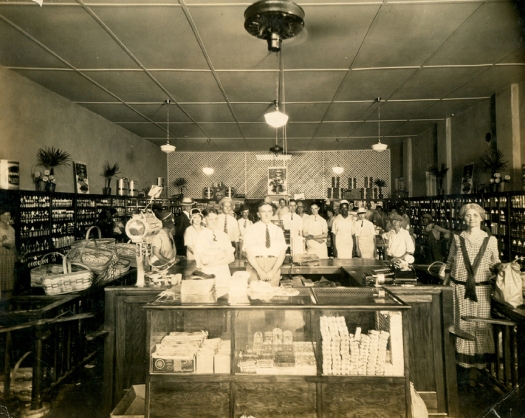
The first Jitney Jungle store was opened April 19, 1919 at 423 E. Capitol Street. A photo provided by Bill McCarty, III, grandson of co-founder William Bonner McCarty, shows the store’s interior as an open front surrounded by shelves alongside walls containing canned goods and other non-perishables. In the foreground was a glass case of tobacco products and sundries and in the rear a meat counter with glass bins displaying produce on beds of crushed ice. The prices were interesting. Bacon was 34¢/lb., salt jowls 15¢, veal steak 17¢, meat loaf 19¢ and baby beef roast 22¢. The manager was A.N. Brannon. (3)
How did Jitney get its name? According to Mr. Will McCarty, at the end of the First World War, returning soldiers would buy an old car for riding about town. They called it a “jitney”. The term “jitney” was slang for a London taxi cab and became jargon in the states for a nickel, the cost for a downtown cab ride.
Back when the establishments were McCarty-Holman Stores, it was the habit of Chancellor V.J. Stricker, who lived just up Adelle Street, to invite the three young merchants, who were living in a nearby boarding house, to his home for Sunday dinner. Mrs. Josephine Bailey’s boarding house at 343 Adelle, could be a dark and foreboding place. Mr. Will relates there was only one light bulb in the entire house and tenants would “borrow” it and pass it around from room to room. One Sunday the boys told the judge they were considering a strictly cash and carry business which would save the customer 20¢ on the dollar over their deliveries. Cash and carry could thus save “a nickel on a quarter.” The merchants asked Judge Stricker to suggest a new name for their stores. Since a cab ride to town cost a nickel, the term “jitney” became popular and it was customary for patrons to shop with “nickels jingling in their pockets.” Judge Stricker suggested the name “Jitney Jingle” but McCarty made a variation when he observed that a wide variation of stock in the new stores would make the store itself “look like a jungle of values.” The name stuck. (1)(2)
1920’s-30’s
Throughout the 1920’s, the owners added a number of stores, each with its own numerical designation which changed over the years. According to the 1930 Jackson City Directory, Jitneys were listed as:
No. 1 – 400 E. Capitol No. 2 – 1077 S. Gallatin No. 3 – 121 W. Pearl No. 4 – 2908 W. Capitol No. 5 – 209 S. State No. 6 – 423 E. Capitol (formerly No. 1) No. 7 – N. State and Fondren Ave. No. 8 – 412 W. Capitol No. 9 – 719 N. Gallatin (later 1209 N. State) No. 10 – 146 N. Farish No. 11 – 167 E. Capitol No. 12 – 850 W. Capitol No. 13 – 1241 N. West
This brings us to the birth of Jitney 14, which, according to the 1930 Directory, existed at that time. The listing contained the 904 E. Fortification Street address, a telephone number (9119) and a manager, Charles Alford. It is conjectured that the original store was small and became a “super store” some four years later. (4) Mrs. Betty McCarty Edwards, daughter of co-founder William B. McCarty, can remember when the new Jitney was just a hole in the ground. “My father had bought some cheap land around the Jefferson-Fortification Street corridor for investment. When the 1930 store was in its planning stage he offered to buy some fill dirt from a local vender. Mr. McCarty thought the price was too high and demurred. After a time the vendor went to him and said, ‘Just let me dump some of my dirt in that hole. No charge.’” Mrs. Edwards’s memories reflect back to when her brother (W.B. McCarty, Jr.) ran a Christmas fireworks stand as a youngster in front of one of the stores fronting Fortification. “He did well,” she said, “but would come home so cold on those December days he would question the wisdom of early entrepreneurship.
The new Super Jitney made a special point of catering to women. According to Mrs. Edwards, when you entered the store there was a platform area to the left for the ladies to sit and visit before they shopped. “There was a woman who taught knitting and the ladies would knit or read as they visited. It even had the first restroom for ladies in a Jackson grocery store. There were also chairs for children to sit in but keeping them still in those seats could be a problem.” There were “Jitney dresses” for sale at all store outlets. “They were not made by Jitney,” Mrs. Edwards says. “They were ‘house dresses’ as slacks were not in vogue at the time. They were good sellers but of course, no two were alike!”
As the business grew, however, more space was needed to display groceries and in time the ladies area was discontinued. (5)(6) Mrs. Edwards grew up in the Belhaven area living first on State Street at Manship, where the new Baptist Hospital building is being constructed, then moving with her family to St. Ann. Later the family moved to the Council Circle area. In the early years of her marriage while still living in Belhaven, Mrs. Edwards and her husband would walk to the store and shop. Few had cars during the war. She would bring home the perishables and her husband would bring the other groceries when he came home from work. (6)
The formal grand opening of “The New Super Jitney-Jungle Store” took place on Friday, November 10, 1933, when according to articles in the Jackson Clarion-Ledger of that year, “Jacksonians gave a hearty welcome to the newest addition to stores of the city Friday and Saturday when thousands of persons visited the new Super Jitney-Jungle at the corner of East Fortification and North Jefferson streets.” (7) (8) Back then 14 was known to the neighborhood as the “Big Jitney” and No. 9 on North State, the “Little Jitney”. 14’s manager was Charles Alford who got his start at the first store in 1919.
Mr. Alford brooked no sloppy doings. Clerks were dressed down for failure to dress up. Ties were compulsory. Alford, however, did have a sense of humor as related in Henry Holman, Jr.’s publication “Save a Nickel on a Quarter”. According to Alford, the store butcher waited on a customer late one Saturday evening who had come in to buy a chicken. The butcher reached into his case and brought out his last chicken. He showed it to the lady but she wanted to see a larger one. He put the chicken back in the case, bent over, moved his arms about, rattled the ice a little – as if looking for the right sized one – and ceremoniously came up with the same chicken. The customer replied with a satisfied smile: ‘Yes, that one is just fine. I’ll take them both.’” Oops! (5)
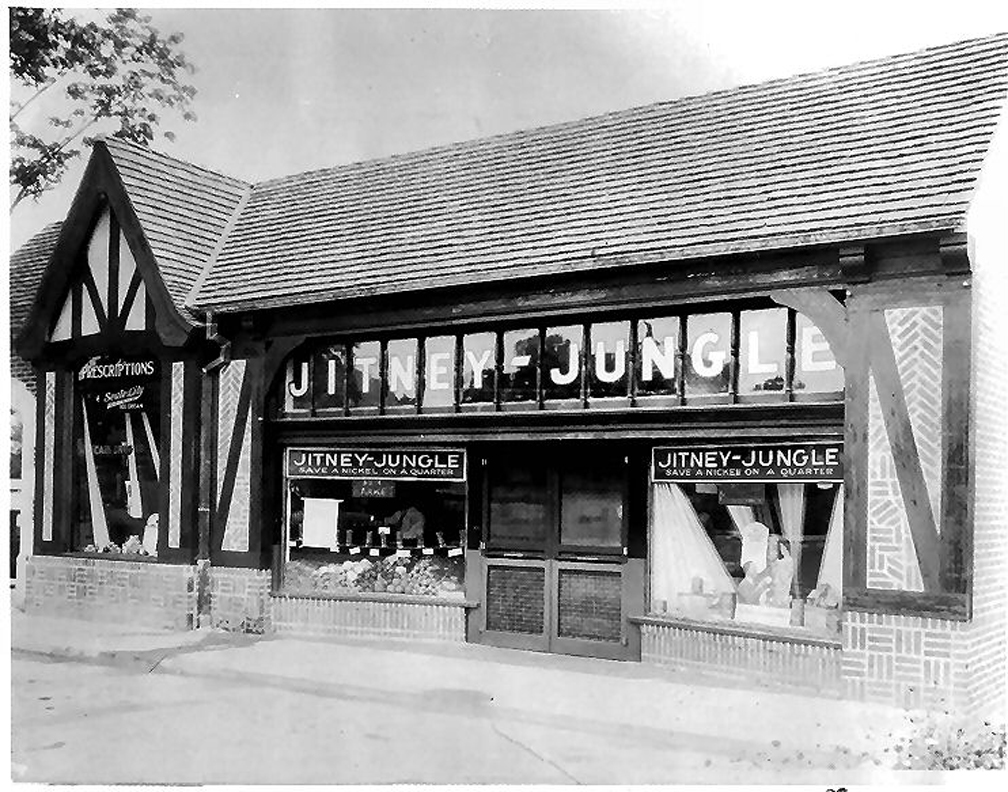
The new Super Jitney was a honey. Bill McCarty, III’s photo shows it facing two-lane Fortification with red and green awnings, tile roof and a glass front through which the shopper could see fresh fruit and vegetables displayed. The interior consisted of wooden floors, school room lighting and aisles of shelving. It contained a bakery, a refrigerated meat counter and a glass delicatessen. It became only the second grocery store in the United States and the first in Mississippi, to have air conditioning.
Its Tudor Revival style was designed by neighborhood architect Emmett Hull and contained only the grocery and the new Price Cain Drugstore at the Jefferson & Fortification corner. There was a small area for angular parking in front of the building and a loading dock and parking area around the corner on Jefferson. Belhaven was a rapidly growing neighborhood and shoppers came from throughout the area to see the new store which featured specialty items and select cuts of meat. (4)(9)
The Jitney chain had expanded rapidly throughout the “roaring twenties”, but by 1930, the Great Depression was beginning to take hold. On a typical Saturday you might drive your new $495, Ford coupe to the Jitney to shop. As you walked the aisles with your grocery basket you would notice green beans, three cans for 25¢; Wesson oil, 49¢ a quart; lemons, 12 for 20¢; cigarettes, 15¢ pack; roast beef, 19¢ lb.; bacon, 26¢ lb.; eggs, 25¢ dozen; lettuce, two heads for 15¢; sugar, 10 lbs. for 50¢; light bulbs, 20¢; fresh salmon, 29¢ lb.; mayonnaise, 29¢ pint; flour, 12 lbs. for 12¢; fryers, 35¢ lb.; Irish potatoes, 4 lb. bag, 55¢; and house coffee, 19¢ lb.
Most of these items you would carry home and place in your brand new $33.95 Ward’s refrigerator. (10) Refrigeration was just coming into play in the early 1930’s. Most people still had iceboxes. Meat was displayed in coolers on crushed ice and fresh fruits and vegetables, usually purchased from street vendors, went quickly early in the day. “Are the greens really fresh,” a housewife would keenly inquire of the store vendor in his white apron. “Yes ma’m,” he would respond. “Always.”
A trip to Jitney 14 was always a special event for the family shopper. An ad in the August 2, 1930 Clarion-Ledger announced “Your Jitney Jungle is arranged so that you can shop from front to back and from side to side without taking unnecessary steps. Your Jitney Jungle fixture arrangement not only provides a one-third more merchandise space than any other fixture plans in the world but is the most convenient. By shopping at Jitney Jungle you ‘save a nickel on a quarter’ on your grocery budget and many steps.” It was obvious these grocery stores were far ahead of their time. (11)
The 1940’s
Jitney 14 in the ’40s,photo courtesy of Bill McCarty
In 1941, Jitney Jungle 14 underwent its first expansion, enlarging eastward to include space for several small businesses. By 1942, the original grocery and adjacent drugstore had added the Beauty Lounge, Marjorie’s Shop (notions) and Snow White Cleaners. It took on the name English Village after its Tutor design. America was at war and throughout the early 1940’s, food items were scarce and rationed and neighbors pulled together and shared what they had. No one minded the sacrifice for their country and its sons overseas. On occasion there were vacancies in the store fronts and Mr. McCarty would let the Junior Red Cross use an empty space rent free to pack boxes to send to the Europeans after World War II. (4) (1)
Henry Holman, Jr. relates this story of an event at Jitney 14 during the days of food rationing. “On a certain April Fool Day, my father had one of the office force impersonate an O.P.A. investigator (rationing enforcer), who telephoned, of all people, the personable switch board operator at the store to find out why she had been getting extra sugar stamps. Since it was strawberry season, she impulsively implied it was to can strawberries – a fruit she and her family never ate! A few moments later father had the ‘investigator’ call back and say he was coming by her house that afternoon to check on her canning. Immediately she scrambled to the warehouse and bought a whole crate of strawberries, then came by to ask my straight-faced father for permission to rush home and can the fruit.” (5)
My own memories of rationing were going to the store with my mother. She would hand me a ration book with pages filled with stamps and instruct me “Billy, tear out half a sheet of tanks and a third sheet of planes.” Regardless of how much money a person had to spend, they had to produce these stamps for sugar and coffee when they were available and a host of other scarce items. Soft drinks such as Coke, Grapette soda, Orange Crush and Royal Crown Cola (twice as much drink for a “jitney”)- like bubble gum and comic books – were mostly unavailable until after war’s end in 1945. There were red meat points for steak or bacon and blue points for canned goods. Tokens, worth a fraction of a penny, were used to “make change” for sales tax. Sometimes the most respectable ladies would don an old cloth coat and slip across the Woodrow Wilson bridge off South Jefferson and into the Gold Coast where black market items such as bobby pins and local beef were available without a ration book. Few questions were asked. A lot of commerce over the years has been done “across the river”.
Jitney Jungle in the ’40s, photo courtesy of Bill McCarty
I learned to shop at Jitney 14. I used to swing on its wooden turnstiles when I didn’t weigh quite as much as I do now. I was sent down one aisle for a five cent box of salt and another for ten cents worth of baking soda. I learned the brand names of foods and how beef and poultry were weighed. I looked for cookies and ice cream cones at Cain’s and helped carry grocery bags to our neighbor’s car since we did not have one. Later on, when I was a bit older, us neighborhood kids hung out near the freight dock on Jefferson. Mr. Elliott and his staff would unload oranges and apples and lettuce and onions and throw the boxes, crates and sacks out the back door for trash pickup. The orange crates were the prize catch. Made of sturdy wood, they had a divider in the middle. We would grab a couple, take them home, stand them on end and connect them with a board. The consummate lemonade stand was born with a shelf on either side for the cash register and the lemons. Profits were spent on Hershey bars and milkshakes at the drugstore. Our mothers loved the apple crates which were used as storage boxes and ideal for new bedding plants in the spring. Of course the lemons, sugar, paper cups and straws all came from inside the store where the high lights and lesser lights came and went. All were on a mission of their own, delighting in the plethora of food and furnishings made available at war’s end. Grand times!
Us kids, however, were only familiar with the outside of the dock area. Mrs. Betty Edwards’ son Steve, who began as a bagboy at “14” knew it as an assistant store manager from the inside out. “The only unusual feature of Jitney 14,” he said, “was the tiny back room area. When the trucks came in, many of the cases of fast moving large items, such as toilet tissue or seasonal extra goods were sent by a conveyer belt to the dark cavern beneath. It was the most challenging storage room of any store in the company except the Jitney in Philadelphia, MS., regarding truck unloading, dock area and storage.” (12) Since all our readers know by now there is or was a ghost in most of Belhaven’s early digs, this one might have lived in the stock room.
Belhaven, from time to time, has been the haunts of several ghosts – most of them good. Rumor has it one lives in the water fountain at Laurel Street Park. One of these days we are going to have to look further into the adventures of these elusive creatures. Throughout the 1940’s and 50’s and into the 60’s, “the Jitney” was the neighborhood’s hub of commerce. And oh, the stories; some not always verified but all, of course, true.
One of the primary ways a young boy could make a little pocket money was to be a bag boy at a local grocery store. It didn’t pay much and was hard work, but rewarding back in the times of self-reliance and personal responsibility. Such a bagboy was Coleman Lowery who, as told by his daughter Maggie, “From the summer of 1946, when I was in the 8th grade at Bailey Junior High School, until the spring of 1951, when I graduated from Central High School, I was a package boy at Jitney 14 where Miss Eudora Welty was a regular customer.
She tipped the package boys a dime. We were making thirty cents an hour – so we fought over the ladies who tipped. Mrs. Fred Sullins and Mrs. Robert Kennington tipped a quarter! Sometimes Miss Welty did as well. “In the fall of 1951, I entered Vanderbilt University, where I graduated in 1955, and that fall in my freshman English class we read ‘Why I Live at the P.O.’ During the discussion that followed I raised my hand and said ‘I know Eudora Welty. I carried her packages at the grocery store at home.” And just to think, Miss Welty could have written “Why I shopped at Jitney 14”. (13) Perhaps someday a manuscript will be found!
Being a package boy was many a youngster’s first introduction into the business world. Both Henry Holman, Jr. and Bill McCarty, Jr. served in this capacity as they learned from the ground up the intricacies of their family business. Store manager Alford once said “All young men in Jackson should start out carrying packages for Jitney.” The Jitney Jungles back in the 1960’s published a little handbook which was given to all the newly hired boys. It began with a mission statement “The purpose of this manual is to show you in step by step fashion, what you should do to be successful in your Jitney Jungle job, and what the store needs and expects of you as one of its important employees.” (14)(5)
The manual goes on to outline instructions on neatness, promptness, making sensible decisions, care and packaging of the grocery product, courtesy and thoughtfulness and always leaving the customer with the comment “come back again and bring a friend.” It concludes “We welcome you into the organization. We hope you will like playing on the Jitney-Jungle team. The game is just beginning. We’d like to see you become a seasoned star – a veteran…you can – and will – if you do your best.” (14) What wonderful lessons for a 14-year-old boy to learn and practice. What good advice on which to enter the professional world.
Writer Willie Morris grew up in Yazoo City. He didn’t get down to Jackson often but many times when he did he visited his grandparents Mr. and Mrs. Percy Weaks who lived at 1017 N. Jefferson Street. The house left the tax rolls in 1968 and the home site has been a vacant lot since. A Tote-Sum Store once sat at the corner with Fortification with a loading area in the rear. Bill McCarty, III remembers as a child an artificial limb maker behind the Tote-Sum and several times going by with his dad at night and seeing prosthetic legs or arms reaching skyward from a pile outside. “That certainly terrified us!” Just north along the sidewalk a small, battle – scarred magnolia remains on which, according to Joanne Prichard Morris, Willie once carved his initials – but time has removed them. Willie Morris was familiar with Eudora’s Jitney. (1)(15)
Writing in his book “Homecomings” in the 1989 article A Return to Christmas Gone, the author tells of his purchase of a half dozen roses in Oxford and brought with him to the gravesites and former homes of his antecedents, the last of whom lived in Belhaven. “I retrace the Christmas journey – down Woodrow Wilson, right on North State Street past Millsaps, left on Fortification to Jefferson….My grandparents’ house is no longer there, long since a parking lot near the Jitney Jungle across the street. The magnolia is still in front, but where the house was is grim, bare asphalt, cold and wet now from the rain. ….Mamie and Percy, Maggie and Susie would be greeting us now, just beyond the magnolia where the front porch was. I close my eyes and hear their happy welcomes. Old Skip has raced beneath their feet into the house in search of turkey livers, and my great-aunts follow in their flowing black dresses.
“I stand in the parking lot where the parlor was. I feel the ripple of the lost voices. I drift back into the kitchen. Time, as one ages, is a continuum. Past and present consume themselves into the ashes. There is no good place for the last two roses. I put them on the asphalt where the dining room table was. Tomorrow someone will run over them in the parking lot. But who would disturb them today?” (16)
1960’s – 80’s
As the years approached the 1960’s, another expansion of English Village and Jitney 14 was underway. It was a massive undertaking of space increment and modernization. New businesses were Pridgens Florist, Collins Barber Shop, and the Beauty Lounge to accompany the older establishments. Cain’s had given way to Parkin’s. Other enterprises that have occupied English Village over the years included the Automatic Laundry Services (washeteria), Neal’s Barber Shop, Ben Franklin Hardware, Southern Pulmonary Clinic, the ABC Coin Laundry, the Village Inn & Pub and now Basil’s. (4) [Basil’s went out of business in early 2014, and a new restaurant, owned by Louis LaRose, is scheduled to open soon.jly] A new and enlarged parking lot was constructed to accommodate growing patronage. A major feature was a complete and enlarged bakery at the front of the store. The pungent odors of fresh bread, cookies, pies and cakes wafted through the store attracting shoppers like a magnet to the freshness and taste sensations of these delicacies.
A photo provided by Bill McCarty, III depicts modern floors and lighting, wider aisles, shelving throughout the store, frozen food cabinets, an up-to-date refrigerated meat market, two turnstiles, six efficient checkout lanes with new calculators and scales and a lunch counter near the front of the store. As a young man, Bill cut his Jitney teeth here. He tells of when he first went to work to learn the shelf stocking end of the business. “Wooden floors were under newer tile throughout the store. One of my jobs was to do shelving on the sales floor. When I stocked the orange juice, I had to put my foot beside one wheel of the cart as I loaded juice into the retail case or else the cart would roll across the aisle. This was simply the result of the wooden floor’s old age. The eastern most addition to Jitney 14, when the entrance was moved to that side from Fortification Street had concrete sub flooring throughout.
“One clear memory was the kitchen directly behind the former Fortification Street entrance where Mrs. Pitts, the deli manager, and the ladies who had cooked there for so many years used a gas burner as part of the stove to cook icings and other bakery items. I once tried to change her brand of flour but after being told that she only cooked with one brand, I went to buy that flour at the best price I could get since I knew I was not going to change her wonderful ways. Mrs. Pitts, who catered many a reception and social event with her great recipes, also had a hand in starting the development of the delicious pimento cheese still available for purchase in McDade’s deli.
Eudora Welty, photo courtesy of fanart.com
“Extra thin sliced bread was so popular we spent hours preparing it on a noisy cast iron slicing machine that was in action every time I went into the kitchen. My personal favorite was the Old Fashioned bread in the wide loaf, one of six sandwich bread items baked in the Mill Street bakery. It came in a white bag with the logo printed on it and tasted much like real homemade. During the Christmas holidays we had red and green and other colors for each holiday that followed designed to compliment party sandwiches requested by our customers. You could just about tell the holiday by the color of the bread. In addition to governors, mayors, lawyers, legislators, doctors and everyone else in town, I vividly remember Eudora Welty coming by and talking with me as I stocked shelves or ran a checkout stand. Frank Haines (former Jackson Daily News entertainment editor) asked me when we were going to get a supply of George Washington Seasoning, so I ordered some for him. One item Jitney 14 always stocked was the small glass jar of Smithfield Deviled Ham spread. I learned to love it in 1972 and special ordered it for myself until it was recently discontinued by the distributor. I remember Mrs. Noone, an elderly lady from up around Madison Street with an Australian accent who came by every day to buy Ryvita Wafers for herself and a small bag of litter and a bit of liver for her 14-year-old cat. ‘The liver had to be tender,’ she told me, ‘or my cat will not eat it.’ On occasion she returned it the next day for more tenderization.
“I recall the Jefferson Street side entrance to Parkin’s Drugstore and going in to their soda fountain as a child where I either had a banana split or chocolate malt.” (1) How many young fellows in the Belhaven neighborhood running barefoot along the hot sidewalks of summer must have done the same.”
Jitney 14 was an icon, attracting patrons from throughout the Jackson metro area and beyond. The pace was quick, the new computerized checkout stands crowded and the clerks challenged with the need for speed and accuracy. One in particular caught the attention and love of many customers: Johanna Wade. Johanna, a native of Amsterdam, the Netherlands, was a 16-year veteran of Jitney 14 when she appeared in a local newspaper article. She was a popular favorite of Jitney shoppers and as the head checker knew many on a first name basis. “I know them by name,” she told the reporter. “I know their children. I like the people. I’ve got lots of friends here in the neighborhood. They’ve always been real good to me.” This goodness came through in 1986 when her husband died. They invited her over for the holidays to relieve her loneliness and they were happy to share their family day with her. When her parents died in 1988, and she made two trips to Holland in a week, customers expressed their sympathy by helping send her. “I came back and it was all in the office- money, checks, everything.” Then store manager Sam Holley called her not only an asset to the store “but to the entire neighborhood.” Such are the rewards of a friendly smile, accommodation and knowing the rhythms of Belhaven. (17)
The 90’s
Eudora’s Jitney rolled into the 90’s with a full head of steam. The company had expanded to hundreds of stores throughout the southeastern United States. Bill McCarty III reports that “business was brisk and by 1994 the Jitney-Jungle chain had expanded to 105 stores in six states and annual sales exceeded a billion dollars. That large volume continued to produce a profit for the company through hard work and efficiency.
“Beginning in 1987, the Jitney 14 structure was completely rebuilt from the inside out with the entire building being replaced except the exterior brick facades and walls along Fortification and Jefferson Streets and the north walls and east main entrance. This preserved the historic character of brick, tile and copper exterior with big improvements to the 30,000 square foot store. The store remained open during this period and the grand reopening was October 8, 1988. Parkins Drug Store was relocated to the structure occupied by Basil’s Restaurant today.” [See note above, jly](1)
The 21st Century
Times change; new generations take over and old ways are altered by current need and circumstance. The sale of the Jitney Jungle chain was finalized in March 1996 and at that time the annual sales volume was approximately $1.2 billion. After the sale, some difficult times followed with subsequent companies. However, Greg McDade purchased the old Jitney in 2005 just before it was to be closed forever and it flourishes today at the same location. Through the 84 years Jitney-Jungle was a McCarty-Holman enterprise it was state of the art as the store remains today. Its staff was courteous and well-trained, its stock and produce of the highest quality and its reputation a solid testament to what a family business can attain with vision, hard work and careful attention to the needs of its customers. Simply put, it did the right things at the right time in the right place.
Eighty-two years after the “Big Jitney” and Price Cain’s drug store first anchored the northeast corner of Jefferson and Fortification, McDade’s Market sits proudly on the site of Jackson’s very first air-conditioned supermarket. Our neighborhood owes a great debt of gratitude to the McDades for saving our store and making it viable. Road equipment churns down the new Fortification bustling with innovative ideas and the coming aesthetics resulting from countless hours of careful planning. Twenty-first century patrons pause along the aerated bins of fresh produce and the well-trained cashiers, stockers, sackers and department managers who hustle to fill their daily needs. The world is faster now but shoppers still pause to say “good morning” and “How are things?” And the employees say the same. It remains our neighborhood grocery.
McDades Market on Fortification in a rare Jackson snowfall. (photo by Jesse Yancy)
As we shop McDade’s this Christmas season and gather together the spices and condiments of the year in anticipation of family reunited, we can reflect on Eudora’s tips to package boys and the spirit of Willie’s roses in the rain. Together they, as have we, been a part of the little store which became an exponent of the American dream as it brought its bounty to our dinner tables and conviviality to our lives. But remember also its journey. The early footsteps are stilled. The old hand-cranked adding machines have been replaced by computers. The aisles are brighter and bracketed with a plethora of universal foods, spices and specialty items. The turnstiles have given way to electronic doors. Roast beef costs a bit more than 35¢ a lb, but on sale days you can still save a nickel on a quarter. New writers and artists recreate its glorious past and its future shines like a freshly polished apple. But beneath it all, through the wooden and concrete floors clad in contemporary colors lies the ground that heard those footsteps in 1930 and above the main entrance, under the archway looking eastward into the sunrise, still stands a harbinger, a numeral that takes us from yesterday to tomorrow at Eudora’s Jitney: “14”.
Bill and Nan Harvey
Bill and Nan Harvey
Nan Ertle Harvey is a native of Yazoo County, a graduate of Mississippi College and has lived with her husband Bill in the Belhaven neighborhood since 1994. She worked in a research position in the Department of Microbiology at UMMC, retiring in 2003. Nan’s hobbies are photography, nature study and family research. She is a volunteer at the Mississippi Department of Archives and History. Bill Harvey is a native Jacksonian, living most of his life in Belhaven. A MSU Bulldog, he has had careers in journalism, education and as development director of the Andrew Jackson Council, Boy Scouts of America. Bill enjoys photography, music, writing articles for neighborhood sources and sharing experiences with friends at a local coffee shop. (Text copyright Bill and Nan Harvey, used by permission of Bill and Nan Harvey; photos of Jitney Jungle copyright Bill McCarty III, used by permission of Bill McCarty III)
Sources: (1) Conversations with Bill McCarty, III, Nov. 2012 [Details are from memory, family members and an April 3, 1962 interview between W.B. McCarty, Sr. and his son W.B. McCarty, Jr.] (2) “Lesson Learned from Strike Here in 1916 was Start of Jitney-Jungle organization” [Jackson Daily News, Oct. 1, 1950] (3) Jitney Jungle is Celebrating Start of 12th Year of Service [Clarion-Ledger, Oct. 12, 1930 (4) Jackson City Directory, 1930, 1916 (5) “Save a Nickel on a Quarter: The Story of the Jitney-Jungle Stores of America” [Address by William Henry Holman, Jr. to Newcomen Society in North America, Jackson, Mississippi, April 18, 1973] (6) Interview with Betty McCarty Edwards [Madison, Mississippi; Nov. 12, 2012] (7) Formal Jitney-Jungle 14 Grand Opening Invitation [Clarion-Ledger, November 10, 1933] (8) “New Super Jitney-Jungle Has auspicious Opening” [Clarion-Ledger, Nov. 12, 1933] (9) Registration Application/National Register of Historic Places/NPS – P. 74. (10) “Store with a thousand Items” [Clarion Ledger, June 26, 1930] (11) Store ad, [Jackson Clarion-Ledger, August 2, 1930] (12) Conversation with Steve Edwards [Nov. 14, 2012] (13) “Knowing Miss Welty: I was Miss Eudora’s Package Boy” – Coleman Lowery as told by his daughter Maggie [Lemuria Book Store blog, Aug. 9, 2012] (14) A Handbook for Package Boys (1960) (15) Conversation with Joanne Prichard Morris [October 31, 2012] (16) Homecomings by Willie Morris (University Press of Mississippi, 1989) (17) “Check Her Out” by Sherry Lucas [Clarion-Ledger, Feb. 7, 1994]
Special thanks to Mrs. Betty McCarty Edwards, Steve Edwards and particularly Bill McCarty, III who provided essential information and much-appreciated assistance. [This article was first published in 2014.]
This recipe comes from the Harvest Café in Oxford. We always served it with a dollop of sour cream, sides of (brown) rice, and a dense crusty bread we got from some stoner in Abbeville. It was a substantial dish, and this recipe will feed dozens of people. The tomatoes were optional depending who was cooking and how hungover, but were always added after the beans were cooked. This is crucial: if you add tomatoes or salt to dried beans, they will toughen and sour.
1 lb. black beans 2 medium white onions finely chopped 5 cloves garlic, minced 1 4 oz. can chopped green chilies 4 poblanos diced 1 can diced tomatoes, drained (optional) 2 tablespoons ground cumin 2 tablespoons paprika 2 tablespoons chili powder 1 teaspoon black pepper corn oil Salt
Sort and rinse beans, place in a heavy metal pot with six cups water (or vegetable stock), and bring to a rolling boil for fifteen minutes. Reduce heat, add onions, garlic and chilies. Simmer covered until beans are soft, adding liquid as needed. Add mixed seasonings and keep on low heat. This is when you should add tomatoes. Blend in a slash of corn oil for consistency. Salt to taste. When serving, provide pico de gallo or a pepper sauce, and toppings such as diced avocado, chopped cilantro, minced onion and peppers.
Much like the ubiquitous pork belly, which seems to find its way onto every upscale menu at an exorbitant price these days, chicken wings were once considered very much a poor man’s pick when it came to buying meat. Wings then more often than not found their way into a stock pot, but sometime in the late 1970s, a wings recipe came out of Buffalo that took the nation by storm and has become a staple. Nowadays, chicken wings cost more than any other cut of chicken in the supermarket, and more than most beef or pork; $3.10 a pound today in my local meat department. I’ve known Ed Komara, a native of Buffalo, for a very long time, ever since he was the curator of the Blues Archive at the University of Mississippi, so I asked him to give me his low-down on chicken wings, and here it is, in 7 points (no less):
REAL Buffalo wings are not battered, but rather deep-fried as-is. After frying, the wings are then shaken in a container with butter (or margarine) and hot sauce (in the cheap places, usually Frank’s Hot Sauce).
The main effect of a true Buffalo wing is the immediate sharpness of the spicy heat, then a quick lowering of that spice.
By contrast, the Rochester, NY version is battered and deep-fried, so as to hold more of the hot sauce (in a sticky/honey sort of variant) and make the spicy burn last for a long time in one’s mouth. (This is especially true of the wings made at Country Sweet in Rochester).
In Buffalo, historically speaking, there are two main places for wings: the Anchor Bar, and Duff’s. The Anchor Bar was where wings were first served in 1964, to the owner’s son and friends as late-night munchies. The bar is located near the Allen Street, aka “Allentown” which is the bohemian arts section of the city. By 1990 when I went there, the “bar” became more like a restaurant serving some killer Italian food (including the richest pizza I’ve ever tried).
Duff’s began offering wings in 1969. It is located conveniently on Sheridan Drive (on the cusp of city and suburb) for those who don’t really want to go all the way to Allentown for the Anchor Bar.
There may be a missing link between the Anchor Bar and Duff’s. My dad remembered sometime in the 1960s that a couple of Buffalo Bills football players were partners in a chicken wing stand that brought wings to city pop-culture attention beyond the Anchor Bar. But I haven’t seen that documented anywhere.
I don’t know where the heck the idea of including celery and blue cheese dressing with wings came from or why. It’s as gratuitous as applesauce with potato pancakes.
Wing stands are pretty common in Buffalo. Much less often seen are places serving beef on weck, the other distinctive Buffalo bar food. The ‘weck is short for kummelweck (or as the locals pronounce it, “kimelwick”), which is a salty bun. The one place among my haunts that served it was Anacone’s Inn (now closed, alas), which always seemed to have run out of beef on weck every time I arrived there (usually at 1 a.m.).
Here is the original recipe. Joint the wings, (discard the tips) then pat dry (IMPORTANT!) and deep-fry them until crispy. Toss in sauce while hot.
8 tablespoons hot sauce (Frank’s or Crystal recommended) 8 tablespoons unsalted butter or margarine 1 1/2 tablespoons white vinegar 1/4 teaspoon cayenne pepper 1/8 teaspoon garlic powder 1/2 teaspoon Worcestershire sauce salt to taste