My grandmother Emma would sit me on a kitchen stool and tell me stories while she cooked. I can still hear her voice, low and level, moving with her work, smell the cornbread in the oven, and see the plopping pot of beans on the back of the stove. She told me how she jumped rope with her sisters, about the tomatoes her grandfather grew, and she’d tap her spoon on the side of the sink to make a sound like sudden rains on a tin roof: “Rat-a-tat at first,” she’d say, “Then so loud you had to shout to talk.” She also told me about roses so blue they made the sky look like it had no color at all.
“Gramaw,” I’d say in my most grown-up way, “roses are red! Or white. Miz Stevens has some white ones. And I saw some yellow ones in the store. But roses aren’t blue!”
Emma would smile and tend to the stove. “Oh, you are such a smart girl!” she’d say. “But you’re not as smart as your old granny. Some roses are blue, but you ain’t gonna to see ‘em in Loris Stevens’ yard, and you ain’t gonna see ‘em in the store. The only place blue roses grow is Africa, on the Mountains of the Moon.” She told me that where the blue roses grow, the east wind from the sea air keeps the mountains clouded against the sun, but at night, when the north wind comes down from desert sands, the skies clear, the moon shines her white, white light on the grey-green slopes, and roses with blossoms blue as a gas flame climb to the stars.
When Emma died, my heart broke into a million pieces, but my heart healed, and I remember Emma, it’s warmed. When I find blue roses for sale, I smile because I know blue roses only grow in Africa, on the seaside slopes of the Mountains of the Moon.
Mix a cup of sour cream to a half cup of sweet cream. Add the juice of half a lime and a tablespoon of capers. Cover, keep at room temperature overnight, then refrigerate. Coat sweet potatoes with vegetable oil and salt. Bake, slice, and cool. Top with cold lime crema and black pepper.
In the realm of riddle recipes, scripture cakes number among examples of culinary evangelism the world over, all stiff echoes of a textured oral tradition. This dense spice cake is typical. Here ingredients precede verse, which you’d not do for a lesson.
Cut, strip, and tear three bunches of turnip and two of mustard greens. If you like, peel and cube/dice turnip roots. Put greens in a clean stoppered sink, sprinkle with salt, cover with water, and agitate to knock off sand and other debris. Repeat until thoroughly clean. Drain and load into a pot along with roots, a quart of water or light stock, a chopped white onion, and a half pound of sliced bone-in ham or smoked turkey tail. After greens have reduced, cut heat to low and cover. Stew, stirring occasionally, for at least two hours. Add liquid as needed. Adjust salt, pepper to taste, and let sit uncovered a half hour before serving with pepper vinegar.
Any time you enter a beer joint in Mississippi, you’re likely to find a big jar of pickled eggs on the counter next to the beef jerky, the pieds de porc à l’écarlate and all the other Bubbas that belly up to the fast food Southern sideboard.
Such eggs are sour, rubber shadows of those properly pickled, which are a great side with cold meats, poultry or game, also good in–and with–tuna, chicken, or vegetable salads. A recipe from a Junior League-type cookbook published in the 1930’s claims that they’re “ever so good chopped into hash, and provide just the right touch bedded on greens with a dressing of sharp, spicy goodness.” Craig Claiborne included a pickled egg recipe in his New York Times Cookbook (wouldn’t he just?).
The white of a pickled egg should be firm, not tough or rubbery, the yolk moist and creamy, not crumbly. The eggs should also have a light, balanced tangy/sweet flavor as a platform for other seasonings: I like a couple of slit hot peppers, a slice or two of garlic and a bay leaf to flavor mine–which are, admittedly, unsuitable for any occasions requiring plates, much less silverware–but dill, caraway or even cloves figure among attractive possibilities for the eclectic.
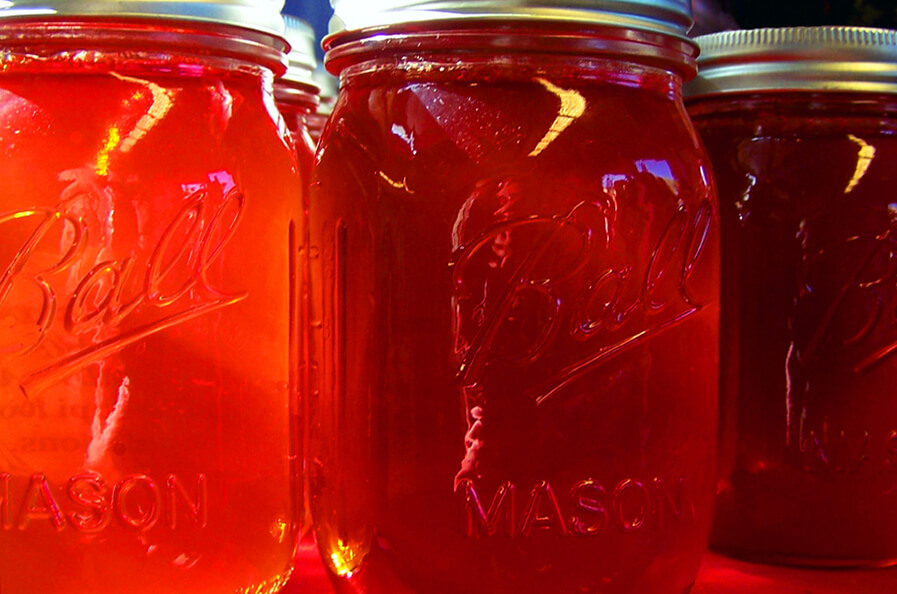
For pickling, boil a dozen medium eggs until just done; you can easily fit a dozen large in a quart glass jar. Then stuff the (peeled) eggs into the jar along with whatever accompaniments you like (jalapenos, onion, garlic, bay leaf, etc.). Fill the jar with a mixture of white vinegar and water (4:1) just to the top; jiggle the jar to burp bubbles. Pour vinegar mixture into a saucepan along with a tablespoon of salt, a tablespoon of sugar and a tablespoon of pickling spices. (If you miss the barroom rose, use beet juice.) Heat to almost boiling and pour back over the eggs; if there’s not quite enough liquid to cover them entirely, add a little more water. Seal the jar and store for at least a week before putting them out at your next kegger.
To confirm that the Charter of Christ embraces the profane cycle of life, the early Church adopted observances of the solar calendar from many different cultures.
The most significant of these are obvious; Easter, on the spring equinox, and Christmas, on the winter solstice. Others include All Saints’ Day, the mid-point between the autumnal equinox and the winter solstice; Lammas Day, the mid-point between the summer solstice and the autumnal equinox, while May Day, in between the spring equinox and the summer solstice (Beltane in the Celtic calendar) marks a celebration of the Virgin Mary in Christian culture.
February 1-2 falls between the winter solstice and the vernal equinox, the middle of solar winter in the northern hemisphere. Called Imbolc in the Celtic calendar, Christians observe the date as Candlemas and the Feast of St. Brigid of Kildare (Ireland), named for the Celtic goddess Brigid, “whom the poets adored.”
By 1986 publishing was already wedded to celebrity so much so that the best-selling cookbook that year was by “The Frugal Gourmet”, an ordained minister who was convicted of molesting teenage boys some years later. But Smith, for all his faults, was an international media presence, while Ernest Matthew Mickler (God rest his sweet soul) who in the same year published White Trash Cooking, was a dying man with a vision.
Ernie insisted on the title, which left him an open target since his simultaneously unblinking and winking approach to the stereotype of the rural South confounded people across the country as well as people on the Redneck Riviera. The only thing even remotely resembling a precedent for White Trash Cooking was written by another Floridian, Zora Neale Hurston, whose studies in anthropology brought her back home, much as it did Mickler, who threw down a gauntlet, insisting that while the nation might profile Southerners as a whole as white trash, the behaviors that earmark anyone anywhere as decent and honorable hold sway in the American South as well, a region that is no more tragic than any other section of the country.
He also knew that people outside of the South consider us low and mean, but we are (as they are) a layered society undeserving of their unilateral condemnation; our culture, our manners, our morals all have as much a measure of civilized imprint as those of our fellow countrymen, but instead of embracing our differences, they persist in considering the South and its people worthy of their disdain.
With White Trash Cooking, Mickler opened a portal of discovery into the essential character not only of the South, but of the nation; white trash cooking uses cheap ingredients, commercially frozen, dried or canned, few seasonings, packaged mixes, plenty of salt and sugar, lard and margarine in dishes that are quick and easy to cook, unsullied by any degree of sophistication. It remains the most basic form of cooking in the nation, the cooking of people who don’t read Bon Appetit, people who work a forty-hour week (or more) at a poorly-paying job with little or no insurance, living from paycheck to paycheck, struggling to make a life for themselves and their children. They wouldn’t go to a Whole Foods store unless they lived next door and had to, which is good advice for anybody without an attitude.
White Trash Cooking celebrates a significant surface of our many-faceted country, one we should all recognize as uniquely ours and none others. Love it.
When the American Institute of Architects awarded Samuel (Sambo) Mockbee the AIA Gold Medal in 2003, he joined an elite company of architects (including Thomas Jefferson) who received the award posthumously. “The AIA does not like to confer a gold medal on people who are no longer living,” says architect Tom Howorth. “It’s an award for those who have the potential to continue contributing to the field of architecture. The fact that it was conferred on Sambo confirms he is continuing to shape the architectural landscape.”
Sambo Mockbee died in 2001. Hailed as a visionary with designs such as the Barton House in Madison, the Cook House in Oxford and the Magee Church of Christ to name a very few, Mockbee set an even higher benchmark when he and D.K. Ruth co-founded the Rural Studio at Auburn University. There in the heart of Alabama’s Black Belt, the studio continues to be a place where students learn the social responsibilities of architecture by creating homes and buildings with a spirit for poor communities.
“Sambo’s mission was to see about people,” Jackie Mockbee says. Jackie married Sambo in 1970. “We had two blind dates, we really did,” Jackie says. “The first was at a homecoming for Sambo when he was at Fort Benning. I’m sure he didn’t remember me; I just remember having fun watching everyone there. Two years later, my cousin called me and said they were going to a party and said there’s this guy that we all know who needs a date. They started telling me who he was, and. I said, ‘Wait a minute; I’ve had a date with him before.’
They asked me if I had fun, and I told them that we really didn’t get to know one another. That night, Sambo asked me if I went to MSCW, if I was a Baptist and if I’d marry him. I said, ‘Yes, yes and no.’ That was in August. We were married that December.” The Mockbees had four children, but Jackie remembers that at their home in Canton, “We had kids everywhere.” Jackie says. “They ran all around the neighborhood, but always ended up in our yard. Sambo was like the Pied Piper; he always had something going on, he was always the coach, and when he hit that door, the kids came running.”
“He was a gregarious, affable, lovable teddy-bear of a guy,” says Malcolm White, a long-time friend. “Once you became his friend, you were his friend for life. He loved collecting eclectic personalities. He was an engaging conversationalist and could sit up literally all night and carry on about Van Gogh or the Civil War or American history or Western civilization or anything else you might be interested in.”
Magee Church of Christ (photo by L. David Fox)“He believed in legacy, he believed in creating things that would last,” Malcolm says. “He wrote a check out of an account that didn’t have a nickel in it for the first float that I ever purchased, the very same trailer that the Sweet Potato Queens use today.”
“In the early 80s, Sambo had an office on North Street on a stretch of property that’s now parking lots,” Malcolm says. “On Friday afternoons, Sambo would gather people and would serve Heinekens, which he loved, and sausages or peanuts, whatever he had on hand. Sambo began to explain to us that he had this big idea that he was closing in on, this notion that was going to involve all of us,” Malcolm says. “He wanted to empower rural people of little means in the same way that wealthy people could empower him to design beautiful, elaborate offices. He wanted to incorporate not just architecture and design, but philanthropy and entertainment and recreation, all the components that build community. Basically what he was talking about became the Rural Studio.”
Former partner Coleman Coker first met Mockbee in Corinth. “I think in 1980 or 1981, and we hit it off, just sitting around and talking. Neither one of us had much work at the time,” Coleman says. “He was making a lot of collages, I was painting, and that’s where we found a commonality in translating the world as we saw it through our constructions and paintings into architectural compositions. We never were successful going out and marketing ourselves, particularly to corporate clients,” Coleman says. “Most of the work we were proudest of involved small residences for people looking for something different, looking for something that had a relationship to place, to locale. Most of those buildings were reflections of the clients, an extension of their personalities, and as we got more built, more people would see them and give us a call.”
“We didn’t sit around talking about the work of other architects; we’d talk about literature—Welty and Faulkner—looking for roots, connections to place, and we found that so much more directly through Southern writers,” Coleman says. “There’s no long tradition of Southern architecture outside of the classical, which comes from Europe, and we weren’t looking for that. We were trying to build on what was just beneath the surface here in the Deep South, whether it was black culture or the culture of the landed gentry, whatever mythology could be unearthed.” Mythology, Coleman admits, is “difficult to talk about.”
“Sambo, through the paintings that he did, was building a whole mythological world,” Coleman says. “Characters would repeat themselves throughout the paintings, and they started telling a narrative. It’s easier to render a narrative through literature, even through painting, than it is through architecture, yet you strive to expound those roots and reprocess them through design. Our concern with social responsibility in professional ethics fell in trying to reach out to a group that was estranged otherwise,” Coleman says. “We were trying to design in context with this locale, the locale in a social sense, when the abject poverty in much of Mississippi was virtually ignored by the great majority of designers and the great majority of people who could afford architects.”
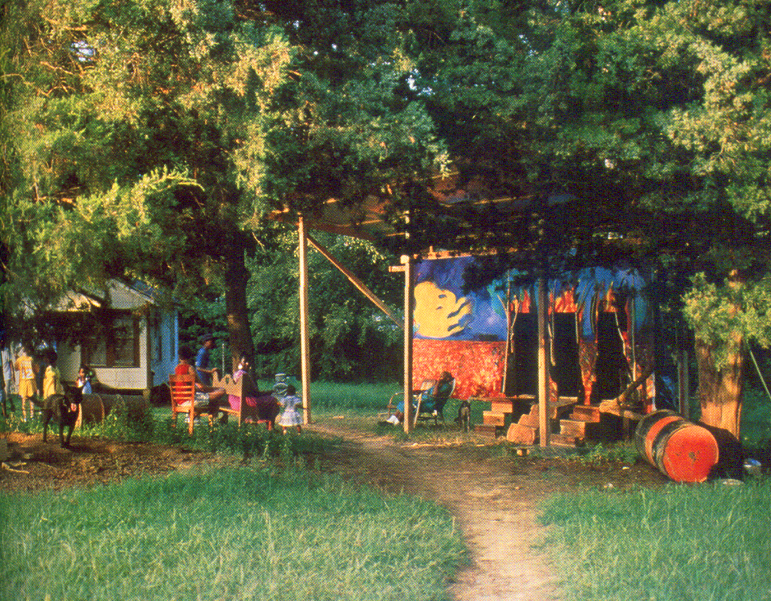
“Eutaw: Children of Eutaw Pose Before their Ancient Cabin” (Mural, photo by L. David Fox)
In 1993, Mockbee and D.K. Ruth founded the Rural Studio. “Prior to the Rural Studio there were a few notable construction-focused, hands-on learning opportunities in architecture schools in the country, notably at Yale,” says Tom Howorth, also a former partner. “But there was nothing on the scale, level of commitment and pedagogical continuity that runs through the Rural Studio. Now there are those sorts of programs across the country. So much of what we do is picked from catalogues that the work of putting buildings together becomes a matter of picking the systems that exist and putting them together in a way that you solve the client’s problem,” Tom says. “That wasn’t what Sambo was interested in; he was interested in creating from scratch. He challenged students to think originally.”
Daughter Carol Mockbee recalls that “Papa (Sambo) first started talking about the Subrosa Pantheon in 1999. In the summer of 2001, they started digging in the Alabama clay. D.K.’s mother had died, as well as two young professors at Auburn, and that was probably when they came to the decision to build a memorial space for the Rural Studio, a place to remember and meditate and reflect. So they started digging out the site for the Pantheon in Newbern. By August, they’d poured the first slab. Papa got really sick that fall and passed away in December.”
“The project was suspended for two years,” Carol says. “After I graduated from Auburn in interior design I applied to the Rural Studio as an outreach student to finish the Pantheon. I knew the idea, knew my father’s mythology behind it, and knew that he loved the project. Had I known then what I know now, I don’t think I would have touched it. But, luckily, I was ignorant, young and energetic. For the first few months, I worked on other projects. I had to find my own way, find my role and boundaries. Everyone was skeptical; one engineer at Auburn said, ‘You know, if you were my daughter, I would not let you do this.’ I left that meeting thinking that I am Sambo Mockbee’s daughter and he wouldn’t want me to be doing anything else. I completed it on August 27, 2005. I was so preoccupied with my last pour three days before that I had no idea Katrina was coming.”
“Every June 21, you can go into the Pantheon and stand at different points, align yourself with stars and planets, then sit on a bench next to someone, lean away from them, whisper into a pipe on your side, and the secret travels back to them.”
Cream 2 cups sugar with 2 sticks softened butter until light and fluffy. Beating well, add 5 eggs one at a time. Sift 3 cups plain flour with a teaspoon each of cinnamon, nutmeg, and ground cloves. Add to butter with a cup of milk, a half cup of orange juice concentrate, and a teaspoon of vanilla extract . Mix thoroughly, pour into an oiled and papered 9″ loaf pan, and bake at medium high (375) until toothpick dry. Slice, toast, and drizzle with honey.
Grind 5 pounds chicken meat–I boned thighs and threw in a couple of boneless breast halves–with skin through a ¼” plate into a large bowl. . Add two tablespoons salt, a tablespoon ground black pepper (more if you want), and a quarter cup each of fresh chopped sage, thyme, and parsley,. Some people add cayenne, but don’t; it kills the herbs. Blend in a half cup fresh chopped green onion along with a half cup cold chicken broth.
Mix very well and refrigerate before stuffing loosely into casings. You’ll need about 12 feet. Twist sausages into about 6-inch links, and refrigerate overnight to let the seasoning work through the meat. This chicken mixture can also be cooked as patties, but will not keep well raw; freeze if you’re not going to use it the following day.