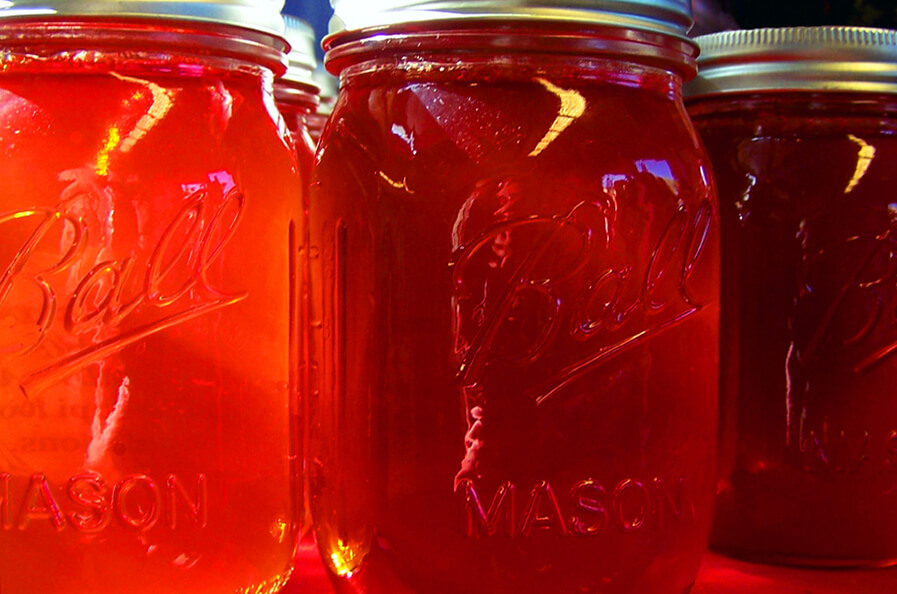
My Tomato Soup

In the best of all possible worlds, I would stroll/waltz/sashay out to my garden, pluck a dozen luscious, slightly over-ripe plum tomatoes from my thriving vines (growing in certified organic compost, etc.), throw them together with twelve other home grown/locally sourced, heirloom herbs and vegetables to make zuppa. Though I occasionally entertain the possibility, I don’t live in best of all possible worlds, and canned tomatoes are a workhorse in my kitchen. This recipe is quite simple, easily a basis for any number of great soups.

Finely dice a small white onion; you want about a cup of root. Put a scant tablespoon or so of oil—olive oil is fine, of course, but that puts a stamp on your variants—in a 2-quart pan, add the onion, and cook on a low heat until the onions are soft and translucent. This, children, is called “sweating,” and you do not want the vegetable to brown much, if at all. To this, add two cups of good, flavorful chicken broth, and a good Italian herb blend. Increase heat and let simmer for about fifteen minutes or so. Add 6 ounces of tomato paste and a 14-ounce can of diced/chopped tomatoes. Stew 30 minutes or so before serving.

Mississippi’s Greatest Chef

A writer, scholar, and an artist as well as the first and foremost chef of note from Mississippi, Howard Mitcham was a brilliant, stone-deaf, hard-drinking bohemian, raconteur, and bon vivant who knew and corresponded with the great and near-great.

A name chef during what Anthony Bourdain called “the early happy days before the glamorization of chefs”, a historian and an artist as well, we should remember Mitcham with gusto, with horns, drums, and songs. His Creole Gumbo and All That Jazz stands loud, proud and without a smidgen of pretension alongside any cookbook written in the past century, a robust ragout of recipes, music, art and lore. His Provincetown Seafood Cookbook, written with the same gregarious spirit, surely sates my fellow countrymen in Massachusetts as fully, but as his fellow Mississippian, Creole Gumbo is closer to my heart.

Mitcham nurtured, cultivated and matured his sprawling genius in the rich enclaves of Provincetown and New Orleans. For decades he was a spectacular bird of passage, summering on Cape Cod, wintering in the French Quarter and coming home to Montgomery County, Mississippi at times. His books trumpet a passion for seafood; his eloquence on oysters and clams, shrimp and fish seems to pant with restraint. Mitcham wants you to partake of everything he knows and loves with the same gusto he does in hearty sentences that growl with gruff humor and wry authority. “People think I’m sort of coo-coo to publish my trade secrets and recipes,” he wrote, “but to me good food is like love, it should be given as wide a distribution as possible.”

James Howard Mitcham, Jr. was born in Winona, Mississippi on June 11, 1917. His father, a house painter, died when he was a year old. His mother moved to Vicksburg to find work, leaving the infant Howard with her parents on their watermelon farm on Sawmill Road. At sixteen Mitcham became deaf from nerve damage resulting from spinal meningitis. For the rest of his life, Mitcham spoke with a thick, booming Southern accent, but used sign language and notes to abet his frequent incoherence. He grew up loving jazz, a love silence didn’t kill. “The last song he ever heard was Billie Holiday’s ‘Am I Blue?’”, his daughter Sabina said. “Whenever he’d sing it, it would just break my heart. At his birthdays he would place his hand on the bell of a sax to get the beat.”

Mitcham attended Greenville High School with lifelong friend Shelby Foote as well as Walker Percy. A May 30, 1934 clipping from “The Pica”, the GHS school newspaper, includes a column by Mitcham (“Rigmarole”) and three poems by Foote. A news article in the same issue notes: “Walker Percy, freshman at the University of North Carolina and member of last year’s graduating class, will journey to Germany for a three months’ tour of that country,” adding that “the tour will be made on foot and on bycicles (sic)”. After graduating high school, Mitcham moved to Vicksburg to live with his mother and began attending Louisiana State University. As an art student at LSU in 1940, Mitcham came to the attention of the Baton Rouge Advocate for befriending a Negro janitor on campus, Felton Coleman, who according to the newspaper article Mitcham “forced” to paint. Reading the account of this incident is almost painful, since it is most likely from our perspective that little coercion was involved at all. Instead, Coleman probably expressed an interest in painting while he was sweeping a studio, and Mitcham, far from ordering him to paint, instead gave Coleman a canvas and paint to take home to his “cabin”, where he soon “spent his evenings . . . painting by the light of a kerosene lamp, intent neighbors (crowding) at his elbows.” A year later, one of Coleman’s paintings, the “brilliantly-colored and strongly composed ‘Baptism’, appeared by invitation at the annual exhibition of Louisiana artists at the capitol.” (The painting is now on permanent exhibit at LSU.) “Coleman can be the greatest artist of his race, at least in the South,” Mitcham is quoted as saying. “It’s a pity that the opportunities to learn are not in the reach of more of his people. They all have talent. Painting gives them a way to express themselves, and they’ve got a great deal to say.” It’s worth noting that to advocate more education for blacks in the South in the 40s was progressive, if not radical.

At some point in the late 1940s, Mitcham moved to Greenwich Village in New York City, where he ran an art gallery. During this time, he became the model for “the stone deaf man” in Marguerite Young’s epic work, Miss MacIntosh, My Darling. Sabina said that during Mitcham’s days in New York, Walker Percy would come to stay with him, often sleeping on the floor in Mitcham’s tiny apartment in the Village.

A little over a decade later, Mitcham’s support for civil rights was confirmed in another medium. Among the papers of Dr. James Silver at the University of Mississippi is a letter from Mitcham to Silver dated 1956 written in a strong articulate script thanking him for a letter and clipping from “the Jackson, Tenn. newspaper” and his vigorous support of Silver’s stance against a closed society. “You have certainly flung down the gauntlet in a manner that was badly needed,” Mitcham wrote. “I only hope you don’t get a potsherd in the urn with your name on it. To defend freedom of thought and expression in Mississippi these days is almost suicidal, they’re more afraid of truth than any other one thing, just can’t afford to face it, or the house of cards will fall down.” The year before, Howard received a letter from Faulkner thanking him for a painting.

Dear Mitcham,
    The picture is here. It was all right, not bent but arch-ed a little but the paint did not crack. I flattened it with careful pressure, am trying to get a frame, something solid behind it. I will let the Buie people hang it for a while if they wish.
    I like it. I have it propped in a chair at eyelevel across the room from my typewriter where I can look up at now and then.
    I don’t know where rumor of illness came from. It’s not mine though. I had measles and such as a child but nothing since. Thank you for condolence though, and many thanks for the painting. I like plenty of dense color.
                                             Yours sincerely
                                             Faulkner

It’s not known if the painting ever did hang in the Buie Museum, but it is still at Rowan Oak. Fred Smith, owner of Choctaw Books in Jackson, pointing out the date as well as the elements of the painting (a Tokyo newspaper, a bottle of Tabasco sauce and a pipe) said, “Mitcham probably painted this to mark the publication of Faulkner’s New Orleans Sketches by Hokuseido Press in Japan on April 1. Faulkner also traveled to Japan that August on a goodwill tour.”

Mitcham’s first book, Fishing on the Gulf Coast, was published by Hermit Crab Press in 1959. “I don’t know much about fishing,” Mitcham confesses in his preface, but that doesn’t stop him from offering instructions on how to catch dozens of fresh and salt water species using methods anyone on the Gulf would use now. But Fishing on the Gulf Coast, in the final analysis, is a cookbook, Mitcham’s first, and it establishes his life-long love for seafood. Fishing includes many recipes you’ll find in later works (bouillabaisse, court bouillon, pompano en papillote and, of course a gumbo, in this instance from Antoine’s, no less). While the recipes are elaborate (and nowadays quite expensive to make), they’re easy to follow; they make perfect sense to anyone from south of I-10, with procedures for such things as smoking mullet (much beer-drinking seems to be involved) and incredibly detailed maps of the Gulf Coast along Louisiana, Texas, Mississippi and the Florida Panhandle.

What makes Fishing on the Gulf Coast even more of a treasure are Mitcham’s beautiful woodcut prints of fish and marine life. Art (along with a passion for antique clocks and clockworks) provided Mitcham with a fruitful outlet for his talents throughout his life. The 1963 summer and winter issues of The Carolina Quarterly featured two portfolios with six of his woodcuts prints. Like his fellow Mississippi artist Walter Anderson, who also made woodcut prints, much of Mitcham’s work reflects a strong interest in classical mythology. This is nowhere more evident than in his Four Tales from Byzantium (Wattle Grove Press: 1964). Incredulously enough, Wattle Grove Press was a small publishing house founded in Launceston,Tasmania by Professor Rolf Hennequel in 1958. According to a pamphlet issued by the Queen Victoria Museum & Art Gallery in Launceston, Hennequel stated that the purpose of the press was “. . . for printing unusual literature, which could not possibly be launched commercially. This was—and is—our only purpose, which also includes the desire to help young writers.” How Mitcham connected with this small, progressive press in a part of the world that could be considered almost the antipodes of Mississippi is an as-yet unfathomable mystery. Somewhat later, the book was re-issued by Hermit Crab Press in New Orleans.

The quirk of fate or fortune that first took Mitcham from his home in the Deep South to the distant shores of Cape Cod is a matter rich for speculation, but he claims to have made his first visit there as early as 1948. Thereafter for most of his life, Mitcham divided his years between New Orleans and Provincetown. An editor of The Provincetown Advocate described Mitcham as “Artist, block print maker, chef par excellence, pro-beatnik, draughtsman and one of the most talented ‘nuts’ ever to come into Provincetown.” Mitcham maintained an art gallery on the Cape, painted signs and repaired clocks (one correspondent claims he published an article on antique clocks in Gentleman’s Quarterly). In the 1960s, Mitcham wrote a column in the Advocate called the “The Cape Tip Gourmet” and another called “The Cape Curmudgeon”. He wrote that the first place he headed when he first arrived in Provincetown, and most likely from then on, was Town Wharf. “It made my heart jump to see the enormous hauls of herring that the trap boats were bringing in,” Mitcham said. “But my gourmet’s heart was broken when I found out that this wonderful fish was being knocked down for two bucks and fifty cents a barrel and shipped off to the cat food factory.”

His abounding love for Provincetown bore prodigious fruit in 1976 with the publication of The Provincetown Seafood Cookbook, an unsurpassed ode to a food, a place and a people. Bourdain, who worked in Provincetown during the mid-1970s when he was attending (of all places) Vassar, knew Mitcham and in his Kitchen Confidential writes that “Howard was the sole ‘name chef’ in town.”

“To us, Howard was a juju man, an oracle who spoke in tongues,” Bourdain wrote. “He could be seen most nights after work, holding up the fishermen’s bars or lurching about town, shouting incomprehensibly (he liked to sing as well). Though drunk most of the time and difficult to understand, Howard was a revered elder statesman of Cape cod cookery, a respected chef of a very busy restaurant and the author of two very highly regarded cookbooks: The Provincetown Seafood Cookbook and Creole Gumbo and All That Jazz—two volumes I still refer to, and which were hugely influential for me and my budding culinary peers of the time. He had wild, unruly white hair, a gin-blossomed face, a boozer’s gut and he wore the short-sleeved-snap-button shirt of a dishwasher. Totally without pretension, both he and his books were fascinating depositories of recipes, recollections, history, folklore and illustrations, drawing on his abiding love for the humble, working-class ethnic food of the area. His signature dish was haddock amandine, and people would drive for hours from Boston to sample it.”

“We might not have understood Howard, but we understood his books, and while it was hard to reconcile his public behavior with the wry, musical and lovingly informative tone of his writings, we knew enough to respect the man for what he knew and for what he could do. We saw someone who loved food, not just the life of the cook. Howard showed us how to cook for ourselves, for the pure pleasure of eating, not just for the tourist hordes. Howard showed us that there was hope for us as cooks. That food could be a calling. That the stuff itself was something we could actually be proud of, a reason to live.”

In Provincetown, Mitcham bonded strongly with the local Portuguese community, where he made many deep and lasting friendships and his love for them shines from his works. In Fishing on the Gulf Coast, Mitcham claims he contacted the Portuguese Embassy to obtain a recipe, and The Provincetown Seafood Cookbook contains many, many more. “Transplanting the Azores Islanders to Provincetown was a great step forward because they brought with them their beautifully rambunctious cookery, and this husky, euphoric cuisine has quietly worked its way into Cape Cod and New England cookery in general,” he wrote. “I have been observing Portuguese cooks for twenty-five years, and I find that they have the following relative units of measurement: (1) a little, (2) some, (3) a bit more, (4) a lot, (5) plenty, (6) enough.”

Mitcham’s best-known work in my part of the world is Creole Gumbo and All That Jazz (1978), arguably the most embracive and best-written book about the food and people of southern Louisiana. The exuberance of this work needs many readings to encompass. In Creole Gumbo, Mitcham celebrates his love for the kaleidoscopic, carefree world of the Crescent City: its food, its history and, astoundingly, its music. Reading Creole Gumbo, you discover Mitcham the bohemian, a Falstaff in the French Quarter, ebullient in his adoration for life and the bounty of the waters.  Creole Gumbo could well serve as a textbook for New Orleans cuisine, since it not only includes the most recognized dishes of the city with authoritative recipes usually garnered from reliable sources but more so, it places the foods of the city within the demographics that shaped them. Like any knowledgeable writer on the subject — Paul Prudhomme, for instance — Mitcham takes great pains to distinguish between Creole and Cajun, two distinct populations often erroneously lumped together by less astute writers and epicures. He also describes other people that combined in the great cauldron: the native Choctaws, the immigrant French, Spanish, Albanian, Sicilian, Chinese and Filipino. Mitcham also offers a “Short Biography of a Creole Building”, that being the Skyscraper on the corner of Royal and St. Peter Streets, where he lived with his friends, artists Johnny Donnels and Maggi Hartnett, noting that the building was also home to Sherwood Anderson and William Faulkner during the 1920s and the site of jam sessions by legendary jazz artists like Kid Thomas, George Lewis, Percy Humphries and Lewis Nelson. Mitcham had an apartment in the 600 block of St. Peter Street in the French Quarter. His longtime friend, photographer Johnny Donnels, lived on the floor below, and on the efficiency stove in Donnels’ apartment was where Mitcham tested his recipes. “If it didn’t kill anybody or make anybody sick,” Donnels said, “we put it in the book.”

mitcham_creole_remoulade_whIn her Sept. 12, 1979 article in The New York Times, “A Library of Creole-Cajun Cooking”, Mimi Sheraton said that Creole Gumbo is “a delightful book with excellent recipes for the gumbo, jambalaya, crab, shrimp, crawfish and other seafood dishes that distinguish both the Creole and Cajun kitchens.” She praises Mitcham’s “beautifully simple recipe for the pungent barbecued shrimp of the type made at Pascal’s Manale restaurant and some unusual folklore dishes such as the Chimney Sweep’s shrimp boil that Mitcham and his Guild of Chimney Sweepers (named in honor of a dinner that Charles Lamb hosted for the London sweeps) hosted yearly for French Quarter bohemians during the 1950s and 1960s.”

“At our last big party we boiled 400 pounds of shrimp and 400 fat crabs for 200 guests and we drank eight thirty-gallon kegs of beer,” Mitcham said. “For music we had Kid Thomas and his Algiers Stompers, the famous old gut-bucket jazz group from Preservation Hall, and the Olympia Funeral Marching Band”.

Sheraton notes that Creole Gumbo, like its predecessor The Provincetown Seafood Cookbook, deals (almost) exclusively with seafood, for which Mitcham had an avowed and lifelong passion, but it’s worth pointing out that with few exceptions (bananas Foster springs to mind) the recipes we associate most with New Orleans are seafood-based: trout amandine meuniere, oysters Rockefeller, seafood gumbo, pompano en papillote, the aforementioned barbecued shrimp (which, it must be said, resembles no other type of Southern barbecue) and many others. This emphasis on seafood provides a convenient point for a brief comparison with The Provincetown Seafood Cookbook. Two points must be emphasized: first, that one city sits on the edge of the North Atlantic, the other at the mouth of the Mississippi River; secondly, the ethnic make-up of places, New Orleans a hodge-podge of race and nationalities, Provincetown a New England enclave with an important Portuguese community. Geography plays an important role in the types of seafood used. Recipes for clams of all sorts and the fish of the North Atlantic (cod, haddock, bluefish, etc.) dominate the Provincetown Seafood Cookbook, while the emphasis in Creole Gumbo is on oysters, shrimp and such fish that thrive in the warm waters of the Gulf of Mexico (redfish, snapper, speckled trout, etc.) as well as the denizens of the fresh and brackish water environments along the Gulf: alligators, snapping turtles and catfish.

In 1981, The Hermit Crab Press published Maya O Maya! Rambunctious Fables of Yucatan. According to a synopsis by Creighton University, which owns one of the 500 published copies, the book is “a collection of humorous parodies of ancient lore about gods, statues, and rites. The first, ‘The World’s Strongest Cocktail,’ presents Ixnib, the god who invented the drink balche. The woodcut figures are reminiscent of Mayan statues in museums.”

Mitcham’s final, and in many ways his most personal book, is Clams, Mussels, Oysters, Scallops, and Snails: A Cookbook and a Memoir (1990). Were we to judge by this book alone we might well concur that Mitcham’s favorite food among all the denizens of the sea is the clam, since well over half the book is a paean to this bivalve mollusk, it’s biology, its history as a foodstuff (particularly in New England) and recipes from all over the world. Mitcham delves into the American “Chowder War” (New York/Long Island tomatoes vs “Yankee”—New England—cream) and of course offers several Portuguese recipes. In addition, somewhat surprisingly to me because the idea of Mitcham as riveted to a New Orleans/Provincetown axis, he reveals himself as a far-ranging traveler, journeying not only to Portugal itself, but to southern Spain, the Pacific Northwest, Philadelphia and Chicago. He also introduces a cadre of chefs who were very much his fellow celebrities in the culinary world of his day: Joseph Poon, Louis Szathmary and Jeff Smith, among others. Many of his recipes for oysters are repeated from Creole Gumbo, which given their excellence is quite excusable, and he covers scallops, periwinkles and moon snails deftly and with expertise. As always, Mitcham’s style is light, breezy and wry, a delight to read. It’s in this book we also come to know many of the people who make up his world, an off-beat collection of people who clustered around Howard as the cynosure of a starry sky.

Mitcham shared his days  between New Orleans and Provincetown, where he worked in local restaurants. He also became very much a fixture in the town; Jan Kelly, who wrote a food column for The Provincetown Advocate with Mitcham for years, described him as “brilliant, a great art lover and so well-read that there wasn’t a literary or mythical reference that he didn’t know. He was an absolute genius, terribly complicated at times, but never boring.” Mitcham died at the age of 79 on August 22, 1996, at Cape Cod Hospital. Mitcham once told Donnels he’d like to be buried in a Truro, Mass., cemetery beside an old clam digger friend of his, but at another time Donnels said, “We were sitting in Pat O’Brien’s, and he said if ever he died, he would like to be cremated and have his ashes scattered through the ventilating fan of the ladies room there.”

Mitcham’s ashes were cast over the ocean off Cape Cod.

Mose Allison, V.P. Ferguson, and the Cool World at Ole Miss

Unforgettable to his contemporaries, a will-o’-the-wisp to others, Verell Pennington Ferguson III is often described as Mississippi’s first beatnik, a gleeful and strident nonconformist at Ole Miss and points beyond. V.P. Ferguson has become a legend to many, a status fully justified by his utmost legacy, Days of Yoknapatawpha, a “memoire/timeplay” written at the urging of a friend in the publishing business who told him to “Recall the old days, Faulkner still alive, and you managing the cultural life of Oxford with la main gauche while beating time with the other for your various and assorted bandsmen.”

The section reproduced here, entitled “7th Movement: Mose Allison and the Cool World: Ole Miss—1949-50”, describes V.P.’s first encounter with another legend, Mississippi jazzman Mose Allison, on the campus of the University of Mississippi on a winter’s day in 1949. It is only a fragment of an astounding manuscript, full of humor and insight and populated by some of the most famous people of mid-20th century Mississippi. Deepest and most profound thanks to artist, gentleman, and bon vivant Johnny Hayles for his perceptive, indefatigable research, considerate advice, and unmitigated generosity.

It was a lovely day in early January—at zero degrees centigrade—where a sun-filtered mist, breaking down at ground level, enshrouded the campus in a crisp, ashen whiteness. Shortly after lunch, about 14 hours, the Ole Miss Grill was overflowing with permanent grill-hounds, many of whom considered class attendance as secondary activity, if not outright torture, and of course the classic défilé of bewitching doe-eyed gazelles—and long-stemmed greyhounds.

The in-house jukebox was playing “Greeneyes” (“those cool and limpid”: Jimmy Dorsey, Bob Eberly and Helen O’Connell). Nobody could be unhappy around here, I reflected, as I duly parked the nervous little Ford in front, then wandering through the University Post Office for a quick mail check before floundering into some serious grill-hounding myself. Hardly inside and seated before cherished breaded veal cutlets with Roquefort, I was warmly heckled by “Fish” Salmon, the powerhouse quarterback, and Douglas “Little Abner” Hamley, a star linesman from Lake Charles, Louisiana, both inveterate Damon Runyon wits. “Yeah, that’s it, dad. Hang up the gloves, man, hang up the gloves! You’ll never make it, V.P. Ferguson!” (They were both right.)

Both faces gleefully pointed out a large black and white press photograph thumb-tacked onto the adjacent campus bulletin board before I sniffed out the source of my public shame. It was that jinxed photo again! Maybe the Tombigbee Sage was right after all: “People are no damn good!”, which, unfortunately, down in Columbus, hadn’t stopped the Sage, now the Hook, both of whom read the Memphis press, to roundly snigger at my latest public nemesis. The large, inopportune photo in question was untimely taken a short while back during the Golden Gloves Mid-South Tournament of Champions staged at Memphis, where, to say the least, I was engaged in a real “down-home slug-out”. The caption read: “Ole Miss’s V.P. Ferguson heads for a hard seat—before coming off the canvas to take a unanimous decision.” It was, and I did. Salmon and Hamley got all torn up. Mysteriously, someone even paid for my breaded veal cutlets.

However, feeling called upon to explain, I “thrusted home” like the grill-hound Cyrano that I was. “When that George T. Billy from Fort Smith, Arkansas pummeled me around my flat-topped head, I saw a grandiose colored flash, like a purple ball of fire, and ricocheted off the canvas. But without a count, mind you: a crew of cameramen flashed on me like I was the real Richard Widmark in a fast-paced, Grade B thriller: but when, in turn, I fire-stormed good old George T Billy to the canvas, at least twice, not a flash bulb went off. That’s the shabby popular press for you: but it couldn’t happen around here. You all ball-player grill-hounds are coming down with hamburger guilt, a Freudian jock strap transfer blaming the other goof folks whenever you “lose the big game”. In the Ole Miss/Quo Vadis/S.P.Q.R. show, none of you gladiator ball jocks are ever photographed all strung out on the ground, or worse, like poor fighters! Those AA/PR men around here are better paid than foreign agents!”

My lost dog act played out better than expected. Both Manley and Salmon invited to smuggle me into the jock strap steakhouse tonight for still another seared slab of fabulous Texas longhorn. The Richard Widmark act was not without merit, and grill-hounding had become an art. Abandoned at the corner side table for a quarter of an hour or so, I fondly reflected that outside of my romantic, geo-pantheistic idée fixe of canoeing down legendary waters, I entertained the lingering dream of creating another dance band. Not a big orchestra; the on-campus, well-rehearsed “Mississippians” were far beyond me for a class, but a high voltage jazz combo operating with about 6 or 7 Damon Runyon characters like myself—sunbelt hard cats living out the life adventure in rhythm, fervor, and soul. Leaving the table and the pulsating Ole Miss Grill, I had it: “The Let It Roll Band”—it was as sure as death and taxes.

Returning to the ’32 Ford Roadster, I adroitly placed a pair of powerful binoculars, canoe paddle, and a copy of Philip Wylie’s Generation of Vipers up behind the front seat. Having read the innovative intriguer, (The Mom, Apple Pie and Baseball Flap I was relieved to discover that among other bourgeois nightmares, I had happily escaped what Wylie allegedly described as The Dreadnaught Syndrome: there’s no good old Mom, the catalyzer of the All-American Square, in the new family Buick off to the supermarket to load up on more burger meat and tons of ketchup.

That was heady stuff, attacking good old Mom, burger meat and ketchup was tantamount to Jack the Ripper slashing Saturday Evening Post covers. Curiously enough however, seen from another angle, Wylie’s fevered, Freudian, matriarchal fiasco humorously backed into certain of my reflections concerning good old George, and Miss Milly T. Billy, the archetypical bird-brain hicks. But intellectual macho was already démodé, if not effete, and Wylie might be heading for unnerving trouble with the ladies, including a new race known abouts as “Jane the Beards” pulling on line from corporate board rooms to backwater togetherness. As for the common man’s Richard Widmark, I liked Philip Wylie, apple pie and baseball. As for good ole Mom, whom I had nothing against, end even visited on occasion, she dutifully machined through the University of Virginia Law School at Charlottesville, as did my sister Betty, belatedly becoming an excellent professor of commercial law in that elegant state, but my existential good taste remained beyond reproach: I was raised by the Wizard and “belonged to Ole Miss”.

Once the daydream drifted off, I leisurely opened up the small rumble seat on the fast back, fumbling around with some unread novels, river maps and assorted outdoor gear when I saw it: the vast spinach greenness wearing Tallahatchie County license plates—kept coming and coming, finally docking beside my modest little ’32 Ford Roadster, imposing as it were through the sun-filtered, ashen whiteness. I saw that all of that long greenness belonged to the latest model Chrysler New Yorker—a veritable limousine de ville: the driver, flashing a generous smile, sprang out as if he was making a homecoming landfall. (He was.) If the eyes were the windows of the soul, the stranger, looking out on the world in blue electric, extolled instant intelligence.

And there he was, an authentic sunbelt hard cat of medium build, cinnamon hair worn in a brush, a classic, sensitive face, and moreover, decked out in cool, California/Vegas togs: Bordeaux red cardigan, with polished brass buttons, snug-cut butter yellow shirt with oversized buttoned-up collar, worn over full rich lemon trousers, a hand-crafted Aztec beaded belt, and ankle-length high desert boots. While the long spinach greenness had little in common with the California Special, there was, however, an irrefutable linkage to the Damon Runyon world, as I reflected for an instant that we both solicited the same mail-order West Coast tailor. But it was an illusion. Upon second glance I realized that the unknown creature momentarily appreciating my roadster was hardly inspired by hip advertisements in hot rod magazines. While flashing the same “Culver City style”, his “threads” were obviously more refined, and several cuts above mine.

As usual, my Richard Widmark act was spontaneous: “Man, with a cruiser like that, you must need a harbor pilot! But the next time you cool in with all that lovely greenness, please extend me the grace of not docking alongside my little ’32 Ford. You make me insignificant.” The colorful character fleeing across the street toward the Vardaman-Longstreet dormitory complex flung an arm high in the air: “Don’t panic, dad! Energy of that class commands a lot of respect!”

Room address in a suede gloved hand, I, in turn, wandered across Grill Street to the Vardaman-Longstreet in hopes of ferreting out a few high tension elements for the on-coming “Let It Roll Band”. Although someone said “third floor right”, it was irrelevant—I picked up on the solid jazz sounds even before entering the building. Arriving at the moment of truth, I peered through the half-opened doorway into a blue-bulbed inner sanctum at what was surely the cutting edge on the cutting edge, where six or eight sunbelt hard cats, all dressed in California/Vegas togs, were solemnly planted around a scratchy record player listening to hardcore bebop. I rapidly spooked out the pilot of the long spinach greenness, a proselytizer, if not a high priest of la nouvelle vague (New Wave jazz). I hesitated a moment until he recognized me, smiled and waved me into the inner sanctum, where, by happenstance, I entered into a new dimension. That simple gesture, although coming from the same Damon Runyon world, portended a certain esoterical attitude, engendering, as it were, a colorful lifestyle of its own. I was altogether intrigued.

The stranger was called Mose Allison, Junior, from Tippo, Mississippi, a lovely, lost corner in fecund Tallahatchie County, where he was raised in an affluent plantation family. Upon first contact, however, in front of the Old Miss Grill, by the strange mystique of instant enlightenment, I somehow realized that Allison was world class talent, (I was not wrong) and indeed honored to have made a brilliant new friend. The comfortable, blue-bulbed dormitory room, spatially limited, cluttered and strewn out pell-mell with the banalities of quotidian existence, took on the allure of an urban ritual where bohemian characters from the 4th dimension gathered around a record player instead of a fire, listening, as it were, to fascinating far out new sounds.

When the frenetic record, re-played several times, finally ended, Allison, ardently searching for another in the stack, paused, and looking up with a smile, announced my modest entrée to no one in particular: “Ah! It’s the California Special back on the scene: We were listening to Dizzy Gillespie’s “Things to Come”. Did you pick up on it, dad?” I was at ease. My Damon Runyon background was well anchored: “Oh yeah. That’s frantic stuff, man! But outside of my collection of Stan Kenton and Herman’s Jimmy Giuffre thing, “Four Brothers”, sadly enough, I don’t know a lot about New Wave jazz.” Someone on the far side of Allison allowed as to how it was called bebop.

“Sure. Yeah, man, I know, the image is colorful enough, but somehow obscure. At any rate, let’s face it New Wave jazz has outgrown show business. In fact, it’s no longer dancefloor stuff. It’s moved into the concert hall where it really belongs.” Concluding my rather off-hand reflection, the relative silence rippling across the blue-lighted little room of sunbelt hard cats was my no means an admonishment, but rather heralded a warm, on the spot friendship which was to endure for years, or as it were, if Mose Allison was an ace proselytizer and high priest of New Wave jazz, seen from a certain angle, I was a defending knight, or an engagé as the French would have it.

Among the six or eight, there was Bill “Big Jay” Katz (after Big Jay McNeely, “Deacon’s Hop”-1948, etc.), a hard-driving tenor saxophone player from New York City tall, well-groomed with burnt, desert sand hair, matching eyes and a disarming, soft-glowing smile. John Earn MacDade, a hip, bushy-haired ace Mississippi trombone veteran—and blithe spirit, avoiding all physical effort whenever possible, championed the “L.A. hard look” and could have just wandered off Hollywood and Vine in a lime green cardigan, tomato red shirt with oversized, buttoned-up collar, worn over pleated, black velvet slacks and Aztec moccasins. Thomas “Bunky” Lane was a romantic, slender-built mystic with raven-hazel hair worn in a tall bush cut, whose sensitive, near melancholic face and deep chestnut eyes reflected the inner fire of an introverted intellectual. Lane, an ethereal alto saxophone player and biology major, normally dressed in black or blue double-breasted suits and dark Windsor ties, possessed the ultimate, if not indefinable talent: a musician’s musician, playing New Wave jazz with a relaxed, full-blown richness inspired by the beguiling tenor sax, Stan Getz (“Early Autumn” with Woody Herman-1948), Lennie Tristano, Dave Brubeck, and the Modern Jazz Quartet, Lane, “The Mystic” readily measured up to any avant-garde, mastering a style which had just begun to be called “Cool Jazz” (1948-55).

As for the creative brilliance of Mose Allison, Jr., out in the surrealist world of good ole George T. Billy, amid a myriad of bucolic squares, he was light years ahead of the scene, ,and moreover, he knew it. But for the ongoing moment, however, he allowed as to his recent Tallahatchie county homecoming: “I was discharged from the army a short while back, where I was in training with special ski troops out in Colorado Springs, the fabulous Far West—real Nirvana! But I picked up all those hip threads in Denver, man, a mountain paradise a mile above sea level. Someday I’ll make that scene again!”

Suddenly John MacDade (Hollywood and Vine) and “Big Jay” Katz got all torn up, which apparently had little to do with Allison’s hip Denver togs. By the time Lane “The Mystic” chimed in, I knew in my bones what was coming. (It did.) “Say, Man, aren’t you the fighter cat in that action photo over at the campus grill?”; “Yeah, man, the one where Widmark is going through the ropes, head first!”; “Yeah, man, he’s the cat. The whole campus has spooked that photo. In your case I would either sign it, or take it down! You’re playing out a no win scene, man!” Somehow I was happy, if not mollified. “A good sense of humor was the escape valve of humanity.” Good musicians were my chosen people, an idée fixe—happily following me into old age.

“Okay, you cats! So I suffered an inglorious scuffle—but I don’t plan to make a lifetime of it! In fact, that purple ball of fire convinced me how right I was to take up the slide trombone. It’s easier on the jaw!” The scene shifted into another direction as Mose Allison spooked out an amusing intruder. “It’s Mister Coffee Nerves—the phantom nerve ball of the corridors! Coming to rain on all the hard cats about all this degenerate bebop music!

Allison, possessing a spark-jumping, electric wit, apparently enjoyed riding super-squares like Mister Coffee Nerves, distant outsiders going far beyond mere Squaredom into an anti-bourgeois dimension, which seen from a certain point of view, was a negative form of hip. Mister Coffee Nerves, ostensibly a precursor to Sal Mineo (Plato in Rebel Without a Cause) dressed in impeccable buttoned-up tweeds, gave the impression of tortured precocity: a chubby, cherub-faced little enigma, with the pink, stubby fingers of a child strangler, and who had been thrown out of an impressive number of tony prep schools on strange and obscure charges, including “ghoulism”, whatever that entails. Mister Coffee Nerves professed to being a self-styled nerve grater, sand papering the nerve endings of even the most comatose victims with astonishing success. Flashing his dead fish smile, Mister Coffee Nerves entered the inner sanctum with customary flair: “Gentlemen: or should I more fashionably say “sunbelt hard cats”? I suppose that all of this bebop monkey music has softened your brains: it was inevitable.”

Mister Coffee Nerves, pausing for effect, lit up a super perfumed, long, rainbow-colored cigarette and gleefully moved into action. “Perhaps you should like to receive with me some good old “down home” Dixieland. Why not Louis Armstrong? Yes, that’s it. “When the Saints Go Marching In”! Good for the soul, you know, and a bit of Doris Day. Good, bitter-sweet for broken hearts. And of course Harry James. That “crying trumpet”! Ah! A good ole circus man, Harry! Gentlemen, excuse me, I mean hard cats, this decadent bebop can only lead to catatonic schizophrenia, or worse! You had better repent and go back to ragtime! Rudy Vallée is great!”

The super square had talent. Nobody could be that outrageous by happenstance; one had to work on it, which he did. The triggered ubiquitous reaction readily proved that point, nearly driving MacDade, H&V and Big Jay Katz, among others, up the walls. Coffee Nerves listened on in ecstasy. “Most of those old-style cats were greatmechanics, man, but they played themselves into a dead end!”; “You’re cool, dad. That “crying trumpet” cat plays good B.C. (*Before Christ) horn, but in A.D. (*After Dizzy) he sounds like he’s changing a flat tire!”; “You’re a hard can, man! And that D.D. chick (*Doris Day) sings like a melting river of chocolate at the Lonely Hearts Club!”

Mister Coffee Nerves, fawning over a certain Pavlovian success, fired up another rainbow-colored cigarette, and came up with his best dead fish smile ever, although somewhat askew, on the spot; one wondered how a lone cigarette could be charged with so much perfume. Shortly thereafter, Mister Coffee Nerves, freezing on the dead fish smile, took leave of the bebop inner sanctum, as usual, in super-square flair. “Well, gentlemen, if you’re please excuse me, as those “hipsters” say down in good old rockabilly, ‘See you laters, alligators!’” Pulling hard on the rainbow-colored cigarette, the chubby, cherub wandered off down the corridor to bug a couple of itinerant Jehovah Witnesses passing through to save Ole Miss from abject heresy and assorted Devils. But destiny can be cruel even for fevered missionaries, Mister Coffee Nerves would see to that. In the worst case scenario, the naïve zealots, disillusioned, would certainly be losing face, if not faith.

Back in the inner sanctum, where even the ace proselytizer was a bit slack-jawed, the sunbelt hard cats returned to normal, playing “Night in Tunisia”, “Manteca” (Dizzy G.) and “The Chase” (Wardell Gray/Dexter Gordon) not without a last reflection: “Man, I fell you, that Mister Coffee Nerves is really a twisted little cat!”; “Aw, yeah, dad, he’s warped 360 degrees! And there’s no exit!”; “Yeah, man, coffee nerves is all strung out with an eerie talent for negative genius!”

Cherry Coke

Use chopped red maraschinos and crushed ice. Mix ice and cherries well so you can eat it with a spoon after you’ve finished the soda. Dribble cherry syrup over ice before pouring in Coca-Cola (the Real Thing). Serve with a straw or you’ll go to hell sure as Sunday.

Choctaw Books

In January, 2010, a book written and illustrated by a man who lived and worked in Mississippi sold for a record-setting $11.4 million in a Sotheby auction; another copy of the same work sold for $9.7 million this year. Fred Smith, owner of Choctaw Books in Jackson, says he wouldn’t be at all surprised if there weren’t still a folio of Birds of America in Natchez, where Audubon lived in 1832.

“He would have known people down there,” Fred says, “And Natchez had more millionaires per capita than anywhere in the country before the war, so they certainly could have afforded to subscribe to the book.” Smith knows, since he has spent over a quarter of a century dealing with collectors, estates and institutions as a buyer, seller and appraiser of books, manuscripts and documents of every description, but primarily works about or related to Mississippi, the South and the Civil War; in short, every aspect of our multi-faceted regional history. As a result, he has become a one-man institution in and of himself, the go-to man for anyone in (or out) of the state wanting a set, subset or full collection of volumes of pages you’re unlikely to find at Books-a-Million or Barnes & Noble.

John Evans, owner of Lemuria Books in Jackson, has known Smith for over thirty years; he calls Fred a compadre, and after reflecting back to the times when they’d alert one another to a shifty customer, says, “A great used book seller is there to provide information you can’t find anywhere else. Oh, you can google a book on some obscure moonshiner in the Delta, but Fred’s going to tell you if you really need that book at all, and if you’re lucky, he’ll know of a book you ought to have instead of that one. Fred’s father Frank knew the past seventy-five years of the culture of Mississippi, and he handed that down to his son Fred.”

Frank E. Smith was a managing editor of the Greenwood Morning Star, served as an aide to Senator John Stennis, as a member of the Mississippi state senate, in the U.S. Congress, and as a director of the Tennessee Valley Authority. He and Fred began thinking about opening a business in the 1970s. “We figured the state needed a used bookstore. Our literary culture was so important that someone needed to make them available for people here to own and to treasure,” Smith says. “The goal was that we’d pull together an inventory and open up a store in 1983. Then my aunt, who had an antique store in Vicksburg where we’d place books to see how they’d sell, had an accident and had to close her store. All of a sudden, we had a lot of nice furniture. When we opened up, we were half antiques and half books.”

“That first year, Eudora Welty bought a piece of furniture for $700,” Fred remembers. “Now, selling a few books here and there is one thing, but that was by far my biggest sale. I wanted to keep the check, but the furniture was not mine, so I had to go ahead and cash it. Years later, I did two appraisals for Miss Welty, one on the letter that Faulkner had written to her and another on some other correspondence. I called up her lawyer, Carl Black, and asked him if it would be alright to keep one of the checks (for $250) and he said that she’d never know. I kept the check.”

“I don’t always make people happy,” Fred says, though it’s hard to imagine, since Fred has a jovial, Dickensian presence, the proprietor of a modern-day curiosity shop, an unpretentious clapboard building at 926 North Street in Jackson’s Belhaven Heights neighborhood that’s chock-a-block with books, maps and manuscripts. But Fred, because of his unique knowledge and sincere appreciation of Mississippi’s history, literature and bibliographic legacy, is also the premier appraiser of the state’s books, manuscripts, maps and other assorted documents, making him a unique denizen of Mississippi’s bibliophilic Parnassus.

“My job as an independent appraiser is to put a value that I consider to be valid on materials I’m asked to consider. Most of what I do is for tax purposes because people are donating materials for tax breaks. But a lot of folks think their stuff is worth a lot of money just because it’s theirs, and that’s not necessarily the case. I have done many appraisals over the years, and have not been called into question on any of them; people know to call me.”

Hugh McCormick, who started McCormick’s Book Inn in Greenville in 1965, said, “I admire Fred a lot. As far as I know, he’s the only person who occupies the sort of role he does in the Tri-state area. People who come to Fred are looking for something very specific, very hard to find, and more often than not, he’s the only one who knows what they’re asking for.”

Cham Trotter says that when he first began collecting Old Miss yearbooks, Fred was the first person he thought of going to for help. “I’m a Civil War buff, so I had been in Fred’s store before. Ole Miss started publishing yearbooks in 1897; what I had in mind to do was to have a yearbook from each decade. I had several yearbooks from when I was in school from the Sixties and Seventies, from my parents who went to school there in the Forties, from my grandfather, who was business manager at Ole Miss in the Thirties and a few from when he had been a student there around 1909.”

“But I walked in Choctaw Books one day and Fred had boxes and boxes of Ole Miss annuals from the Thirties, Forties, Fifties, even up into the Seventies and Eighties. The family of Dean Frank Moak had given these yearbooks to Fred on consignment. So I decided to try and get one from every year. I got even more from Fred over the years, and now I have a full set.”

John Evans, who has every reason to know, says that the preponderance of the internet spells the end of the used book business as we know it. “The used book seller could come back, but I think we’re going to go through a void before that happens. When Fred’s business goes away, you’re not going to have someone to rush in and start another store like Choctaw Books the next day.”

Meatball Kabobs

These bobs are made from ground turkey (a recommendation) but you can use beef, pork, or chicken. Season lightly with salt and an Italian blend, form into balls, skewer with onion/pepper, and place in the freezer for at least an hour. Brush with garlic and black pepper oil before grilling or broiling.

Thoroughly Modern Tapioca

My sister Cindy was a beauty, and a tremendous baton twirler as well, but for a county-level Miss Mississippi preliminary, my mother (a formidable woman who loved her children) decided that Cindy should forego twirling—which Mom considered trashy—and dance to the title tune from Thoroughly Modern Millie instead.

Cindy practiced her heart out, wore a really cute pink flapper outfit with a white feather and a ruby garter belt, but she placed first runner-up to a girl who belted out “Stand By Your Man” with such fury that the windows of the Calhoun City school gym rattled. The new Miss Calhoun County–who didn’t even make top 20 at finals–also attended MSU; Cindy was enrolled at Ole Miss. Later in the lobby, my Mother, in a pronounced state of righteous indignation, observed quite audibly that three of the five judges were State alums.

Cindy gave up competitions, but after hours of watching her rehearse, I ended up memorizing the soundtrack to Thoroughly Modern Millie, including a tune called “The Tapioca”. For the past thirty years (or so) this song was the closest I ever got to actually eating tapioca, but recently I’ve had a bee in my bonnet over it, and nothing else would do except for me to cook me some tapioca and eat it. Call it mental floss.

Tapioca isn’t something you typically find in Southern supermarkets; the only place I could find it was at Mr. Chen’s. You can get anything from Mr. Chen. Even frogs. Nobody cooks tapioca exactly the same way. The only thing everyone agreed on was that the pudding needed to be cooked at an even heat. I soaked a cup of large pearls in two cups of water overnight. In the morning they looked very much like cottage cheese. I put the drained tapioca in a heavy pot on a flame-buster over a low flame with 4 cups whole milk and 1 cup whole cream.

After two hours of occasional stirring, the tapioca had thickened considerably. I beat a whole egg with three egg yolks, tempered it into the mixture by adding warm tapioca to the eggs bit by bit until it could be added without curdling. When well-blended, I stirred in a half cup of sugar with a tablespoon of vanilla and let it sit a bit before serving.

R. Crumb’s Five Joint Soup

1⁄4 cup mung peas
1⁄4 cup azuki peas
1⁄4 cup lentils and/or split peas Cranberry beans – enough to
cover bottom of kettle
1⁄2 bunch celery
1 lb. carrots
4 large yellow onions.
1 bunch bok choy
1⁄2 cup chard
1 medium potato
Any vegetable to taste – solid ones first, leafy ones last
1 tomato
4 lb. sliced mushrooms
2 cubes of beef or chicken bouillon
1-2 cups red wine (any cheap, dry red goofy)
Grated Parmesan cheese

Use a large kettle (can be picked up for about a quarter at most thrift shops) of 1 gallon or more capacity. Put enough water in the kettle to reach 2-3 inches up the sides. Pour in cranberry beans and other beans and peas, I sliced onion, and 3 stalks chopped celery, including leafy part.
Season with liberal/radical amounts of salt, black pepper, celery salt, thyme, oregano.
Season conservatively with bay leaves, allspice.
Season fascistically with cayenne or curry powder.
Season piggishly with chili powder.

1. Let this first part cook for 45 minutes to 1 hour. As it comes to boil, stir occasionally.
2. Now during the first hour of cooking, get away from the stove, sit down, roll one, have some tea, look out the window-relax.
3. After one hour begin adding vegetables-hard ones first-celery, carrots, potato, etc.
4. Put in leafy vegetables after the second hour.
5. Add mushrooms and tomato in the last 20 minutes, wine in the last 5 minutes. Sprinkle with Parmesan cheese before serving.

Herb-Roasted Rutabagas

One large rutabaga, peeled and cubed into more or less bite-sized pieces, will serve four people easily. Coat the pieces in oil, sprinkle with salt, pepper, and granulated garlic. Bake at 350 in a well-oiled pan, tossing and turning occasionally to brown evenly. When they’re just tender, sprinkle with dried  sage, rosemary, and thyme, add a few pats of butter, toss and cook until done through.

Satsuma Season

The Louisiana satsuma crop ripens from October until late November, and they’re the sweetest citrus you’re going to get all winter. Use satsumas like oranges, and if you’re feeling really froggy, here’s an ambitious recipe from “Louisiana Cookin.”

Satsuma Upside-Down Cake

3¾ cups sugar, divided
4 cups water
24 (¼-inch-thick) sliced satsumas
1 cup unsalted butter, softened
3 large eggs
1 teaspoon vanilla extract
3 cups all-purpose flour
½ cup yellow cornmeal
2 teaspoons baking powder
1 teaspoon salt
½ cup whole milk
1 teaspoon satsuma zest
½ cup fresh satsuma juice

Preheat oven to 350°. Line the bottom of a 9-inch spring-form pan with parchment paper, and prep with baking spray with flour. Sprinkle ¼ cup sugar in bottom of pan.

In a large skillet, stir together 1½ cups sugar and 4 cups water. Add satsuma slices, bring to a boil, then turn off heat. After 15 minutes, remove fruit with a slotted spoon, and place on a wire rack to drain. Reserve the syrup. After 30 minutes or so, place slices in prepared pan, overlapping slightly.

In a large bowl, beat butter and remaining 2 cups sugar with a mixer at medium speed until fluffy, 3 to 4 minutes, stopping to scrape sides of bowl. Add eggs, one at a time, beating well after each addition. Beat in vanilla. In a medium bowl, whisk together flour, cornmeal, baking powder, and salt; in a small bowl, whisk together milk, zest, and juice. Gradually blend flour and butter mixtures alternately with milk, beginning and ending with flour, beating just until combined after each addition.

Gently spoon batter over satsuma slices, cover with foil, and bake until a wooden pick inserted in center comes out clean, about 30 minutes. Let cool in pan for 15 minutes. Loosen edges with a knife, invert cake onto a serving plate, and remove parchment paper. Drizzle with ¼ cup syrup before serving.