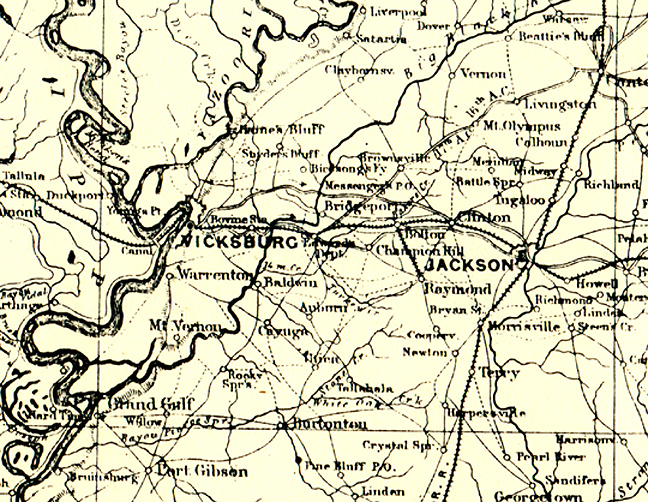
In the spring of 1863, the war dividing the nation focused on Vicksburg. Lincoln told his civilian and military leaders, “Vicksburg is the key!” Confederate President Davis was of the same mind: “Vicksburg is the nail head that holds the South’s two halves together.” In Confederate hands, Vicksburg blocked Union navigation down the Mississippi and allowed communications and reinforcements from Confederates to the west. The natural defenses of the city were ideal, earning its nickname of the Gibraltar of the South.
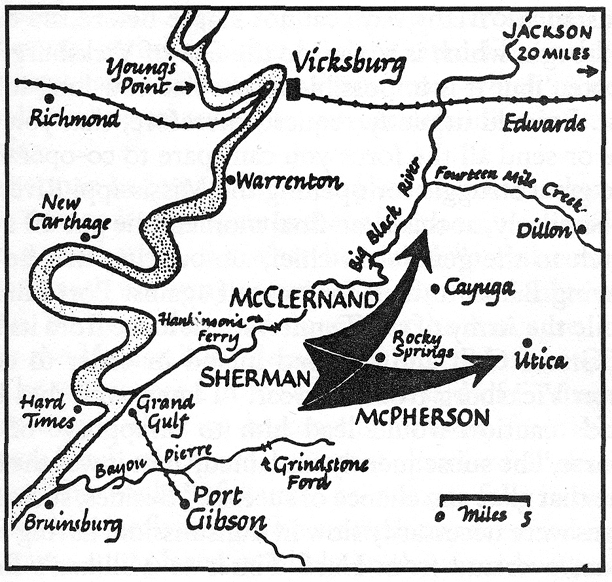
Frustrated in his former attempts to take Vicksburg, the Battle of Port Gibson (May 1) gave Union General Ulysses S. Grant a much-needed foothold on the eastern bank of the Mississippi south of the city, but Grant needed a base north of Vicksburg that could be supplied via the river from Memphis and Port Hudson to subdue the stronghold.
 Grant’s Confederate opponent in the campaign, General John C. Pemberton, was of the same mind: “To take Vicksburg, to control the valley of the Mississippi, to sever the Confederacy, to ruin our cause, a base upon the eastern bank immediately above (Vicksburg) was absolutely necessary.” Pemberton admitted that such a move on the part of Federal troops “might destroy Jackson and ravage the country”, but “that was a comparatively small matter.” Though Jackson had the only secure railhead east of Vicksburg, a vital connection to the rest of the Confederacy, Pemberton, a Pennsylvanian who had taken up rebel arms, thought little of Mississippi’s capital city on the Pearl in comparison to his vital command on the Mississippi.
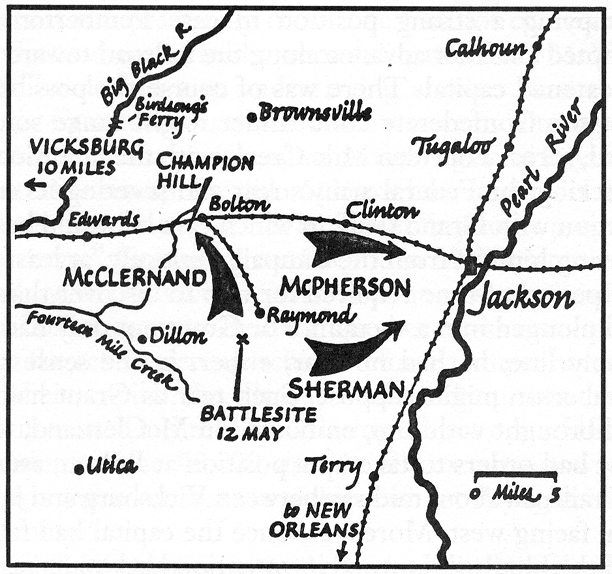
To secure this hypothetically crucial base above Vicksburg, Grant, along with his trusted lieutenant William T. Sherman, moved the Army of the Tennessee to the northeast, and on May 12 headquartered his troops at Dillon Plantation some 6 miles west of Raymond. About sundown, as the camp was settling in to its evening routine, an excited courier drove his lathered horse into camp and poured out the news that Federal troops under Maj. Gen. James B. McPherson’s XVII Corps had encountered a large Confederate force commanded by Brig. Gen John Gregg at Raymond, defeating it after a savage battle. “When the news reached me of McPherson’s victory at Raymond,” Grant later wrote, “I decided at once to turn the whole column towards Jackson and capture that place without delay.”
 At first little more than a dot on a map in the mind of the great Union captain, Jackson now came into focus for Grant as a military objective. He had become convinced that Confederate forces assembling in or near Jackson might be stronger than he had initially supposed, and he had reports of reinforcements pouring into the city, including Gen. Joseph E. Johnston, the Confederate commander of the Department of Tennessee and Mississippi. Johnston was widely respected by his troops, fellow officers and even President Davis, with whom he had an acrimonious relationship.
These reports put at risk Grant’s proposed crossing of the Big Black near Edwards, a move designed to bring his troops north of Vicksburg, since it would leave a potentially strong army commanded by a reputedly able general on his rear flank. He now saw more clearly the city’s value as a communication and transport center through which supplies of men and war materials could be funneled to Vicksburg. In addition, destroying Jackson, which also had some importance as a manufacturing center (mostly of cloth), would cripple the state’s ability to supply the rebel army. It’s reasonable to assume that Grant would also be aware of the impact on morale that the capture of the capital city of Mississippi, the home state of President Jefferson Davis, would have on the Confederacy as a whole.
 Grant was confident that he could take Jackson then swing his forces back to the west before Pemberton took notice. It was an audacious ploy; by this move to the northeast of Port Gibson, Grant had cut himself loose from his base, but the Northern general had learned to provision his troops as they marched, taking what they needed from the farms and villages they encountered, and the Union army found plenty to sustain their progress. Because the city was reputedly heavily fortified, he decided to strike with his entire army, 10 divisions, some 40,000 men. Grant positioned McPherson to the north and Sherman to the south of his eastern advance towards Jackson, positioning Gen. John A. McClernand on the western flank, facing any possible attack from Pemberton’s troops in Vicksburg.
Jackson, at the outbreak of the war, had a population of 3,191 (Vicksburg had 4,591 and Natchez, the most prosperous city in the state, 6,612.) The city’s arsenal had been destroyed in a disastrous explosion the previous November; Confederate troops stationed there for its defense numbered some 6,000. Well before the final advance of Federal forces, the city seemed to have resigned itself to subjugation. As early as May 2, Pemberton (ever the fatalist) telegraphed Governor J.J. Pettus, advising him to remove the state archives from the capital. By May 6, people began leaving Jackson. The Mobile Register and Advertiser reported, “The trains for the interior are crowded with non-combatants, and the sidewalks blocked up with cases, barrels, old fashioned trunks and chests, which look antiquated enough to have come out of Noah’s Ark.”
 By the time Johnston arrived to take command of the city’s defense on the 13th, all who had the means to escape the city had done so, and the Confederate commander’s assessment of his chances to save Jackson could not have been buoyed by the then funereal aspect of the beleaguered capital. Johnston knew his situation was dire; Pemberton had refused his request for reinforcements from Vicksburg the previous week, and the additional troops promised by his superiors had yet to arrive. Johnston was met in Jackson by Gen. Gregg, who was forced to retreat to Jackson with his 3,000 soldiers after the fierce encounter at Raymond. Faced with a two-pronged Union attack by able commanders leading some 25,000 troops and with no time to organize any reasonable defense, Johnston, a seasoned general and career solider, retreated to the northeast.
On May 14, Union forces advanced towards Jackson in a deluge turning roads that had choked them with dust for weeks into trenches of shin-deep mud. After two short skirmishes lasting less than four hours, Grant’s troops entered a silent Jackson under a pouring rain. The Battle of Jackson, such as it was, had ended. Rails and bridges were destroyed, factories put to fire. Vicksburg’s artery to the east was cut; in less than two months, the Confederate Gibraltar would fall into Union hands. Jackson, abandoned by its defenders and occupied by a hostile army, was looted and burned by soldiers and civilians alike for the first of four times, bitterly earning its nickname: Chimneyville.