Ron Shapiro

A Southern Gallimaufry
Parochialism is endemic in rural America, and though Southerners are of a naturally hospitable nature, they and Mississippians in particular have an acquired sense of xenophobia engendered by their brutal treatment at the hands of outsiders, most especially writers.
In the case of Mississippi, perhaps the most stupefying example of such mistreatment comes from Bill Bryson, a native Iowan and former chancellor of Durham University, U.K., who recounts his visit to Mississippi in The Lost Continent: Travels in Small-Town America, in which Bryson chronicles a 13,978 mile trip around the United States in the autumn of 1987 and spring 1988. Bryson’s tale of his journey through Mississippi is as full of bile as most American writers who venture south, packed with shopworn stereotypes and clichés, saturated with ridicule and derision. He left Mississippi with impressions of the state that are what we have come to expect of most people who visit with baggage consisting of preconceived prejudices and with no desire to do anything more than capitalize upon the surety that their condescension would be well-received by the world at large.
That same summer of 1988, V.S. Naipaul visited Jackson during a tour of the American South that resulted in his travelogue A Turn in the South, which was published the following February. Naipaul, who was awarded the Nobel Prize in 2001, had by that time achieved international recognition as an observer of post-colonial politics and societies. It was in this vein, that of an observer, that Naipaul visited the South, ostensibly to compare it to his own Trinidadian background. Though the issue of race was of obvious interest, the importance of race seems to move further to the background as the work progresses, and Naipaul finds himself increasingly preoccupied with describing the culture of the South, including country-western music, strict Christianity, Elvis Presley and rednecks. This shift of focus seems to take place largely in the section on Mississippi. Entitled “The Frontier, the Heartland”, his visit to the state is for the most part restricted to Jackson, where he becomes captivated with a character he calls Campbell, from whom he received a description of rednecks that fascinated and entranced Naipaul to the extent that he seems to become obsessed (he describes it as “a new craze”) with rednecks not merely as a group or class of people, but as almost a separate species; when someone tells him that “There are three of your rednecks fishing in the pond,” he “hurried to see them, as I might have hurried to see an unusual bird . . .”
Then we have Richard Grant, whose primary if not unique distinction among outside observers of Mississippi is that he did not “just pass through”. Grant is still here, though no longer in Pluto. He also sounds like a nice fellow, and his tale of buying a home on the fringes of the Mississippi Delta has a somewhat beguiling innocence about it, reminiscent of that involving a certain young lady who fell down a rabbit hole. Indeed, his story has a few other holes in it, not the least of which is why Grant, a British travel writer formerly based in Tucson but living in New York decided to “buy a house and move to Mississippi”. Some might find simply visiting here in character for a travel writer; after all, Mississippi, a state of overwhelming poverty with a stratosphere of commanding wealth, does have a perverse sort of attraction for people in search of something off the beaten path as well as a solid claim to have produced one of the most enduring and influential musical genres of any century, but the most embarrassing legacy of blues music and one augmented by Delta writers themselves (no surprise there) is the myth of the Delta as “the most Southern place on earth”, when in reality it’s just as full of “poverty, faith and guns” as any other neck of the woods between Annapolis and Austin.
Three clues as to why Grant came to Mississippi to live and write are his friendship with a Delta food maven with a national profile whose well-to-do father just happened to have a high-end fixer-upper to sell in a hamlet on the eastern bank of the Yazoo River, a pixilated party with the Usual Suspects at Square Books in Oxford and Grant himself, a talented and hard-working writer with an ear for blues music as well by all appearances a bit of capital and no small amount of time on his hands. If those aren’t compelling components for a new book about the Mississippi Delta, then I challenge you to fabricate more plausible ones.
Grant is a fine writer with an amiable voice, but there’s a lot to get past in Dispatches from Pluto. He understands the intensity of isolated people and knows that in such empty places minds fix on petty matters, but in Mississippi he seems to have lost his compass on what is petty and what is not. Granted, travel writers should employ a degree of objectivity, but at some point the observer must become engaged, and throughout this book I kept asking myself, “Where is Richard Grant?” The answer is that he was making a living on many levels, steadily at work not only on what eventually became Dispatches but also on any number of other projects, including making the house he bought habitable, an effort that took an increasing amount of time and money, surely trying not only his patience but that of his long-suffering companion Mariah, not to mention Savannah. His engagement with the Mississippi Delta is in the most basic sense one of making do and getting by, one to which by his own accounts he as a free-lance writer is well accustomed and one well understood by Mississippi’s native residents. It’s worth suggesting that this is the reason he came and stayed, though there’s far more to it than that. A man such as Richard Grant does not lead a simple life.
This is not to say that all else in Dispatches is window-dressing, but much of it can be dismissed as such. One reads a great deal about the people, places and things in the Delta that any Mississippian or for that matter most people in the South or even the nation might find iconic to the point of cliché; the same tired recitation of the rich, sophisticated upper crust and poor, simple lower crust, the same circuitous itinerary of colorful towns and villages, the same boring assortment of restaurants, juke joints and run-down architecture as well as the obligatory nods to racial tension, a whole slew of blues musicians, firearms, possums and raccoons, alligators and snakes, cotton, sweet potatoes and catfish. In Dispatches from Pluto you won’t find any airy odes to the union of earth and sky or muddy elegies on the preponderance of the past; such things are no doubt within Grant’s ability, but that’s just not his style. He is a journalist at heart, a documentarian, if you will.
Curtis Wilkie likens Dispatches to Innocents Abroad, which might be more apt than it appears on the surface; Twain was of course far from innocent, and one suspects that Grant’s placid detachment is a mask for the sort of ferocious cynicism Twain himself often employed, but cynicism doesn’t seem to be Grant’s style either. He is a camera with a finely-ground lens, and this is why you should read this book, particularly if you are from Mississippi: to see Mississippi through the eyes of another person who came here not to deride or ridicule but for an account of how it is being here, or in Eliot’s fortuitous phrase, to explore and perhaps arrive where we started and know the place for the very first time.


Kudzu Kings began their reign on a stretch of Harrison Street that descends east of Lamar down to South 14th through and into Oxford’s arguably greatest band venue, fostering ground for a rockin’ Southern music culture.
At the top of the hill, Proud Larry’s; at the bottom, The Gin—the matriarch of Oxford’s bar scene—and in between was Ireland’s (later Murff’s, and now Frank & Marlee’s). While Ireland’s has been unjustly derided as a “blue-collar bar” and because of its lack of pretention (pool tables, dart boards, and Lance snacks) had its share of bubbas bellied up to the bar, at any given time you’d find people from all walks of life there swilling beer (among them Larry Brown) and at night listening to some of the best music in Oxford.
Singer and rhythm guitarist Tate Moore and bass player Dave Woolworth, affectionately known as “Kudzu Dave,” who had a weekly gig at Ireland’s, hooked up with electric guitarist Max Williams, formerly of The Mosquito Brothers, a New Orleans-style funk band. Williams drafted Mosquito Brothers drummer Chuck Sigler and keyboardist Robert Chaffe. “We merged both bands because Tate was playing with Dave, doing the acoustic thing,” Williams said. “So I was like, ‘Hey, I know some other cats that know how to play music, why don’t we just make a band out of it?’” They were soon joined by George McConnell, a co-founder of Beanland, Oxford’s premiere band during the late 80s and early 90s.
 This lineup was the root of the Kudzu Kings (the origins of the name are a matter of dispute) in late 1994, and they soon spread up and down Harrison Avenue. “You know, what’s interesting was that it was really like ‘The Battle of Harrison Avenue’ for where the Kudzu Kings would play that week,” Moore said. “It was between the Gin, Ireland’s, and Proud Larry’s. I think there was actually a week or two when we played all three places.”
“We were still doing a house band sort of thing every week at Ireland’s, which was pretty much a bar locals went to, our friends,” Williams said. “But little by little the college kids started to realize how much fun it was, and they started coming too. Soon we had all kinds of people having fun and that’s when we started having to find places big enough for everybody.”
“It was Mondays at the Gin, Tuesdays at Ireland’s,” Chaffe said. “Every week, that was a given; Larry’s would be somewhere in the Thursday, Friday, Saturday mix. “We had a lot of gigs in the early days, and we developed a good chemistry early on. Packing the Library (a large venue west of the Square) came a bit later.”
 The group has described their music as “funktry,” a unique version of syncopated country that nobody had really done before (“Except for maybe those groovy 70s era recordings from Willie Nelson,” Chaffe said), with an infusion of muddy New Orleans funk that got people moving. The lineage of Kudzu Kings is easily traced to The Tangents, a subject of legend across the state and beyond. The Tangents brought their own spectacular blend of blues, jazz, and rock to Oxford many times in the early 80s and sowed the seeds that sired Beanland.
“When I was with Beanland, we were trying to be the Tangents,” McConnell said. “With their soul, their camaraderie, their stage presence, they were a huge influence on me when I got here to Ole Miss in 1981, and when I caught them at the Gin, I was like, ‘Who ARE these guys?’ They were the Bad Boys from the Delta, man. They could play those old songs as well as anyone could, plus they did it with their own style. Beanland had some legendary shows with the Tangents at Syd & Harry’s; we’d swap sets, but they always closed the show and ended up mopping the floors with us. That carries on with the Kudzu Kings, so we’re going to do a couple of Duff’s songs, ‘Peace Lily of the Valley’ (about a bend in the Sunflower River) being one of them, another being ‘234’ (a room number at the Holiday Inn in Greenville).”
 Kudzu Kings’ biggest early break came in 1996, when they opened for Widespread Panic at Mud Island in Memphis. “That’s when we fell into it,” Tate said. “I remember seeing Jeff Bransford backstage and he was like ‘Hey man, how did you guys swing this?’” They have shared the stage many times with Widespread Panic (McConnell eventually joined up with Widespread Panic in 2002, but has since left). Kudzu Kings toured together for almost ten years (1994–2003), garnering a significant following in their native South as well as in Colorado and Texas playing at several big music venues and sharing stages with the likes of Bob Weir, Leftover Salmon, Ratdog, Jimmie Dale Gilmore, Junior Brown, and Aquarium Rescue Unit. The band has also collaborated with musicians such as Chris Etheridge, Bucky Baxter, John “Jojo” Hermann, Cody Dickinson, and Tony Furtado.
Kudzu Kings (1997), their debut CD, was produced by Grammy Award-winner Jim Gaines. In his review at Allmusic.com, Richard Foss said, “Picture in your mind a really good country band that has been playing the biker bar scene for a while.  They’re tight and energetic and rowdy, and everybody works together really well. Now lock that band in a room with a whole bunch of Grateful Dead and Phish CDs and several dozen cases of beer, and tell them that they can only come out when the beer is gone and they have heard every album at least twice.” Foss called their music a mix of honky-tonk, country-rock, and jamming. “Many of the songs will be about getting drunk, getting laid, and being broke,” along with ones about relationships (“It’s a Play,” “Streetwalkin’”) and free verse set to music (“Amsterdam”), but Foss concedes that “the focus is on party music … The track that pushes this over the edge to greatness is ‘I Love Beer.’ ” Other crowd favorites are “Panola County Line” and “Mississippi Mud.”
 By this time, Kudzu Kings were playing places such as the Varsity Theater in Baton Rouge, Tipitina’s in New Orleans and Newby’s in Memphis, as well as venues in Colorado such as The Fox and Boulder Theatres in Boulder and The Gothic Theater in Denver. Y2Kow (1999), the band’s second release, was co-produced by the band and Jeffrey Reed of Black Dog Records. By then the first of many changes in the lineup had taken place, with Ted Gainey replacing original drummer Chuck Sigler, and Bryan Ledford, a protégé of bluegrass musician Ed Dye, replacing Max Williams. Ledford brought an element of both bluegrass and gospel to the Kudzu Kings’ sound, and Y2Kow included new favorites like “Hangover Heart” and “Bound for Zion.”
 After their watershed 2000 performance at the Red Rocks Amphitheater in Morrison, Colorado—again opening for Widespread Panic—the Kudzu Kings found themselves at a crossroads. Resisting offers of a nation-wide tour, the band endured further lineup changes and decided to mostly book shows themselves. They toured heavily, but not for long. By 2003, the wear of nine years on the road was showing, the crowds were smaller, and a third album was cashiered. Since that time, the band’s members have for the most part moved on to other projects, but they still play together, keeping the brotherhood alive. While Proud Larry’s is going strong, the down Harrison Street scene is gone, but that sound lives on, and after twenty years, Kudzu Kings are bringing it back to Oxford with a show at the Lyric Theatre on Van Buren Nov. 28.
“I want to warn everybody that Dave Woolworth has gathered up jugglers, fire breathers, dancing girls, and nubile young ladies to serve drinks. Not only that, we’re holding a lottery for a tea cart we’ve been threatening to give away for years,” McConnell said. “We’re bringing in about every drummer we’ve ever played with, most all of the guitar players from over the years, lots of guests to sit in throughout the event, trying as best we can to begin with the songs we started with and move through the history of our music. We hope to show that there isn’t a band without progression.”
 “This is the first time we’ve ever been really able to capture the group in all of is different phases,” Chaffe said. “Most of our former members are coming back, so it really feels like family when you go back twenty years and think about all the people that have gone in and out, all the relationships we’ve had. It’s going to be neat to bring this all together on an emotional level on top of the purely musical statement. I didn’t envision myself in Oxford twenty years later, but it just so happened that the relationships that were made as a direct result of being in this band have shaped my life in more ways than just the band itself.”
“It’s only been a good time,” Woolworth said. “In all marriages you grow, and when you’re a band, in a sense you’re married to everybody else. We’re still able to do things together. That’s exciting.”

All photos courtesy of Kudzu Kings.


With Beanland: Rising from the Riverbed, Scotty Glahn and Kutcher Miller have distilled the essence not only of a hot jam band but of a special milieu. 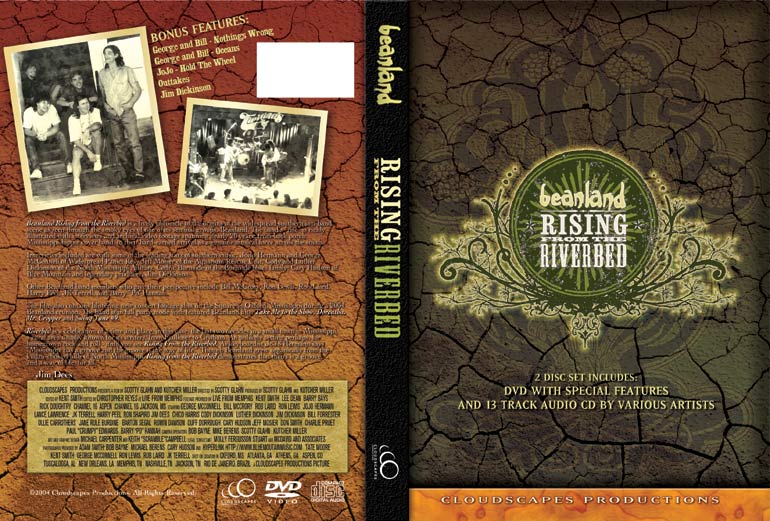 Art fares best in an open forum, and in the 80s and early 90s no freer field could be found than in Oxford, Mississippi, where a variety of thriving businesses supported an eclectic marketplace for invention that Mississippi will never see the likes of again. In those halcyon days, Willie Morris, Barry Hannah and Larry Brown contributed their literary wattage to an arts scene already illuminated the bright musical lights of the Hilltops/Blue Mountain, the North Mississippi Allstars and, of course, Beanland. It was a heyday of the muses; throw in a couple of Jere Allen’s brilliant brushstrokes, and you have nothing short of a red clay Parnassus.
Rising from the Riverbed attempts to and largely succeeds in capturing the freewheeling, lackadaisical and somewhat dissipated spirit of that time and place. This achievement proves to be somewhat of a drawback, however, since the result is a roman à clef best appreciated by those who were there then and know or knew members of the cast of characters. It’s an insider’s view into a seminal period in the cultural life of Oxford. Interviews add to the film’s appeal (Barton made the cut). Nostalgia is not a bad thing, especially when it’s worked out so carefully and lovingly. Allow me to tip my hat to Glahn and Miller not only for recognizing Beanland as worthy of a broader stage, but also their foresight in documenting a very special time in a very special place.