The Siege of Jackson

In the Memorial Hall Foundation Museum in New Orleans sits a chunky Chickering “square” parlor piano manufactured in Boston in the 1840s. The piano, the former proud possession of the Cooper family of Jackson, Mississippi, once helped to shore up a Civil War redoubt facing south along the Jackson Railroad line. The fortification was manned by the Fifth Company Washington Artillery, part of General Joseph Johnston’s Confederate “Army of Relief” defending Jackson against Sherman.

On the sweltering morning of July 12, the Confederates began playing the piano, oblivious to the Federal line advancing on their position. The men sang songs of home as their skirmish line was pushed back behind the redoubts, and while the men were called to their guns, the pianist, Private Andrew Swain, began playing “You Shan’t Have Any of My Peanuts.” The attack began, but the Confederate line held, and Swain resumed his place on the piano to play “Oh, Let Us Rejoice.”

The saga of the Cooper family’s piano is just one of the many wonderful stories that enrich Jim Woodrick’s The Civil War Siege of Jackson, Mississippi, an account of Sherman’s little-known and less-documented attack on Mississippi’s capital after the fall of Vicksburg in July, 1863. The Siege of Jackson, as Terrence Winschel observes in his introduction, was “the final, yet seldom mentioned scene of ‘the great drama’—i.e. the campaign for control of the Mississippi River.” The capital of Mississippi became, for that week, a battlefield. Its capitulation capped Grant’s victory at Vicksburg, put a black band around the Confederate war effort, and reduced the nascent city of Jackson to smoking ruins.

In the spring of 1863, the war in the west focused on Vicksburg. Lincoln told his civilian and military leaders, “Vicksburg is the key!” Confederate President Davis was of the same mind: “Vicksburg is the nail head that holds the South’s two halves together.” In Confederate hands, Vicksburg blocked Union navigation down the Mississippi and allowed communications and reinforcements from Confederates to the west. The natural defenses of the city led to its nickname, the Gibraltar of the South.

Earlier in the Vicksburg Campaign, Union General Ulysses S. Grant became convinced that Confederate forces assembling in or near Jackson might be stronger than he had initially supposed. The eradication of Jackson was essential for two reasons: first, Jackson was a focal point for the relief of Vicksburg, with a railhead and the entire Confederacy behind it; secondly the destruction of the capital city of President Davis’s home state presented a significant opportunity to demoralize Confederate leadership and the Confederacy itself.

In a torrential downpour on May 14, 1863, Grant’s men drove through Johnston’s weak defenses and captured Jackson. To conserve his forces, Johnston abandoned the city and withdrew to Canton. Weeks later, after Grant besieged Vicksburg, Confederate Secretary of War James Seddon urged Johnston to relieve the river city. Seddon, however, refused to send Johnston reinforcements, and Johnston declared that “saving Vicksburg is hopeless.”

Nevertheless, in mid-May, when General William Loring and some five thousand Confederate troops entered Jackson, Johnston set about organizing a relief column. On June 28, he began moving west, and advanced as far as the Big Black River only to discover that Vicksburg had fallen on July 4. Johnston retreated to Jackson, fortified the city, and by July 10 was invested by greatly superior Union forces under William T. Sherman. The siege of Jackson had begun.

Map by Howard Bahr

For Jackson readers, The Civil War Siege of Jackson, Mississippi—hereafter, The Siege of Jackson—brings the violence of a hundred and fifty-six years ago to street level. Novelist and historian Howard Bahr observes that few current residents of Mississippi’s capital city are aware of the dramatic events of July, 1863: “The reader may well be surprised, as I was, by the scope of this operation and the great violence and loss of life that occurred on the ground we walk over every day. Jim Woodrick’s account, well-written and meticulously researched, offers for the first time a detailed, comprehensive narrative of the weeklong siege supported by maps, period drawings, an Order of Battle, and photographs. The account is enlivened by humorous anecdotes and, more important perhaps, a focus on individual participants and the personal tragedies of soldiers who died far from home.”

The Siege of Jackson is very much a work of scholarship. Terrence Winschel, author of the introduction, has recently retired as the Chief Historian of the Vicksburg Military Park; Woodrick, a native of Meridian, graduated from Millsaps with a degree in political science, was active in the Jackson Civil War Round Table, and is currently the former Deputy State Historic Preservation Officer at the Mississippi Department of Archives & History. Woodrick said he decided to write The Siege of Jackson for two reasons.

First of all, only one book has been previously published that covered the Jackson campaign and the subsequent siege, and that book, published in 1980 by the Jackson Civil War Round Table, combined the siege with the May 14, 1863, battle of Jackson, When I first started exploring the possibility of a book on Jackson, it was actually intended to be an updated version of that book with one of the original co-authors, Warren Grabau. Unfortunately, Warren passed away before we could tackle that project and the idea went to the back burner for a time.

But the idea of writing about the Siege of Jackson stayed with me,” Woodrick said, “and the more I studied the campaign the more I felt it deserved to be studied on its own. Considering that I work next door to the Old Capitol Museum – essentially in the middle of the siege lines – I thought it fitting that I be the one to tell the story of the approximately 70,000 men – blue and gray – who fought for a week in July 1863 for control of Mississippi’s capital city.

Woodrick’s retelling of the siege is a significant upgrade from that of Bearrs and Grabau, who primarily concentrate on military aspects of the action. Woodrick’s version is far more inclusive, incorporating, vivid descriptions of the action, details of the terrain, conditions and armaments and profiles and accounts of individual soldiers and commanders. It is an essential book for Jacksonians interested in the city’s history and is highly recommended for anyone interested in the Civil War. Woodrick went on to say:

When I started working on the book, I was perhaps most interested in the two army commanders involved in the siege,” Woodrick went on to say. “Sherman and Joseph E. Johnston would meet again, but the Jackson Campaign is actually the first time they faced each other, and the siege of Jackson is, I think, an interesting look into their leadership abilities at this point in the war.

Woodrick writes for readers interested in military history and tactics, a demanding audience indeed. Woodrick rises to the occasion by describing in detail the most significant—and bloodiest—action of the week-long siege: Union Brigadier General Jacob Lauman’s calamitous assault on Breckinridge’s Division in the Confederate redoubt southwest of the city where the entrenched Washington Artillery manned two James rifles, four Napoleons, and a Chickering piano.

Woodrick ensures the book’s broader appeal by positioning the siege of Jackson within the framework of the Vicksburg Campaign, which is—to Mississippians, at least—the most familiar military action of the Civil War. Woodrick underscores the importance of both the Battle of Jackson (May 14, 1863) and Siege of Jackson as components of Grant’s successful Siege of Vicksburg and Union domination of the Mississippi, in both instances to eradicate Jackson as platform for Confederate forces. Woodrick says:

In a cursory sense, I suppose the campaign could be viewed as simply a rearguard action, but I think that’s selling it far short. In reality, the Siege of Jackson is the exclamation mark at the end of the Vicksburg Campaign. Having finally achieved the long-sought goal of capturing Vicksburg, Grant simply could not ignore Johnston’s still-intact army looming to the east, and in that sense, I think it was critical to the ultimate success of the Vicksburg Campaign. Unfortunately, because of events in Pennsylvania (i.e., Gettysburg), the Jackson Campaign in many ways gets overlooked by historians (and at the time), especially since the siege didn’t end in a grand charge or the capture of an army (as at Vicksburg). That doesn’t diminish the importance of the campaign, however, in finally securing the Mississippi River for the Union.

The fall of Jackson affected Mississippians viscerally. Jefferson Davis wrote in July, 1863, “In these times of disaster, when my relations and nearest friends are the objects of most cruel animosity, when my beloved Mississippi is being overrun by the invader, I deeply feel my want of that sustaining power which had in times past upheld the just cause, and given to the weak the power to defend the strong.” Even after Vicksburg’s capture, the fall of Jackson sent a shudder throughout the Confederacy.

While Sherman and Johnston are key players in Woodrick’s bloody drama, the central player is the city of Jackson itself. “As the book progressed, I think the most interesting ‘character’ to emerge was the city itself and, of course, the stories of the common soldiers who served here and–for some­–who died here,” Woodrick said.

One of the main points that I intended to make when I began the book was to disprove, once and for all, the story of “Chimneyville”. Based on a number of factors, I was convinced that the oft-told stories of Jackson’s destruction were in large part myth. As I looked closely at the evidence, however, I discovered that the opposite was true–that Jackson and her citizens did indeed suffer catastrophic losses as a result of the siege, both from Union soldiers and Confederate troops. As a result, Jackson was in large part reduced to rubble.

Charred ruins of Bowman House Hotel with Capitol Building.

Sherman’s signature scorched earth policy was initiated in Jackson. Bruce Catton, in Grant Moves South (1960), writes, “every installation which might conceivably be of use to a struggling Confederacy were destroyed with grim effectiveness. Sherman reported to Grant that ‘Jackson cannot again become a place for the assemblage of men and material with which to threaten the Mississippi River.’ private soldiers looked at the wreckage and gave Jackson the descriptive name of ‘Chimneyville,’ and on July 23, Sherman pulled his army back. He left a desert behind him.”

Contemporary accounts of the devastation are hyperbolic. Although Sherman assured Mayor Manship and a committee of twenty prominent citizens that “all citizens acting in good faith will be respected by me and my command,”  George Whitman, a soldier in the 51st new York Infantry and the younger brother of poet Walt Whitman, reported, “Soon after we entered [the city], the western troops began to come in and they ransacked and plundered completely.” Another Union soldiers reported, “I never saw or heard of a city being so thoroughly sacked and burned as this place.” Contemporary newspapers also confirm the devastation. The New York Herald: “As our men would reach private dwelling houses they would enter them and in a short time scenes of the most unmitigated plundering took place.” The Memphis Bulletin: “Lazy, contemptible stragglers could be seen. . . engaged in dividing their ill-gotten plunder, which consisted of fine silks, shoes, ladies’ bonnets . . . my pen can never record what outrage was done that day.

The following eyewitness account appeared in the Canton American Citizen while Sherman’s troops were still tearing up the railroad: “One must visit Jackson to learn the extent of the destruction it has sustained. It is a mere wreck of its former self . . . look in whichever direction you may from the front of the Capitol, ruins meet the eye. The numerous chimneys still standing upon burnt districts and the undisturbed debris of charred walls and destroyed wares will remain until the end of the war, silent but terrible monuments to the devastating inroad of the vandal hoards. . .”

Woodrick’s portrait of pre-war Jackson at the outbreak of hostilities in the 1860s reveals it to be a provincial town that became a capital without ever becoming a city. Jackson had barely begun to build before it was destroyed. By 1866, “Chimneyville” was on the mend. Woodrick includes a panoramic photograph of Jackson taken from the cupola of the state capitol in 1869 as documentary evidence of an “expanding but still somewhat rural city” and dismisses doubts the photograph might raise about the actual extent of damage to the city by reference to the “overwhelming number of primary accounts and evidence of rebuilding found in newspapers of the period.” Finally, Woodrick provides us with what few physical reminders of the siege that remain, and concludes:

Jackson has not changed to such a degree that the battlefield cannot be understood, and there are areas throughout Jackson where interpretation could be used to explain what took place. Such an effort would in some small way help in remembering the sacrifices made by the men in blue and gray during those hot days in July 1863. We owe them nothing less.

Favorite Cookbooks of Mississippi Chefs

Vishwash Bhatt: (Snack Bar) Bill Neal, Southern Cooking; Ben and Karen Barker: Not Afraid of Flavor: Recipes from the Magnolia Grill; Norman van Aken, New World Kitchen; Floyd Cardoz, One Spice Two Spice: American Food, Indian Flavors; John Currence, Trailgreat: How to Crush It at Tailgating; Lafcadio Hearn, The Times-Picayune Cookbook; Irma Rombauer, The Joy of Cooking. And obviously, I am a big fan of my own book! (I Am From Here: Stories and Recipes from a Southern Chef)

 Dan Blumenthal: (BRAVO!) La Technique by Jacques Pepin—step by step intro to classic French cooking with many helpful photos; On Food and Cooking by Harold Magee-The Bible of food chemistry; just loaded with knowledge about food in general; The Classic Pasta Cookbook by Giuliano Hazan—Wonderful intro into the world of Italian pasta making

Marisol and Rory Doyle (Leña Pizza + Bagels) We went to Naples, Italy, in 2022 to study at the Associazione Verace Pizza Napoletana (AVPN) and Scuola di Pizzaioli. These are the books we used for research before opening Leña Pizza + Bagels: Flour, Water, Yeast, Salt, Passion – Vera Pizza Napoletana by Carlo Petrini; Flour, Water, Salt, Yeast by Ken Forkish, and The Pizza Bible by Tony Gemignani.

 Alex Eaton: (The Manship) Donal Link – Real Cajun -This is a bad ass book that is spot-on with his recipes.  He really is teaching how to cook real Cajun food.  From boudin to fried oysters it’s my go to when cooking rustic Cajun food. Mike Solomonov – Zahav Cookbook– In the world of Middle Eastern cooking Arab chefs are so secretive; I once tried to learn how to plate hummus and the chef would not let me come back in the kitchen and watch. This book is useful and extremely helpful with his techniques in the secretive cooking of Middle Eastern food. Hot and Hot Fish Club Cookbook, Chris and Idie Hastings; I love this book not only because it goes season by season… but I actually worked here and was impressed that the cooks and prep cooks used the book for their work; often times chefs seem to just guess at these recipes, and they never come out right.

Hunter Evans: (Elvie’s) Two of my favorite and formative cookbooks while learning to cook were Afield, by Jesse Griffiths and Southern Comfort by Slade Rushing.

Martha Foose: (the Bottle Tree Bakery, author of Screen Doors and Sweet Tea) The Inverness Cookbook, The Time-Life Picture Cookbook, and The Better Homes & Gardens Look and Cook Book.

Jeff Good (BRAVO!, Broad Street Baking Company, Sal & Mookies) In the early years of BRAVO!, our twins were toddlers, and my wife was the chair of the Junior League of Jackson Cookbook Committee.  She would spend afternoons with the girls buckled in their car seats and the back of the white station wagon filled with cases of the wildly successful Come On In! cookbook – the second effort by the Junior League at providing households with an abundance of time-tested and tasty recipes great for family meals or fancy parties. She would deliver these books to bookstores, retailers and whoever wanted to carry the cookbook everyone was talking about.

As a part of her work, a lot of these recipes came alive in our kitchen.  I would return home past midnight most nights, and raid the refrigerator for leftovers, often something savory from the pages of Come On In!.  For this reason, when asked what cookbook has been most influential to me, this one wins hands down.

Dixie Grimes: (Sweet Mama’s) These are in no particular order, as I adore all three equally. White Trash Cooking– Ernest Matthew Mickler. This book speaks to my very soul as a southerner from rural Mississippi. One has to understand that this is not a book mocking a poor class of people but a shout out to the most real and righteous cooking of the south. Recipes for Potato chip sandwich, Cooter Stew, 1-2-3-4 cake as well as or most importantly Fried Squirrel, Butt`s Gator Tail and Aunt Donnah`s roast possum.

It is all about necessity, using what you have, not what you want and making it taste good. Betty Crocker`s Picture Cookbook circa 1950. This book was geared towards the 1950`s housewife, an era of three martini lunches, church socials, afternoon bridge games and cocktail parties and the perfect Ozzie and Harriet housewife/mother who flawlessly executed them without so much as a wrinkle in her skirt: simple, yet elegant. The recipes consist of all things souffléd, scalloped, congealed and supremed. Canapes and sparkling punch with sherbet is what’s up.  As a chef I adore the nostalgia this book holds, and the old school feel of classic recipes no longer in use like Pompano En Papillote and Seafood a la Newberg.

The Joy Of Cooking: The title says it all, cooking can be fun and easy it does not have to be a chore or dreaded task. This is the book that I give to all young couples starting out and to anyone who says, “Hey, I would love to learn to make some basic dishes but just do not know where to start.” I consider this book a staple in my own kitchen. It pretty much has a recipe for ANYTHING one might want to cook as well as covering all basic techniques of baking and cooking, i.e. roasting, boiling, braising, sautéing etc. It explains why things work the way that they do, like why butter needs to be cold for biscuits and pie crust or softened for cakes and frostings. Also included is a fantastic conversion chart for measurements which believe it or not I still use regularly, because like most chefs math is not my strong point.

Jesse Houston: (formerly Saltine) Three cookbooks that had a large influence on my career are Momofuku by Peter Meehan and David Chang, The Lee Brothers Southern Cookbook, and Under Pressure by American chefs Thomas Keller and Michael Ruhlman. I read them all cover to cover and absorbed as much of their knowledge as possible. I’ve cooked more recipes out of Momofuku than almost all of my many cookbooks combined.

I was a kid right out of culinary school when it came out and picked it up because I heard it was a fresh way of looking at food. In the opening pages they were dropping f bombs, and I knew this would be unlike anything I had read before. Being a Dallas native, Southern food wasn’t really easy to come by and I didn’t know much about it, but I was about to relocate to the South to open a revolutionary Southern restaurant, Parlor Market. I read every word in the Lee brothers’ book, and I was able to get comfortable with ingredients I had never used before in my life. It should be considered a Southern cook’s bible.

Under Pressure is a book all about advanced cooking techniques used in a modern kitchen, most noticeably sous vide. Although I don’t use sous vide much anymore, it taught me so much about modern cuisine. Currently I’m influenced by books from Noma and Rene Redzepi for their beautiful simplicity and natural approach. They use a lot of modern techniques as well, but hide them in ways that will surprise you, but also seem incredibly natural, as if it were found in nature that way.

Lou LaRose: (Lou’s Full-Serv) I can tell you that Larousse Gastronomique was the first book I ever got. My dad gave it to me back in the early 90’s. From there I was intrigued by lots of the recipes. Old school French was definitely a favorite of mine. I was also very fond of the early “great chefs” shows. I collected all of the books from San Francisco, New Orleans. Chicago etc. James Beard’s Beard on Bread was a hand me down from my grandmother, and I cooked many things from that as well.

April McGreger: (author, The Complete Guide to Canning and Preserving (Centennial Books), and Sweet Potatoes (UNC-Press) By the time I was 12 years old, I was proficient enough in the kitchen that I could follow my mother’s index card recipes for easy weeknight meals, mostly either casserole-style bakes like chicken and rice or smothered cabbage. I was a young teenager when I decided I wanted to learn how to make chicken spaghetti. I had it at a church supper and came home to ask and my mama why she’d never made it. “You make it!” she responded. I think there’s a recipe in Pick of the Crop.”

The Pick of the Crop was the cookbook most important to my development as a cook and, particularly, as a Southern cook, is. It was published the year after I was born in 1978 by the North Sunflower PTA of Drew, Mississippi. I do not know the details of the book’s journey out of the Delta and 100 miles east to the red clay hills of Mississippi in which I was raised, but it was hands down the most constant source of recipes that sustained my family. My mother’s copy was littered with her left-handed checks and notes like “try this!,” “soo good!,” or “easy!”. Mark’s Chicken, Cabbage Casserole, and Sausage-Rice Casserole were all in regular rotation on the McGreger supper table, but the first dish that I personally ever became known for was Mrs. Archie (Olivia) Manning’s Chicken Spaghetti I. I was 12 years old from a family of Mississippi State fans. I didn’t even know who Archie Manning was. Nobody yet knew Peyton or Eli.

But from that recipe I learned the value of stock when I was instructed to cook the spaghetti in the broth in which I cooked the chicken. Years later when I was taught the classic French bechamel and Mornay sauces, I realized I’d been making them since 1989 when Chicken Spaghetti became my signature dish.

Alex Perry (Vestige) Three books stand out: The first two are books that when I finished them, it made me realize how little I knew about food and cooking, which is somehow both innervating and inspiring.

The French Laundry Cookbook (original pressing). During culinary school, a then girlfriend gifted me this book for my birthday. Now attending Le Cordon Bleu, I was very self-assured that I was getting the summation of what French cuisine was…until I parted that iconic cover…here was food that was complex, multi-staged, but so modern, fresh, and clean. Immaculate presentation, but nothing ever seemed ornate or garish…no movement was wasted, no ingredient superfluous. And all rooted in French traditions. I knew then I hadn’t even hit mark twain on what food could be.

Kaiseki: The Exquisite Cuisine of Kyoto’s Kikunoi Restaurant.  One Christmas, Kumi (wife and Vestige co-owner) got me this book to introduce me to the world of high-end Japanese cuisine. Now this book was one where the recipes were tucked away in the back, so when viewing the dishes, you really didn’t know much about what went in to them. To say these plates of food were jaw dropping in their beauty would be underselling it.  Every dish would be right at home adorning the walls of the world’s best galleries. How did they do it?? Surely dishes like this would require massive ingredient lists with days or even weeks of preparation, right? Get to the end…. some dishes would only feature 4 our 5 ingredients total! What?? How??? It became very obvious rather quickly that Chef Murata was operating on a seemingly different plane of existence. The ability to capture the majesty of nature and the seasons with so few ingredients was transformational.

The Art of Living According to Joe Beef: A Cookbook of Sorts. A book about true love for food and those that inhabit a restaurant’s walls. With all the chefs’ witticisms and anecdotes, you learn to just let go and not take yourself too seriously. Food at the end of the day should be fun…enjoy the process, be gracious in all things, and never let self-doubt limit your ability to create.

Taylor Bowen Ricketts: (Fan and Johnny’s) The River Cottage Cookbook by Hugh Fernley-Whittingstall because I love him and the way he cooks, my great-grandmother’s well-documented, preserved and used notebooks that somehow I was lucky enough to inherit, and the St. Stephens’ Episcopal chicks of Indianola, Ms. cookbook, Bayou Cuisine. Delta women are by far and away the best cooks and hostesses, more particular, demanding, and expecting of any women on earth, and rightly so; almost every one of us bitches can cook.

Robert St. John: (Crescent City Grill, Mahogany Bar, Loblolly Bakery, columnist, author) Culinary Artistry by Andrew Dornenburg and Karen Page— My copy is so dogeared and worn. This book probably gets more use than any other in my collection. The recipes and restaurants are dated at this point, but the flavor profiles and dynamics are spot-on and useful. It’s the first book I bought my son when he told me of his desire to go into the restaurant biz. “The Flavor Thesaurus” by Niki Segnit is a newer, more comprehensive, book. I just bought my son a copy of this one, too.

Malcolm White (formerly Hal & Mal’s, host of “Deep South Dining” on Mississippi Public Broadcasting) Jesse’s Book of Creole and Deep South Recipes, 1954; The New Orleans Cookbook by Rina and Richard Collin, 1975; Southern Food by John Egerton, 1987; A Cook’s Tour, by Angela Myers & Susan Puckett (forward by Willie Morris), 1980

Randy Yates: (formerly Ajax, now at large) The Joy of Cooking and the Jackson Junior League cookbook, Southern Sideboards, were always in our kitchen, as was River Road Recipes. I learned how to read from a book version of “On Top of Spaghetti.”

Dog Days

At the height of our summer, the winter constellations begin to be seen in the eastern dusk, which at this latitude (Jackson, Mississippi is 32.2988° N) is between July 21 and August 3,. Among the brightest of these starry arrays is Orion, and close on the heels of the great hunter is his big dog, Canis Major, with the brightest star in the night sky, brilliant Sirius, the Dog Star. With the rise of Sirius our dog days begin, and for the next forty days or so, it’s just hot as hell all the damn time.

Eisenhower Conquers Vicksburg

It’s somewhat of an irony that Vicksburg, Mississippi, a city in rebellion against the United States, surrendered to Union forces under Grant on July 4, 1863, but the city’s citizens and defenders were simply exhausted to the point of desperation by a siege that had lasted forty-seven days, and Pemberton, commanding general of the Confederate forces—himself a native of Pennsylvania—hoped for sympathetic terms from Grant by surrendering on Independence Day. Grant paroled the captured military not because of the date, but because he never imagined that given their state of dejection any would ever fight again (many did, of course, in the coming years).

Thereafter for eighty-two years, until July 4, 1945, a scarce two months after Allied troops under Eisenhower accepted the surrender of the Axis forces in Europe, the city of Vicksburg, Mississippi held no public observance of Independence Day, and even then there were cries of “Sacrilege!” from older residents, and by all accounts the celebration was a muted affair. The following year some attempt was made to make the July 4th celebration more overt, but even then opposition was offered by those who clung to the memory of that summer morning in 1863 when the hungry, weary city garrison of 30,000 laid down its arms and the city silently watched as Grant’s army occupied a city draped not in bunting but in mourning.

Two years later, in 1947, quite a different situation presented when General Dwight Eisenhower, Supreme Commander of the Allied Forces in Europe and current chief of staff of the U.S. Army, accepted invitations from Senator James Eastland, Representative John Bell Williams, and Governor Fielding Wright of Mississippi to make the Fourth of July address in Vicksburg. It’s conceivable that Eastland, Fielding, and Wright extended the invitation in hopes of luring Eisenhower to run on the Democratic ticket, though it’s more likely that the three simply intended to make political hay out of the general’s visit. Ike, on the other hand, a committed scholar of history, was eager to see the military park, which for the record had been established in 1899.

To be sure, Ike had likely been apprised of the holiday’s history in the city, but he was also already treading turbid political waters. Later that month, on July 11, President Truman offered to run as Ike’s running mate on the Democratic ticket if Douglas MacArthur won the Republican nomination, but Eisenhower was still struggling to stay above politics, as had William T. Sherman had upon learning that he was being considered as a possible Republican candidate for the presidential election of 1884. (Sherman declined, saying, “I will not accept if nominated and will not serve if elected.”)

Eisenhower had not announced any party affiliation and cited Army regulation 600-10.18.i forbidding partisan political activity by serving officers. Eisenhower eventually defeated Robert Taft for the Republication nomination in 1952 and won in a landslide that excluded the Democratic Solid South. His running-mate Richard Nixon was to flip affiliation that thirty years later. It must be said that Southern patriotism was certainly well-established long before Ike came to Vicksburg in 1947. Florence King states that the rest of the nation was surprised at the numbers of Southerners who flocked to recruiting stations during the Spanish-American War (1898), but then Havana is on our doorstep, as was dramatically brought back home in October, 1962.

Spanish-American War vet Teddy Roosevelt—whose mother was a Georgia belle—built the biggest navy in the world and expanded U.S. influence over the globe, and Southerners were conspicuous participants in the various chauvinistic, jingoistic isolationist movements that swept the country in the periods leading up to the two world wars, but it wasn’t until after the Allied victory in World War II, and the return of Southern G.I.s from far-flung corners of the earth, that memories Vicksburg and Pickett’s Charge failed, and a new patriotism became entrenched in the Southern Zeitgeist. Vicksburg’s surrender to Eisenhower stands as a watershed for that mindset.

So it was that on July 4, 1947, the city of Vicksburg, Mississippi, instead of laying down its arms, opened them for another U.S. general. An estimated 50,000 people attended the festivities, which included picnic lunches spread in public parks, plenty of florid speeches, miles of bunting, and fireworks over the broad waters of the Mississippi River. The celebration also included a solemn noon-day salute to honor the memory of the Confederate casualties of the siege; the city had forgiven, but not forgotten.

The Hoka’s Hot Fudge Pie

The Hoka had two signature desserts: the New York-style cheesecake made by the Freer sisters, and a hot fudge pie made by Jani Mae Locke Collier. Jani Mae is a native of Oxford. She and my sister Cindy lived together at a big house at the end of North 14th in the mid-1970s when the Hoka started. Jani brought this recipe to the Moonlight when Betty Blair got it going. Jani Mae is married to Emmett Collier, who makes beautiful pottery in Brandon, Mississippi. It’s a very simple recipe, easily made, and best served à la mode.

Jani Mae’s Hot Fudge Pie

1 cup sugar
1 stick butter
½ c. plain flour
5 tablespoons cocoa
2 eggs beaten

Cream butter and sugar, mix well with flour, cocoa and eggs. Spoon into a toasted pie crust. Place in middle rack of oven at 350 until firm in the middle, about 20 minutes or so. Serves four.

Dragon Peach

The sun was well up, blaring over the trees when I parked in front of Rick’s apartment building. He stepped out of his door wearing a straw fedora and linen jacket, worn chinos, and canvas loafers, the very picture of a dirt road dandy gone to seed. Watching him wrangle his legs down the steep stairs, Ricky suddenly seemed frail to me, and I felt a pang in my chest. I’d known hm for less than five years, but in those years, I’d come to love him like a brother; he’d filled my losses, propped me up, and pushed me back into a life I could lead on my own. He claimed to be sixty-eight, but he said a lot of things I didn’t question.

He clambered into my old truck and we headed to Linda’s market north of downtown. The market sits far back from traffic under a long tin roof, a colorful oasis in a dull, hot desert of asphalt surrounded by cars parked without regard to space or bearing. As we drew closer, we could hear the shuffling rattle of a homemade pea sheller.

Under the roof, our eyes adjusted to the shade and found melons mottled and striped, green-upon-green, blazing red cayennes, motley purple peas, and speckled beans. We paused over the corn, looking for fresh ears with tight shucks, green stem ends, and sweet-smelling tassels. We chose cucumbers that were slightly under-ripe, firm, and shading to jade. The tin roof popped as the sun bore down. Ricky walked over to the peaches, rows of baskets filled with Chilton County Elbertas, saffron blushing to carmine, some with stems and leaves. Over these he lingered, walking back and forth, occasionally reaching down to brush one with his fingers, picking another up, holding it to his nose, and putting it down.

I brought him a paper sack and shook it open with a pop. “What do you look for?” I asked.

Ricky snapped out of his reverie, looked at me and smiled. “A dragon,” he said.

“Jackson, Mississippi is nowhere near Middle-Earth, Ricky.”

“Yancy, listen for once,” he said. (As if I didn’t always.)

“The world is full of magical and wonderful things. A few of them amaze you so much you can’t get rid of them,” he said. “Those are the dragons, the ones you keep looking for. I remember this peach from a basket in Tupelo. When I bit into it, suddenly I couldn’t see, I couldn’t hear. That peach just sucked everything out of me, and all I could do was eat that peach, and I’ve spent the rest of my life buying lousy peaches chasing that dragon.”

We loaded our sacks in the truck. As we were pulling onto the highway, Ricky reached into the back, rummaged around and pulled out a peach. He wiped it with the handkerchief he kept in his back pocket, turned it around in his hand, and took a bite. I looked at him expectantly. He smiled and shook his head, rolled down the window, and threw it out.

“I’ll find it one day,” he said, and my heart broke.

Art, Food, and History: a Second Campaign in Vicksburg

As incredible as it may sound to us now, in the 1940s the Old Warren County Courthouse in Vicksburg was under threat of destruction from the very city itself.

The building is perched on the highest point in Vicksburg on land given by the family of the city’s founder, Newitt Vick. Construction began in the summer of 1858 on what was then to be a new Court House for Warren County. Contractors were the Weldon Brothers of Rodney, Mississippi, who used 100 highly skilled artisans to make the brick and erect the building, which was completed in 1860 for a cost of $100,000. During the War, the building dominated the city’s skyline and was the target of much Union shelling but suffered only one major hit. It was here on July 4, 1863 that the Stars and Bars were lowered and the Stars and Stripes were raised as General U.S. Grant reviewed his victorious army.

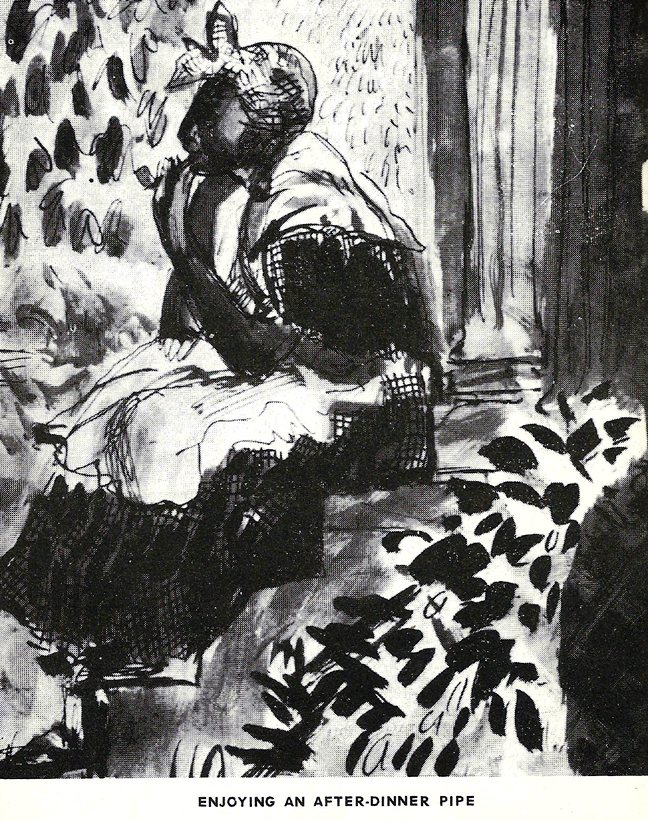
Enjoying an After-Dinner Pipe-Bucci

With the construction of a new Warren County Courthouse in 1939, the Old Courthouse stood practically vacant for years, and there was talk of its demolition. What was possibly planned to take its place on the highest point in the former Gibraltar of the Confederacy goes (perhaps mercifully) unrecorded.

But a local activist, Mrs. Eva Whitaker Davis, realized the significance of the building and established the Vicksburg and Warren County Historical Society for the purpose of preserving the structure. In 1947 she was elected president of the society and with the help of volunteers began cleaning the building and collecting artifacts.

On June 3, 1948 the museum opened its doors, where she continued to work on a volunteer basis for many years. Eva Davis was a local celebrity; she had a daily radio show, “Court Square”, which was a feature of WQBC in Vicksburg for many years. She put out two cookbooks, Court Square Recipes and Mississippi Mixin’s, both likely in the 1950s, though neither book is dated. A grateful public added the name Eva W. Davis Memorial to the Old Courthouse Museum several years before her death in 1974.

Fishing in the Mississippi-Bucci

Mississippi Mixin’s was illustrated by her fellow townsman and renowned Mississippi artist, Andrew Bucci. Sadly, Bucci’s art is reproduced in black and white, but the impact of the images is still powerful, perhaps even somewhat enhanced. Most of Bucci’s artwork in the book is comprised of small images for chapter headings, doubtless resized from larger works, but two large images are printed full-page (5.5×7). Again, dating these works has so far been unsuccessful and it is not known whether the original artwork still exists.

At least one image is by artist Suzanne Wilder, who was a student in the Mississippi Art Colony at Allison’s Wells, a popular resort in Way, Mississippi that was established in 1889. The Mississippi Art Colony was founded at Allison’s Wells in 1948, and Bucci along with noted Jackson artist Mildred Wolfe taught there until 1963, when the resort was destroyed by fire, then relocated to Utica, Mississippi.

Mississippi’s Ark of Taste

The Ark of Taste is an online catalogue developed and maintained by the Slow Food Foundation that records small-scale quality productions of foodstuffs belonging to the cultures, history and traditions of our world. The Ark grows day by day, gathering alerts from people who see the flavors of their childhood disappearing. This is a selection of the foods in the catalogue tagged with Mississippi. Native Mississippians will find many familiar, some surprising, and likely a few objectionable. As a Calhoun County native, I’m  proud to include two sweet potato varieties.

American Native Pecan
American Paddlefish
American Persimmon
Bradford Watermelon
Cotton Patch Goose
Hayman Sweet Potato
Louisiana Mirlitron
Mississippi Silver Hull Bean
Moon and Stars Watermelon
Nancy Hall Sweet Potato
Pawpaw
Piney Woods Cattle
Shagbark Hickory
Southern Field Peas
Traditional Sorghum Syrup
Tupelo Honey
Watermelon Pickles
White African Sorghum
White Velvet Okra
Wild Gulf Coast Shrimp
Yellow-Meated Watermelon

Outrageous Justice: Faulkner, Mitford and McGee

Best known for her work The American Way of Death, Jessica Mitford was a British aristocrat, writer, and political activist who came to Mississippi in 1951 to publicize the unjust execution of Willie McGee, a black man from Laurel who was sentenced to death in 1945 for the rape of Willette Hawkins, a white housewife.

McGee’s legal case became a cause célèbre that many find has striking similarities to the trial Harper Lee wrote about in To Kill a Mockingbird nine years later.. William Faulkner wrote a letter insisting the case against McGee was unproven, and Mitford sought him out in her effort to rally support against a travesty of justice that many find has striking similarities to the trial Harper Lee wrote about in To Kill a Mockingbird nine years later. This excerpt is from Mitford’s memoir A Fine Old Conflict.

‘We had already overstayed our time in Mississippi. The four weeks allotted for the trip stretched into five, as we did not wish it to appear we had been chased out by the Jackson Daily News. But we decided we could not leave the state without attempting to see Mississippi’s most (indeed its only) illustrious resident, William Faulkner.

The reserves having drifted back to their respective homes, it was the original four of us who drove down to Oxford. We asked a gangling, snaggle-toothed white boy for directions to Faulkner’s house. “Down the road a piece, past the weepin’ willa tree,” was his response, which I took as augury of our arrival in authentic Faulkner country. We turned through a cast-iron gate into a long avenue of desiccated trees leading to a large, run-down plantation-style house, its antebellum pillars covered with grayish moss. Through the window we saw Faulkner, a small man in a brown velvet smoking jacket, pacing up and down, apparently dictating to a secretary.

We gingerly approached and rang the front doorbell. Faulkner himself came to the door, and when we explained the reason for our visit, greeted us most cordially, invited us in, and held forth on the McGee case for a good two hours. Faulkner spoke much as he wrote, in convoluted paragraphs with a sort of murky eloquence. I was desperately trying to take down everything he said in my notebook, and frequently got lost as he expatiated on his favorite themes: sex, race, and violence. The Willie McGee case, compounded of all three, was a subject he seemed to savor with much relish; it could have been the central episode in one of his short stories.

Later it was my job to edit down his rambling monologue as a brief press release to be issued by our national office. He said the McGee case was an outrage and it was good we had come. He cautioned us that many people down here don’t pay much attention to law and justice, don’t go by the facts. He said in this case they are giving obeisance to a fetish of long standing. He expressed fear for McGee’s safety in jail. When we left he wished us good luck. William Patterson was jubilant when I telephoned to tell him of our interview with Faulkner. It was a major break- through, he said. The release would certainly be picked up by the wire services and flashed around the world! But he insisted we show it to Faulkner and ask him to initial it, for fear that pressure from his Mississippi compatriots might later induce him to repudiate it.

This time I drove alone past the weepin’ willa tree to find Faulkner in dungarees and hip boots, up to his knees in dank manure, working alongside one of his black farmhands. I showed him the release and explained why I had come: “Mr. Patterson thought I should ask you to sign this, for fear you might later repudiate it.” He read it through, initialed it, and as he handed it back murmured softly, as though speaking to himself, “I think McGee and the woman should both be destroyed.”

“Oh don’t let’s put that in,” said I, and clutching the precious document made a dash for my car. One can only conclude that Faulkner gave expression, in his own distinctive voice, to the deep-seated schizophrenia then endemic among white liberals and racial moderates of the region.’