For six hard-boiled eggs, mix the yolks with 4 ounces of minced smoked oysters and a tablespoon of the oil in the can. Add a tablespoon each of brown mustard and chopped canned pimentos along with enough mayonnaise to cream Season with white pepper and thyme. Sprinkle with salt before serving.
Vienna sausages—along with (it must be said) potted meat—rank high among the South’s signature noshes, both indispensable companions to the purple worms and Little Rebels in your tackle box.
Historically, a Vienna-style sausage (Wienerwurst) is a frankfurter-style mixture of meats sold in braided links, but in America it transmogrified into a canned sausage cut into two-inch lengths that appeared around 1900. Chicago-based Armour, Swift, and Libby, along with Hormel in Minnesota, soon dominated the market.. The first commercial meat processor in Mississippi, Bryan Packing Company of West Point, unlike northern companies, began canning sausages in oil, and these old-school Bryan “vy-ennas” are legendary.
Vienna consumption has declined since its heyday in the middle of the 20th century. Armour, which introduced the pop-top aluminum can, remains the industry sales leader. Viennas—like Spam—seeped into international cuisines through U.S. military bases. The sausages are used in Filipino pancits, and a popular Cuban dish consisting of Viennas cooked with yellow rice (arroz amarillo con salchichas) likely comes courtesy of Guantanamo Bay.
These days it’s difficult enough to think about a turntable at all, much less to think about one as a piece of furniture. But in the middle decades of the 20th century, they became mammoths.
These record players (for that’s essentially what they were, hi-fi or stereo) came in all sorts of styles to match your other furniture, too: Mediterranean, French provincial, Queen Ann, you name it. Furniture stores sold these primitive behemoths as well as recordings themselves, and it’s through the furniture business that Lillian Shedd McMurry, a former secretary and law student, fell down a rabbit hole and into the land of the blues.
According to her nephew, recording artist John Webb (“Wilder”) McMurry, “My Uncle Willard, Lillian’s husband, and his family weren’t real musical folks. They all had furniture stores. Willard and a furniture store, my dad, Webb, had a furniture store, and my uncle Carl had Super Furniture Market in Jackson. Willard’s niche was used furniture stores and he would buy the pre-existing stock out of a bankrupt store and get it going again. So there was some stock in a hardware store Willard had bought on Farish Street that included 78s of black music, what would have been called “race music” at the time. Lillian had a lot of get-up-and-go, had played the piano early in her life and was interested in music. But she knew nothing about blues or secular music.”
Lillian selected a record and put it on the turntable The record she chose was Wynnie “Mr. Blues” Harris’s “All She Wants to Do Is Rock”, and according to an interview with Living Blues magazine in 1986, what she heard changed her life. “It was the most unusual, sincere and solid sound I’d ever heard,” she said. “I’d never heard anything with such rhythm and freedom.”
“So Lillian,” Webb continued, “being enterprising, set the rest of the records out on the counter and they sold like hot cakes. And she began to get more involved.” Lillian acquired more records and began selling them on a full-time basis. She made trips to New Orleans and Memphis to bring in more recordings and eventually the couple converted the hardware store into a record/furniture store called Record Mart-Furniture Bargains.
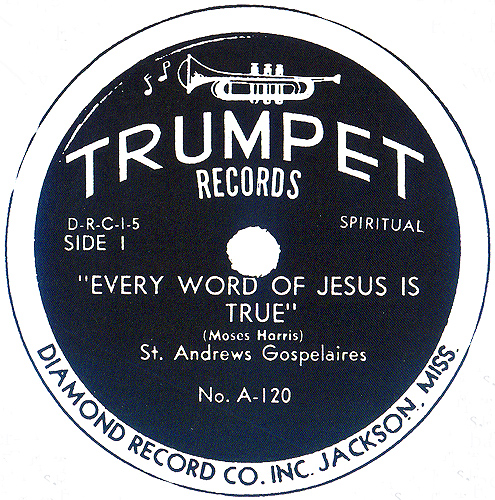
The store specialized in blues, gospel and what was then called “hillbilly” music. Between walk-ins and mail orders the business began to thrive. “The Record Mart became a very big mail-order business,” Webb said. “I didn’t know until recently how big a deal that was.” It wasn’t long before Lillian got the idea to record her own material using local talent. Lillian and Willard McMurry became the founders and owners of the Diamond Record Company, which released records on the Trumpet label. “God, I didn’t know what I was getting into,” Lillian said later.
What she was getting into was a pioneering position in the roots music recording industry. The label’s first releases were gospel recordings by the St. Andrews Gospelaires, a 3-piece jubilee group from the Enoch Grove Baptist Church, and the Southern Sons, who were the most popular and influential gospel groups performing during the early 50s in the Mississippi Delta. McMurry made many trips to the Delta to sign up talent, and on one she signed up a “harp” player who called himself Sonny Boy Williamson. Sonny Boy Had garnered a devoted following through his appearances on “King Biscuit Time” over station WFFA in Helena, Arkansas.
McMurry signed Sonny Boy to a contract in December, 1950. She did not learn until years later that his real name was Alex “Rice” Miller. Miller had appropriated the name of another highly-regarded harmonica-playing blues singer because he had once been convicted of stealing a mule from a neighbor. He had whitewashed the mule, which was a sure disguise for the animal until the next inevitable Delta downpour. With McMurry riding herd on him, Sonny Boy Williamson (II) turned out a string of blues standards, including “Eyesight to the Blind”, “Nine Below Zero” and “Red Hot Kisses”, written by Lillian herself. Sonny Boy also wrote a tribute to McMurry’s car, which was recorded as “Pontiac Blues”.
Edward Komara, former head of the Blues Archive at the University of Mississippi, said, “The main thing I remember about Lillian McMurry is her toughness, which was a combination of a low tolerance for bullshit and a lion-taming instinct. This toughness was not something she had to develop while running Trumpet. She may have well had it since birth. She was also born with a pageant-quality beauty, as evidenced by the published photos of her in her 50s, taken during the Trumpet years. But musicians and record industry people alike learned she was much more than a pretty face.”
However she came by it, Lillian McMurry’s toughness became a key asset in the rough-and-tumble world of the independent record business. Sonny Boy Williamson, her biggest star, was hard-drinking, cantankerous and prone to drunken brawling. Williamson also carried a knife and a gun and freely used profane language, but only once around Lillian. Legend has it that when Williamson began cursing in the studio one day, Lillian told him to leave. When he refused, McMurry took his own gun, which she had taken the precaution to relieve him of, marched him outside and sent him on his way. A much-humbled Williamson returned a couple of weeks later, and McMurry took him back in.
According to Webb, McMurry had problems with other artists as well. “She had Elmore James under contract, but Elmore had problems sticking to it. At one point, she got a tip-off and had to go to Canton to bust up a recording session that Elmore had no right to do. There’s actually a tape recording of a telephone conversation between Elmore and Lillian where he’s asking about coming back, and she said, ‘Well, Elmore, would you stand hitched?’ meaning would he honor a contract. But he never followed up on it.”
Elmore James’s only Trumpet recording, “Dust My Broom”, became a nation-wide hit and a classic in the blues repertoire. “She and Willard were visiting with my parents when I was in high school or junior high, and she was sitting there in the front room and I was dashing out the door with a vinyl copy of “Tommy” by The Who. And she said something like, ‘Oh, I thought the rock opera was an abortion,’ or an abomination or something like that. And I left thinking, ‘Well what does she know?’ but later I realized they recorded HER song wrong. She cut the original ‘Eyesight for the Blind’ but they did it in a minor key with a whole different feel and melody.”
But the Trumpet label was short-lived. Even with such brilliant talent stock as Jerry McCain, Arthur “Big Boy” Crudup and Willie Love, competition with labels having deeper pockets eventually proved to be too much. According to blues aficionado Dr. Woody Sistrunk, “One of the biggest reasons Trumpet ended was that a large record distributor in Texas went broke. And back then, it was not cash for sale. A lot of business was on credit, especially as records became hits. If a record became a hit, you had to get it to a pressing plant, and no one had a pressing plant except for the big labels. You had to have it pressed, and if you didn’t get paid by your distributors, or one-stops as it were for stocking juke boxes at the time, you simply didn’t have any money to pay them off,” Sistrunk explained.
“At the very end of Trumpet, Sonny Boy Williamson was the biggest artist that the label had. His contract was traded to Buster Williams’ Plastic Products in Memphis as a trade for some of the label’s debts,” Sistrunk said. “Williams then turned over Sonny Boy’s contract to the Chess Brothers with options, who in turn picked up Sonny Boy and ran with him.”
After only five years (1951-56) in the business, this was Trumpet’s last note. “That was it, except for another $50,000 that Lillian and Willard had to absorb, which they did strictly through hard work,” Sistrunk said. “A lot of people don’t realize how important their studio was. Many of the records were cut at the old State Furniture Company at 211 State Street on the corner of State and Pearl. For a long time, they would cut records in the back room on Sunday afternoons with someone else’s equipment. But by 1954, they had a studio at 309 Farish Street where they were cutting a number of things. That was another big expense during 1953-54, and that set them back some as well.”
Lillian McMurry was a scrupulous businesswoman, a meticulous bookkeeper and obsessive when it came to royalties. “For eight years, I maintained her Trumpet papers at the Blues Archive,” Komara said, “and she never let a single detail slip by. She fought hard and successfully for the artists whose financial estates she assisted. She continued until her death to assist her Trumpet recording artists, scoundrels though they sometimes were. She demanded honesty and got honesty and delivery of contracted promises from them during the recording sessions, and in return she made sure they received what was due.”
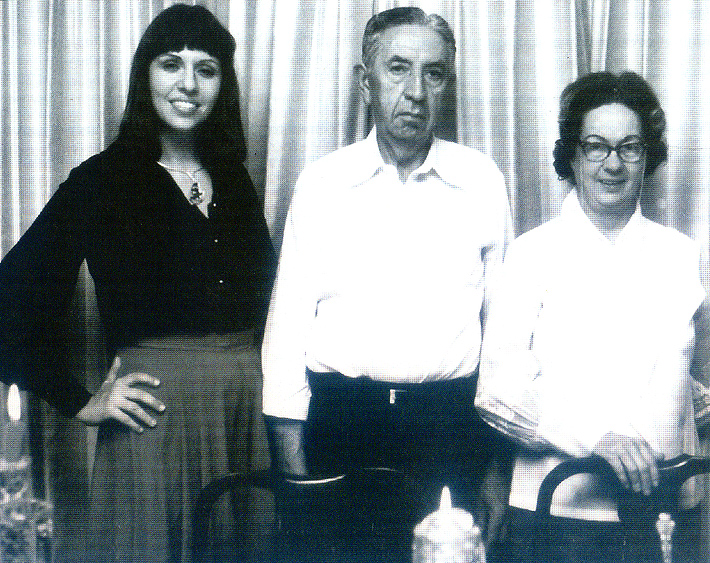
Vitrice, Williard and Lillian McMurry in the 1980s (image via “Trumpet Records: Diamonds on Farish Street”, Marc W. Ryan)
“She knew about artists’ egos and she protected them, plus she knew about artists’ sufferings and made sure they all got paid,” Sistrunk said. Vitrice McMurry Rankin, Lillian and Willard’s daughter, said, “Mom was always a strong-willed and fierce person who fought for what was right, treated the musicians with a great deal of dignity and fought for their rights. She was incredibly cagey, and could deal with copyright lawyers on a level of legal think so that she was able to win most of the suits she brought. “
“She was actually close to graduating from Jackson School of Law when she met my Dad and got married, which seems untypical of her that she wouldn’t have gone ahead and finished school,” Rankin said. “She had that kind of steel clamp of a mind that could handle thousands and thousands of legal ramifications and technicalities and argue to the death. I think some of the settlements she got were just to get her off their backs because she was so utterly relentless in her pursuing of these people who did so much bold-faced thievery. She would tend to spend $10,000 to make $10,000. Who knows ultimately if financially it was worth it, but ethically it was, because so many people were vindicated.”
But McMurry’s upstanding business ethics were often sorely lacking in other recording business personalities of the 50s. And the demise of the Trumpet label may have been in part to unscrupulous machinations on the part of other record labels. “Lillian told me that there were some people who wanted to press her out of the business,” Sistrunk said. “And one big label allegedly said, ‘If you stock her labels, we won’t let you stock ours.’ This was a big label, and every jukebox carried this label, and it seemed pretty ugly.”
After McMurry got out of the music business, she still maintained a studio. According to Sistrunk, “’From the Bottom’ and a lot of the later Sonny Boy Williamson songs were recorded there, and she was the one ‘at the knobs’ when Earl King did ‘Those Lonely, Lonely Nights’ for Ace Records. ‘Rockin’ Pneumonia and the Boogie Woofie Flu’ could very well have been recorded there as well.”
The impact of the Trumpet label on American music has been profound and lasting. “You can’t describe Trumpet’s contribution to music history strictly within a blues niche,” Sistrunk said. “You’d have to describe it in terms of the music of Mississippi that was not being recorded, that being gospel with the Southern Sons Gospel Quartet, that being Lucky Joe Almond, Jimmy Swan and all the other hillbilly artists and that being Sonny Boy Williamson and Willie Love with the blues.”
“All of those folded together are basically what made rock-and-roll as we know it. It’s all incredible.”
Jennifer Baughn says of her seminal work, Buildings of Mississippi, that the goal “from the start was to integrate—and I use that word purposely—black and white landscapes.” In this splendid essay (presented as a sidebar on p. 313), Baughn explains how the components of Mississippi’s landscape came to reflect the divisions of the state’s closed society.
Before the Civil War, enslaved blacks were discouraged or prohibited from congregating without white oversight, and although blacks and whites interacted on a daily basis, it was in the context of owner and owned, powerful and powerless. For a brief period following emancipation this power relationship eased, but after 1896, when the U.S. Supreme Court decided in Plessy v. Ferguson (1896) that “separate but equal” facilities were constitutional, all manner of places and spaces began to be segregated.
As blacks began to move to urban centers around 1890, new neighborhoods of narrow streets and alleys lined mostly with shotgun houses were developed, as for example the Henry Addition (see DR54) in Greenwood. Dense populations, limited employment opportunities, and widespread poverty characterized many of Mississippi’s black neighborhoods, even as they gave rise to an African American middle and upper class. Towns with large black populations–notably Jackson, Greenville, Meridian, Hattiesburg, and Clarksdale–often developed a separate, self-contained African American community with its own business district, hotels, churches, cultural center, schools, and funeral homes. Although often located adjacent to industrial or flood-prone areas, these districts gave African Americans relative security to form their own institutions without white interference. Because churches were one of the few institutions owned and run by black leaders, they became the anchors of such neighborhoods, but public and private schools also provided focus and space for community events.
By the early 1950s, a rising African American middle class began to embrace suburban living, moving out of the old mainstays such as Jackson’s Farish and Greenville’s Newtown neighborhoods into new black subdivisions lined with small ranch houses, such as the residence of Medgar and Myrlie Evers. By 1960 many black congregations with modest newfound wealth began replacing their older churches with new buildings. Such projects often allowed black architects (e.g., DeWitt Dykes and Clair M. Jones) to make their mark in such churches as Laurel’s St. Paul Methodist (pictured below). It was in this complex landscape of neighborhoods dotted with bungalows and shotgun houses and modern schools and churches that the civil rights movement formed and activated around the state.
Pasta salads come and go, but they’re always here, and the best ones are robust, the pasta providing a springboard for any number of wonders. This recipe has enough and to spare, since the rich and textured binding embraces additions. Elbow macaroni makes a great salad because it’s fluffier than other hollow pasta, and you can’t beat it for economy and availability. The other ingredients are just as familiar, and the combination is savory and attractive. The recipe is easily doubled, tripled or whatnot. For an evening meal make it in the morning, for lunch the night before, but this dish doesn’t keep well at all, no more than a day.
16 oz. large elbow macaroni, cooked 2 cups ham diced sautéed 1 cup diced raw bell pepper or pimento (better) 1 cup diced white onion (half green is great, too) 1 cup diced celery 1/2 cup sliced-diced black bottled olives 6 egg yolks mashed 1 cup mayonnaise 1 cup small raw broccoli florets 2 tbs. yellow and 1 tbs. spicy brown mustard 2 tbs. dill/sweet relish*
*There’s a bone of contention with the relish, so take your pick; likewise with the granulated garlic, which we add when we’re making it for home, but it doesn’t travel well.
The Southern boomer table—for which, I might add, I barely qualify—is peppered with dishes fabricated in company test kitchens. Green bean casserole is likely the most conspicuous example, but there are hundreds of others. Many vintage commercial dessert recipes include the word “magic,” which evokes the thrill of discovery with whiff of Disney. This recipe is from The Country Gourmet, distributed by the Mississippi Animal Rescue League in 1983. The book features a short forward by Eudora Welty, who writes, “Guarding and protecting, trying to save, all life on earth is a need we all alike share.”
Beat six ounces of whipped topping with a thawed can of lemonade concentrate and a can of condensed milk. Pour into a graham cracker pie crust and freeze, recommending at least one hour before serving, but I make and freeze it a day ahead.
It’s late summer. The exhausting heat endures, and September’s sure to extend the drought, but on a (rather singular) bright note, muscadines are beginning to appear in markets.
North America has two native grape species, Vitis labrusa, often called the fox or possum grape, which has several cultivars, and the more popular Vitis roundifolia, which most people call a muscadine. Muscadines have a thick skin and rind–they’re actually chewy; when you bit into them, you get an explosion of sweet, sharp flavor, and of course that essential hint of musk. They’re a little bit pricey, but to me, they’re worth it. Naturally, both species are widely used for making wines, which are most often cloyingly sweet, the sort of thing a little old lady would poison, pour into cut crystal aperitifs, and serve to a middle-aged rogue she’d discovered was cheating on her with the choir director.
The name muscadine comes from its similarity to early settlers with the Muscat grape, a Mediterranean type used in making muscatel, both words deriving from the Sanskrit muska-s (testicle,) in reference to the musky scent of the fruit. (Never underestimate etymology.) Muscadines come in a variety of colors, but there are two basic color types: the black/purple and the white/bronze. The white/bronze type is called a scuppernong because of a natural cultivar discovered on the Scuppernong River in North Carolina. Because this plant is such an early variety, any ”white” muscadine is called a scuppernong.
Use muscadines as you might any berry: in pies and cobblers, muffins, jams and jellies as well as the aforementioned wines, but the fresh fruit is incredibly wonderful, so keep a bowl out to nibble on.
This article by Alexander Lee Bondurant appeared in Publications of the Mississippi Historical Society, vol. 1 (pp. 104-6), printed for the Society in Oxford, Mississippi in 1898. Other entries include “Mississippi as a Field for the Student of Literature”, by W.L. Weber, “Suffrage in Mississippi”, by R.H. Thompson and “Some Inaccuracies in Claiborne’s History in Regard to Tecumseh” by Charles Riley.
Most alumni of the University of Mississippi will find Professor Bondurant’s name familiar if only for the classes they took in Bondurant Hall, though some of the most hard-core Rebel fans will remember him as the man who established the University of Mississippi football team and served as its coach during its first season in 1893. For the record, the Rebs had a 4-1 season, losing only to the Southern Athletic Club in New Orleans (0-24) on Nov. 30; they stayed in the city long enough to beat Tulane there two days later (12-4). Bondurant was also a classics scholar with degrees from the University of Virginia and Harvard.
I reproduce Bondourant’s essay refuting the existence of the Free State of Jones out of historical interest. I myself remain solidly convinced that the Free State of Jones was never a cohesive entity, much less one with noble objectives, most likely nothing more than a handful of outlaws protecting themselves and their families against the depredations of a moribund, corrupt local regime.
Did Jones County Secede?
It seems that many within and without the State would answer this query in the affirmative, and even their ordinance of succession is given by one writer on the subject as follows:
“WHEREAS, The State of Mississippi, for reasons which appear justifiable, has seen fit to withdraw from the Federal Union; and,
WHEREAS, We, the citizens of Jones County, claim the same right, thinking our grievances are sufficient by reason of an unjust law passed by the Confederate States of America forcing us to go into distant parts, etc., and therefore, be it
RESOLVED, That we sever the union heretofore existing between Jones County and The State of Mississippi, and proclaim our independence of the said State and of the Confederate States of America; and we solemnly call upon Almighty God to witness and bless this act.”
Such being the case, it has seemed to me in order to advert to a discussion in The Nation beginning March 24, 1892, which throws considerable light on the question. In the paper of this date Samuel Willard, of Chicago, writes that he had been a soldier in the army which invaded Mississippi, and that he had never during the war heard of such an occurrence. When, therefore, he saw the statement made in The New England Magazine for November, 1891, the author being professor Hart, he doubted its accuracy.
It may be stated just here that Professor Hart, in a subsequent history of The Nation, gives as his authority Mr. Galloway, historian of the Sixth Army Corps, who published in The Magazine of American History for October, 1886, an article entitled “A Confederacy Within a Confederacy”; but upon what authority Mr. Galloway based his statements does not appear. He therefore wrote to the Governor of the State of Mississippi and to the clerk of Jones County, and elicited replies from both of these gentlemen, and Governor Stone enclosed a letter from his predecessor, Hon. Robert Lowry, who was sent to Jones County during the war in command of troops for the purpose of arresting deserters. The texts of the letters are too long to quote in full, so a few passages will have to suffice. Gov. Stone writes:
“It gives me great pleasure to inform you that the whole story is a fabrication, and there is scarcely any foundation for any part of it. To begin with, Jones County furnished perhaps as many soldiers to the army of the Confederacy as any other county of like population. * * * Many of them declined to go into the army in the beginning, but so far as formal withdrawal or resolution to that effect is concerned, no such thing ever occurred in Jones County. Hon. Robert Lowry was sent to Jones County during the war for the purpose of arresting and returning deserters to their commands, and there was some little fighting with these bands of deserters, or rather bush-whacking of his men by the deserters; and some of the deserters were arrested and executed, but only a few. The whole story is the veriest fabrication, and I presume few persons of intelligence will believe any of it.”
Ex-Governor Lowry writes: “The county furnished nearly and probably its entire quote of soldiers, many of whom did splendid service. No such effort as establishing a separate government was ever attempted. The story of withdrawal and establishing a separate government is a pure fabrication—not the shadow of foundation for it.”
Governor McLaurin, in a recent letter to me on this subject, writes: “I was a boy thirteen years old when the war commenced. I was ‘raised’ in Smith County, a county adjoining Jones. I was at home the first three years of the war, and, if there was any attempt by Jones County to secede and set up a separate government, I did not hear anything of it. I was in a brigade that intercepted a federal raid that started from Baton Rouge to Mobile in November or December, 1864, and we passed through or very near Jones County, and I never heard of any attempt to set up a separate government in the county. I think it safe for you to negate the whole story.”
E.B. Sharp Esq., chancery clerk, writes: “The report is utterly false in every particularly.”
Light in August is in many if not most ways Faulkner’s darkest work, dealing with madness, alienation, miscegenation, murder, and sexual mutilation. The title has inspired a great deal of speculation. Some consider it simply a reference to the onerous sunlight of a Mississippi August; others would have us understand that the title refers to the light cast by Joanna Burden’s burning house.
Then there are careful readers who point to Reverend Hightower’s observation of “how that fading copper light would seem almost audible, like a dying yellow fall of trumpets dying into an interval of silence and waiting” while scholars with a regional bent so note that the phrase “(to be) light in August” is a Southern slang term for pregnancy, concentrating on Lena Grove.
The story that would eventually become the novel, started by Faulkner in 1931, was originally titled “Dark House” and began with Hightower sitting at a dark window in his home. But after a casual remark by his wife Estelle on the quality of the light in August, Faulkner changed the title, and later affirmed this inspiration:
“…in August in Mississippi there’s a few days somewhere about the middle of the month when suddenly there’s a foretaste of fall, it’s cool, there’s a lambence, a soft, a luminous quality to the light, as though it came not from just today but from back in the old classic times. It might have fauns and satyrs and the gods and—from Greece, from Olympus in it somewhere. It lasts just for a day or two, then it’s gone…the title reminded me of that time, of a luminosity older than our Christian civilization.”
The artist for this original 1932 dust jacket, was the brilliant Arthur Hawkins, who faithfully captured the dark drama of the work.