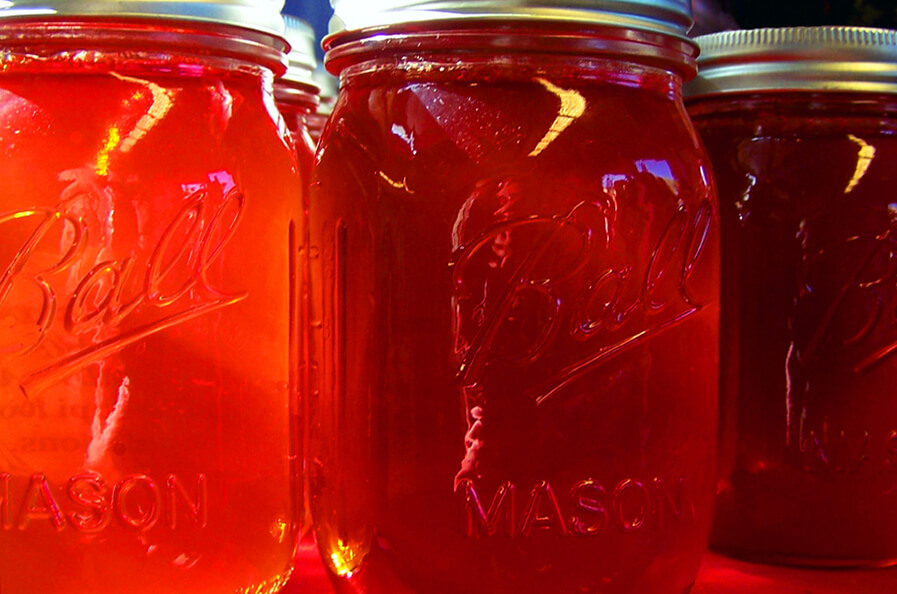
Our Summer Salad

Within living memory this simple dish was a staple throughout the rural South, a mild fresh summer vegetable laden vinaigrette that goes well with most meats, beans, and fresh greens. Use the freshest produce you can find. Cut into bite-sized pieces, place in a glass or ceramic bowl, and toss with salt and fresh ground black pepper. Resist the temptation to use garlic and/or herbs. Add enough white vinegar to cover the vegetables a quarter way and half that amount of corn oil. Toss and refrigerate before serving. Refresh the mix with vegetables, seasonings, and liquids as needed.

Fresh Peach Cobbler

For four cups of sliced fruit make six cups of simple syrup with a teaspoon of vanilla; a dust of nutmeg is a nice touch. Stew fruit in hot syrup just enough to color and flavor. Pour into a deep baking dish. Make biscuit dough using sweet milk and sugar, knead lightly, and roll out to about a quarter inch. Cut into strips and drop by pieces into the hot fruit/syrup mixture. Spoon syrup over dropped dough. Bake in hot (350-400) oven until browned and bubbling. Cool before, and if don’t serve this with a scoop of vanilla ice cream the devil will drag you to hell by your short hairs in a second flat.

Ode to Salisbury Steak

When I was growing up in small-town Mississippi in the 1960s, TV dinners were a treat, something different from home-cooked, not better, by any means, just exotic, some indication that change was possible in the stagnant backwater of Bruce, Mississippi, if only by way of convenience foods. Frozen pizza held a similar glamour. For a little over a dollar, we could buy fried chicken, meatloaf, or turkey and dressing with a puddle of piped-in potatoes and neon peas in a space-age metal container, heat it in the oven, and eat them on the sheet-pan fold-away TV tables that became available simultaneously. I remember eating a turkey and dressing version the first time I saw “It’s the Great Pumpkin, Charlie Brown.” I was eight.

My favorite was the fried chicken, but brother Tom’s was Salisbury steak (as close as he could get to a hamburger). It’s named for James Salisbury, one of those impressive food faddists of the late 19th century whose ranks include Kellogg, Post, and Mary Grove Nichols (by far the coolest of the three.) Salisbury advocated the same low-carb diet as Tarnower and Atkins (known now as paleo), his being very much meat-centered. Salisbury’s version of a “lean beef cake,” calls for meat “from the centre of the round” procured from “well-fatted animals that are from four to six years old,” but there’s really no rationale for being so specific.

For a pound of lean ground beef, add a quarter cup bread crumbs, and if you don’t have any of those little-bitty cans of tomato sauce, work in a generous squirt or two of ketchup along with a good dusting of black pepper. Don’t over-work the meat. Form into no more than four cakes about an inch thick. Cook in a low oven to medium well.While this recommendation doesn’t fit the doctor’s diet, my optimal serving of Salisbury steak requires mushroom gravy (a light one), creamed potatoes with a little pitty-pat of butter, and green peas, just like Mother Swanson served.

Stuffed Pork Loin

Remove sinews and fat from loin, butterfly, and brush with corn oil seasoned with black pepper, salt, and freshly-minced garlic. For the stuffing, use day-old cornbread moistened with butter and chicken stock seasoned with fresh rosemary (not too much!), thyme, basil, salt and pepper, along with finely-minced onions. Stuff loin, roll, truss, brush again with seasoned oil, and roast on medium heat (300) about an hour for a ten pound loin. Serve with Jezebel sauce.

Yellow Meats

While working in a Florida restaurant, I kept having trouble ordering a yellow-meated watermelon from my produce guy. He said he could never find one, even though I’d seen them in local markets. Finally it came out that with my heavy hill country Mississippi accent he thought I was ordering a melon from some mythical specialty locale in California: “Jala Meadad”. He even wrote it down that way.

Here in the Deep South yellow-meated season is short; you’ll rarely find them marketed before late June or after early August, and you’ll almost never find them sold in supermarkets, usually only at roadside produce stands. The variety of yellow meats I find most often here in central Mississippi has broad dark green and light green stripes, though over in Clay County, Alabama, where they have the Clay County Yellow Meated Watermelon Festival, the eponymous variety is an almost uniform light green.

The flesh can range from pale yellow to deep gold. The best contain large brownish black seeds, seeds being an essential ripening agent for the fruit, whose flavor I find sweeter than the reds, offering notes of honey, apricot, and vanilla.

Good for Your Heart and Soul

In 1918, 21-year-old Pierre Chauvin opened the Union Canning Company in Union, Louisiana, and began canning fresh figs, blackberries, cane syrup and other items in his backyard. In 1946, he partnered with Clay Englade, moved operations to Ascension Parish, and changed the name of the company to Gonzales Product Co., Inc.

Chauvin and Englade introduced their first canned red bean product, based on a recipe Chauvin learned from his grandmother. From the get-go, the beans were award winning, taking the top prize at parish fairs all over Louisiana. For that reason, they named what would become their signature product “Blue Ribbon Creole Cream Style Red Beans,” and then eventually renamed the company Blue Runner Foods. While a blue runner is both a fish and a snake, the company name comes from fact that the trailing ribbon on a blue ribbon medal are called “runners.”

All products are still produced in Gonzales, Louisiana.

What it mean to love red beans

Adam’s Banana

During his famously quoted expedition in search of Livingston, Stanley also said, “If we run out of food, we’ll eat bananas.”

Sir Henry’s flippant dismissal of this vital foodstuff in lieu of boiled beef sums up the Brit empiricist mind; millennia before Stanley’s split second of Victorian condescension, bananas had been a staple in Asia since Homo erectus. While European versions of the Expulsion have Eve offering up an apple (probably a Winesap; the Granny Smith is theologically impossible) as the principle instrument of temptation, many African, Asian and Oceanic interpretations depict Adam as succumbing to a nice banana instead (Eve had a rough cut, why not Adam?). These accounts also describe our primal DNA donors as masking their shame with banana leaves, which makes far more sense to me than that fig drag, even for Eve.

Before Chiquita and other mega-growers began shipping bananas in chemically sterilized bunches, stores would impale whole untreated stalks on ceiling hooks to ripen. Given the number of nooks and crannies in these masses of vegetation, it’s unsurprising that the occasional tropical creature would piggy-back its way across the Gulf of Mexico into the rural South. My grandfather Jess kept a small country store that supported an endless series of banana stalks from the Cockrell Banana Company in Tupelo on a hook from the ceiling as well as any number of worthless relatives and other such riff-raff from the cash box under the counter. Jess checked out produce before he put it up for sale, and occasionally he’d discover some sort of exotic fauna cowering deep amid the bananas.

He’d usually find a spider big enough to scare the bejesus out of any little old lady getting a couple of bananas for pudding to take to a homecoming. These he fed he to the chickens, but once, to his great delight, he found a small boa and kept it in a glass gallon jar with some hay in the bottom for everyone to ogle before he he sent it to the University of Mississippi, where it enjoyed a long, happy career as a desensitizing agent for people with snake phobias.

He once told a slacker cousin that he could get a snake into Ole Miss, “But I can’t get your ignorant ass into a decent barber school.”

Banana Pepper Relish

Seed and dice a pound of sweet banana peppers (throw a hot one in if you like), a white onion, mix with a cup of shredded cabbage, a grated carrot, and two finely-minced cloves of garlic. Dust with salt and sugar (about 2:1), toss to mix well, pack into jars, and cover with hot white vinegar. Seal and store for a week before serving. This is great with grilled meats–particularly sausages–and spicy beans.

The Battle of Jackson: May 14, 1863

In the spring of 1863, the war dividing the nation focused on Vicksburg. Lincoln told his civilian and military leaders, “Vicksburg is the key!” Confederate President Davis was of the same mind: “Vicksburg is the nail head that holds the South’s two halves together.” In Confederate hands, Vicksburg blocked Union navigation down the Mississippi and allowed communications and reinforcements from Confederates to the west. The natural defenses of the city were ideal, earning its nickname of the Gibraltar of the South.

Frustrated in his former attempts to take Vicksburg, the Battle of Port Gibson (May 1) gave Union General Ulysses S. Grant a much-needed foothold on the eastern bank of the Mississippi south of the city, but Grant needed a base north of Vicksburg that could be supplied via the river from Memphis and Port Hudson to subdue the stronghold.

Grant’s Confederate opponent in the campaign, General John C. Pemberton, was of the same mind: “To take Vicksburg, to control the valley of the Mississippi, to sever the Confederacy, to ruin our cause, a base upon the eastern bank immediately above (Vicksburg) was absolutely necessary.” Pemberton admitted that such a move on the part of Federal troops “might destroy Jackson and ravage the country”, but “that was a comparatively small matter.” Though Jackson had the only secure railhead east of Vicksburg, a vital connection to the rest of the Confederacy, Pemberton, a Pennsylvanian who had taken up rebel arms, thought little of Mississippi’s capital city on the Pearl in comparison to his vital command on the Mississippi.

To secure this hypothetically crucial base above Vicksburg, Grant, along with his trusted lieutenant William T. Sherman, moved the Army of the Tennessee to the northeast, and on May 12 headquartered his troops at Dillon Plantation some 6 miles west of Raymond. About sundown, as the camp was settling in to its evening routine, an excited courier drove his lathered horse into camp and poured out the news that Federal troops under Maj. Gen. James B. McPherson’s XVII Corps had encountered a large Confederate force commanded by Brig. Gen John Gregg at Raymond, defeating it after a savage battle. “When the news reached me of McPherson’s victory at Raymond,” Grant later wrote, “I decided at once to turn the whole column towards Jackson and capture that place without delay.”

At first little more than a dot on a map in the mind of the great Union captain, Jackson now came into focus for Grant as a military objective. He had become convinced that Confederate forces assembling in or near Jackson might be stronger than he had initially supposed, and he had reports of reinforcements pouring into the city, including Gen. Joseph E. Johnston, the Confederate commander of the Department of Tennessee and Mississippi. Johnston was widely respected by his troops, fellow officers and even President Davis, with whom he had an acrimonious relationship.

These reports put at risk Grant’s proposed crossing of the Big Black near Edwards, a move designed to bring his troops north of Vicksburg, since it would leave a potentially strong army commanded by a reputedly able general on his rear flank. He now saw more clearly the city’s value as a communication and transport center through which supplies of men and war materials could be funneled to Vicksburg. In addition, destroying Jackson, which also had some importance as a manufacturing center (mostly of cloth), would cripple the state’s ability to supply the rebel army. It’s reasonable to assume that Grant would also be aware of the impact on morale that the capture of the capital city of Mississippi, the home state of President Jefferson Davis, would have on the Confederacy as a whole.

Grant was confident that he could take Jackson then swing his forces back to the west before Pemberton took notice. It was an audacious ploy; by this move to the northeast of Port Gibson, Grant had cut himself loose from his base, but the Northern general had learned to provision his troops as they marched, taking what they needed from the farms and villages they encountered, and the Union army found plenty to sustain their progress. Because the city was reputedly heavily fortified, he decided to strike with his entire army, 10 divisions, some 40,000 men. Grant positioned McPherson to the north and Sherman to the south of his eastern advance towards Jackson, positioning Gen. John A. McClernand on the western flank, facing any possible attack from Pemberton’s troops in Vicksburg.

Jackson, at the outbreak of the war, had a population of 3,191 (Vicksburg had 4,591 and Natchez, the most prosperous city in the state, 6,612.) The city’s arsenal had been destroyed in a disastrous explosion the previous November; Confederate troops stationed there for its defense numbered some 6,000. Well before the final advance of Federal forces, the city seemed to have resigned itself to subjugation. As early as May 2, Pemberton (ever the fatalist) telegraphed Governor J.J. Pettus, advising him to remove the state archives from the capital. By May 6, people began leaving Jackson. The Mobile Register and Advertiser reported, “The trains for the interior are crowded with non-combatants, and the sidewalks blocked up with cases, barrels, old fashioned trunks and chests, which look antiquated enough to have come out of Noah’s Ark.”

By the time Johnston arrived to take command of the city’s defense on the 13th, all who had the means to escape the city had done so, and the Confederate commander’s assessment of his chances to save Jackson could not have been buoyed by the then funereal aspect of the beleaguered capital. Johnston knew his situation was dire; Pemberton had refused his request for reinforcements from Vicksburg the previous week, and the additional troops promised by his superiors had yet to arrive. Johnston was met in Jackson by Gen. Gregg, who was forced to retreat to Jackson with his 3,000 soldiers after the fierce encounter at Raymond. Faced with a two-pronged Union attack by able commanders leading some 25,000 troops and with no time to organize any reasonable defense, Johnston, a seasoned general and career solider, retreated to the northeast.

On May 14, Union forces advanced towards Jackson in a deluge turning roads that had choked them with dust for weeks into trenches of shin-deep mud. After two short skirmishes lasting less than four hours, Grant’s troops entered a silent Jackson under a pouring rain. The Battle of Jackson, such as it was, had ended. Rails and bridges were destroyed, factories put to fire. Vicksburg’s artery to the east was cut; in less than two months, the Confederate Gibraltar would fall into Union hands. Jackson, abandoned by its defenders and occupied by a hostile army, was looted and burned by soldiers and civilians alike for the first of four times, bitterly earning its nickname: Chimneyville.