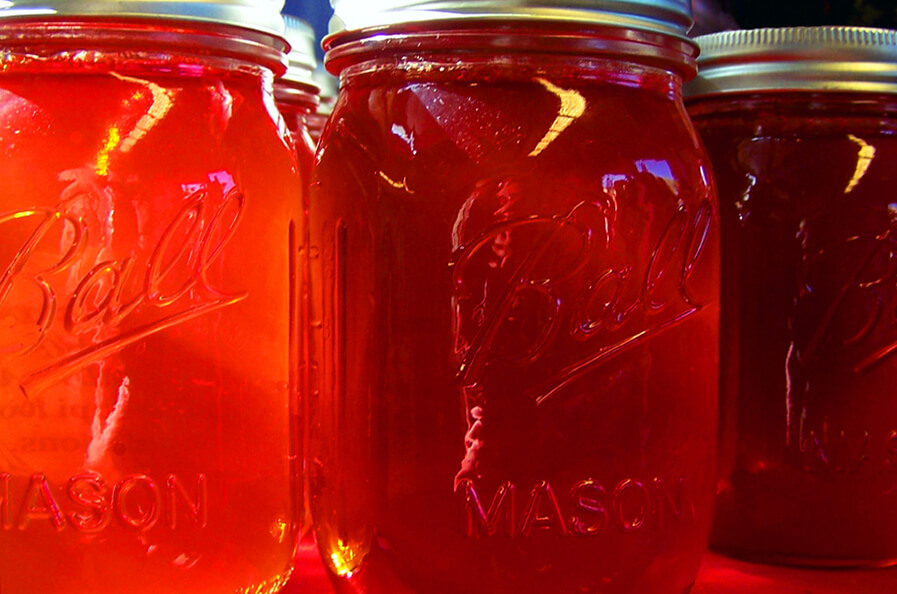
Line a lightly buttered loaf pan with parchment paper, and place it in the freezer. Add two teaspoons pure vanilla to 14-ozs. sweetened condensed milk and refrigerate. Whip two cups of heavy cream to stiff peaks. Working quickly, GENTLY fold the whipped cream into the sweetened condensed milk, along with any additions—mashed macerated fruit, chocolate syrup, or crushed cookies or nuts—until well blended. Pour into the cold loaf pan and cover with plastic wrap. Freeze for at least four hours. Some recipes will tell you to stir the mixture after about two hours (while you still can) but you don’t have to.
Muscadines and Scuppernongs
It’s late summer. The exhausting heat endures, and September’s sure to extend the drought, but on a (rather singular) bright note, muscadines are beginning to appear in markets.
North America has two native grape species, Vitis labrusa, often called the fox or possum grape, which has several cultivars, and the more popular Vitis roundifolia, which most people call a muscadine. Muscadines have a thick skin and rind–they’re actually chewy; when you bit into them, you get an explosion of sweet, sharp flavor, and of course that essential hint of musk. They’re a little bit pricey, but to me, they’re worth it. Naturally, both species are widely used for making wines, which are most often cloyingly sweet, the sort of thing a little old lady would poison, pour into cut crystal apéritifs, and serve to a middle-aged rogue she’d discovered was cheating on her with the choir director.
The name muscadine comes from its similarity to early settlers with the Muscat grape, a Mediterranean type used in making muscatel, both words deriving from the Sanskrit muska-s (testicle,) in reference to the musky scent of the fruit. (Never underestimate etymology.) Muscadines come in a variety of colors, but there are two basic color types: the black/purple and the white/bronze. The white/bronze type is called a scuppernong because of a natural cultivar discovered on the Scuppernong River in North Carolina. Because this plant is such an early variety, any ”white” muscadine is called a scuppernong.
Use muscadines as you might any berry: in pies and cobblers, muffins, jams and jellies as well as the aforementioned wines, but the fresh fruit is incredibly wonderful, so keep a bowl out to nibble on.
Biscuits for Floozies
Making quick breads is such a basic culinary skill that at one time those persistent legions of people who spend their time minding other people’s business sniffed their disapproval of a newly-wed husband’s wife by saying, “He married a woman who can’t even make biscuits.”
Those were more genteel times. Nowadays, of course, those same people would just say he hooked up with a tramp and be done with it. For all you floozies out there who need a bonus the morning after–like a reputation–here’s how to make biscuits. And if you don’t carry a skillet with you, well, you’re on your own.
Like many short bread recipes, the one for biscuits is more technique than ingredients. Getting the biscuits to rise well is key, and if you don’t follow a reasonable procedure, you’re going to end up throwing away a pan of hockey pucks.
Your ingredients work best if chilled. Biscuits shouldn’t be worked a lot; excess kneading makes the dough so dense that it won’t rise. Biscuits should also be cut out quickly while the dough is cool, and with a clean, sharp edge that will not pinch. Crowding the biscuits a bit also helps them to rise, but if you get them too close together the centers won’t bake through. Also make sure the oven is hot (450/475) before you put them on a rack in the upper third of the oven.
Buttermilk Biscuits
Take two cups of self-rising flour (I use Martha White) and sift in dry a scant teaspoon of baking soda; activated by the buttermilk, this helps the rise. Work thoroughly into this about 1/3 a cup of cold vegetable shortening or butter; shortening gives a lighter texture, butter a better flavor. Mix with the fingers until it has an almost granular texture. Then, working quickly, stir in enough cold buttermilk to make a sticky dough, about 3/4 cup.
Throw this dough out on a generously-floured surface, sprinkle with a scant more flour and knead a couple of times, enough to coat the dough with flour. Roll out to about a half-inch and cut into rounds. You can make them as big or small as you like, just be sure to cut them with a sharp edge: a Mason jar just won’t work.
Again, work quickly so that the dough doesn’t get warm. Place biscuits just touching in a lightly greased skillet and pop them into a hot oven for about a quarter an hour. You want them golden-brown and fragrant; brush lightly with butter while hot.
Godmother of the Blues
These days it’s difficult enough to think about a turntable at all, much less to think about one as a piece of furniture. But in the middle decades of the 20th century, they became mammoths.
These record players (for that’s essentially what they were, hi-fi or stereo) came in all sorts of styles to match your other furniture, too: Mediterranean, French provincial, Queen Ann, you name it. Furniture stores sold these primitive behemoths as well as recordings themselves, and it’s through the furniture business that Lillian Shedd McMurry, a former secretary and law student, fell down a rabbit hole and into the land of the blues.
According to her nephew, recording artist John Webb (“Wilder”) McMurry, “My Uncle Willard, Lillian’s husband, and his family weren’t real musical folks. They all had furniture stores. Willard and a furniture store, my dad, Webb, had a furniture store, and my uncle Carl had Super Furniture Market in Jackson. Willard’s niche was used furniture stores and he would buy the pre-existing stock out of a bankrupt store and get it going again. So there was some stock in a hardware store Willard had bought on Farish Street that included 78s of black music, what would have been called “race music” at the time. Lillian had a lot of get-up-and-go, had played the piano early in her life and was interested in music. But she knew nothing about blues or secular music.”
Lillian selected a record and put it on the turntable The record she chose was Wynnie “Mr. Blues” Harris’s “All She Wants to Do Is Rock”, and according to an interview with Living Blues magazine in 1986, what she heard changed her life. “It was the most unusual, sincere and solid sound I’d ever heard,” she said. “I’d never heard anything with such rhythm and freedom.”
“So Lillian,” Webb continued, “being enterprising, set the rest of the records out on the counter and they sold like hot cakes. And she began to get more involved.” Lillian acquired more records and began selling them on a full-time basis. She made trips to New Orleans and Memphis to bring in more recordings and eventually the couple converted the hardware store into a record/furniture store called Record Mart-Furniture Bargains.
The store specialized in blues, gospel and what was then called “hillbilly” music. Between walk-ins and mail orders the business began to thrive.
“The Record Mart became a very big mail-order business,” Webb said. “I didn’t know until recently how big a deal that was.” It wasn’t long before Lillian got the idea to record her own material using local talent. Lillian and Willard McMurry became the founders and owners of the Diamond Record Company, which released records on the Trumpet label. “God, I didn’t know what I was getting into,” Lillian said later. 
What she was getting into was a pioneering position in the roots music recording industry. The label’s first releases were gospel recordings by the St. Andrews Gospelaires, a 3-piece jubilee group from the Enoch Grove Baptist Church, and the Southern Sons, who were the most popular and influential gospel groups performing during the early 50s in the Mississippi Delta. McMurry made many trips to the Delta to sign up talent, and on one she signed up a “harp” player who called himself Sonny Boy Williamson. Sonny Boy Had garnered a devoted following through his appearances on “King Biscuit Time” over station WFFA in Helena, Arkansas.
McMurry signed Sonny Boy to a contract in December, 1950. She did not learn until years later that his real name was Alex “Rice” Miller. Miller had appropriated the name of another highly-regarded harmonica-playing blues singer because he had once been convicted of stealing a mule from a neighbor. He had whitewashed the mule, which was a sure disguise for the animal until the next inevitable Delta downpour. With McMurry riding herd on him, Sonny Boy Williamson (II) turned out a string of blues standards, including “Eyesight to the Blind”, “Nine Below Zero” and “Red Hot Kisses”, written by Lillian herself. Sonny Boy also wrote a tribute to McMurry’s car, which was recorded as “Pontiac Blues”.
Edward Komara, former head of the Blues Archive at the University of Mississippi, said, “The main thing I remember about Lillian McMurry is her toughness, which was a combination of a low tolerance for bullshit and a lion-taming instinct. This toughness was not something she had to develop while running Trumpet. She may have well had it since birth. She was also born with a pageant-quality beauty, as evidenced by the published photos of her in her 50s, taken during the Trumpet years. But musicians and record industry people alike learned she was much more than a pretty face.”
However she came by it, Lillian McMurry’s toughness became a key asset in the rough-and-tumble world of the independent record business. Sonny Boy Williamson, her biggest star, was hard-drinking, cantankerous and prone to drunken brawling. Williamson also carried a knife and a gun and freely used profane language, but only once around Lillian. Legend has it that when Williamson began cursing in the studio one day, Lillian told him to leave. When he refused, McMurry took his own gun, which she had taken the precaution to relieve him of, marched him outside and sent him on his way. A much-humbled Williamson returned a couple of weeks later, and McMurry took him back in.
According to Webb, McMurry had problems with other artists as well. “She had Elmore James under contract, but Elmore had problems sticking to it. At one point, she got a tip-off and had to go to Canton to bust up a recording session that Elmore had no right to do. There’s actually a tape recording of a telephone conversation between Elmore and Lillian where he’s asking about coming back, and she said, ‘Well, Elmore, would you stand hitched?’ meaning would he honor a contract. But he never followed up on it.”
Elmore James’s only Trumpet recording, “Dust My Broom”, became a nation-wide hit and a classic in the blues repertoire.
“She and Willard were visiting with my parents when I was in high school or junior high, and she was sitting there in the front room and I was dashing out the door with a vinyl copy of “Tommy” by The Who. And she said something like, ‘Oh, I thought the rock opera was an abortion,’ or an abomination or something like that. And I left thinking, ‘Well what does she know?’ but later I realized they recorded HER song wrong. She cut the original ‘Eyesight for the Blind’ but they did it in a minor key with a whole different feel and melody.”
But the Trumpet label was short-lived. Even with such brilliant talent stock as Jerry McCain, Arthur “Big Boy” Crudup and Willie Love, competition with labels having deeper pockets eventually proved to be too much. According to blues aficionado Dr. Woody Sistrunk, “One of the biggest reasons Trumpet ended was that a large record distributor in Texas went broke. And back then, it was not cash for sale. A lot of business was on credit, especially as records became hits. If a record became a hit, you had to get it to a pressing plant, and no one had a pressing plant except for the big labels. You had to have it pressed, and if you didn’t get paid by your distributors, or one-stops as it were for stocking juke boxes at the time, you simply didn’t have any money to pay them off,” Sistrunk explained.
“At the very end of Trumpet, Sonny Boy Williamson was the biggest artist that the label had. His contract was traded to Buster Williams’ Plastic Products in Memphis as a trade for some of the label’s debts,” Sistrunk said. “Williams then turned over Sonny Boy’s contract to the Chess Brothers with options, who in turn picked up Sonny Boy and ran with him.”
After only five years (1951-56) in the business, this was Trumpet’s last note. “That was it, except for another $50,000 that Lillian and Willard had to absorb, which they did strictly through hard work,” Sistrunk said. “A lot of people don’t realize how important their studio was. Many of the records were cut at the old State Furniture Company at 211 State Street on the corner of State and Pearl. For a long time, they would cut records in the back room on Sunday afternoons with someone else’s equipment. But by 1954, they had a studio at 309 Farish Street where they were cutting a number of things. That was another big expense during 1953-54, and that set them back some as well.”
Lillian McMurry was a scrupulous businesswoman, a meticulous bookkeeper and obsessive when it came to royalties. “For eight years, I maintained her Trumpet papers at the Blues Archive,” Komara said, “and she never let a single detail slip by. She fought hard and successfully for the artists whose financial estates she assisted. She continued until her death to assist her Trumpet recording artists, scoundrels though they sometimes were. She demanded honesty and got honesty and delivery of contracted promises from them during the recording sessions, and in return she made sure they received what was due.”

“She knew about artists’ egos and she protected them, plus she knew about artists’ sufferings and made sure they all got paid,” Sistrunk said. Vitrice McMurry Rankin, Lillian and Willard’s daughter, said, “Mom was always a strong-willed and fierce person who fought for what was right, treated the musicians with a great deal of dignity and fought for their rights. She was incredibly cagey, and could deal with copyright lawyers on a level of legal think so that she was able to win most of the suits she brought. “
“She was actually close to graduating from Jackson School of Law when she met my Dad and got married, which seems untypical of her that she wouldn’t have gone ahead and finished school,” Rankin said. “She had that kind of steel clamp of a mind that could handle thousands and thousands of legal ramifications and technicalities and argue to the death. I think some of the settlements she got were just to get her off their backs because she was so utterly relentless in her pursuing of these people who did so much bold-faced thievery. She would tend to spend $10,000 to make $10,000. Who knows ultimately if financially it was worth it, but ethically it was, because so many people were vindicated.”
But McMurry’s upstanding business ethics were often sorely lacking in other recording business personalities of the 50s. And the demise of the Trumpet label may have been in part to unscrupulous machinations on the part of other record labels. “Lillian told me that there were some people who wanted to press her out of the business,” Sistrunk said. “And one big label allegedly said, ‘If you stock her labels, we won’t let you stock ours.’ This was a big label, and every jukebox carried this label, and it seemed pretty ugly.”
After McMurry got out of the music business, she still maintained a studio. According to Sistrunk, “’From the Bottom’ and a lot of the later Sonny Boy Williamson songs were recorded there, and she was the one ‘at the knobs’ when Earl King did ‘Those Lonely, Lonely Nights’ for Ace Records. ‘Rockin’ Pneumonia and the Boogie Woofie Flu’ could very well have been recorded there as well.”
The impact of the Trumpet label on American music has been profound and lasting. “You can’t describe Trumpet’s contribution to music history strictly within a blues niche,” Sistrunk said. “You’d have to describe it in terms of the music of Mississippi that was not being recorded, that being gospel with the Southern Sons Gospel Quartet, that being Lucky Joe Almond, Jimmy Swan and all the other hillbilly artists and that being Sonny Boy Williamson and Willie Love with the blues.”
“All of those folded together are basically what made rock-and-roll as we know it. It’s all incredible.”
Blue Man
Pondering Divinity
Welty, a conscientious cook as well as an authority on human nature, provides a sublime observation on two manifestations of divinity in The Ponder Heart..
God bless Uncle Daniel! If anyone can be generous to a fault it’s him, though Grandpa called it an open disposition and claimed that within the realm of reason there were people who would take advantage of such, which is how Uncle Daniel, attracting love and friendship with the best will and the lightest heart in the world, ended up with Grandpa in his new Studebaker sitting with old Judge Tip Calahan driving through the country on his way to the asylum in Jackson. From the word go Uncle Daniel got more vacations than anyone because they couldn’t find a thing in the world wrong with him, and he was so precious all he had to do was ask and he’d be on the branch-line train headed back to Clay County. Everybody missed Uncle Daniel so bad when he was gone that they spent all their time at the post office sending him things to eat. Divinity travels perfectly, if you ever need to know.
Pecan Divinity
It’s important to know that divinity, as with all recipes using whipped egg whites, is best made in dry weather. Having said that, boil three cups of sugar, one-half cup of Karo corn syrup, three-fourths cup of water to the hard ball stage. Beat the whites of two eggs with a teaspoon each salt and vanilla until stiff. Pour the warm syrup over the whites and blend in chopped pecans. When it begins to harden drop by spoonfuls onto wax paper or spread in a oiled pan and cut to shape.
Pizza Den’s Submarine Sandwich
Frank Bowen sent me this recipe, and here I reproduce his original mail with the reminder that while the location has changed. Pizza Den is still open, and Bob’s family is carrying on the tradition of great local food in Oxford. Go see them the next time you’re there.
The following is a recipe that was posted on an Ole Miss Spirit message board several years ago. I made it several times and can attest that it is faithful to the original at the Pizza Den. It is not in standard recipe format, but it tells how to make the sandwich very well. I don’t know who made the post. He had a user name of Reblanta. I have found that the instructions of letting it rest on the counter for 15-20 minutes to simulate delivery is an important step.
Pizza Bob’s Famous Submarine Sandwich
In May, 1983, I had just bought a new car and decided that I would take it out on the road and drive up to Oxford for the afternoon, primarily to drop by Pizza Den and pick up some submarines to take back home and share with my Ole Miss friends that night. Things were slow late that afternoon when I got there but Pizza Bob was in good spirits. Since nobody else was there, I decided to broach the sacred subject on just how Bob made his famous submarine sandwich. Whether he was thinking of the good times he’d had in Nam, the money he had made off of me over the years, or perhaps he just felt sorry for me, I couldn’t tell, but this is what he told me. I watched him make the submarines and committed the process to memory.
Take your baguette, split it down the middle. Pour butter over the open slices of bread, sprinkle on a generous portion of both Parmesan and mozzarella cheese and place several thin slices of ham, salami, AND luncheon meat! Bob dusted all slices in between with the same cheese mixture, then in the middle of the meats he ladled in spaghetti sauce. Over the top of the meats he sprinkled more of the cheese mixture and then placed the other half of the bread on top. Finally, just as he was ready to seal up the sandwich in foil, he poured more melted butter over all. I cook mine about 20 minutes total in 350 degrees, turning it over about half way to disperse the butter evenly throughout. Finally, to make it authentic, take it out of the oven, and leave it on the counter top for about 15 to 20 minutes to simulate the delivery to Fraternity Row. Always remember to press the sandwich down as well.
I make it a point to make “Pizza Bobs” for every first televised football game of the year and I suggest that you do as well. I make mine exactly like he told me to except for that luncheon meat stuff. I hope that when you make your “Pizza Bob” sandwiches, you’ll think of Pizza Bob. I once heard this said and believe it now to be true: If food were a religion, Pizza Bob would be the High Priest.
Bringing Home a Melon
Magic Pie
The Southern boomer table—for which, I might add, I barely qualify—is peppered with dishes fabricated in company test kitchens. Green bean casserole is likely the most conspicuous example, but there are dozens of others.
Many commercial dessert recipes include the word “magic,” as if merely waving your hands over the ingredients would produce a cake, pie, or cookie. This recipe is from The Country Gourmet, distributed by the Mississippi Animal Rescue League in 1983. The book features a short forward by Eudora Welty, who writes, “Guarding and protecting, trying to save, all life on earth is a need we all alike share.”
Beat six ounces of whipped topping with a thawed can of lemonade concentrate and a can of condensed milk. Pour into a graham cracker pie crust and freezer one hour before serving.
Hometown Calhoun
Hometown Mississippi is an informative and entertaining book compiled by James F. (Jim) Brieger and published privately in 1980. It’s also an important work, since it includes all of Mississippi’s towns and counties of record, with a short write-up providing significant data. These are the entries for Calhoun County; Pittsboro, as county seat, is first listed, then the others alphabetically. Interestingly, the town of Heron on the map below is not on the list.
CALHOUN COUNTY
Organized in 1852, Calhoun County is located in the Sand Clay Hills Soil Area of the state. It was the fifty-ninth county to organize and ranks thirtythird in area. The county was named for John C. Calhoun, Vice-President of the United States, and at the time of formation, Henry s. Foote was Governor of Mississippi, and Millard Fillmore was President of the United States. Calhoun was the home county of Dennis Murphree, twice Governor of Mississippi, 1927-28 and 1943-44.
PITTSBORO
Pittsboro was founded on July 26, 1852 along with Calhoun County. The county seat was temporarily located at Hartfords, four miles east of the present site of Pittsboro, with monthly court being held in a log building which was used as a courthouse, Hartford did not remain for long as the county seat as the geographical center of the county was determined to be within a few hundred yards of Camp Springs,
On July 15, 1852, the Board of Police met at this point to discuss the matter of a permanent county seat, and Ebenezer Gaston, a wealthy local citizen offered 160 acres as a gift to the county for the location of a seat of government. The gift was accepted by the board and the proposed new town was named Orrsville, for J.A. Orr who had been very instrumental in the organization of the county. The name of the town was later changed to Pittsboro, for Pittsboro, North Carolina, which was Mr. Orr’s original home.
The Odom Grocery Store was the first building to be constructed, and in 1853, the Pittsboro Academy was established, being conducted in a two-story log building. In 1886, a frame building was erected to house the Pittsboro Male and Female College, then in 1888, Honorable B.J. Lowery, noted educator and statesman, taught his first school as principal of this college. The red brick courthouse was built the same year as the log jail, in 1856. In this courthouse the Secession Convention was held in 1861, and many other events connected with the war and reconstruction centered around it.
Pittsboro has had its times of prosperity and adversity, but has remained the county seat throughout the years, with many attempts having been made to move it, but all failed. In 1922 the courthouse was destroyed by fire, with the loss of almost all the records.
BANNER
Located eight miles north of Brice, Banner is one of the oldest existing places in the county, being settled by the Finn family from Ireland in 1840. The story is told, that Uncle Mickey Finn gave his reason for coming to America was the fact that land was so high in his native Ireland that he could not afford to buy a burial plot for his family. When he bought his land here and gave it the name, Banner, he immediately built a house, then he marked off a family burying ground,
Several large planters and slave owners were permanently settled here before the Civil War, and the town was known as a social as well as an educational center. A college was established in 1889 which offered commercial and music courses, but with the establishment of public schools the college became extinct. Since the start of the 1900’s, the place has been on the decline because of its remote location,
BENELA
The origin of its name is not known, but Benela was established eight miles southeast of Pittsboro in 1840. There were settlers here in the early 1830’s, but Benela was not founded until 1840 when Hugh Gaston came here with several others to establish business enterprises,
In 1853, Dr. S.T. Buchanan, Captain Enoch, Wiley and Austin Woodward settled here and Benela soon became a thriving trade center. In 1865 the town boasted six stores, two saloons, a large water mill and manufacturing plant. Being located on the Yalobusha River, cotton was transported to Greenwood by keel boat, bringing back supplies on their return trip. Lumber was also shipped down the river in rafts until the railroad was built to Calhoun City in 1905.
The growth of Benela was impeded by the fact that the railroad missed the town, and its rivals, Calhoun City and Derma gained the supremacy in leadership growth, and as trading centers, The Church, mill, and school were finally abandoned and the community became a farming area, using other points as trading centers,
BENTLEY
Bentley, located ten miles southeast of Calhoun City, was established in 1844 by Jesse H. Bently, the first settler, who erected a water mill on nearby Bear Creek. The town was incorporated in 1911.
BIG CREEK
Big Creek was founded eight miles west of Calhoun City in the 1840’s, The first settlers were R. Chruthird and Abram Sellers in the early 1840’s, being joined by other pioneers between 1845 and 1855. At this time Big Creek was located two miles north of its present location and was the distributing point for the sale of whiskey, with a wholesale house having been opened here,
Being so far from the railroad, the growth of the town was slow but with the building of the highway, two miles to the south, Big Creek was moved to its present location near the highway in 1920 with more stores being added and a post office being established.
BOUNDS
About 1824, J.R, Bounds, a cattleman, settled almost midway between the Skuna and Yalobusha Rivers, about eight miles west of present-day Pittsboro. His brother, Henry Bounds, joined him in 1828 and they found an ideal cattle range between the two streams. The two brothers rented this land from an Indian sub-chief named Bob Cole during their first two years of settlement, but later bought the land.
BRUCE
Bruce was founded in 1927 when the E.L. Bruce Lumber Company purchased a vast acreage in this section, four miles north of Pittsboro and established their large mill three miles north of Pittsboro in the Skuna Valley. The company purchased the Thurman Barton farm which became the home of George Rogers, Superintendent of the Bruce interests.
Johnny Main Mountain, six miles east of Brue, is the highest point in the county, covering several acres. Some remarkable rock formations are found on the mountain, and Skuna River flows around the base on the north side. According to legend, this mountain was the home of a prominent Chickasaw Chief named Piomingo at the time the Indians occupied this section. The mountain received its name from Johnny Main, an old Dutchman who hunted and trapped here during the 1860’s.
BUSYTON
Busyton was established about 1865, four miles south of Sarepta, and at one time a post office was located two miles to the southeast, but it was discontinued in 1905. Sometime after 1905, when State Highway 9 was improved, J.T. Ivy built a store on the highway and called it Busyton.
CALHOUN CITY
Federal Land Records show that the site on which Calhoun City stands, ten miles south of Bruce, was conveyed to an Indian named Ish tah hath la, T.P. Gore purchased an entire section of 640 acres from this Indian, supposedly for a handful of bright-colored beads, a few furs, and several quarts of whiskey. Being a large slave owner, Gore cleared a plantation and lived an easy life, in which horse racing and cock fighting figured prominently. Before his death he is thought to have buried a great amount of gold on his plantation, but died without revealing its hiding place. He is buried near Calhoun City in a wooded section of his former plantation,
In 1900 the Gore property passed into the hands of T.L. Beadles and Jeff Boland, being purchased from them in 1904 by Frank Burkett and J.S. Rowe. The place was named Burkett for Frank Bukett, but the name was later changed to Calhoun City for John C, Calhoun. These men learned that the Mobile & Ohio Railroad was planning to build a branch line through this section and made plans for the building of a town. One mile east lived two other landowners who were demanding that the terminal be located on their land. A legal battle was fought, and the court decided in favor of both places, so just one mile east of Calhoun City was established the town of Derma, Because of this matter, hard feelings existed between the towns cor several years.
The present town of Calhoun City was surveyed and laid off in lots in 1905. That same year, a hotel was built and a central parkway was laid out, awaiting the time when Pittsboro would relinquish its claim to the county seat and a courthouse could be erected.
The year of 1906 brought the incorporation of Calhoun City as well as many new families. On the first Sunday in January, 1907, the first passenger train ariived in Calhoun City. This was a great event in the history of the town and people, many of whom had never seen a train, came from miles around to witness the arrival.
DENTONTOWN
Located fourteen miles southwest of Pittsboro.
DERMA
In 1905, upon learning of the railroad to be built from Okalona to Calhoun City, Frank Burkett and J.S. Rowe immediately made plans for the establishment of a town in the vicinity of Calhoun City. Just one mile east lived J.M. Smith and Dr. S.H. Lawrence who also proposed to build a depot and town, Heated controversy resulted in a court decision in favor of both places, and soon there sprang up two rival towns. It is said that in time, Captain Burkett and Dr, Lawrence, both Civil War Veterans, were able to ease the friction between the two towns to a large extent. During the early history of the town, Derma enjoyed gradual growth which continued until the depression of 1929, at which time the town began to decline, The town also suffered several disastrous fires from which it never recovered, but at its peak, Derma boasted two churches, fourteen stores, and an Agricultural High School.
About four miles southeast of Derma is the site of the boyhood home of Fox Conner who was promoted to the rank of Major General by President Franklin D. Roosevelt. During World War I, Fox Conner was General Perishing’s fight hand man, and Perishing once stated that Fox Conner did more to help win the war than any one man he knew.
ELLARD
Located six miles northwest of Pittsboro,
ELZY
Settlers first came to this site, three miles north of Vardaman, in the 1840!s, and called the settlement Cherryhill. The place was later named Elzy, supposedly for B.M. Elzy an early merchant. A post office was established here in the mid 1850’s and was in operation until 1905. The village began its decline when the railroad was built through three miles to the north, and the railroad accommodations attracted most of the residents to Vardaman,
HARDIN TOWN
Hardin Town was established and named by Johnnie Hardin who came to this site, four miles east of Calhoun City, in 1845. The place also seems to have been known as Hopewell, since the post office, which was in operation from 1880 until 1903, and the school was known as Hopewell. Hardin Town was never much more than a one store settlement, and that became extinct during the depression of 1929.
HARTFORD
The extinct town of Hartford is historic in the fact that it was the first county seat of Calhoun County. Established in 1830, Hartford served as the seat of government from January until July of 1852, at which time Pittsboro, four miles to the southwest, was selected as the permanent county seat. Martin Murphree, Grandfather of Dennis Murphree, was one of the first settlers in this section, coming in 1835. A few years later Hartford had become a thriving trade center, with a furniture and jug factory being operated by 0. K. Bennet in the early 1840’s. Soon after the establishment of the county seat at Pittsboro, the town of Hartford began to decline, and by 1886 was an extinct village.
HOLLIS
Prior to 1860, Alexander Hollis and his brother, Marvin V. Hollis settled in this locality, three miles east of Derma and the place was named for these two brothers. Hollis was no more than a rural community until the building of the railroad in 1905, and it became a flag station. At that time a post office was opened and the town became incorporated in 1910. Hollis prospered for a few years but when the post office was discontinued in 1922 it began to decline. The nearby larger towns drew most of the trade and by 1927 the town was almost extinct.
LOYD
Located eight miles east of Pittsboro, the name origin is uncertain, but it is known that the community was settled before 1860. A post office was established at Loyd following the Civil War and in 1900 there were three stores in operation. The post office was discontinued in 1910 and mail was received from Vardaman.
MABRY
Mabry was a railroad switch located a short distance west of the depot at Derma. The switch served a large planing mill operated by G.C. and I. Mabry of Derma. Mabry became extinct with the abolishment of the switch in 1939.
PARTEE
Located seven and one-half miles west of Pittsboro,
PITTMAN
Pittman was established as a flag station on the Mississippi and Skuna Valley Railroad, twelve miles west of Bruce. The station was named for Sam Pittman who owned the land where the station was located before it was sold to the Bruce Lumber Company.
REID
It is thought that Young Phillips, who arrived here about 1850, was the first settler in this section, nine miles north of Vardaman, Other early settlers included the Hardins, Campbells, Morgans, and the Reid family, for whom the town was named. A post office had been in operation for several years when a store was opened by Tom Phillips in 1880. Three other stores were eventually built, and Reid enjoyed good business activity until the building of a railroad to the south in 1904. At that time the population began to shift to the railroad, business started to decline, and in 1910, the post office was discontinued.
RETREAT
About 1890, Stewart Warner opened a merchantile store near his home, ten miles northwest of Calhoun City, and in time, the settlement gained a post office which was named Retreat. Within a few years the post office was discontinued, and at that time the business of Stewart Warner was closed and Warner moved to Big Creek.
SABOUGLA
This settlement, located eleven miles southwest of Calhoun City, was first known as Davis Town, for J.W. Davis, who settled near here in the 1830’s. About 1880 when & post office was granted, the community was given the name, Sabougla for the creek on which it is located.
SAREPTA
Located eleven miles northeast of Bruce, it is thought that John Hellum was the first settler, coming in 1836 from Tennessee and acquired land a few miles north of the present site of Sarepta. Dr. Andrew Roane, son of Governor Archibald Roane of Tennessee, settled here in 1840 and at that time there was one store which was operated by a man named McLarty.
There is a story told of a happening in Sarepta, when in the 1880’s the backwoodsmen of the area had the habit of coming to town and taking the law in their own hands. It seems that a government man named Wise came to Mississippi in 1884 in search of a criminal. When he reached Oxford, he was reassigned to locate and arrest two brothers named Dock and Jim Bishop. The two brothers were wanted for the killing of two Harmon boys in a drunken brawl near Sarepta. Jim Bishop was finally located by Wise, who made friends with him, thinking that he could be persuaded to betray his brother. He gave Jim Bishop a bottle of drugged whiskey for his brother, setting a time and place for his capture.
Instead of betraying Dock, Jim betrayed Mr. Wise, and hiding behind a tree they ambushed him, filling him full of buckshot. They then buried him in a shallow grave where he was found a few days later. About three years later Dock Bishop was captured, convicted, and hanged for his crimes. A song, “The Ballad of Dock Bishop,” was then composed by one of the local citizens, and is probably still sung occasionally.
SHEPHERD
Located three and one-half miles northwest of Pittsboro,
SKUNA
Located six and one-half miles west of Pittsboro.
SLATE SPRINGS
Located nine miles south of Calhoun City, the place took its name from the springs located west of town on the Slate Springs-Grenada Road. The exact settlement date is uncertain, but it is thought by local people to be older than Pittsboro. If this is true, then Slate Springs could possibly be the oldest settlement in the county. Slate Springs appears to have been a trading center in the early 1800’s. At that time, in addition to the saloons, there were two stores, the first one probably being operated by a man named Woodward. Between 1880 and 1890, a post office, flour mill, and two churches were added. Also, at this time the Fox College was opened, with Fuller Fox as the first teacher.
TRUSTY
This small community, located twelve miles northwest of Sarepta, falls just within the county line. A store, in which was housed the post office, was given the name Trusty, for a local resident. The store as well as the post office have been discontinued, the Trusty family, along with other residents have moved away, and little now remains to mark the site of the settlement.
VANCE
Now listed as being extinct, Vance was located about two miles east of Slate Springs, being named for William Vance, who in 1837 was the first settler. After building a log cabin in 1837, Vance established a water mill on Shulispear Creek for the purpose of grinding grain. In 1844, Vance cleared a plot of ground about 300 yards from his mill on which to erect a larger home. He died before the home was built, and on being buried in the clearing, the spot came to be known as the Vance Graveyard, being used by the community which later sprang up.
For many years wheat as well as corn was ground at the mill, and during the Civil War and Reconstruction, this old mill provided bread for many people. Shulispear Creek was an ideal fishing spot, and people bringing their grain from many miles away would take advantage of the opportunity to camp for several days at a time, fishing and hunting while their grain was being ground. After William Vance’s death his son operated the mill for a few years, then it was sold and operated under the new owners until it was discontinued in 1914.
VARDAMAN
This settlement, four miles east of Derma, was originally known as Ticky Bin, and several stories have been told as to how the name originated. In those days the cattle grazed in the bottom lands where ticks were found, not only on the cattle but on the grass and trees as well. In 1872 a store was opened by Tom Richardson, but the chief industry in this section, especially from 1895 until 1903. was the stave industry. Handhewn staves were made all up and down the Yalobusha and Skuna Rivers, and at the time of the Paris World’s Fair, several staves were sent to the fair and received first prize.
By 1904 the community of Ticky Bin had increased in population and the need of a post office was realized by the citizens. The long hoped for railroad had. been surveyed so a petition was sent to President Theodore Roosevelt for the establishment of a post office to be named Vardaman, in honor of James K. Vardaman. The office was granted but was named Timberville instead of Vardaman as proposed. As the town grew, business firms, schools, and churches were established. The citizens, never satisfied with the name, Timberville, requested and was granted the name change to Vardaman.


