Cemetery Arch

A Southern Gallimaufry



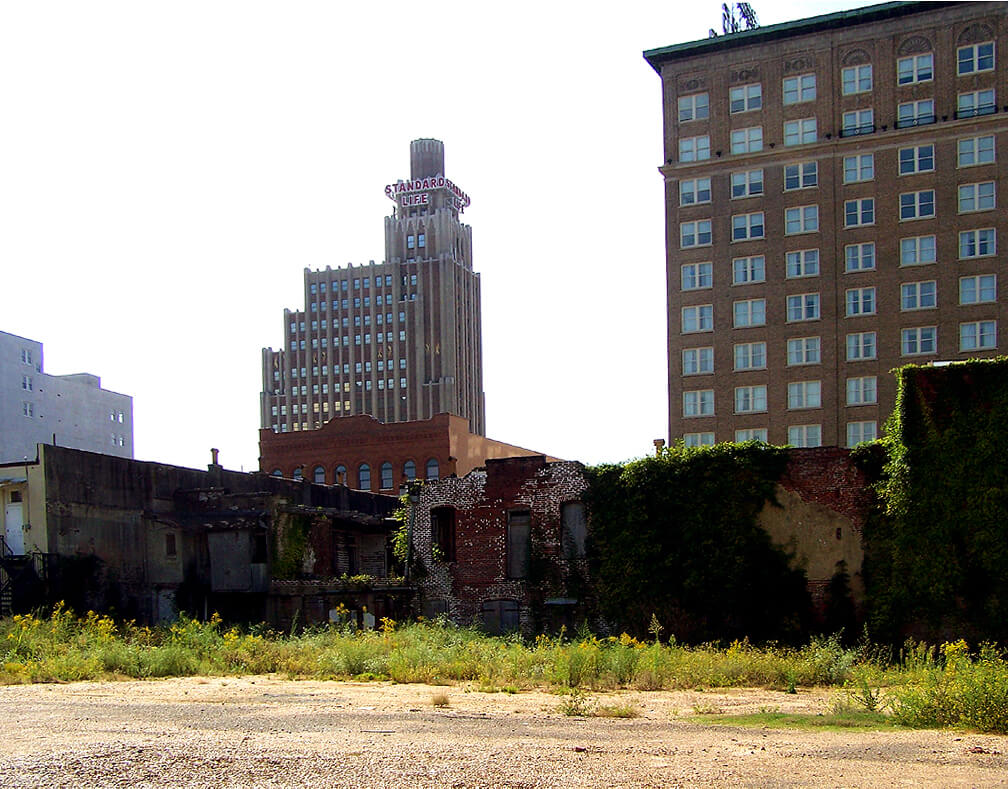

Smith Park is the oldest city park in the nation, and for that reason alone should be declared a Mississippi Landmark. In addition, although there has never been a formal archaeological study of the park, it represents the only undisturbed square in downtown Jackson and may hold as much archaeological value as a site as it does historical value as a park. Another compelling reason is that Smith Park is home to monuments of the state’s history and the capital city, monuments that deserve protection from the caprice and greed of municipal developers.
President Thomas Jefferson conceived of a basic municipal plan for Mississippi’s capital city in 1821, and Smith Park is the only remnant of his “checkerboard plan” that had a green space on every other square. The park was officially established on February 16, 1838, when the Mississippi Legislature voted to dispose of all unsold land given by the federal government “… except such blank squares as deemed necessary to be reserved as commons, for the health, ornament, and convenience of the city of Jackson.”
Smith Park is named for James Smith, Jr., son of James and Ann Preston Smith of Edinburgh, Scotland, who was born in 1816. Smith immigrated to the United States in 1832, and opened a hardware store on State Street in Jackson. Smith moved back to Scotland In the 1850s, due to his wife’s ill health. Smith became a millionaire from the sale of iron stoves acquired under the name of Smith’s Jackson hardware store and marketed in Great Britain and elsewhere by the firm Smith and Wellstood, Ltd. Smith died on April 11, 1886.
In May 1883, Jackson’s mayor and board of aldermen adopted an ordinance authorizing the mayor “…to solicit subscriptions of cash or donations of material for the purpose of putting a suitable fence around the square owned by the city in the rear of the Executive Mansion, and that he purchase a deficit of material needed, and at such time during the summer as he may select, that he enclose said square and put such gates as may be deemed necessary.” On January 1, 1884, Mayor John McGill wrote, “I mentioned the matter to a number of parties, and had promises of assistance, but received nothing from anyone except Mr. James Smith, a former resident of Glasgow, Scotland, who was here on a visit to his old home and friends. He gave me $100, $95 of which I paid on account of lumber purchased, and $5 to Mr. Phil Hammond on his account for building the fence.”
In the April 4, 1888, minutes of the Jackson city aldermen, a Mr. C.L. Gaston wrote: “Mrs. Gaston received a letter from Mr. James B. Smith, of Sterling, Scotland, informing her that he and his two brothers Messrs. Robert and William Smith had on hearing of the city’s improvement of the Public Park named in honor of their father, the late Mr. James Smith, of Glasgow, determined on contributing twelve cast-iron benches or settees.”
A bandstand was built in 1890, and Smith Park was open to black citizens as early as 1897. In the early 1900s, the bandstand was ordered repaired and the Jackson light and power company was asked to install lighting in the structure. Smith Park has always had a water feature, including at one time a goldfish pond and a fountain at the Amite-West Street entrance. On New Year’s Day, 1918, a pergola and fountain were erected on the southwestern edge of the park across from St. Peter’s Catholic Church as a memorial to one of Jackson’s most beloved citizens, W.J. Davis, “The man who led/Where others groped.” Davis founded the LaVernet Stock Farm near the outskirts of the city, “the means of which the advantages and availability of Jackson, Hinds County and Mississippi as a stock raising section was abundantly and decisively advertised to the world.” (Jackson Daily News, Thursday, Jan. 3, 1918, p. 6) This memorial, the oldest landmark in Smith Park, is still standing, but is not included in the proposed “renaissance” by the so-called “Friends of Smith Park” and Downtown Jackson Partners.
In April, 1934 the Order of the Eastern Star dedicated a memorial on the northeastern edge of the park to Robert Morris, whose home once stood across the park on Congress. Morris founded the Order of the Eastern Star at the Little Red Schoolhouse (Eureka Masonic College) in Holmes County. This monument to the founder of the Order is a shrine to its members, but it is not included in the “renaissance” proposal put forth by the so-called “Friends of Smith Park” and Downtown Jackson Partners, who clearly plan to destroy this vital piece of Mississippi history. Another significant landmark, the pavilion in the east central portion of the park, was constructed during the Depression, perhaps at the same time (late 1930s) as similar stone structures at the Jackson Zoo, including the former rhinoceros house, old concession stand, and old restrooms. This is the only landmark retained under the “renaissance” proposal.
On February 10, 1950, the Jackson Daily News declared, “Smith Park was donated to the city for park purposes and should be used only for park purposes,” purposes which surely include repose in the shade, leisurely walks and a soothing flow of water. In 1973, the park was redesigned, with wide walkways, an amphitheater featuring an A-frame band shell, a wooden stage with sunken seating area, and, the most beautiful and prominent feature, an artificial river designed by award-winning landscape artist and then city landscape architect Rick Griffin. This water feature includes a dramatic fountain on the northeast whose waters feed into a stream bed that encircles the park beneath walkways, in a flowing pool before the A-frame stage, ending on the southeast in a pool with a drain and pump that recirculates the water back to the fountain. The project was completed in 1975, the park re-dedicated that September. The “renaissance” proposal does not include a water feature and would also cut the oldest trees in the park, it’s only shade from the strong Mississippi sun.
In 1976, Smith Park was listed in the National Register of Historic Places, but this is insufficient protection for the oldest park in the state. Unless Smith Park is afforded protected status as a Mississippi Historical Landmark, the site will be subject to the whims of irresponsible municipal developers. It’s time to preserve the park as a shaded jewel in the state’s epicenter.

In August, 1905 a Dutch immigrant, horticulturalist and fitness buff became the first plant explorer hired by the USDA’s newly-created Office of Foreign Seed and Plant Introduction to travel the globe in search of plants useful for American agriculture. The first expedition (he undertook three others through 1918) through China, Manchuria and Korea in 1905 was daunting, to say the least, but Meyer was an enthusiast if not to say fanatic, and the constant travel on foot, the weather, the tumultuous politics and the Spartan living conditions were simply taken in stride.
In the Far East Meyer discovered the eponymous plant now most widely recognized by the general public (horticulturalists are also familiar with Meyer zoysia grass). Though Meyer failed to take note of its origin, he probably purchased the ornamental lemon plant from a nursery in Fentai near Peking. Meyer lemon (Citrus x limona ‘Meyer’ or citrus x meyeri) is most likely a hybrid between Citrus limon, the true lemon, and C. reticulate, the mandarin orange. While the Meyer lemon is larger, juicier and more cold tolerant than true lemons, it doesn’t ship well and has never been widely adopted by the citrus industry. In time, it has become successful in limited local marketing and has become a gourmet selection for any number of culinary uses.