Fountain Boy
A Southern Gallimaufry

At first, I was trying to buy Walker’s Drive-In; I really wanted that place badly. I’d become such a fixture in there, I could feel my personality taking over, and it seemed only natural to get it, but the deal didn’t work out, so I started looking around for a place to put Sartin’s, or rather Sartain’s, since my last name is French, and I wanted to get into classic French cuisine. I went to Blockbusters in Castlewoods to drop off a movie, and I saw the Little Caesars next door was for sale. I just looked at it and though I could do my own pizza place. So I called the guy, Johnny Solomon, who owned all the Little Caesars and Popeyes in the area. He said he wanted $50,000 for the place, I offered $30,000, he came back with $35,000, and that was it. I started with $35,000. My dad loaned me the money out of his house equity. This was 2000. We opened February 7, 2001.
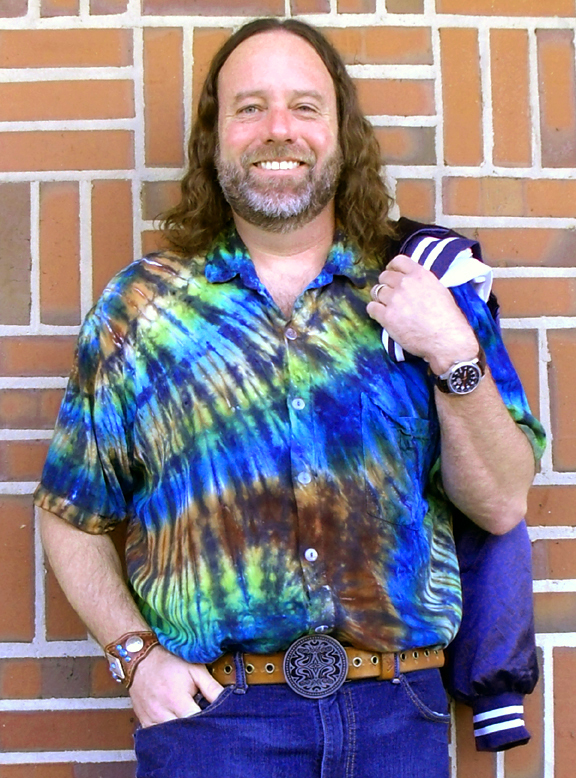
I decided I was going to open a pizza place, and when I realized I could do that, what with the casualness of the atmosphere, I realized I could simply be who I wanted to be and not worry about cutting my hair or what clothes I wear and putting off the customers. I decided I would make the theme of the place the music of the Allman Brothers, the Grateful Dead, the blues, the jam scene of the Sixties and Seventies because I had to be in there a hundred hours a week and why not enjoy myself while I’m there, hang up the pictures I like on the wall, almost make it like my college dorm room. It was almost accidental, how it all came together. I didn’t know what I was going to do. I was 30 years old. I had tried the insurance business; my dad and his brothers were very successful in it, and somehow that’s what I figured I’d always end up doing, but I just didn’t like it. It’s not that it’s a bad business, it just wasn’t for me. I was an artist; I needed to write, paint, sing, play, cook, and that’s what I needed to do to be happy. My Dad got behind me, and I’ll never forget that. That was a big deal, it meant a lot to me. He had the money to get me started at the time. He wasn’t wealthy when he was growing up and had to work to earn everything he got, all the brothers did, so he wasn’t going to just lay it out there for me. But this seemed like a safe thing; if it failed, it would sting to lose $35,000, but not change his life.
And it went off like a rocket. I think people wanted something real. Also, there wasn’t another gourmet pizza shop in Jackson at the time. I don’t think at all. We made everything from scratch, had some great music playing. It helped that we were next door to a Blockbusters at the time, which was before Netflix and all that. I had two guys in the kitchen, and I took some of the recipes that I knew from Walker’s, like the crawfish bisque and a bread pudding, you know the bread pudding that Miss Hazel baked and I would watch her. I took a little bit of something from everywhere I worked, brought it to the table and went to my guys and said, “Alright, let’s do this.” The recipes have changed up since then. The pizza dough now is nothing like it was back then. Now it’s a 300-year old French artisan recipe. We used everybody who was there and pulled upon their knowledge and experiments. Over the years I changed things to make them better, particularly the pizza crust, which I wasn’t happy with in the beginning. We sold a lot of pizzas and people loved it, but I wasn’t satisfied with it. I think in retrospect it was really the ovens, not the recipes, so now that’s why I have brick ovens in every location. I changed up the recipe and moved forward.
We moved into Hal & Mal’s in ’02. Malcolm would come into Soulshine at Castlewoods for some reason, and you didn’t see him that often outside the city limits. We started talking, and I kept thinking about it because I often hung out at Hal& Mal’s, thinking there was room there for a Soulshine. They weren’t using that back room all the time, and so I said, “Hey, man, we’ll open up a Soulshine at Hal & Mal’s. He loved the idea. Hal and Charly didn’t like the idea, they didn’t have anything against us, they just saw trouble coming, and they were right. My first idea was to pay rent and have the bar in there, but you can’t buy two liquor licenses under one roof, so I said how about I don’t pay any rent, you sell the liquor, and I’ll keep a crowd in this room for you. I’ll make it worth it to you just for me to be here and you can sell all the alcohol you want based on my customers. And that was okay, but it still wasn’t worth it for both parties.It didn’t make sense. Then there was a lot of partying going on, and that’s really what made it fail. I learned a lot of lessons. I pulled out of there after being mugged for a third time in Jackson. My car was broken into, I was losing money and on top of that, I just wasn’t sure what I was doing and everybody was partying. There were other factors, too, but it might have worked if I’d known what I was doing, but if I’d known what I was doing, I’d never have gone there to begin with, nothing against Hal & Mal’s.
Anyway, I decided to go out to Highland Colony Parkway because I could see it all going there. I could see the future. We were the first restaurant out there. I signed a lease in ’04, we opened in ‘06. It took a year and a half. I just knew that’s where the white-collar world was headed, you could see it happening. There was nothing there, just this one little center that I’m in which is a big development now. But I could just see it coming. I believe in the township; I thought it would be cool to live there, like being in Belhaven in the Fifties. I could walk to the grocery store and this and that. So I got there, and it was too soon. I lost my ass for a little while. Once again, I really didn’t know what I was doing, I just had a great idea and I could talk to people and put out good food, make sure the place was clean, but when the business shuts down, when you’re through serving people, when all the food it put up, there’s still a lot of work to do, in the office, at the bank, with your attorneys, whoever it is, and I didn’t know anything about it. And what’s maybe even worse, I didn’t want to know anything about it. I just wasn’t interested in it.
Really, I’m just a glorified bartender at forty-six, and that’s alright with me. I’m not special; I just feel like I had a dream, and I was willing to lay it all on the line to either lose it or end up ultimately happy. I was willing to lose everything because I was literally just miserable. As an artist, you know that if you don’t create, you’re miserable. I had to create in some shape or form. A couple of years into that store, we just weren’t where we needed to be. That area still hadn’t developed yet. We got there too soon. So that’s when I went to Porter & Malouf and asked them to be my partners, to back me and help me with the business end. I’d been going out to Tim Porter’s house cooking pizzas in a brick oven at parties, so I went to them and said, “I need help.” They love me and they love the place, and they decided to do it. When I realized how backed up I was, it turned out to be a substantial investment, which surprised both me and them, but they were in. They stepped up to the table, and we became partners. That was 2008, and we’ve been together ever since.
Once we got some organization, the business really took off; we caught up on taxes and bills that had me behind the eight ball. The story was that I moved the Hal & Mal’s location to Highland Parkway, which was the way I spun it to the press, but that was bullshit because I was just a failure there. I shut it down, but I knew what I was going to do in Ridgeland, so I spun it off to the public as “We just had to get out of Jackson.” We eventually took off in Ridgeland, and it’s been great ever since. We moved from Castlewoods to Old Fanin, then we moved out Lakeland Drive again, now we’re out there in a big place right on Lakeland Drive. It’s done really well, and I’m really pleased with it. Those people out in the Reservoir community have been eating Soulshine pizza for fifteen years. They’ve been really good to me. I grew up out there.
When I first opened the original location in Castlewoods, it was just strictly a to-go Little Caesars spot. My mother, my sisters and I went in and painted and made it cool. I put the stereo in, took all the Little Caesar’s stuff down, played music over the speakers in the kitchen and then I decided to put in a dining area. People kept saying that they needed a place to sit and the bay next door in the center where we opened was available, so I got it, put tables in there, built a little makeshift bar, put in a few TVs, and I’d actually bartend and wait on every table myself. And everybody who came in, most of them I knew, had known them for years and years, and if I didn’t know them, I got to know them really fast. It was a magical time. I was doing what I believed in and that was really all that mattered. The people liked the food, they liked the music; they liked the way they got treated. It was all about service, and it was all about art, expression, and I didn’t think about much else. I still don’t think about much else. That’s why I have partners. You have to worry about it, you have to get involved, and they push me to get more involved, but it’s hard to get anyone who’s forty-six years old, ADD, an artist a musician, writer and songwriter to sit down at a computer and go through a P&L. It’s hard for me to do because I don’t have a natural interest in it; I just make sure it gets done.
Why Oxford? There are a lot of reasons and one of the reasons is you have to get your partners to buy into it, but my partners are Ole Miss guys, and I knew they’d like it. Everybody wants to do something in Oxford, but what most people don’t realize is that Oxford really isn’t Oxford unless a ball game is going on, at least when it comes to retail. Everybody’s there for whatever big occasion is going on, but on a Tuesday in July, what are you going to do? It’s better now that people are moving there to retire. This coming April we’ll have been there for four years. The anniversary is April 20th (4/20). I opened it up on that date on purpose. We didn’t have our kitchen quite ready, but I opened up and served hot dogs that night so people would come in and drink and our anniversary would be 4/20. That makes it really easy for me to remember, because I never remember dates, and the number spans the culture of Soulshine. But the Oxford location has been fabulous, has kicked butt. When we cleaned up the floor of that location, stripped off the years of filth that had built up, we discovered that the site was once the location of one of the first Kroger’s in the state. It took my breath away. I’ll never forget looking at that and thinking wow this is history here. I’m a history major, and any time I can put in a Soulshine, and I only have four, I strive to keep that historical significance if possible, that feeling of realness, I don’t want them all to be alike. I’m always torn over how many I’m going to have and keeping it real, not being a sell-out.
The music is still relevant, and there’s still good music that comes out. You’re always going to have people listen to that kind of music; it might not be the masses, but the music is still there. The music is timeless. I didn’t call it “artisan pizza” back then; I didn’t call it anything. It was just Soulshine, and it still is. I don’t like to call it anything else. It’s always going to be Soulshine pizza, and now we’re making the switch to stone-baked. As I’ve gotten older, I’m not Mr. Detail still, but I’m also striving to get better. To be up where we need to be, I felt like we needed to take the cooking method to another level, to another tier, and that’s what we’re doing this year with the ovens to match everything else, which seemed to be so perfect. And I felt like you look on the internet now and you see brick-fired, coal-fired, wood-fired and felt like we needed to do that. And we have; we have a brick oven in Oxford and Nashville, and we just installed one in Flowood last week. All I have to do now is to install one in the Ridgeland store, and it will take a couple of weeks before we do that. I feel like that gives me the confidence to move to another fifteen years and look up when I’m sixty-one and say, “Yeah, okay. What’s next?”
If I had to look back on life, the last fifteen years of my life and the hardships I’ve gone through, from divorce to being broke, broke, broke, somehow I dug in and made it happen Soulshine has meant so much to me. It wasn’t just a restaurant that I opened up that could fail or be successful. It’s my life on the walls. Everything means something to me, the customers will always mean something to me, the music, everything. It meant more to me than money or my perceived success. But ultimately, in the end, taking care of the people and what I believe in paid off for me down the road. I consider myself a success now. I still think I’ve got a lot of room to get better, and I think that’s what drives me a lot, too, that I’m never satisfied; not with me, or the business or whatever. I’m satisfied that I’m living the life I’ve always wanted to live in certain ways, but I’m competitive. I’ve always been athletic, and I was out there playing tennis until I was forty and wanting to win.
So I think my competitive nature pushes me. I wasn’t going down, and I wasn’t going to let anybody take me down. I also felt like I owed it to the people not to give up; the people who came in there, the people who supported me and the people who worked for me, who had jobs. There were many times when I could have come in on a Monday and said to hell with it, it’s not worth it anymore. That happens all the time in the restaurant business, people just give up. But I’ve never let it go, and I still won’t. It’s me not letting go of myself, which is a big part of my identity and who I am. Sometimes people say your job should not be who you are or whatever, but I turned my job into who I was. I sell myself. When you open up a restaurant, people are going to come see you because you are who you are and it’s about you, but after they’ve eaten there enough times, maybe had a bad meal or two, and you’re having trouble, they just quit coming. They’ll be there to hug you when you close, but the food has to be good, too. And it has been. I’ve never been quite satisfied with it, but I doubt if I ever will be.
I decided to open a Soulshine in Nashville because my oldest daughter lives there, and I knew after being remarried and having two more daughters, I wanted them to be raised together. So we moved there after we opened in 2011, in Midtown near Vanderbilt. It’s a killer place; we have a rooftop patio with a stage up there. The Who’s Who list of legendary musicians and current stars who sit in there with our Soulshine Family Band is very deep. Once I was singing, and I look up and there’s Steve Tyler, for instance. Another time I’m standing in there around Halloween. I see this cat and I’m thinking, “Is that Billy Gibbons or is this dude in costume?” Well, it was him. This stuff happens all the time. I’m floored all the time by who walks in and tells me, “This place is cool, man, Nashville needed something real.” Maybe that’s what I want to have on my tombstone:
Brother Chris Sartin lies here.
“He kept it real”
“That realm is best and most stable which is ruled in accordance with God’s will alone,
and the worst and weakest is that which is ruled arbitrarily.”
Ulrich Zwingli
Jackson’s First Presbyterian Church (FPC) is a prime example of stability. It is located at 1390 North State between Pinehurst and Belhaven Streets. The current church, which opened in 1951, began its history 114 years before at the corner of N. President and E. Capitol Streets in Mississippi’s first state house building. Greater Belhaven’s only church was organized on a Saturday afternoon, April 8, 1837 by the Rev. Peter Donan and four persons: Mrs. Margaret E. Mayson, Mrs. Susan Patton and Mr. and Mrs. John Robb. There was a pastor (Rev. Donan), but no elders for two years, no deacons for six years nor an individual house of worship until 1845. In its first two years of existence, the church had but three new members. (1)
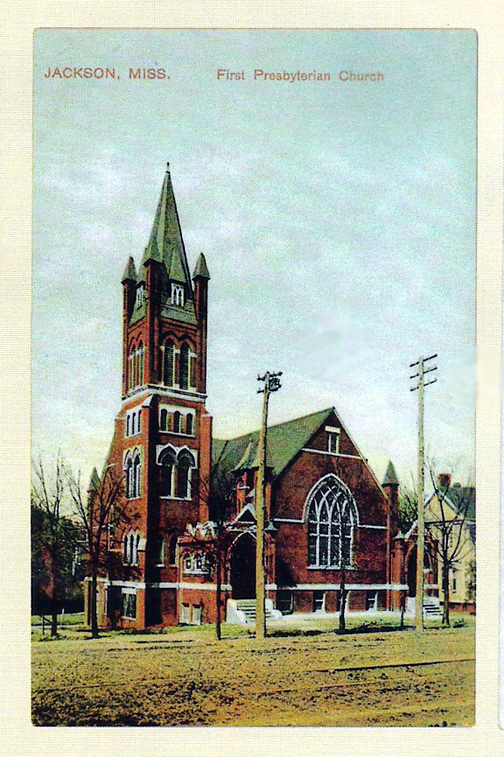
The State of Mississippi owned considerable land in the downtown area of Jackson in the early 1800’s. It made land available to religious denominations in the vicinity of Smith Park and First Presbyterian purchased a tract a bit north and east of the original designations at the corner of Yazoo and North State Streets. Its first home edifice was erected on this site in 1845-46. Somehow, it escaped the fiery ravages of General W.T. Sherman 18 years later and was razed in 1891. It was replaced by a small red brick building in 1893 (left) which served the congregation until the opening of the present structure in 1951. The final service in the old church was preached by Belhaven College President Dr. Guy T. Gillespie on August 26, 1951. (2) (3) (4) (15)
The land on which the church rests today (Hinds County MS parcel number 13-38), was owned by a group of developers in 1925. These were early Jacksonians S.S. Taylor, C.E. Klumb, S.K. Whitten Jr., W.N. Watkins and H.V. Watkins. This group sold the land on December 4, 1925 to W. N. Cheney, R.S. Dobyns, Carl L. Faust, W.E. Guild and Stokes V. Robinson. The Pinehaven Realty Corporation purchased the property from this group on March 1, 1927 for $12,700. (5) (6) (7) For the much of the following 23 years, Pinehaven Realty Corporation maintained the land where the church sits today. A single dwelling and out building were shown on the 1925 Sanford Fire Insurance map. The majority of the land between Pinehurst and Belhaven Streets was vacant and remained so until purchased by First Presbyterian Church on September 20, 1950. Prominent Jacksonian and church member Chalmers Alexander was instrumental in this transaction. (8) (17)
According to Jacksonian Judge Swan Yerger, much of this north end of the 1300 block of north state was a field which served as a softball diamond for the older Power School boys who were enrolled in the old Power School on Pinehurst. The spent their recess and many hours after school on this diamond. Since the inception of the church in 1837, First Presbyterian has had only 12 permanent senior ministers. The tenures shown below do not include interim or guest preachers.
Rev. Peter Donan – 1837-41
Rev. S.H. Hazard – 1841-42
Rev. Leroy Jones Halsey – 1842-48
Rev. Halsey built the first church sanctuary
Rev. Isaac James Henderson – 1849-53
Rev. L.A. Lowery – 1853-55
Dr. John Hunter – 1858-95
Dr. James Buchanan Hutton – 1895-1939
Dr. R. Girard Lowe – 1940-52: When this man knelt to welcome little children to Sunday School, he was a giant.
Dr. John Reed Miller – 1952-68: Dr. Miller was active in missions and in 1962, led the church in founding a Winter Theological Institute which was continued as Reformed Theological Seminary. For 16 years his sermons were broadcast on radio and beginning in the early 1960’s, the morning worship services were televised.
Dr. Donald B. Patterson – 1969-83: During Dr. Patterson’s ministry Twin Lakes Conference center was established near Florence and he served as chairman of the steering Committee that formed the Presbyterian Church of America. The PCA was Founded in 1973 and is focused on the infallibility and historicity of the Scripture and the Westminster Standards. According to Dr. William K. Wymond, minister of music and media, “We distinguish ourselves by these tenants.”
Dr. James M. Baird – 1983-95: Dr. Baird gave leadership to three new building programs, popularized the Church’s TV ministry and was instrumental in involving the church’s Mission Mississippi movement.
Dr. J. Ligon Duncan, III – 1996 – 2013: The son of an eighth generation ruling elder, Dr. Duncan recently resigned his pastorate to take over the position of Chancellor of the Reformed Theological Seminary. (1)
The Rev. David Strain took over the responsibilities of pastor in early 2015. Since that time several other worthy churchmen have helped fill the pews on Sunday morning. Today’s original sanctuary was opened Sunday, September 2, 1951 with the first service preached at 7:30 p.m. by interim pastor Dr. Albert Sydney Johnson. Additions to the original building have been the Lowe Fellowship Hall in 1956 which included additional Sunday School space, Westminster Hall in 1986 and Miller Fellowship Hall which contains the music suite, choir suite and kindergarten. A study center is located on the northeast side of the church which includes a gymnasium and three stories of Sunday School space. The present sanctuary was expanded in 2005-07 and currently seats 1,380. (2) (15) Since its inception 176 years ago, Jackson’s First Presbyterian Church has been housed in but three permanent buildings in three locations. It has been served by 12 elected ministers, for an average of just under 15 years each. This consistency is proof of the stability to which Zwingli alluded and is testimony of the continuity and permanence of this institution.
“And I say also unto thee, Thou art Peter, and upon this rock I will build my church;
and the gates of hell shall not prevail against it.”
Matthew 16:18
On July 10, 1950, while the present sanctuary was under construction, the church cornerstone, which dates from 1891, was transported from the old building on Yazoo Street to the left side of the new church’s front door. Dr. Girard Lowe oversaw the insertion of documents pertinent to the time. These included a bible, a church history, the church roll, various bulletins, a list of major actions leading to erection of the new building, names of the building committee, a roster of the major contributors up to that time, the departmental leaders and daily newspapers chronicling the event. (9)
The mission of First Presbyterian Church is that which is the answer to the question posed by the Westminster Shorter Catechism: “What is man’s chief end?” Man’s chief end and the mission of the church is “to glorify God and enjoy Him forever.” Today’s church is composed of over 3,100 members, 2,550 of whom are resident members that represent 1,375 families. Many currently live in the Belhaven neighborhood. There are 105 staff members including those at Twin Lakes Conference Center. The church is governed by a 70 member Session which is made up of elders. The minister’s role is to provide spiritual leadership. Property and care of the church is done by deacons. Ministers belong to the Presbytery. Major decisions are normally made by the Session with senior ministers selected by the congregation. Early growth of the church was overseen by its senior pastors and pioneer Jacksonians such as the Power, Williford and Wells families, Judge Julian P. Alexander, Bob Cannada, George Lemon Sugg and R.E. Kennington. Many leading elders and youth leaders have also contributed to church growth. (2)
“Those who have arrived at very eminent degrees of excellence in the practice of an art or profession have commonly been actuated by a species of enthusiasm in the pursuit of it.”
John Knox
The Presbyterian ministry throughout its history, which dates back to the Reformation, has been shaped by the knowledge of Christian faith and the principles of the history which surrounds it. Since the Reformation church leaders have placed a high premium on the education of its ministers and laity. A primary source of this knowledge is the Reformed Theological Seminary (RTS). The RTS was started in Jackson, Mississippi in 1966 by five men, four of whom were elders in First Presbyterian Church. Its purpose is to train for the ministry based on a high view of scripture and historic Westminster standards. With ancillary campuses in Orlando, Charlotte, Dallas and Washington, DC, it offers advanced degrees in bible studies, missions and family counseling. (10) Belhaven University has received significant support from FPC for a number of years.
A thriving institution today, Belhaven experienced some fallow years in the early and middle 1900’s involving its endowment and accreditation. In spite of the heroic efforts of its third president Dr. Guy T. Gillespie, the school struggled to maintain its viability. The designation of the college as a co-educational institution in 1954 helped the situation but it was its transfer by the Synod of Mississippi Presbyterian Church in the United States to the Belhaven College Board of Trustees in 1972 that ensured its modern independence. FPC elders serve on the College’s board and significant support is provided by the church. (11) FPC has historically supported private academies which base their mission on Christianity and character. Chamberlain–Hunt Academy in Port Gibson has a history that goes back to 1830 at Oakland College in Rodney. Founded as a military school, its fortunes waxed and waned through the years and were quite low in the mid 1990’s due to decreased enrollment. In 1996, members of the First Presbyterian church in Jackson and French Camp Academy in Choctaw County–in which the church also has an interest–purchased from a local bank the historic buildings, over 200 acres of land and the school’s educational equipment. This purchase ensured the viability of the Port Gibson facility at that time. (12)
Twin Lakes Conference Center near Florence was obtained in 1970. It serves as a summer camping facility in warm weather months and an events center the balance of the year. Over the years millions of dollars have been invested in this first class facility which is available for rental by outside groups. (13) FPC is youth oriented beyond Twin Lakes and its regular ministry. It supports the neighborhood Christian Center in the minority community which emphasizes Christian ethics, academic tutoring and breaking the chains of poverty. (2) Other outreach programs include work with Mission Mississippi, world missions, campus student groups and assistance in starting new churches within the PCA movement. The First Presbyterian Day School was established in 1965 and is located in Miller Hall on Pinehurst Street. The day school contains grades k-6 and currently has a student body of about 650. It involves normal school curriculum, which according to Dr. Wymond, “is based on a Christian and world life view.” It is designed so that the school and church complement each other. While this school can present some traffic challenges when taking in and letting out, it greatly strengthens the character of the neighborhood and is an attraction to numerous young families, many of which have remained in Belhaven after their children finish the sixth grade. (14) (2)
Let us not cease to do the utmost so that we may incessantly go forward
in the way of the Lord;and let us not despair of the smallness of our accomplishments.”
John Calvin“
When asked of the church’s future plans, Dr. Wymond stated “the First Presbyterian Church is always looking for opportunities to serve and preach the gospel. He further added, “No new projects are scheduled at present except to help the city. We are here for Jackson and as an institution to anchor the neighborhood, to conduct bible studies in the Mid Town neighborhood and be helpful and supportive of the church.” (2) On a rainy Sunday morning on the first day of October 1950, Billy Harvey, age 11, stood before the 400 member congregation in the little brick church on the corner and accepted Christ as his personal savior. He held a bible given to him by his parents and a Shorter Catechism provided by the church. Dr. Lowe asked the congregation to accept him into church membership and, standing, they agreed. Looking back through the prism of 63 years he would joyfully do so again. One hundred and seventy six years ago a pastor and four early Jacksonians met in a statehouse in a tiny city only 15 years in existence. They planted the seeds of a great church and a monument to their faith.
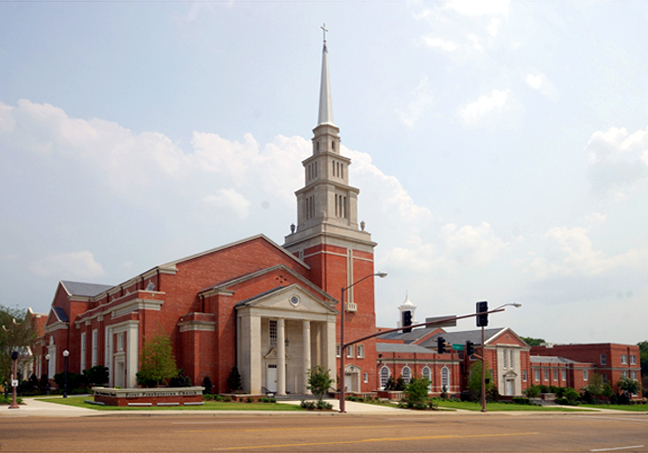
Today the First Presbyterian Church of Jackson rests firmly on its foundation, its steeple soaring toward the heaven we aspire to and towers over the memories of old Power School to the south on State Street and the rambling Green Apartments to the north. It surveys to the west what was at its construction the Hederman home at Marshall Street, the beautiful Vaughan Watkins house at Webster and Beth-Isreal Cemetery in between, ever facing east. Its mission remains the glorification of God. It is not moving to the suburbs. It is not changing its doctrine. It is not going away. Like Peter’s rock, it represents a hallmark of stability and is grounded in the inspiration of its purpose belonging to all as a beacon of faith, a citadel of strength and a cornerstone of our neighborhood.
Bill & Nan Harvey
September 2013
SOURCES
(1) Church history from web site
(2) Interview with Dr. William K. Wymond, minister of Music and Media, (09/30/13)
(3) Historic marker, NW corner of Yazoo & State Streets
(4) FPC archives
(5) Hinds County deed records, book 174, page 22, (12/04/1925)
(6) Hinds County deed records, book 190, page 284 (03/01/1927)
(7) Hinds County deed records, book 676, page 87 (09/20/1950)
(8) Jackson city directories 1930-50
(9) Program, Laying of the Cornerstone, FPC, 07/10/1950
(10) Reformed theological Seminary, Internet Wikipedia, (09/04/2013)
(11) Gordon, James F., Jr., A History of Belhaven College 1894-1983, Jackson, MS Belhaven College (1983)
(12) Chamberlain-Hunt and French Camp Academies web sites
(13) Twin Lakes Conference Center web site
(14) Mission Statement, FPC Day School, A Kingdom School, Established 1965
(15) Jackson Daily News, Sunday 8/26/51
(16) Conversation with Judge Swan Yerger (09/29/13)
(17) Sanford Fire Insurance Company map – 1925
ACKNOWLEDGEMENTS
(A) Thanks are extended to Dr. William K. Wymond, minister of Music and Media at First Presbyterian Church for his kind contribution of time to explain much of the background of today’s church
(B) Appreciation is extended to Rev. Brister Ware, minister of Pastoral Care for his efforts to coordinate permission and approval of this article
(C) Appreciation is extended to the senior pastor and others associated with the governmental structure of First Presbyterian Church of Jackson for their support and approval of this article.
As culinary curator at the Mississippi Museum of Art, I match food and art together. We’re planning on starting an art gallery in the kitchen, a food art gallery. That’s where I come into play; with a chef’s table in the kitchen, I’ll be able to curate every meal and tell a story. The new kitchen in the museum has a complete chef’s table, a mounted-to-the-wall table we put in about a month ago that will never go anywhere. I’ll let people walk through the kitchen and view the art, beginning on our monthly ‘Sipp Sourced event on third Thursday. People will be able to come in to the museum and get a kitchen experience. It’s never been done quite like this in Mississippi, and it’s one of the things that make chefs more intelligent by bringing us out of the box. Often we get caught up in this stereotype of Mississippi: stewed collard greens and fried chicken and such. We need to tie food in to more than what you usually think of when you consider it. If you sit down and talk with my grandmother, and if you open your ears up and really listen and let her curate her past, you can stitch that into artwork; when you look at her pecan-wood tables you can tell they have a story. If you go to my grandmother’s house, really anybody’s grandmother’s house, you’ll find art. We tend to focus on the plate on the table, but we need to begin thinking about everything else in the environment. That’s what I want to do; I want to curate my surroundings.
I will be at the James Beard House on April 13 with Mitchell Moore from Campbell’s Bakery and Dan Blumenthal from BRAVO! It’s a beautiful thing when you have fellow chefs who are honored to do it; they know what the business is and know we have to bring the finest quality we can to the table. When the James Beard Foundation invites you, it’s for a reason, and it’s an honor to be one of the ones they call on from Mississippi. I’ve done two other events with the James Beard people. I’ve cooked twice in the house itself. I also did the Hamptons event where they honored Carla Hall. Mitchell and Dan have been with me at every event. It’s a tough experience, but fun to do and showcase Mississippi. Carla talked about getting me on The Chew soon. I can’t wait until that happens, so I’m going to keep bugging her about that so one of the Mississippi fellows can be on The Chew talking about Mississippi.
Everywhere I go, I celebrate Mississippi. With the menu for the Beard event, I will try to take it all the way. For appetizers, the Simmons Delta catfish are smoked and made into croquettes, the pickled radishes are coming from Madison, and I will pair it up with a pickled peach and dry sake spritzer with lemon oil celery bitters. The other appetizer dear to my heart is the Mississippi Gulf shrimp boudin served on Mitch’s house-made crackers. We’re doing fennel sauerkraut and pairing that up with a Gibson-style martini with pickled mustard seed and pickled striped beets. The other group that’s supporting us in this dinner is Trinchero Family Estates in Napa Valley. I met those people when I was a corporate chef with Marriott, and so nine years later I call them to pair up Mississippi food with Napa Valley wines. And they’re donating it all. I’m still going to be taking Cathead vodkas and Hoodoo coffee liqueur that we’ll be pairing with our desserts and other things we’re cooking. I’ll also take a few Mississippi beers to pair up with our all-time famous pickle brined fried chicken, maybe a Sweetwater.
Our Jackson Public Schools partnership started last November. I was already going into the cafeterias and working with the staff. It’s a different world, so I’m still trying to get adjusted to it, since as a chef, having worked in restaurants all my life and going into a cafeteria, it’s a totally different environment. Honestly, I probably jumped in a little too soon and was a little too aggressive about it, so I had to learn how to think about things a little differently. I have to really connect with the kids as opposed to a guest who is going to come into your restaurant. When I do a menu now, I might even turn on some cartoons just to be in the background where I can hear them, but I have to take myself back to where I was when I was a kid to relate, and it’s kind of tricky. I’ve been working with the kids, the cafeteria workers, the staff and the parents. Now we’ve rolled out this concept in which I do a rotating menu that changes every month. The menus are highlighted on Mondays, when the kids bring their parents, their grandparents; their families come out and dine with them. This month we’re doing a “Mississippi Italian” menu. We’re doing a homemade flatbread pizza, a veggie pizza that’s made to order with things like fresh broccoli, squash, zucchini, peppers, onions, tomatoes, and this pizza is the number one thing the kids are asking for. You’d think they’d want sausage and pepperoni, but the kids are excited about their vegetables. Instead of just giving them a boring plate we put a fun twist on it. I try to balance myself between the two schools we’re in now, Blackburn and Powell Middle School, but as soon as we work out the kinks a little bit more the goal is to go into all thirteen schools later this year.
Working with the staff in the schools takes me back to a world I’m used to, that of being a corporate chef for Marriott. I floated around to at least seven hotels at one time, so I had to instill everything I had been taught into the chefs at each hotel. It’s the same thing with the cafeteria managers and the different schools; you get on the same level with one another. I invite them to the kitchen here in the museum, we play around in the kitchen, and we establish a relationship. They see how I like to touch food, and move food and season food so they can map me and get closer to how I like to work in the kitchen. We take photos, make recipes and put them in a book. They’re beautiful people. I remember coming up and being stuck into a hotel environment where I’m cooking the same foods over and over again. I thought corporate had forgotten all about me, I’m tired of cooking the same chicken breast, when are we going to do something different? With Marriott, you couldn’t just change things overnight; you had to wait for it to become system-wide. This sense of institutionalization in public schools is the same.
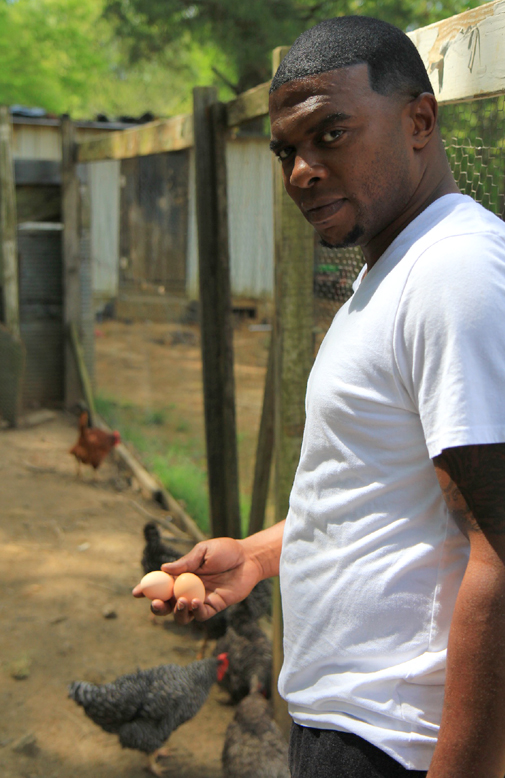
Coming up on February 18th is is the first year anniversary of my monthly ‘sipp Sourced pop up restaurants. We’re going to celebrate with Mississippi burgers, and we’ll have “Art for Burgers” too. I’ll be grinding local goat and veal, chicken from Hattiesburg, beefalo out of Morton, and pork and beef from Lena. All will have a different theme, all from different counties. We’re also revamping the Mississippi Museum of Art garden, planting a pumpkin patch for the kids. I work with Bill Evans, who’s with MSU out of Crystal Springs, and he assists us pro bono. My goal is to put in a small chicken coop; wouldn’t it be cool to drive down Court Street in downtown Jackson and see chicken coops?