The Rivers of America is an important series of books that started in 1937 with the publication of Kennebec: Cradle of Americans by Robert P. T. Coffin and ended in 1974 with the publication of The American: River of El Dorado by Margaret Sanborn. For the most part, the editors were successful in bringing the regional folk life of America to focus through the lenses of her rivers.
Constance Lindsay Skinner, a Canadian writer and historian initially conceived the series in the early 1930s. She was also the first series editor. In an essay that was included in early volumes of the series, Skinner stated, “This is to be a literary and not a historical series. The authors of these books will be novelists and poets. On them, now in America, as in all lands and times, rests the real responsibility of interpretation.” Skinner lived to edit only six of the volumes, but her criteria for authors and the freedom she granted them—a policy continued by subsequent editors—guaranteed not only the success, but the importance of the series.
The series’ editors sought out a wide cross section of poets, novelists, historians, and illustrators to produce living literary portraits rather than historical tomes. The illustrators included many famous and soon-to-be-famous artists, including R.E. Banta, Ross Santee, John Steuart Curry, Nicolai Fetchin, John McCrady, and Andrew Wyeth. George Annand and Rafael Palacios were the series’ principal cartographers. Annand drew the maps for nearly half the forty-nine Rivers books published in the first eighteen years of the series, including the two “Mississippi Rivers” The Lower Mississippi and The Yazoo.
Skinner wanted the Rivers of America books to create popular literature reflecting the regional history of America. For Skinner, it was imperative to incorporate a Southern region into her work, partially to confirm that a distinct and vibrant population still resided in the South. As she wrote to a potential author during the series’ planning stages, “I had been sure there was this solid ‘backbone’, a sound folk-core, or the southern backcountry would have gone back to timber and wild animals.”
For the South to work in Skinner’s series, its character had to stem from the people’s relationship with nature, specifically with the natural history of the rivers of the nation. Cecile Hulse Matschat’s Suwannee River: Strange Green Land (1938) remains a best-selling volume, and Marjory Stoneman Douglas’s The Everglades: River of Grass (1947), a landmark in American environmental writing.
Of Skinner’s original vision of twenty-four volumes, three focused on Southern rivers, the Suwannee, the Arkansas, and the Lower Mississippi, designated to portray the Mississippi River south of St. Louis. (The Upper Mississippi: A Wilderness Saga, by Walter Havighurst, the second volume in the River series, was published in 1937). All told, however, only seven rivers in the South are covered in the series: the Tennessee—two books, both by Donald Davidson The Old River, (1946) and The New River (1948), inclusive of the profound changes wrought by the Tennessee Valley Authority—the Santee, the Arkansas, the St. Johns, the French Bend, and in Mississippi, the Lower Mississippi, and the Yazoo.
Skinner died in 1939. Nearly a year later, in 1940, the publisher, Farrar & Rinehart, announced the editors of the Rivers of America series, Stephen Vincent Benét and Carl Carmer. Four Rivers titles were published under their editorial guidance in 1940 (The Wabash, by William E. Wilson; The Arkansas, by Clyde Brion Davis; The Delaware, by Harry Emerson Wildes; and The Illinois, by James Gray). Three more titles followed in 1941, The Charles, by Charles Bernon Tourtellot; and the TheKaw, by Floyd Benjamin Streeter, and The Brandywine, by Henry Seidel Canby, which included the first illustrations of the young Andrew Wyeth.
The Lower Mississippi
A book on the Lower Mississippi is named on the first page of Constance Skinner’s “Rivers of America Journal,” a preliminary plan for the series, dated August 17, 1935. Written as “New Orleans & Lower Mississippi,” the author Skinner designated for the volume was Edward Larocque Tinker. Tinker today is best known as a scholar of Latin American culture, but he wrote several books about New Orleans, including Lafcadio Hearn’s American Days (1924) and Closed Shutters: Old New Orleans – the Eighties (1931), but for whatever reasons did not take on the Lower Mississippi volume.
The editors then committed to a contract with Lyle Saxon, writer and journalist who reported for The Times-Picayune in New Orleans, who had written Father Mississippi in 1927. However, Saxon apparently reneged on the project (likely because he was directing the Federal Writers’ Project Works Progress Administration’s Guide to Louisiana (1941). Carmer came to New Orleans to cancel the Farrar & Rinehart contract with Lyle Saxon for the Rivers book on the Lower Mississippi where he met a family friend, Betty Carter, wife of Greenville, Mississippi journalist Hodding Carter II. At the time, Carter was in New York City, working for the progressive newspaper, PM.
While he was at Harvard, in response to an invitation and subsequent encouragement from an editor at Alfred A. Knopf, Hodding Carter had written five chapters of a book which was to analyze the racial and political situation of the South. (Carter’s work was not accepted.) Showing Carmer the material Hodding had written for Knopf, Betty was able to interest Carmer in Hodding as the “perfect” candidate for the writing of the Mississippi work. In July, 1940, Hodding Carter signed the contract for Lower Mississippi, receiving a $400 advance. In September, he resigned from PM and returned to Greenville and his newspaper, the Delta Democrat-Times.
The Carters did much of the research for the book at the Tulane University library. In November 1940 the National Guard was called to active duty. Hodding’s regiment was moved to Florida, and he became a correspondent for the Democrat-Times. He had offers for such work from two other newspapers and from the Associated Press, but he concentrated on writing the Rivers book. Reviewing its early chapters, Carl Carmer observed that the book would be one of the two most significant volumes of the series. He advised Carter not to worry about the June 1, 1941 deadline established in the contract, noting that the book was too good to hurry. The Lower Mississippi was published in the fall of 1942 to favorable reviews.
Writing in The New York Times (Dec. 6, 1942), noted critic Horace Reynolds—who also took a strong interest in Faulkner’s first novels as well as the early publications of the Lomaxes—stated, “By responding to the realistic rather than the romantic aspect of his river, Mr. Carter has written one of the best books in the Rivers of America series. His astringent approach is fresh and welcome. He has dug below the surface ease and softness of the delta life to the savagery and pain which lie beneath them.”
“No river in America has been more over-romanticized than the Lower Mississippi,” Reynolds wrote. “Fiction, popular history and popular song have all combined to give it a personality which does not exist. The Lower Mississippi doesn’t look like the pictures or sound like the songs. It is a wilderness of muddy water and deep sky, with a thin wedge of flat land in between. Its great beauty is not easily discernible. To that beauty, which has been best described by Lafcadio Hearn, Mr. Carter is articulately sensitive. But he is no exploiter of the Southern tradition. A man of thought and conscience, he is troubled by the social problems of a section to the intensity of whose plight the phenomenon of a Huey Long is an index. His book cuts deep into the life of his valley.”
The book was illustrated by John McCrady. In a letter to the Carol Fitzgerald, author of The Rivers of America: A Descriptive Bibliography (1991), Matt Martinez, a friend of John McCrady’s widow, Mary, wrote that he had spoken to Mrs. McCrady about her husband’s role as illustrator of The Lower Mississippi: “To address your questions, Mrs. McCrady felt that Hodding Carter approached McCrady, but this was fifty years ago or so, so it’s a little hazy. Mr. Mc and Carter were boyhood friends in Hammond, Louisiana, in the late 19teens. and early 1920s…. I’m not sure of any causal information in terms of who approached who at that time, but the two men who are a big part of The Lower Mississippi had a personal history together that preceded their professional association.”
In his foreword to “John McCrady 1911-1968,” a catalog issued by the New Orleans Museum of Art in 1975, E. John Bullard, the museum’s director, observed, “During the 1930s John McCrady was recognized as the most important exponent of Regionalism working in the South. In his paintings, McCrady visually captured the unique aspects of rural Mississippi and Louisiana with the same authenticity and insight that Benton and Curry brought to their depictions of the Mid-West.” Life published a five-page spread on the artist and commissioned him to paint “the second in a series of dramatic scenes in twentieth century American history.” McCrady chose to paint the assassination of Huey Long and produced perhaps his best-known, and certainly his most controversial artwork.
The Yazoo
The second Mississippi river included in the Rivers of America Series is the Yazoo, However important the Yazoo seems to Mississippians—and the Yazoo Basin undeniably has the richest cultural heritage of any other section of the state—its choice as a subject for the Rivers series gives us some food for thought. Three other rivers, the Atchafalaya, the Tombigbee, and perhaps particularly the Red River (of the South) deserved consideration.
So why the Yazoo? The answer is Hodding Carter. Carter’s friendship—if not to say influence—with Carl Carmer, who by 1949 had become the principal editor of The Rivers of America, and would remain the series editor until the publication of the final book (The American: River of El Dorado, by Margaret Sanborn) in 1974. Carter must also have already had in mind Frank E. Smith as the author. Smith was managing editor of the liberal-leaning newspaper Greenwood Morning Call in 1946 and 1947. He was a legislative assistant to United States Senator John Stennis from 1947 to 1949 and was elected to and served as a member of the Mississippi State Senate from 1948 until 1950, when he was elected as a Democrat to the U.S. House of Representatives from Mississippi’s 3rd Congressional district.
In a June 1991 letter, Smith wrote, “I started on the Yazoo in 1947, when I was recommended to the editor by Hodding Carter, who had written Lower Mississippi a few years before. He was a friend and associate in newspaper work. I wrote two or three sample chapters, and Rinehart gave me a contract and a $1,000 advance.”
On January 7, 1948, Frank Smith signed an agreement with Rinehart & Company which called for delivery of a completed manuscript of The Yazoo in its final revised form on or before January 1, 1951. He was to receive royalties of 10% of the retail price on the first 5,000 copies sold; 121/2% on the next 5,000 copies. sold; and 15% on all copies sold thereafter. He was to be receive an advance on royalties of $750, $250 on signing the agreement, $250 on delivery of the manuscript, and $250 upon publication of the book.
“I forgot about the contract when I became involved in some personal endeavors,” Smith later wrote, “but was reminded of it in 1953, when Rinehart wrote telling me to produce the manuscript in three- or four-months’ time or return the money. I was busy at that time as a member of Congress, but I didn’t have the money to reimburse them, so I produced the manuscript, and it was published the next year with no revisions or deletions.”
Reviews of The Yazoo were overwhelmingly favorable. Reviewing in the Chicago Tribune, (May 16, 1954) Harnett T. Kane, author of Huey Long’s Louisiana Hayride: The American Rehearsal for Dictatorship 1928-1940 (1941) wrote, “The author is something of a rarity, a politician who can write. The 36-year-old Mississippi congressman had a role in the ending of Bilboism; he represents a new south. His style is non-lyric, non-emotional, almost matter- of-fact. a novelty in certain circles of regional writing.”
Fellow Mississippian Hubert Creekmore, reviewing in the New York Times (May 9, 1954) states, “Since Frank Smith is a Delta native and a Congressman, it is not surprising that his best passages are those dealing with political, and economic problems. His discussion of the sharecropper-commissary system is concise and understanding, and the survey of flood control and the touchy subject of the four dams on Yazoo tributaries is sensible.” Finally, Hodding Carter himself, in his review of The Yazoo in his newspaper, the Delta Democrat-Times (May 9, 1954), writes, “(Smith) is Mr. Yazoo, even Mr. Delta himself; attuned to and informed on its manifold problems.” Here it must be noted that both Creekmore and Carter take Smith to task, Creekmore “for the omission of a full and organized essay on the Delta planters” and Carter for Smith turning a blind eye to Parchman penal farm, “the nation’s worst such institution, where the lash, the convict trust system, and the lack of any real rehabilitation program conspire to breed worse criminals out of men who are to be returned to society.”
The illustrations in The Yazoo are by Janet Turner (1914-1988), a Missourian who graduated with distinction in 1936 with a Bachelor of Arts degree in Far Eastern History. Her first postgraduate work was done at the Kansas City Art Institute, where she studied under Thomas Hart Benton and John de Martelly, the illustrator of The Wabash (1940), the eighth book in the Rivers series. In 1941, after five years of postgraduate work, she was awarded the Institute’s diploma. She attended Claremont College for two years, studying under Millard Sheets and Henry McFee, receiving a master’s degree in fine arts in 1947.
During her artistic career, Turner had more than two hundred one-woman shows, won more than a hundred awards, and saw her works displayed in every state of the United States and in more than forty foreign countries. Her works were purchased by prestigious museums and galleries around the world, including the Victoria and Albert Museum in London, the Biblioteque Nationale in Paris, the Smithsonian Institution, the Library of Congress, and the Metropolitan Museum of Art. Seventy of her prints were purchased by the United States Information Agency for display in U.S. embassies around the world, and more than two hundred of her prints and paintings are held in some eighty college or museum collections.
In the early 1950s, Turner was living in Nacogdoches, Texas, teaching at Stephen F. Austin State College. In 1952, she was awarded a Guggenheim Fellowship to experiment with prints of Gulf Coast flora and fauna. She was primarily a printmaker at this time, utilizing different printmaking techniques in new and unique ways. Given her illustration of the Greenwood Leflore Hotel (below), it’s almost certain that Turner came to Greenwood sometime in 1953, though Smith wrote that they never met.
. . .
The first edition of The Lower Mississippi received four printings between 1942 and 1959 (1942, 1945, 1947, and 1959) ranging in price from $2.50 (1942-45), to $3.50 (1947) and $5 (1959). The number of copies printed is unknown, but according to WorldCat, the book is held in 887 libraries worldwide. Almost all are the first (1942) printing,
The Yazoo had an initial printing of 5,000 copies, and a projected reprint of another 5,000. How many copies Rinehart actually published is unknown, however WorldCat finds the 1954 edition in 507 libraries. The Yazoo was reprinted (in paperback) in 1988 by University Press of Mississippi. According to Frank Smith’s son Fred, University Press printed 1000 copies in paperback, and printed 50 special edition hardback copies, all of which were signed by Frank Smith and sold at Choctaw Books in Jackson, Mississippi.
Ronald Reagan appeared at the Neshoba County Fair in August, 1980. Many—including me—consider Reagan’s choice of an appearance in a locale with a bloody and brutal history in the struggle for civil rights as well as his speech, in which he stated, “I support states’ rights,” and promised to “restore to states and local governments the power that properly belongs to them” perpetuated Richard Nixon’s “Southern strategy,” a game plan that eventually made the Old Confederacy the Republican party’s home field.
Reagan defeated Carter by a landslide, winning every Southern state except Georgia, ushering in an era of tax cuts that enriched corporate interests and decimated the middle class with a profound recession, reduced wages, and the highest level of unemployment since the Great Depression. I seriously doubt if Nancy Reagan ever saw the inside of an oven in her life—more the pity—and this marginally homespun recipe most likely was fabricated by a giggly public relations intern. Mrs. Reagan, like her husband, had no interest in the public weal.
This recipes comes from the signature Giant Houseparty Cookbook put out by the Philadelphia-Neshoba County Mississippi Chamber of Commerce in 1981.
Cream 2 sticks softened butter with two egg yolks and a half cup sugar. Add 2 ½ cups flour to make a soft dough, and pat out to about a half inch on a buttered cookie sheet or baking pan. Bake at 350 until lightly browned. Remove from oven, cool, and top with a 10-oz jar of raspberry jelly or apricot preserves and a cup of semi-sweet chocolate bits. Top with a meringue made with 4 egg whites. Bake for another 20 minutes or until lightly browned.
I was always interested in art, but it wasn’t until 2000, when I was in my mid-thirties that I began going to galleries and taking a serious interest in painting. When I was living in Monroe, La., a local college was offering a painting class through their community enrichment program, so I signed up for a course, six hour-long sessions, and I became hooked at that point. I completed one painting in that course, and after that put it down for a while. Not long after that I was driving through my neighborhood there and saw an easel set up in a window. I found out a lady was teaching a class there, so I took that. We painted from photographs of old masters and I didn’t like painting from a photograph even back then. I learned how to mix paints, some composition, and basic things.
Shortly after that, I moved back to Jackson, this was 2007, I was painting on my own, improving basically by trial and error, still painting from images and still life, but I wanted to be legit, I didn’t want to be just basically copying somebody else. My uncle, who had taken art from Bob Tompkins, saw my paintings and said I should go see Tompkins. He was very helpful; he just didn’t go as far as I wanted to go. I wanted to paint the landscape. I asked him about that once, and he said that he was a studio painter.
But I wanted to paint outside; the artists I was drawn to painted on location from life. So I took a workshop from Roger Dale Brown in Nashville, who is a very well-known plein air painter, and I learned a ton from him about painting outside. After that, I struck out on my own and simply painted what I saw. My still lifes were very tight, very realistic; but when you’re painting outside, you don’t have a lot of time to fuss around because you only have like an hour or an hour and a half before the light changes. The painting of Fenian’s was different for me. I wanted to try painting at night, which has never really worked out well, but I was riding around, saw the rain, found a good place to stand, and really the subject isn’t so much Fenian’s as it is the atmosphere, the feel of the street, the clouds, the telephone poles.
The one in Vicksburg is different because it’s earlier in the day than I usually paint; I rarely paint in the middle of the day. It was also cloudy, and I couldn’t find a sunny spot to paint, and I like to paint when there’s a lot of sun. I like light and dark and shadow. I wanted to paint with the sky as the subject, the main part of the painting. The sun had come out a bit, but the light wasn’t as intense as what I normally paint. I visited Wyatt Waters recently, and I asked him about painting things that don’t really inspire me. I asked him if he had a hard time finding something to paint when he’s not inspired, and he said, “Inspiration is for amateurs; you’ve got to get out there and start painting and the inspiration will come.” So I’ve been trying to make myself paint even when I’m really uninspired.
When I moved to Belhaven, I wasn’t impressed and thought about leaving, but I kept putting it off. Then I started painting outside, and I fell in love with it. When I first moved here, I was thinking I simply wanted to paint landscapes. I didn’t want any man-made structures in a painting. I wanted it to look like an old master painting with nothing modern in it at all. There’s a dictum in art about not painting anything that’s beautiful, that you really can’t improve on it, and I think there’s something to that. I like stuff that’s funky and gritty. Now I really don’t want to paint anything unless it has a city street or a sidewalk or a telephone pole in it. It all kind of came together moving here. Being immersed in a locale, you see more.
I’m not much for change, and I’ve stuck with the same basic palette Bob Tompkins taught me; I even still set it up the same way he showed me. But Jarrod Partridge was a big help to me developing my palette because he studied under the colorists, like a of Mississippi painters. Sammy Britt, Richard Kelso, John Pat Marbury all studied under Henry Hensche, whose lineage goes back to William Merritt Chase. Jarrod helped me with my color, and I need good color because I want to make beautiful paintings, but still the most important elements to me are the light and dark, the contrast. I think someone would say I’m a tonalist, working with light and dark. I’ve heard it said that if the light and dark are correct, that the colors will work no matter what they are, but I consider myself just someone who paints what he sees.
Craig Claiborne, a culinary icon of his day and an avatar of ours, now seems overshadowed by his contemporaries, James Beard and Julia Child. Though described by Betty Fussell as more “accessible” than the vivacious Child or jolly Beard, by comparison the enigmatic, complex Claiborne remains now more than ever a shadowy–albeit Olympian–figure.
When it boils down to it, Claiborne might best be described as the right man in the right place at the right time. His hiring as the first male food editor of a major newspaper came about as the result of crass opportunism if not (as is hinted) outright chicanery, but The New York Times provided Craig Claiborne with the preeminent platform to fulfill his mission, which one authority (McNamee) describes as nothing less than “advancing the nation’s culinary culture”.
Claiborne’s trumpet for reform in his April 1959 column “Elegance of Cuisine is on the Wane in U.S.,” came at a time when the nation was ripe for unabashedly elitist change; within a year, Jackie Kennedy, designer clothing and a French chef were in the White House. Claiborne, with lavish finesse and training he received in Switzerland, set the tone of American culinary culture.
By the mid-Sixties Claiborne had become America’s unquestioned authority on the full culinary spectrum of foods and restaurants, chefs and cookbooks His columns went directly to print. His pervasive influence extended into the Reagan administration. In retrospect, his detractors–including John and Karen Hess, who wrote the seminal The Taste of America–seem nitpickers.
Claiborne wrote and co-wrote many best-sellers, first and foremost The New York Times Cookbook, to which he acquired rights while the Times editorial board was asleep at the wheel. More significantly, while he held the pulpit, he discovered and promoted chefs as cultural and media personalities – Jacques Pépin, Alice Waters, and Paul Prudhomme among many others – helped publicize the West Coast/James Beard movement and introduced Americans to nouvelle cuisine. Claiborne also reveled in a “pan-global eclecticism”, promoting the cuisines of China, Mexico and Vietnam (during that war), among others, and lived to celebrate a resurgence of great American home cooking.
Though McDonald’s Ray Kroc and other fast-food titans have influenced America’s diet far more than Claiborne, he established food as media culture, and his sheer adventurism still informs our attitude towards food and cooking. Yet for all that, while Claiborne’s ill-advised 1982 autobiography, A Feast Made for Laughter (Henry Holt: 1983), provides copious evidence that his personal life does not bear up well under scrutiny, he remains something of a sacred cow, so I wouldn’t expect a biopic or a Netflix series any time soon.
Chef and author Dixie Grimes lives in Water Valley, Mississippi.
This sinfully delicious and beautifully iconic blue cheese dressing will make your mouth water and your taste buds sing: silky and salty with a hint of sweetness, a perfect showcase for your favorite Maytag or Stilton. It is a beautiful thing; that is, until you have had to make it for a fine dining restaurant on the fly.
This recipe is by far one of the most temperamental that I have ever used. Everything has to be just right, including proper alignment of the stars and planets, and even then it might not work. However, I highly recommend giving it a whirl. The depth and flavor of this dressing is not like anything I have had before or since I worked at the Downtown Grill. We eventually retired it, and I came up with an easier alternative for the prep cooks to make; it would do, but it’s nowhere near as good as this one.
I started my professional culinary career at the Downtown Bar and Grill. I was a prep cook which meant I was the low man on the totem pole, the grunt; it was my job to do whatever the chefs needed me to do and get yelled at constantly for either not doing it properly or quick enough or both. That being said, I could hold my own and for the most part the guys gave me as much respect as a chef will give a prep cook (which ain’t much). I was allowed and expected to make everything and anything the guys needed for service, except of course the blue cheese dressing. Why would they not let me make it? And why did I never see it being made and why was only one person allowed to handle this recipe?
I would soon find out when I saw my name on the prep sheet aside the blue cheese dressing on a football Friday of an Ole Miss home game, in other words no room for error. Had I finally moved up to the upper echelon and was so bad ass that I was going to be allowed to make the sacred and secret blue cheese recipe that only Alison Wilkes was allowed to make? Alison was the Queen of the Downtown Grill and the most difficult recipes were given to her and her alone. It was at that moment I realized that for the first time during my shift Alison was off that night; she had worked earlier in the day and during the chaos the blue cheese was overlooked. The chef forgot to put it on the prep sheet! It was not the call to greatness I thought I had earned, it was out of pure necessity that I was allowed to make this recipe for the first time, much to the trepidation of the chefs as well as me.
There was really no room for failure now, all eyes were on me. I had no idea of the tediousness of executing this recipe, how everything has to be perfect: the measurements, the order of the ingredients as you add them, the temperature of the kitchen and the weather (not even kidding). I had no idea that this recipe had a 99% failure rate for anyone who tried to make it besides Alison. As I was reading through the recipe I remembered two things that Alison had told me prior to my employment at the Downtown Grill when we were just lifetime buddies. I remembered Alison talking about this recipe and that it gave her great pleasure basking in the joy of being only 1 of 20 people in a professional kitchen who could make this dressing that the Grill was so famous for; I also remembered her telling two key pieces of information as to why her always turns out, two things that were NOT written in the recipe. One, that there are three separate ingredients which are incorporated in one at a time, and they have to be added in alphabetical order: EOV; eggs, oil and vinegar. Two, everything has to be basically the same temperature, the bowls for the mixtures, the ingredients, air temp, all the same. Again, these instructions were not included in the recipe, so who knew? Well, Alison, of course.
So armed with this key information, I started the process, praying the whole time; please God let the dressing turn out. As I added the final mixture of vinegar the angels started to sing. ‘Holy crap!’ it’s working, I thought. I could see it coming together. To my surprise, I had done it, but instead of jumping up and down and screaming, which is what I wanted to do, I quietly tucked into my corner, not saying a peep, just getting the sacred dressing ready for service and storage. Then I casually walked up to the chef, container in hand. “Here you go chef. Do you need any on the line?”
Y’all, his jaw literally dropped. “What the hell!” he said. “You actually got it to turn out! We were planning on cussing at you for your futile attempt to make something that couldn’t be made.”
“Guess I just got lucky chef!” I said, remembering something else I learned from Alison: “Never tell the bastards anything.”
Downtown Grill Blue Cheese Dressing
2 eggs, whole 2 cups vegetable oil 2 teaspoons minced garlic 1 teaspoon white pepper 1 teaspoon dried mustard 1 teaspoon salt 1 tablespoon brown sugar 1 tablespoon white vinegar 1 tablespoon lemon juice 1 teaspoon white wine 1 tablespoon Worcestershire sauce a generous slash of Tabasco 6-8 ounces blue cheese
Using a blender, whip eggs for a minute, then slowly pour in the vegetable oil, a teaspoon at a time, until it starts to come together, then trickle in to consistency. Add a vinaigrette made with all the other ingredients. Mix for a minute. Pour dressing in a bowl, stir in crumbled blue cheese, and refrigerate.
Depending on the compendium of time it could have been Eudora Welty, Willie Morris’ grandmother, Marie Hull, James Canizaro, Mrs. Fred Sullins, Mrs. R.E. Kennington, Betty Edwards, or my mother who shared the aisles with them all.
Since around 1930, Jitney Jungle 14 has been a fixture in Jackson, Mississippi’s Belhaven neighborhood, providing food, conviviality, and a hub of small town news to those who shared its aisles on Fortification. While the Jitney served the culinary needs of a diversity of incomes and interests it was the equal servant of all. The price of eggs was always the same for everyone. This article will be primarily about Jitney 14 but in the course of its journey we will learn a few things about its famous corporation, early Jackson and two of its foremost families. Settle back, pour yourself a cup of Jungle Queen Coffee and enjoy shopping the aisles of our history at the Jitney.
There could have been no “14” if there had not been a “1”. That “1” was born April 19, 1919, the dream of three young men whose fortunes lay ahead of them in the risk and rewards of yesterday’s America where a man could fail and rise again to prominence and success with God’s help and a good plan. Such was the destiny of Judson McCarty Holman, William Henry Holman and William Bonner McCarty, the fathers of the little store where you could “Save a nickel on a quarter.”
A Bit of Family History
W.B. McCarty and Jud and Henry Holman were cousins who first operated a store together in September 1912, on the southwest corner of Adelle and Grayson (N. Lamar) Streets in north Jackson. Each of the cousins put up a third of the start-up cost. This business had relocated from a block north at the corner of Grayson and McTyere Streets which was torn down to build houses for the McCarty sub-division. That store was operated by W.B. McCarty, Sr. and Jud Holman and A.N. Brannon worked for him. It was a cash and carry store and had initially been operated by W.B. McCarty’s father W.H. McCarty and located in the 1200 block of N. West Street near Millsaps. It was called Jackson Mercantile Company, the name given to it by Mr. W.H. McCarty, its founder.
W.H. McCarty had moved his family to Jackson in 1905 after operating the McCarty Store in Hemingway, Mississippi in Carroll County. Jud Holman came to Jackson in 1907 after working in the grocery business for Greenwood Grocery in Greenwood and began work with W.H. McCarty in his Jackson Mercantile Store along with Anthony N. Brannan. W.H. McCarty died in 1909. W.H. Holman came to Jackson in 1910 and worked for Mississippi Motors in Jackson, run by Joe Coffee McCarty, bother of Will McCarty, until Holman and McCarty joined together in Jackson Mercantile. When Will McCarty and Jud Holman opened the first Jitney Jungle #6 on East Capitol Street in April 1919, W.H. Holman was in France during the end of WWI. He returned to Jackson in June 1919 and helped his two cousins proceed to convert their other stores from credit to cash and carry and self service with the Jitney Jungle name since that first self service store was doing more business than all the other five McCarty/Holman stores combined.
Mr. W.B. McCarty attended law school at Ole Miss in the early Jitney days and returned to continue with the operation and growth of the stores with his Holman cousins. His legal acumen came in handy with an early patent infringement suit which the Jitney stores won. Mr. W.B. McCarty continued to franchise grocery stores in those days in addition to being heavily involved in the chain’s wholesale and retail operations. In his later years, Mr. McCarty would continue to go to his office checking on sales volume as well as the back storeroom doors to be sure they were always locked or attended. Never would a Jitney store manager or worker leave the back door open lest a theft might occur. The Junior Food Mart convenience store company, JFM, Inc. is still in business today and operated by H. Russell McCarty. It had its beginnings in the supermarket franchising that W.B. McCarty started and W.B. McCarty, Jr. continued until his death in 2001. (1) A railroad strike in 1916, left credit customers in such a bind the founders decided to quit the credit business. Business improved and a second store was opened on South Gallatin Street and the McCarty Holman Store chain rapidly grew to seven including stores in Greenwood and Canton. (2)
The First Jitney
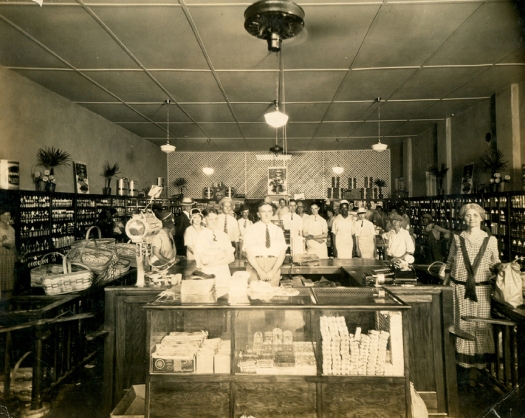
The first Jitney Jungle store was opened April 19, 1919 at 423 E. Capitol Street. A photo provided by Bill McCarty, III, grandson of co-founder William Bonner McCarty, shows the store’s interior as an open front surrounded by shelves alongside walls containing canned goods and other non-perishables. In the foreground was a glass case of tobacco products and sundries and in the rear a meat counter with glass bins displaying produce on beds of crushed ice. The prices were interesting. Bacon was 34¢/lb., salt jowls 15¢, veal steak 17¢, meat loaf 19¢ and baby beef roast 22¢. The manager was A.N. Brannon. (3)
How did Jitney get its name? According to Mr. Will McCarty, at the end of the First World War, returning soldiers would buy an old car for riding about town. They called it a “jitney”. The term “jitney” was slang for a London taxi cab and became jargon in the states for a nickel, the cost for a downtown cab ride.
Back when the establishments were McCarty-Holman Stores, it was the habit of Chancellor V.J. Stricker, who lived just up Adelle Street, to invite the three young merchants, who were living in a nearby boarding house, to his home for Sunday dinner. Mrs. Josephine Bailey’s boarding house at 343 Adelle, could be a dark and foreboding place. Mr. Will relates there was only one light bulb in the entire house and tenants would “borrow” it and pass it around from room to room. One Sunday the boys told the judge they were considering a strictly cash and carry business which would save the customer 20¢ on the dollar over their deliveries. Cash and carry could thus save “a nickel on a quarter.” The merchants asked Judge Stricker to suggest a new name for their stores. Since a cab ride to town cost a nickel, the term “jitney” became popular and it was customary for patrons to shop with “nickels jingling in their pockets.” Judge Stricker suggested the name “Jitney Jingle” but McCarty made a variation when he observed that a wide variation of stock in the new stores would make the store itself “look like a jungle of values.” The name stuck. (1)(2)
1920’s-30’s
Throughout the 1920’s, the owners added a number of stores, each with its own numerical designation which changed over the years. According to the 1930 Jackson City Directory, Jitneys were listed as:
No. 1 – 400 E. Capitol No. 2 – 1077 S. Gallatin No. 3 – 121 W. Pearl No. 4 – 2908 W. Capitol No. 5 – 209 S. State No. 6 – 423 E. Capitol (formerly No. 1) No. 7 – N. State and Fondren Ave. No. 8 – 412 W. Capitol No. 9 – 719 N. Gallatin (later 1209 N. State) No. 10 – 146 N. Farish No. 11 – 167 E. Capitol No. 12 – 850 W. Capitol No. 13 – 1241 N. West
This brings us to the birth of Jitney 14, which, according to the 1930 Directory, existed at that time. The listing contained the 904 E. Fortification Street address, a telephone number (9119) and a manager, Charles Alford. It is conjectured that the original store was small and became a “super store” some four years later. (4) Mrs. Betty McCarty Edwards, daughter of co-founder William B. McCarty, can remember when the new Jitney was just a hole in the ground. “My father had bought some cheap land around the Jefferson-Fortification Street corridor for investment. When the 1930 store was in its planning stage he offered to buy some fill dirt from a local vender. Mr. McCarty thought the price was too high and demurred. After a time the vendor went to him and said, ‘Just let me dump some of my dirt in that hole. No charge.’” Mrs. Edwards’s memories reflect back to when her brother (W.B. McCarty, Jr.) ran a Christmas fireworks stand as a youngster in front of one of the stores fronting Fortification. “He did well,” she said, “but would come home so cold on those December days he would question the wisdom of early entrepreneurship.
The new Super Jitney made a special point of catering to women. According to Mrs. Edwards, when you entered the store there was a platform area to the left for the ladies to sit and visit before they shopped. “There was a woman who taught knitting and the ladies would knit or read as they visited. It even had the first restroom for ladies in a Jackson grocery store. There were also chairs for children to sit in but keeping them still in those seats could be a problem.” There were “Jitney dresses” for sale at all store outlets. “They were not made by Jitney,” Mrs. Edwards says. “They were ‘house dresses’ as slacks were not in vogue at the time. They were good sellers but of course, no two were alike!”
As the business grew, however, more space was needed to display groceries and in time the ladies area was discontinued. (5)(6) Mrs. Edwards grew up in the Belhaven area living first on State Street at Manship, where the new Baptist Hospital building is being constructed, then moving with her family to St. Ann. Later the family moved to the Council Circle area. In the early years of her marriage while still living in Belhaven, Mrs. Edwards and her husband would walk to the store and shop. Few had cars during the war. She would bring home the perishables and her husband would bring the other groceries when he came home from work. (6)
The formal grand opening of “The New Super Jitney-Jungle Store” took place on Friday, November 10, 1933, when according to articles in the Jackson Clarion-Ledger of that year, “Jacksonians gave a hearty welcome to the newest addition to stores of the city Friday and Saturday when thousands of persons visited the new Super Jitney-Jungle at the corner of East Fortification and North Jefferson streets.” (7) (8) Back then 14 was known to the neighborhood as the “Big Jitney” and No. 9 on North State, the “Little Jitney”. 14’s manager was Charles Alford who got his start at the first store in 1919.
Mr. Alford brooked no sloppy doings. Clerks were dressed down for failure to dress up. Ties were compulsory. Alford, however, did have a sense of humor as related in Henry Holman, Jr.’s publication “Save a Nickel on a Quarter”. According to Alford, the store butcher waited on a customer late one Saturday evening who had come in to buy a chicken. The butcher reached into his case and brought out his last chicken. He showed it to the lady but she wanted to see a larger one. He put the chicken back in the case, bent over, moved his arms about, rattled the ice a little – as if looking for the right sized one – and ceremoniously came up with the same chicken. The customer replied with a satisfied smile: ‘Yes, that one is just fine. I’ll take them both.’” Oops! (5)
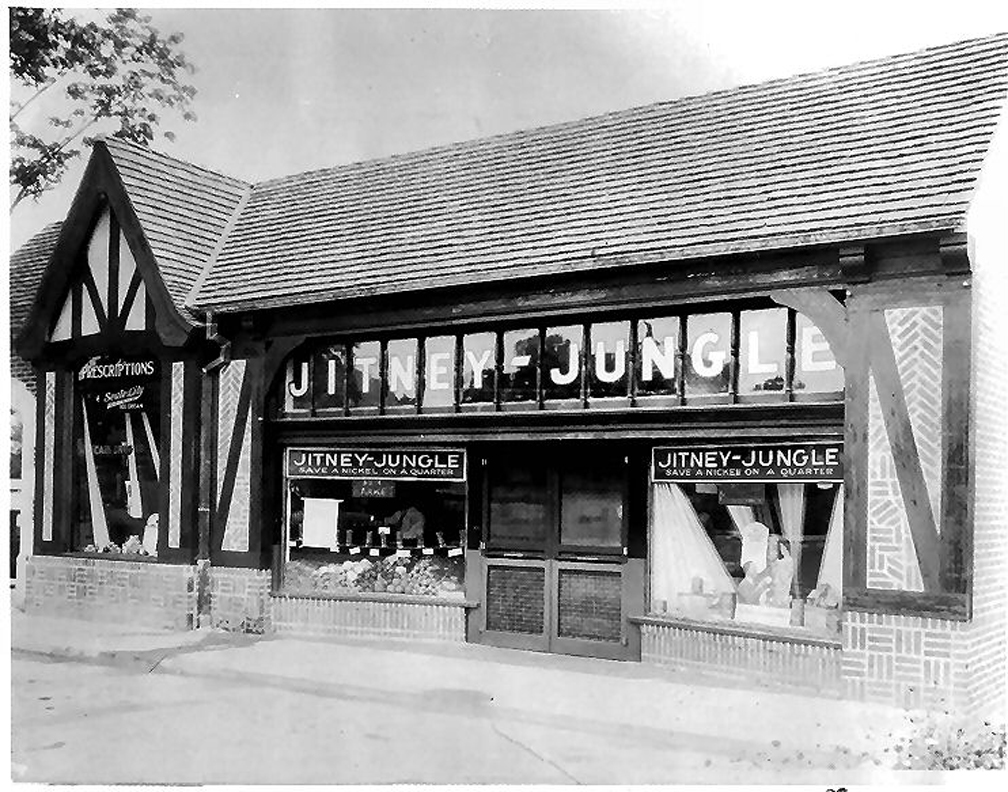
The new Super Jitney was a honey. Bill McCarty, III’s photo shows it facing two-lane Fortification with red and green awnings, tile roof and a glass front through which the shopper could see fresh fruit and vegetables displayed. The interior consisted of wooden floors, school room lighting and aisles of shelving. It contained a bakery, a refrigerated meat counter and a glass delicatessen. It became only the second grocery store in the United States and the first in Mississippi, to have air conditioning.
Its Tudor Revival style was designed by neighborhood architect Emmett Hull and contained only the grocery and the new Price Cain Drugstore at the Jefferson & Fortification corner. There was a small area for angular parking in front of the building and a loading dock and parking area around the corner on Jefferson. Belhaven was a rapidly growing neighborhood and shoppers came from throughout the area to see the new store which featured specialty items and select cuts of meat. (4)(9)
The Jitney chain had expanded rapidly throughout the “roaring twenties”, but by 1930, the Great Depression was beginning to take hold. On a typical Saturday you might drive your new $495, Ford coupe to the Jitney to shop. As you walked the aisles with your grocery basket you would notice green beans, three cans for 25¢; Wesson oil, 49¢ a quart; lemons, 12 for 20¢; cigarettes, 15¢ pack; roast beef, 19¢ lb.; bacon, 26¢ lb.; eggs, 25¢ dozen; lettuce, two heads for 15¢; sugar, 10 lbs. for 50¢; light bulbs, 20¢; fresh salmon, 29¢ lb.; mayonnaise, 29¢ pint; flour, 12 lbs. for 12¢; fryers, 35¢ lb.; Irish potatoes, 4 lb. bag, 55¢; and house coffee, 19¢ lb.
Most of these items you would carry home and place in your brand new $33.95 Ward’s refrigerator. (10) Refrigeration was just coming into play in the early 1930’s. Most people still had iceboxes. Meat was displayed in coolers on crushed ice and fresh fruits and vegetables, usually purchased from street vendors, went quickly early in the day. “Are the greens really fresh,” a housewife would keenly inquire of the store vendor in his white apron. “Yes ma’m,” he would respond. “Always.”
A trip to Jitney 14 was always a special event for the family shopper. An ad in the August 2, 1930 Clarion-Ledger announced “Your Jitney Jungle is arranged so that you can shop from front to back and from side to side without taking unnecessary steps. Your Jitney Jungle fixture arrangement not only provides a one-third more merchandise space than any other fixture plans in the world but is the most convenient. By shopping at Jitney Jungle you ‘save a nickel on a quarter’ on your grocery budget and many steps.” It was obvious these grocery stores were far ahead of their time. (11)
The 1940’s
Jitney 14 in the ’40s,photo courtesy of Bill McCarty
In 1941, Jitney Jungle 14 underwent its first expansion, enlarging eastward to include space for several small businesses. By 1942, the original grocery and adjacent drugstore had added the Beauty Lounge, Marjorie’s Shop (notions) and Snow White Cleaners. It took on the name English Village after its Tutor design. America was at war and throughout the early 1940’s, food items were scarce and rationed and neighbors pulled together and shared what they had. No one minded the sacrifice for their country and its sons overseas. On occasion there were vacancies in the store fronts and Mr. McCarty would let the Junior Red Cross use an empty space rent free to pack boxes to send to the Europeans after World War II. (4) (1)
Henry Holman, Jr. relates this story of an event at Jitney 14 during the days of food rationing. “On a certain April Fool Day, my father had one of the office force impersonate an O.P.A. investigator (rationing enforcer), who telephoned, of all people, the personable switch board operator at the store to find out why she had been getting extra sugar stamps. Since it was strawberry season, she impulsively implied it was to can strawberries – a fruit she and her family never ate! A few moments later father had the ‘investigator’ call back and say he was coming by her house that afternoon to check on her canning. Immediately she scrambled to the warehouse and bought a whole crate of strawberries, then came by to ask my straight-faced father for permission to rush home and can the fruit.” (5)
My own memories of rationing were going to the store with my mother. She would hand me a ration book with pages filled with stamps and instruct me “Billy, tear out half a sheet of tanks and a third sheet of planes.” Regardless of how much money a person had to spend, they had to produce these stamps for sugar and coffee when they were available and a host of other scarce items. Soft drinks such as Coke, Grapette soda, Orange Crush and Royal Crown Cola (twice as much drink for a “jitney”)- like bubble gum and comic books – were mostly unavailable until after war’s end in 1945. There were red meat points for steak or bacon and blue points for canned goods. Tokens, worth a fraction of a penny, were used to “make change” for sales tax. Sometimes the most respectable ladies would don an old cloth coat and slip across the Woodrow Wilson bridge off South Jefferson and into the Gold Coast where black market items such as bobby pins and local beef were available without a ration book. Few questions were asked. A lot of commerce over the years has been done “across the river”.
Jitney Jungle in the ’40s, photo courtesy of Bill McCarty
I learned to shop at Jitney 14. I used to swing on its wooden turnstiles when I didn’t weigh quite as much as I do now. I was sent down one aisle for a five cent box of salt and another for ten cents worth of baking soda. I learned the brand names of foods and how beef and poultry were weighed. I looked for cookies and ice cream cones at Cain’s and helped carry grocery bags to our neighbor’s car since we did not have one. Later on, when I was a bit older, us neighborhood kids hung out near the freight dock on Jefferson. Mr. Elliott and his staff would unload oranges and apples and lettuce and onions and throw the boxes, crates and sacks out the back door for trash pickup. The orange crates were the prize catch. Made of sturdy wood, they had a divider in the middle. We would grab a couple, take them home, stand them on end and connect them with a board. The consummate lemonade stand was born with a shelf on either side for the cash register and the lemons. Profits were spent on Hershey bars and milkshakes at the drugstore. Our mothers loved the apple crates which were used as storage boxes and ideal for new bedding plants in the spring. Of course the lemons, sugar, paper cups and straws all came from inside the store where the high lights and lesser lights came and went. All were on a mission of their own, delighting in the plethora of food and furnishings made available at war’s end. Grand times!
Us kids, however, were only familiar with the outside of the dock area. Mrs. Betty Edwards’ son Steve, who began as a bagboy at “14” knew it as an assistant store manager from the inside out. “The only unusual feature of Jitney 14,” he said, “was the tiny back room area. When the trucks came in, many of the cases of fast moving large items, such as toilet tissue or seasonal extra goods were sent by a conveyer belt to the dark cavern beneath. It was the most challenging storage room of any store in the company except the Jitney in Philadelphia, MS., regarding truck unloading, dock area and storage.” (12) Since all our readers know by now there is or was a ghost in most of Belhaven’s early digs, this one might have lived in the stock room.
Belhaven, from time to time, has been the haunts of several ghosts – most of them good. Rumor has it one lives in the water fountain at Laurel Street Park. One of these days we are going to have to look further into the adventures of these elusive creatures. Throughout the 1940’s and 50’s and into the 60’s, “the Jitney” was the neighborhood’s hub of commerce. And oh, the stories; some not always verified but all, of course, true.
One of the primary ways a young boy could make a little pocket money was to be a bag boy at a local grocery store. It didn’t pay much and was hard work, but rewarding back in the times of self-reliance and personal responsibility. Such a bagboy was Coleman Lowery who, as told by his daughter Maggie, “From the summer of 1946, when I was in the 8th grade at Bailey Junior High School, until the spring of 1951, when I graduated from Central High School, I was a package boy at Jitney 14 where Miss Eudora Welty was a regular customer.
She tipped the package boys a dime. We were making thirty cents an hour – so we fought over the ladies who tipped. Mrs. Fred Sullins and Mrs. Robert Kennington tipped a quarter! Sometimes Miss Welty did as well. “In the fall of 1951, I entered Vanderbilt University, where I graduated in 1955, and that fall in my freshman English class we read ‘Why I Live at the P.O.’ During the discussion that followed I raised my hand and said ‘I know Eudora Welty. I carried her packages at the grocery store at home.” And just to think, Miss Welty could have written “Why I shopped at Jitney 14”. (13) Perhaps someday a manuscript will be found!
Being a package boy was many a youngster’s first introduction into the business world. Both Henry Holman, Jr. and Bill McCarty, Jr. served in this capacity as they learned from the ground up the intricacies of their family business. Store manager Alford once said “All young men in Jackson should start out carrying packages for Jitney.” The Jitney Jungles back in the 1960’s published a little handbook which was given to all the newly hired boys. It began with a mission statement “The purpose of this manual is to show you in step by step fashion, what you should do to be successful in your Jitney Jungle job, and what the store needs and expects of you as one of its important employees.” (14)(5)
The manual goes on to outline instructions on neatness, promptness, making sensible decisions, care and packaging of the grocery product, courtesy and thoughtfulness and always leaving the customer with the comment “come back again and bring a friend.” It concludes “We welcome you into the organization. We hope you will like playing on the Jitney-Jungle team. The game is just beginning. We’d like to see you become a seasoned star – a veteran…you can – and will – if you do your best.” (14) What wonderful lessons for a 14-year-old boy to learn and practice. What good advice on which to enter the professional world.
Writer Willie Morris grew up in Yazoo City. He didn’t get down to Jackson often but many times when he did he visited his grandparents Mr. and Mrs. Percy Weaks who lived at 1017 N. Jefferson Street. The house left the tax rolls in 1968 and the home site has been a vacant lot since. A Tote-Sum Store once sat at the corner with Fortification with a loading area in the rear. Bill McCarty, III remembers as a child an artificial limb maker behind the Tote-Sum and several times going by with his dad at night and seeing prosthetic legs or arms reaching skyward from a pile outside. “That certainly terrified us!” Just north along the sidewalk a small, battle – scarred magnolia remains on which, according to Joanne Prichard Morris, Willie once carved his initials – but time has removed them. Willie Morris was familiar with Eudora’s Jitney. (1)(15)
Writing in his book “Homecomings” in the 1989 article A Return to Christmas Gone, the author tells of his purchase of a half dozen roses in Oxford and brought with him to the gravesites and former homes of his antecedents, the last of whom lived in Belhaven. “I retrace the Christmas journey – down Woodrow Wilson, right on North State Street past Millsaps, left on Fortification to Jefferson….My grandparents’ house is no longer there, long since a parking lot near the Jitney Jungle across the street. The magnolia is still in front, but where the house was is grim, bare asphalt, cold and wet now from the rain. ….Mamie and Percy, Maggie and Susie would be greeting us now, just beyond the magnolia where the front porch was. I close my eyes and hear their happy welcomes. Old Skip has raced beneath their feet into the house in search of turkey livers, and my great-aunts follow in their flowing black dresses.
“I stand in the parking lot where the parlor was. I feel the ripple of the lost voices. I drift back into the kitchen. Time, as one ages, is a continuum. Past and present consume themselves into the ashes. There is no good place for the last two roses. I put them on the asphalt where the dining room table was. Tomorrow someone will run over them in the parking lot. But who would disturb them today?” (16)
1960’s – 80’s
As the years approached the 1960’s, another expansion of English Village and Jitney 14 was underway. It was a massive undertaking of space increment and modernization. New businesses were Pridgens Florist, Collins Barber Shop, and the Beauty Lounge to accompany the older establishments. Cain’s had given way to Parkin’s. Other enterprises that have occupied English Village over the years included the Automatic Laundry Services (washeteria), Neal’s Barber Shop, Ben Franklin Hardware, Southern Pulmonary Clinic, the ABC Coin Laundry, the Village Inn & Pub and now Basil’s. (4) [Basil’s went out of business in early 2014, and a new restaurant, owned by Louis LaRose, is scheduled to open soon.jly] A new and enlarged parking lot was constructed to accommodate growing patronage. A major feature was a complete and enlarged bakery at the front of the store. The pungent odors of fresh bread, cookies, pies and cakes wafted through the store attracting shoppers like a magnet to the freshness and taste sensations of these delicacies.
A photo provided by Bill McCarty, III depicts modern floors and lighting, wider aisles, shelving throughout the store, frozen food cabinets, an up-to-date refrigerated meat market, two turnstiles, six efficient checkout lanes with new calculators and scales and a lunch counter near the front of the store. As a young man, Bill cut his Jitney teeth here. He tells of when he first went to work to learn the shelf stocking end of the business. “Wooden floors were under newer tile throughout the store. One of my jobs was to do shelving on the sales floor. When I stocked the orange juice, I had to put my foot beside one wheel of the cart as I loaded juice into the retail case or else the cart would roll across the aisle. This was simply the result of the wooden floor’s old age. The eastern most addition to Jitney 14, when the entrance was moved to that side from Fortification Street had concrete sub flooring throughout.
“One clear memory was the kitchen directly behind the former Fortification Street entrance where Mrs. Pitts, the deli manager, and the ladies who had cooked there for so many years used a gas burner as part of the stove to cook icings and other bakery items. I once tried to change her brand of flour but after being told that she only cooked with one brand, I went to buy that flour at the best price I could get since I knew I was not going to change her wonderful ways. Mrs. Pitts, who catered many a reception and social event with her great recipes, also had a hand in starting the development of the delicious pimento cheese still available for purchase in McDade’s deli.
Eudora Welty, photo courtesy of fanart.com
“Extra thin sliced bread was so popular we spent hours preparing it on a noisy cast iron slicing machine that was in action every time I went into the kitchen. My personal favorite was the Old Fashioned bread in the wide loaf, one of six sandwich bread items baked in the Mill Street bakery. It came in a white bag with the logo printed on it and tasted much like real homemade. During the Christmas holidays we had red and green and other colors for each holiday that followed designed to compliment party sandwiches requested by our customers. You could just about tell the holiday by the color of the bread. In addition to governors, mayors, lawyers, legislators, doctors and everyone else in town, I vividly remember Eudora Welty coming by and talking with me as I stocked shelves or ran a checkout stand. Frank Haines (former Jackson Daily News entertainment editor) asked me when we were going to get a supply of George Washington Seasoning, so I ordered some for him. One item Jitney 14 always stocked was the small glass jar of Smithfield Deviled Ham spread. I learned to love it in 1972 and special ordered it for myself until it was recently discontinued by the distributor. I remember Mrs. Noone, an elderly lady from up around Madison Street with an Australian accent who came by every day to buy Ryvita Wafers for herself and a small bag of litter and a bit of liver for her 14-year-old cat. ‘The liver had to be tender,’ she told me, ‘or my cat will not eat it.’ On occasion she returned it the next day for more tenderization.
“I recall the Jefferson Street side entrance to Parkin’s Drugstore and going in to their soda fountain as a child where I either had a banana split or chocolate malt.” (1) How many young fellows in the Belhaven neighborhood running barefoot along the hot sidewalks of summer must have done the same.”
Jitney 14 was an icon, attracting patrons from throughout the Jackson metro area and beyond. The pace was quick, the new computerized checkout stands crowded and the clerks challenged with the need for speed and accuracy. One in particular caught the attention and love of many customers: Johanna Wade. Johanna, a native of Amsterdam, the Netherlands, was a 16-year veteran of Jitney 14 when she appeared in a local newspaper article. She was a popular favorite of Jitney shoppers and as the head checker knew many on a first name basis. “I know them by name,” she told the reporter. “I know their children. I like the people. I’ve got lots of friends here in the neighborhood. They’ve always been real good to me.” This goodness came through in 1986 when her husband died. They invited her over for the holidays to relieve her loneliness and they were happy to share their family day with her. When her parents died in 1988, and she made two trips to Holland in a week, customers expressed their sympathy by helping send her. “I came back and it was all in the office- money, checks, everything.” Then store manager Sam Holley called her not only an asset to the store “but to the entire neighborhood.” Such are the rewards of a friendly smile, accommodation and knowing the rhythms of Belhaven. (17)
The 90’s
Eudora’s Jitney rolled into the 90’s with a full head of steam. The company had expanded to hundreds of stores throughout the southeastern United States. Bill McCarty III reports that “business was brisk and by 1994 the Jitney-Jungle chain had expanded to 105 stores in six states and annual sales exceeded a billion dollars. That large volume continued to produce a profit for the company through hard work and efficiency.
“Beginning in 1987, the Jitney 14 structure was completely rebuilt from the inside out with the entire building being replaced except the exterior brick facades and walls along Fortification and Jefferson Streets and the north walls and east main entrance. This preserved the historic character of brick, tile and copper exterior with big improvements to the 30,000 square foot store. The store remained open during this period and the grand reopening was October 8, 1988. Parkins Drug Store was relocated to the structure occupied by Basil’s Restaurant today.” [See note above, jly](1)
The 21st Century
Times change; new generations take over and old ways are altered by current need and circumstance. The sale of the Jitney Jungle chain was finalized in March 1996 and at that time the annual sales volume was approximately $1.2 billion. After the sale, some difficult times followed with subsequent companies. However, Greg McDade purchased the old Jitney in 2005 just before it was to be closed forever and it flourishes today at the same location. Through the 84 years Jitney-Jungle was a McCarty-Holman enterprise it was state of the art as the store remains today. Its staff was courteous and well-trained, its stock and produce of the highest quality and its reputation a solid testament to what a family business can attain with vision, hard work and careful attention to the needs of its customers. Simply put, it did the right things at the right time in the right place.
Eighty-two years after the “Big Jitney” and Price Cain’s drug store first anchored the northeast corner of Jefferson and Fortification, McDade’s Market sits proudly on the site of Jackson’s very first air-conditioned supermarket. Our neighborhood owes a great debt of gratitude to the McDades for saving our store and making it viable. Road equipment churns down the new Fortification bustling with innovative ideas and the coming aesthetics resulting from countless hours of careful planning. Twenty-first century patrons pause along the aerated bins of fresh produce and the well-trained cashiers, stockers, sackers and department managers who hustle to fill their daily needs. The world is faster now but shoppers still pause to say “good morning” and “How are things?” And the employees say the same. It remains our neighborhood grocery.
McDades Market on Fortification in a rare Jackson snowfall. (photo by Jesse Yancy)
As we shop McDade’s this Christmas season and gather together the spices and condiments of the year in anticipation of family reunited, we can reflect on Eudora’s tips to package boys and the spirit of Willie’s roses in the rain. Together they, as have we, been a part of the little store which became an exponent of the American dream as it brought its bounty to our dinner tables and conviviality to our lives. But remember also its journey. The early footsteps are stilled. The old hand-cranked adding machines have been replaced by computers. The aisles are brighter and bracketed with a plethora of universal foods, spices and specialty items. The turnstiles have given way to electronic doors. Roast beef costs a bit more than 35¢ a lb, but on sale days you can still save a nickel on a quarter. New writers and artists recreate its glorious past and its future shines like a freshly polished apple. But beneath it all, through the wooden and concrete floors clad in contemporary colors lies the ground that heard those footsteps in 1930 and above the main entrance, under the archway looking eastward into the sunrise, still stands a harbinger, a numeral that takes us from yesterday to tomorrow at Eudora’s Jitney: “14”.
Bill and Nan Harvey
Bill and Nan Harvey
Nan Ertle Harvey is a native of Yazoo County, a graduate of Mississippi College and has lived with her husband Bill in the Belhaven neighborhood since 1994. She worked in a research position in the Department of Microbiology at UMMC, retiring in 2003. Nan’s hobbies are photography, nature study and family research. She is a volunteer at the Mississippi Department of Archives and History. Bill Harvey is a native Jacksonian, living most of his life in Belhaven. A MSU Bulldog, he has had careers in journalism, education and as development director of the Andrew Jackson Council, Boy Scouts of America. Bill enjoys photography, music, writing articles for neighborhood sources and sharing experiences with friends at a local coffee shop. (Text copyright Bill and Nan Harvey, used by permission of Bill and Nan Harvey; photos of Jitney Jungle copyright Bill McCarty III, used by permission of Bill McCarty III)
Sources: (1) Conversations with Bill McCarty, III, Nov. 2012 [Details are from memory, family members and an April 3, 1962 interview between W.B. McCarty, Sr. and his son W.B. McCarty, Jr.] (2) “Lesson Learned from Strike Here in 1916 was Start of Jitney-Jungle organization” [Jackson Daily News, Oct. 1, 1950] (3) Jitney Jungle is Celebrating Start of 12th Year of Service [Clarion-Ledger, Oct. 12, 1930 (4) Jackson City Directory, 1930, 1916 (5) “Save a Nickel on a Quarter: The Story of the Jitney-Jungle Stores of America” [Address by William Henry Holman, Jr. to Newcomen Society in North America, Jackson, Mississippi, April 18, 1973] (6) Interview with Betty McCarty Edwards [Madison, Mississippi; Nov. 12, 2012] (7) Formal Jitney-Jungle 14 Grand Opening Invitation [Clarion-Ledger, November 10, 1933] (8) “New Super Jitney-Jungle Has auspicious Opening” [Clarion-Ledger, Nov. 12, 1933] (9) Registration Application/National Register of Historic Places/NPS – P. 74. (10) “Store with a thousand Items” [Clarion Ledger, June 26, 1930] (11) Store ad, [Jackson Clarion-Ledger, August 2, 1930] (12) Conversation with Steve Edwards [Nov. 14, 2012] (13) “Knowing Miss Welty: I was Miss Eudora’s Package Boy” – Coleman Lowery as told by his daughter Maggie [Lemuria Book Store blog, Aug. 9, 2012] (14) A Handbook for Package Boys (1960) (15) Conversation with Joanne Prichard Morris [October 31, 2012] (16) Homecomings by Willie Morris (University Press of Mississippi, 1989) (17) “Check Her Out” by Sherry Lucas [Clarion-Ledger, Feb. 7, 1994]
Special thanks to Mrs. Betty McCarty Edwards, Steve Edwards and particularly Bill McCarty, III who provided essential information and much-appreciated assistance. [This article was first published in 2014.]
When the American Institute of Architects awarded Samuel (Sambo) Mockbee the AIA Gold Medal in 2003, he joined an elite company of architects (including Thomas Jefferson) who received the award posthumously. “The AIA does not like to confer a gold medal on people who are no longer living,” says architect Tom Howorth. “It’s an award for those who have the potential to continue contributing to the field of architecture. The fact that it was conferred on Sambo confirms he is continuing to shape the architectural landscape.”
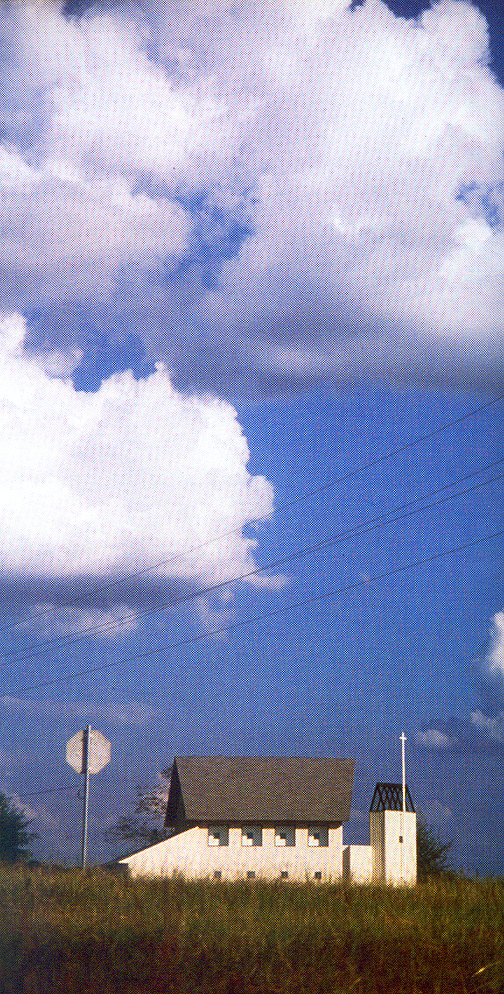
Sambo Mockbee died in 2001. Hailed as a visionary with designs such as the Barton House in Madison, the Cook House in Oxford and the Magee Church of Christ to name a very few, Mockbee set an even higher benchmark when he and D.K. Ruth co-founded the Rural Studio at Auburn University. There in the heart of Alabama’s Black Belt, the studio continues to be a place where students learn the social responsibilities of architecture by creating homes and buildings with a spirit for poor communities.
“Sambo’s mission was to see about people,” Jackie Mockbee says. Jackie married Sambo in 1970. “We had two blind dates, we really did,” Jackie says. “The first was at a homecoming for Sambo when he was at Fort Benning. I’m sure he didn’t remember me; I just remember having fun watching everyone there. Two years later, my cousin called me and said they were going to a party and said there’s this guy that we all know who needs a date. They started telling me who he was, and. I said, ‘Wait a minute; I’ve had a date with him before.’
They asked me if I had fun, and I told them that we really didn’t get to know one another. That night, Sambo asked me if I went to MSCW, if I was a Baptist and if I’d marry him. I said, ‘Yes, yes and no.’ That was in August. We were married that December.” The Mockbees had four children, but Jackie remembers that at their home in Canton, “We had kids everywhere.” Jackie says. “They ran all around the neighborhood, but always ended up in our yard. Sambo was like the Pied Piper; he always had something going on, he was always the coach, and when he hit that door, the kids came running.”
“He was a gregarious, affable, lovable teddy-bear of a guy,” says Malcolm White, a long-time friend. “Once you became his friend, you were his friend for life. He loved collecting eclectic personalities. He was an engaging conversationalist and could sit up literally all night and carry on about Van Gogh or the Civil War or American history or Western civilization or anything else you might be interested in.”
Magee Church of Christ (photo by L. David Fox)“He believed in legacy, he believed in creating things that would last,” Malcolm says. “He wrote a check out of an account that didn’t have a nickel in it for the first float that I ever purchased, the very same trailer that the Sweet Potato Queens use today.”
“In the early 80s, Sambo had an office on North Street on a stretch of property that’s now parking lots,” Malcolm says. “On Friday afternoons, Sambo would gather people and would serve Heinekens, which he loved, and sausages or peanuts, whatever he had on hand. Sambo began to explain to us that he had this big idea that he was closing in on, this notion that was going to involve all of us,” Malcolm says. “He wanted to empower rural people of little means in the same way that wealthy people could empower him to design beautiful, elaborate offices. He wanted to incorporate not just architecture and design, but philanthropy and entertainment and recreation, all the components that build community. Basically what he was talking about became the Rural Studio.”
Former partner Coleman Coker first met Mockbee in Corinth. “I think in 1980 or 1981, and we hit it off, just sitting around and talking. Neither one of us had much work at the time,” Coleman says. “He was making a lot of collages, I was painting, and that’s where we found a commonality in translating the world as we saw it through our constructions and paintings into architectural compositions. We never were successful going out and marketing ourselves, particularly to corporate clients,” Coleman says. “Most of the work we were proudest of involved small residences for people looking for something different, looking for something that had a relationship to place, to locale. Most of those buildings were reflections of the clients, an extension of their personalities, and as we got more built, more people would see them and give us a call.”
“We didn’t sit around talking about the work of other architects; we’d talk about literature—Welty and Faulkner—looking for roots, connections to place, and we found that so much more directly through Southern writers,” Coleman says. “There’s no long tradition of Southern architecture outside of the classical, which comes from Europe, and we weren’t looking for that. We were trying to build on what was just beneath the surface here in the Deep South, whether it was black culture or the culture of the landed gentry, whatever mythology could be unearthed.” Mythology, Coleman admits, is “difficult to talk about.”
“Sambo, through the paintings that he did, was building a whole mythological world,” Coleman says. “Characters would repeat themselves throughout the paintings, and they started telling a narrative. It’s easier to render a narrative through literature, even through painting, than it is through architecture, yet you strive to expound those roots and reprocess them through design. Our concern with social responsibility in professional ethics fell in trying to reach out to a group that was estranged otherwise,” Coleman says. “We were trying to design in context with this locale, the locale in a social sense, when the abject poverty in much of Mississippi was virtually ignored by the great majority of designers and the great majority of people who could afford architects.”
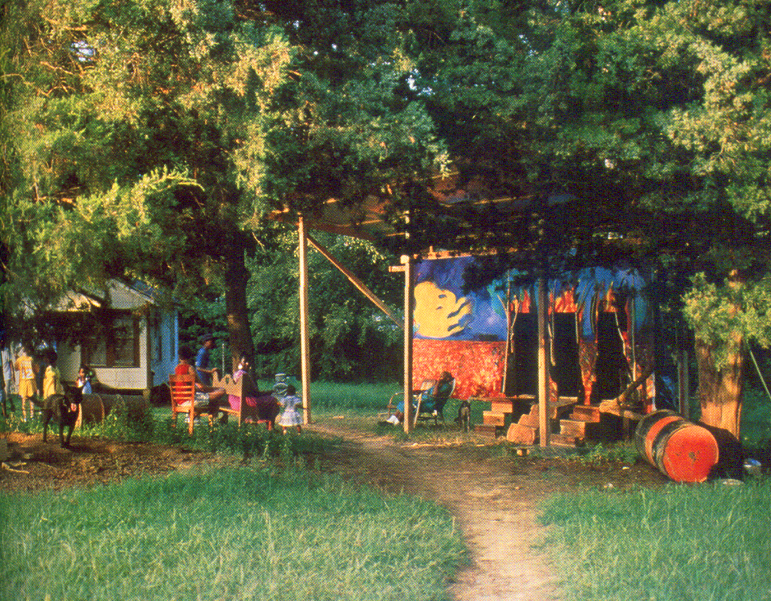
“Eutaw: Children of Eutaw Pose Before their Ancient Cabin” (Mural, photo by L. David Fox)
In 1993, Mockbee and D.K. Ruth founded the Rural Studio. “Prior to the Rural Studio there were a few notable construction-focused, hands-on learning opportunities in architecture schools in the country, notably at Yale,” says Tom Howorth, also a former partner. “But there was nothing on the scale, level of commitment and pedagogical continuity that runs through the Rural Studio. Now there are those sorts of programs across the country. So much of what we do is picked from catalogues that the work of putting buildings together becomes a matter of picking the systems that exist and putting them together in a way that you solve the client’s problem,” Tom says. “That wasn’t what Sambo was interested in; he was interested in creating from scratch. He challenged students to think originally.”
Daughter Carol Mockbee recalls that “Papa (Sambo) first started talking about the Subrosa Pantheon in 1999. In the summer of 2001, they started digging in the Alabama clay. D.K.’s mother had died, as well as two young professors at Auburn, and that was probably when they came to the decision to build a memorial space for the Rural Studio, a place to remember and meditate and reflect. So they started digging out the site for the Pantheon in Newbern. By August, they’d poured the first slab. Papa got really sick that fall and passed away in December.”
“The project was suspended for two years,” Carol says. “After I graduated from Auburn in interior design I applied to the Rural Studio as an outreach student to finish the Pantheon. I knew the idea, knew my father’s mythology behind it, and knew that he loved the project. Had I known then what I know now, I don’t think I would have touched it. But, luckily, I was ignorant, young and energetic. For the first few months, I worked on other projects. I had to find my own way, find my role and boundaries. Everyone was skeptical; one engineer at Auburn said, ‘You know, if you were my daughter, I would not let you do this.’ I left that meeting thinking that I am Sambo Mockbee’s daughter and he wouldn’t want me to be doing anything else. I completed it on August 27, 2005. I was so preoccupied with my last pour three days before that I had no idea Katrina was coming.”
“Every June 21, you can go into the Pantheon and stand at different points, align yourself with stars and planets, then sit on a bench next to someone, lean away from them, whisper into a pipe on your side, and the secret travels back to them.”
The culinary literature of any given city (or region) reflects the character of its peoples, and taken altogether, this selection, which I submit as the “best of the best”, shows Jackson as richly cultured, with an enduring commitment to the commonweal. Among its citizens have been talented cooks who were writers of surpassing ability. These books encompass an extraordinary amount of cultural history, contain the highest order of culinary exposition, and taken altogether could work as a syllabus for any tutorial on Southern cooking.
Allison’s Wells: The Last Mississippi Spa (Muscadine Press: 1981)
In 1981, proprietor Hosford Fontaine—doubtless at the urging of countless friends—published Allison’s Wells: The Last Mississippi Spa. The book is a treasure-trove of history, with profiles of the people who kept the resort functioning as well as other unforgettable characters, musicians and artists such as Till Caldwell, Inez Wallace, Ted Faires, Marie Hull and others. Many of these people contributed to the illustrations, which are augmented by dozens of charming vintage photos including a poignant image of Hosford standing amid the charred ruins. Best of all, The Last Mississippi Spa also includes a sprawling section on recipes for almost anything to put on the table: hors d’oeuvres, soups, salads, dressings, breads, meats, seafood, vegetables, breakfast and brunch dishes, desserts, candy and cookies, all “tried and true” from the La Font kitchens. The book includes a warm and heartfelt Forward by Charlotte Capers and a brief introduction by Eudora Welty.
The Jackson Cookbook (Hederman Brothers: 1971)
This cookbook could well be held up as an archetype of a Southern ladies’ cookbook; it’s stiff with tradition and understated elegance. Indeed, in a note “About the Cover,” the editors explain that Artist Carl Davis translated Welty’s comments about “the era of the Madeira tea napkin,” into a work of art using an heirloom tea napkin “hand embroidered by Miss Irene Anderson,” with Jackson’s monogram “J”. This note follows a short essay by the Women’s Editor of The Clarion-Ledger, Mary Alice Bookheart, “The Aesthetics of Eating,” which states in part, “This is not necessarily a cookbook of old Jackson recipes. … What (the cookbook committee) has attempted to do in compiling this book is to achieve a happy blend of old and new …” This book also includes some restaurant favorites, such as the “Edwards House (King Edward Hotel) Chicken”. The recipes are simple and use familiar ingredients as well as commercial items, and provide recipes for any occasion, ranging across the menu. The Jackson Cookbook is a wonderful addition to any kitchen library, but what sets it apart, raising it to a level no other cookbook in Mississippi can hope to achieve, is the Forward, “The Flavor of Jackson,” a jewel of exposition by Welty.
The Southern Hospitality Cookbook Oxmoor House: 1976
Simply put, Winifred’s The Southern Hospitality Cookbook is not only a groaning board of splendid recipes, but as a whole nothing less than an illuminating documentation of upper-class cooking in the mid-20th century South. The recipes are rich and varied, the ingredients often expensive and times for preparation are usually considerable. Indeed, the most frequent critiques of the book involve how “fussy” the recipes are, many calling for minute amounts of several various ingredients and elaborate stage-by-stage instructions on their preparation. But this is the way Winifred and the women of her class and generation cooked; they had plenty of time on their hands, and more often than not enough money to spend on costly and hard-to-find ingredients. Many of the recipes are true heirlooms from Virginia and the Eastern Seaboard. She also includes recipes from dozens and dozens of friends and neighbors. The Southern Hospitality Cookbook is a milestone in the culinary history of Jackson, but what takes it to a higher level is a short essay by her editor at The National Observer, David W. Hacker (“Savoring Miss Welty’s Wit at a Special Seafood Lunch”) and a preface by Eudora herself (“A Note on the Cook”).
Standing Room Only Hederman Brothers: 1983
“With Narratives by Eudora Welty and Beth Henley,” announces the marquee on New Stage’s truly superb “Cookbook for Entertaining”. Henley’s short essay on theatre parties is quite fun, and Welty’s “A Note about New Stage” is the definitive article on this beloved Jackson institution. The posters and playbills, along with the accompanying texts, that separate the divisions are also marvelous diversions, but the true stars here are the recipes. This is hands-down my favorite Jackson cookbook because the recipes are sumptuous, clearly presented, and a lot of them are just damned fun. Most of them are written for more than four servings and are captioned with “can double”. Also included are the invaluable sections, “Buying Guide for 50 Guests” and “Setting a Bar for 50 for One Hour”. SRO throws in an herb and wine guide as curtain calls.
Southern Sideboards Wimmer/JLJ: 1978
The most distinguished cookbook in this selection, and winner of the prestigious Southern Living Hall of Fame Award, Southern Sideboards is THE right cookbook for traditional Southern recipes before the “foodie revolution” of the 1980s. These recipes aren’t designed for health or with an eye to fussy ingredients, so if you’re the type of person who wouldn’t be caught dead in a checkout with a can of Cream of Celery soup, then it’s certainly not for you. But if you’re one of those hide-bound traditionalists who want to know EXACTLY how Granny made that Southern Cornbread DRESSING, then this is your book. Sure, the recipes are often complex and some do take a little time, but you know what? Time and preparation are keys to good cooking and good eating. The game recipes are truly superb, as are the desserts, particularly the cakes. Southern Sideboards is distinguished by a splendid, heartfelt essay by Mississippi native Wyatt Cooper, an author, screenwriter, and actor better known as Gloria Vanderbilt’s (fourth) husband.
The Sweet Potato Queens’ Big-Ass Cookbook and Financial Planner Three Rivers Press: 2003
Despite what you may think, I am not including Jill Conner Browne’s cookbook in this list because I’m afraid that if I didn’t, I’d in the very near future have a magenta sequined bootie up my patootie. No, I honestly think the Big-Ass Cookbook is absolutely fabulous. Not only does it have lots and lots of great—albeit indulgent—recipes, it also has reams of practical advice: “Hormones are serious juju, and if you don’t get them sorted out, you might find that you need money for things like lawyers and bail.” I think it’s Jill’s best book, though I must profess a weakness for cookbooks. Here you’ll find satire without (much) malice or rancor, some of the best writing—flat-out writing—to come out of Mississippi, and humor that’s deliberately earthy without being crass or (too) coarse. Of course, I’ll never be deemed worthy to sew a single sequin on an SPQ outfit, but I adore them from afar.
Jack’s Skillet: Plain Talk and Some Recipes from a Guy in the Kitchen (Algonquin, 1997), is by Jack Butler, who isn’t just some guy, but a poet and novelist. He was born in Alligator, Mississippi, to a son of Delta gentry who sought the cloth. He attended high school in Clinton, Mississippi, was ordained in Missouri, and earned an MFA from UA (Fayetteville) in 1979.
Butler’s first novel, Jujitsu for Christ (August House, 1986), told the story of a young man who opens a martial arts school in Jackson, Mississippi. His third book, Living in Little Rock with Miss Little Rock (Knopf, 1993), employs collage, newspaper excerpts, cartoon reprints, and an omniscient narrator who claims to be either the Holy Ghost or a deceased dog. The novel received a nomination for the Pulitzer Prize. He also wrote a food column for The Arkansas Democrat-Gazette. (His 1993 short story collection, Hawk Gumbo, is not a cookbook, but it’s good stuff!).
In Jack’s Skillet, Butler writes about food as pleasure, as ritual, as communication, “satisfaction, the giving and receiving of sustenance and delight.”
“I’m a cook, and I can’t help thinking about food. I’m a novelist, and I can’t help telling stories, I’m a poet, and I can’t help singing out from time to time, As a result, you should think of this book as a story, a story with occasional bursts of paean and dithyramb. The story is the story of our lives with food. I say our.”
“Stories have characters, and this one is no exception. I can’t write about food without writing about people. Stories also have settings and backgrounds. I spent roughly the first twenty years of my life in Mississippi, mostly in the cotton-growing Delta. Then I spent twenty-five or so in Arkansas. You are what you eat, and all my life I’ve eaten Southern. But sort of nouvelle Southern, with pluralistic influences. Semi-enlightened good old boy, you might say.”
“I can’t imagine writing about food and not at some point talking about the absolute best breakfast on earth, which is not, I’m sorry to say, garlic-and-cheese grits, or even pork chops, scrambled eggs, and hot biscuits with strawberry preserves, but novy mit a schmeer-a toasted bagel slathered with cream cheese and layered with capers, thin slices of smoked Nova Scotia salmon, tomato, and onion.”
Jack’s Skillet includes such pearls as “Tomato Gravy and Biscuits,” “Mosey Froghead’s Barbecue Sauce,” “A Southerner’s First Meal in Heaven,” “A Grace for the Old Man,” and this nugget:
How to Get Rid of Beer
I’m not a heavy-duty beer drinker. I like stout, and I like Alaskan amber. Which, incidentally, as I found out on my last trip to Alaska, is what they now call the beer formerly known as Chinook. I spent half a week in Fairbanks asking after Chinook and not finding it before anybody bothered to straighten me out. Seems somebody decided that reminding the thirsty customer of the smell of dead fish just at the point of purchase wasn’t all that grand a marketing strategy. Maybe not. The beer’s just as good, either way.
I do like a snappingly cold brewski or two after a long hike or a hot game in the summertime, but I will never park in front of the tube and start in on a sixpack.
Nevertheless, we always seem to have extra beer around the house, lots of extra beer. Usually several different brands. Lately it’s been Pearl Light and Miller Ice Draft. I can, by the way, recommend Pearl Light as an excellent swimming-pool beer for those 100° Arkansas or Carolina or even Connecticut July days. Only seventy calories a can, and it tastes pretty good. I mean really, I’m not kidding, it tastes pretty good. For American beer.
Anyway, what happens is that we have a party or have some people over, so we go out and buy some beer, and then the people bring their own beer, and then everybody winds up drinking white wine or gets into my Wild Turkey while I’m not looking. So then we have a refrigerator full of beer. It stays full for months and months while I try to figure out ways to get rid of it. And that’s our situation right now.
I can manage a can or two a month myself, if I decide to have boilermakers for a change, but that’s about all, especially during the winter. Clearly, then, I am in need of alternatives. Lately I’ve been experimenting with beer batter. I like batter-fried things. The greasier the better. Grease is good for you, after all. _ And it’s fun to play around with different sorts of batter. I grew up on cornmeal batter and egg batter, though mostly when I do steak fingers or catfish or fried chicken nowadays, as I’ve told you, I just salt, pepper, flour, and fry.
Beer batter is completely different.
The recipe I use is simplicity itself. (I want to caution you that there’s nothing official about this recipe. This is not, repeat not, authentic beer batter.) I put white flour in a bowl, the amount depending on how much batter I think I’m going to need. I sprinkle in some salt according to how salty I think I’m going to want the batter to taste. I cut in some butter or margarine in the ratio of roughly a tablespoon to a cup of flour. I add cold beer, stirring until I have a nice thick batter-liquid, but dense and clinging. I drink the rest of the beer.
Beer batter comes out a lot like tempura, which means it isn’t suitable for just anything. I’ve tried it out on all sorts of things recently, even catfish and chicken livers. On the whole, I don’t think I’d recommend it for most meats, though the chicken livers were just fine hot from the skillet. Jayme liked the catfish, but I had some reservations. My thought is that it would work better for extremely firm-fleshed seafoods, like shrimp and, hm, ah, shrimp.
And vegetables. Beer batter is really great for those deep-fried happy-hour veggie-type gnoshes. It works great for mushrooms, which are almost impossible to get any other sort of batter to stick to. It would, I am sure, if you can bear the concept, work great for nuggets of cauliflower or broccoli, or for dill pickles. It is supreme for onion rings, which I dearly love, and of which good ones are mighty hard to get.
What I do is flour my fryees- the rings, the mushrooms, whatever. Just shake them in a bag with flour, dip them in the batter, drop them in hot oil in a deep fryer, get them golden brown all over, and drain them (beer batter holds a lot of oil). Then you can sit down with your crunchy munchies and tune in to see what the score of the game is, and whether Mike Piazza has hit any more home runs.
And what the hey, maybe even have a cold beer with your meal. It would be appropriate, and you’d be getting rid of two of the cotton-picking things in one evening.
Beer-Batter Onion Rings
1 cup unbleached white flour 1 teaspoon salt 1 small onion, cut into 14″-thick rings 1 tablespoon butter or margarine 6 to 8 ounces beer Cooking oil for deep-frying
Mix flour and salt. Put flour mixture into a paper bag. Throw in onion rings and shake, then set aside. They should be only lightly coated. Transfer flour to a mixing bowl and cut in butter. Add beer gradually, stirring until batter thickens. Heat cooking oil in a deep fryer (a high-walled skillet will do). The oil is hot enough for frying when water dripped onto the oil pops and sizzles. Coat onion rings thoroughly with batter and drop into oil. Fry until golden brown all over, then remove to paper and drain. This batter will also serve as a fine tempura-style batter for a wide range of vegetables.
It should come as no surprise to any of you that most states in our Union actually have official state foods, and it should be equally unsurprising that most are desserts.
Official state foods include Lane Cake, the State Dessert of Alabama, as well as the comparably famous Smith Island Cake, which is that of Maryland. Utah has a State Snack Food (Jell-O!?), and it’s quite telling that the State Snack of Texas is tortilla chips and salsa while that of New York is yogurt. California has all of four State Nuts (almond, pecan, walnut, and pistachio). By my reckoning, Oklahoma has won the state food contest hands down by officiating a State Meal: Chicken-fried steak, barbecued pork, fried okra, squash, cornbread, grits, corn, sausage with biscuits and gravy, black-eyed peas, strawberries, and pecan pie.
Unofficial state foods are often the subject articles assigned to some junior editor for filler/fodder in any given dozens of click-bait slide shows. On any given one of these fluff pieces, you’ll inevitably find a Mississippi mud cake, which is not our official state cake. In fact, unless you count large mouth bass, oysters, white tailed deer, or wood ducks, Mississippi doesn’t have a state food.
Mississippi mud cake is more fudge or a brownie than a cake, and that’s likely how it began, but around fifty years ago in the 70s when all sorts of craziness was going on (yes, I was there), marshmallows—inexplicably and unnecessarily—were introduced, likely because the resulting swirls are reminiscent of currents and eddies. Me, I think marshmallows are a vile alteration, and Australians seem to agree, since the Aussie mud cake—no, they do not call it Murrumbidgee mud cake—is marshmallow-free and smooth as silt.
One icon deserves another, so here’s Tammy Wynette’s recipe for Mississippi mud cake, which she says was taught to her by her mother, Mildred Lee.
2 sticks melted butter 4 eggs, slightly beaten 1 ½ cups plain flour 1 ½ cups pecans, chopped ½ cup cocoa 2 cups sugar 1 teaspoon vanilla ½ teaspoon salt Mix together sugar, cocoa, and butter and eggs. Add flour, pecans, vanilla and salt to above. Bake 35 minutes at 350 degrees in a greased 9×13 oblong pan. Topping: Cover with miniature marshmallows and return to oven to melt. Cream: ½ cup milk 1/3 cup cocoa 1 stick melted butter 1 box powdered sugar Sift cocoa and powdered sugar, add milk and butter. Mix until smooth, then put on top of cake.

 For the South to work in Skinner’s series, its character had to stem from the people’s relationship with nature, specifically with the natural history of the rivers of the nation. Cecile Hulse Matschat’s Suwannee River: Strange Green Land (1938) remains a best-selling volume, and Marjory Stoneman Douglas’s The Everglades: River of Grass (1947), a landmark in American environmental writing.
 Tennessee—two books, both by Donald Davidson The Old River, (1946) and The New River (1948), inclusive of the profound changes wrought by the Tennessee Valley Authority—the Santee, the Arkansas, the St. Johns, the French Bend, and in Mississippi, the Lower Mississippi, and the Yazoo.