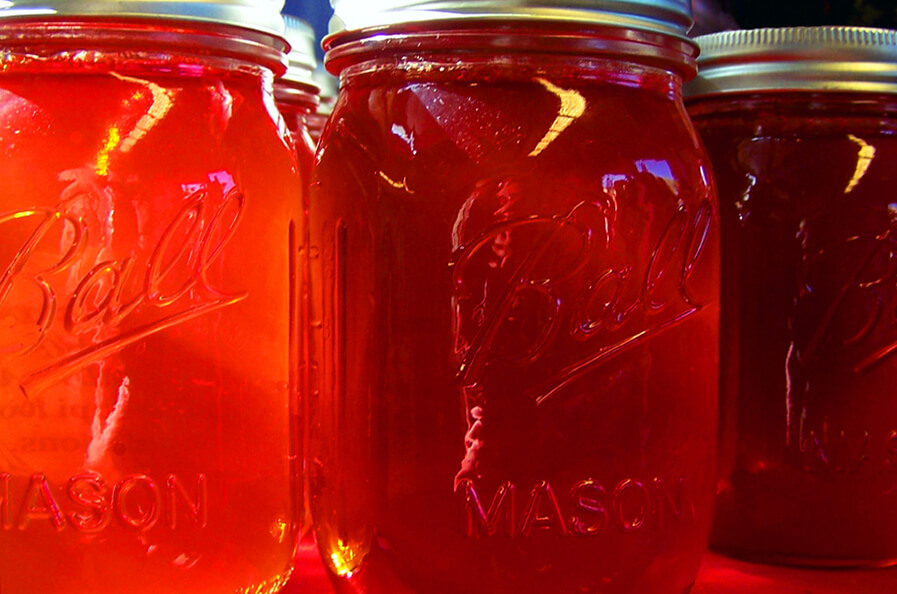
Macerate 4 cups fresh or frozen blackberries with 1 cup sugar; mash and strain. This will yield about 3 cups of syrup. Sift together 1 cup sugar with a tablespoon of cornstarch. Drizzle this mix into a quart of warm half-and-half, add 2 eggs well beaten and a tablespoon of vanilla extract. Simmer until thickened, remove from heat, add 2 cups whole cream, another teaspoon of vanilla, and the blackberry syrup. Whisk until smooth. Refrigerate for at least an hour before processing in the ice cream freezer with a squeeze of lemon. This recipe works well with any berry or stone fruit.
On Pimento Cheese
Robert Moss, who’s from Charleston, is a culinary historian, a geeky gaggle of food writers among whom I am gosling if not egg.
In Going Lardcore: Adventures in New Southern Dining, Moss delves into stories of Low Country dishes such as shrimp and grits and she-crab soup as well as elements of our broader Southern cuisine like bourbon, fried green tomatoes and pimento cheese. Here he becomes troublesome, claiming rum is more Southern than bourbon, that fried green tomatoes are a Yankee invention, and that pimento cheese originated in upstate New York. It’s this pimento and cheese issue I’m all over like a duck on a June bug, but before going any further, let’s turn to this matter of spelling, since I’m acutely aware that any article in Mississippi is going to be scratched over and henpecked by a pompous flock of literati. God help me if my semicolons lack weight.
Yes, I am quite aware that the it’s the pimiento pepper, but in his article “Creating a New Southern Icon: The Curious History of Pimento Cheese”, Moss notes that “In the late 1890s, imported Spanish sweet peppers started being canned and sold by large food manufacturers, which not only boosted their popularity but also introduced the Spanish name pimiento. Soon the ‘i’ was dropped from common usage, and by the turn of the century most print accounts of the peppers call them ‘pimentos’.” I’ll remind you that Moss has a PhD. (in English, no less) from Furman, and though I’m not known for my slavish allegiance to academics, like the rest of you, I always concur with eggheads when they’re in my corner. It looks good on paper.
Moss does not create another idol in this article; instead he reveals himself as an iconoclast of the first order by exposing the Yankee roots of a Southern dish Boston-based food writer Judy Gelman claims is “held sacred by Southerners”, and his research seems brutally thorough. Evangelism is clearly in play. What made pimento and cheese characteristically Southern is the use of cheddar. In memory lives the vivid image of a red hoop of cheddar sitting on the counter of a small country store under wax paper ready to be sliced and eaten with saltines and a hunk of baloney or a can of Viennas or sardines. There’s no doubt in my mind that this was the cheese most often grated and used with homemade mayonnaise for pimento and cheese in rural kitchens throughout the South. Still and all, Moss makes a valid point; if foods we consider Southern are anathematized by Yankee roots, then our idolized pimento cheese has feet of clay. My point is that we found out how to do it right and made it ours.
As to pimento and cheese itself, I’m not going to be so crass as to give you a recipe. You do it the way you like it; God knows you’re going to anyway. Pimento cheese should be devoid of controversy. It’s not; everyone thinks their version is the best. But you’re the one making it, so to hell with them. I also belong to a schismatic if not to say heretical sect who find a fresh sweet peppers from the garden as acceptable as canned pimientos, and have no problem adding chopped green onions, though I get a lot of finger-wagging over that. I just smile.
Jesse’s Heirloom Red Velvet
Great cakes come by the tried-and-true recipes of those who make them. Most of the best cakes involve complicated procedures that aren’t that time-consuming at all if you’re a practiced home cook, and everyone should experience the magic of taking one of these beautiful cakes from the oven. After basking in the aroma and beaming at it for a few minutes, you decorate; the cake is your canvas, and you are the creator of this intentionally temporary masterpiece.
Legend has it that the original recipe for the red velvet cake is from the kitchens of the Waldorf-Astoria, but there’s no solid opinion on that. The cake became popular here sometime after World War II, when the South began to become much more a part of the nation as a whole. Me, I think that the red velvet cake is a variation of the old devil’s food cake and that the name changed because many good religious women were just not going to bring Satan’s sustenance to their tables. It has the same texture, and while no cocoa is used in the icing, the cake’s primary flavoring is cocoa.
This is a family recipe, one of the dozen or so I still have from my mother’s hand. I’m almost sure she got it from her grandmother Eula, who came from a line of exceptional cooks. Her sister, my Aunt Leila, became legendary for her cakes, pickles and preserves. They were all very strict Baptists, and I suspect they were among the ones who would simply not feed their folks devil’s food; doubtless they didn’t want to nurture what they knew was a genetic predisposition for devilment. (It didn’t work.)
Two elements of this recipe betray its age. First is the leavening, which involves that chemistry set action of putting baking soda in a bit of vinegar and watching it foam. The acidic buttermilk in the batter provides additional frothing and the end result is, well, velvety. Many of you will probably take issue with the amount of food coloring involved, but try to relax; besides, it’s so much fun dribbling that red food coloring into your white batter and swirling it in.
Second is the “boiled icing”, meaning an icing that is produced pretty much in the way you would make a sauce or a gravy, by heating starch in a liquid. In some cookbooks, this is referred to as a “roux icing”, but if so, it’s a very, very raw roux indeed. The advantage to this type of icing is that you don’t have to warm it to ice your cake (in fact it needs cooling), and it tastes so much better than that lard and confectioner’s sugar gloop you get at the supermarket.
If you really want it good, cool layers and wrap in wax paper individually overnight before stacking and frosting.
Batter: 1 cup vegetable shortening, 1 ¼ cup sugar, 2 eggs, 1 teaspoon vanilla flavoring, 2 ¼ cups plain flour, 1 teaspoon salt, 1 tablespoon cocoa, 1 cup buttermilk, 2 ounces red food coloring, 1 teaspoon baking soda and 1 tablespoon vinegar. Cream shortening and sugar, and add well-beaten eggs and vanilla. Sift flour, salt and cocoa three times. Add dry ingredients alternately with buttermilk. Blend in food coloring. Dissolve soda in vinegar, and fold into batter. Bake in 3 layers at 350 degrees.
Frosting: 1 ½ cups milk, 4 ½ tablespoons flour, 1 ½ cups butter (3 sticks), 1 ½ cups sugar, 1 ½ teaspoons vanilla flavoring. Gradually add milk to flour in double boiler, stirring constantly until it is thicker than pudding. Remove from heat and stir until cooled. Cream butter and sugar for at least ten minutes, then add vanilla and continue creaming until fluffy. Add flour and milk mixture to creamed butter and sugar and beat at least ten minutes or until no grains of sugar can be detected. Frost and sprinkle with crushed black walnuts.
May the 4th Be With You! Chewy Wookiee Cookies
Preheat oven to 350, and line a lightly oiled baking sheet with parchment paper. Flip paper to oil both sides. Cream together 2 sticks softened unsalted butter with 1 cup sugar. Mix in one 1 large egg, beaten, and add a tablespoon vanilla extract. Set aside. Mix 2 ½ cups AP flour with 1/2 c. cocoa and 2 teaspoons baking powder. Slowly add the dry mixture to the wet ingredients until just combined. On a clean floured surface, work the dough until smooth and roll out to about ¼ inch. Cut into “wookies” with a gingerbread man cookie cutter, place onto the parchment baking sheet, and use a fork to make “fur.” Bake for about 10 minutes, remove from oven and cool thoroughly before making, face, belt, etc, with frosting.
Halcyon Soup
Homemade soups should grace our tables more often; they’ve fed body and soul long before canning came along, and a good soup made with stout stock and proper care is a measure of the cook.
Gazpacho is a king of cold soups, an easily-made, refreshing and to most minds somewhat novel way to serve fresh summer vegetables. Old recipes of this dish always include bread as one of the basic ingredients, usually melded early on with oil, salt and garlic into something resembling a paste. While my recipe does not include bread at that juncture–to me, it gums up the soup–take it from someone who crumbles cold cornbread over his, bread is a service requirement, and any well-textured bread will do.
This recipe is from my halcyon days in Oxford, which was an intoxicating environment, doubly augmented by the wine of youth itself. I was desultorily studying for a degree, diligently exploring my capacities for vice, and desolately working in a string of eateries, among them The Bean Blossom Bistro, by some reckoning the first health-food restaurant in Oxford. It was located on Jackson Avenue across from the old telephone exchange. The Good Food Store, Oxford’s first health-food store—then in its second incarnation—was on the corner next door. Carol Davis opened the Bean Blossom in 1978. We had worked together at the old Moonlight Café, which Betty Blair had opened up in the Hoka a couple of years earlier. Carol and I became fast friends during that time, and when she opened up her own place, she brought me with her.
The Bean Blossom, like so many small restaurants, was founded more on good intentions than experience. I don’t think we ever seated more than fifty people at one time, and usually far, far less. The kitchen could barely hold more than three people. Our menu changed daily, though we could always whip up a tofu burger, or a veggie stir-fry or a great salad any time you wanted it. Carol introduced me to a lot of new foods, including adzuki beans, which I cook like cowpeas, and tofu, which I of course deep-fry.
She also brought gazpacho into my world, and for that I am evermore grateful. I remember dipping the soup from a bucket in the bottom of our double-door refrigerator, a sheen of oil glistening atop the mixture. We served it with a variety of breads, and each bowl I eat now is a serving of nostalgia. Like memories themselves, this soup improves with age.
Bean Blossom Gazpacho
Take two or three cloves of garlic, mince very, very finely and mash in the bottom of a glass or enamel bowl with a teaspoon of salt and about a half a cup of olive oil. If you want to try adding bread, now is the time, but I can’t make a recommendation as to what kind. Add in fine dice one yellow onion, three very ripe summer tomatoes, two peeled cucumbers, two ribs celery (with leaves), and a sweet pepper if you like, though be careful, since the pepper can overpower the other vegetables; a sweet yellow banana pepper works well. If you want to add a hot pepper such as a jalapeno, fine, but I don’t recommend heat; this is a cooling dish, and should be refreshing rather than pungent. Likewise, starchy vegetables such as fresh corn or peas seem out-of-place to me as well, though there are countless variations.
Add another teaspoon of salt, a teaspoon of cumin, a teaspoon of fresh basil, a heaping tablespoon of freshly-chopped parsley, a teaspoon of coarsely ground black pepper and a bit more olive oil, perhaps a tablespoon. Add a vegetable juice such as V8; tomato juice is too thick. Let this mixture sit for a couple of hours in the refrigerator in a sealed non-metallic container overnight. An hour before serving, add more juice if needed, a little fresh chopped parsley, adjust the salt and pepper and return to the refrigerator. Serve in chilled bowls (freshly chopped chives are a nice touch) with good crusty bread.
Tish’s Benedictine
This recipe has a distinguished pedigree; I got it from ex-pat Kentuckian Lynn Tucker, who got it from Tish Clark of Prestonsburg, KY, her amendment of the one in Kentucky’s Best, Fifty Years of Great Recipes by Linda Allison Lewis.
Lynn said, “Years ago, certain bakeries in Louisville used to bake pink and green loaves of bread just for these popular finger sandwiches, a staple at Derby parties, weddings, showers, and appropriate funerals,” which leaves me wondering what an inappropriate funeral would be.
1 8 oz Philadelphia cheese, softened
1 tablespoon of mayonnaise
3 tablespoons of grated cucumber, drained well with a paper towel
1 teaspoon finely chopped green onions with tops
1 teeny tiny drop of green food coloring (the color should be delicate)
a dash or two of Tabasco
“Blend all ingredients together and mix well. Yield: 10-12 servings (I multiply by eight.) You may serve this on trimmed bread as finger sandwiches or as a dip. Please note there is not a single drop of Benedictine liqueur used in this recipe!”
“I like to make a nice pile of these sandwiches on a silver tray lined with a paper doily and garnished with a few cucumber slices and parsley. (Cover with a damp paper towel so your sandwiches don’t dry out and curl before serving. Refresh as necessary.) I also put out big crystal bowl of pimento cheese with Carr’s crackers, celery stalks, and salty peanuts to encourage drinking and deviled eggs to prevent or at least stall off utter drunkenness.”
In a Pickle
Some may say the family is a nest of humanity that nurtures civility and tolerance, but you know just as well as I do that families are more often roiling hotbeds of strife and contention. If you’re lucky and manage to stay out of court most of the time, the drama is petty, like this genetic tempest in a teapot over–-of all things–-pickled peaches.
We’d been having a carefree back-and-forth online discussion on our family website about a traditional holiday meal when I oh-so-casually mentioned that a cold plate featuring stuffed celery, trimmed green onions, black olives, and pickled peaches always appeared on our table. The pit hit the fan when a younger relative professed that she had no idea what pickled peaches were, much less what they taste like, to which I expressed what they obviously considered an excessive degree of shock and dismay.
Before I could sit sideways to assess my position, I was in a pickle myself. Another young cousin called “Mr. High-and-Mighty,” another chimed in with “a snooty old fart”, and after that it was a “jump on Jesse” free-for-all. Confident in my legendary modesty and self-effacement, I managed to remain calm for about 30 seconds. Damned if I do, damned if I don’t.
Pickled peaches are perfect for any holiday table or used as you might any canned peach in cobblers, cakes or for ice cream. Select the smallest fresh cling peaches you can find. It doesn’t matter if they’re a little bit green; in fact, you shouldn’t use peaches that are soft and ripe. Blanch and peel whole peaches. For every four pounds of peaches, combine 3 cups sugar and 2 cups vinegar, add two pieces of stick cinnamon broken into 2-inch pieces and two teaspoons whole cloves. Heat to bubbling. Pack peaches into sterilized quart jars, add hot spiced syrup (with water if needed) seal tightly, and process for 10 minutes. Wait a week before serving.
Shrimp and Eggplant Curry
Once as a very young man, I walked into a health food store that was run by one of those formidable New Age earth mother types whose moral superiority in the realm of nutrition–which she considered an extension of her deep-seated beliefs in The Great Mother and Her Bosom of Beneficence–was further exaggerated by just being an asshole herself. When I asked her where she kept the curry, she literally sniffed, tilted her nose towards the tie-dyed bed sheets on the ceiling and said, “I’m sure you make your own. If you’ll give me your recipe, I’ll show you where to find the ingredients.”
So I fumbled in my pockets and mumbled something about leaving the recipe my friend Rupta had given me at home before beating a retreat and hitting the books only to discover that curry is indeed not a singular spice or seasoning, but a combination of any given number of ingredients with endless variations. Still, that experience cooled my tenuous relationship with curries–my experiences with earth mothers was more extensive, and on the whole much more . . . positive–and though I have read Madhur Jaffre’s pontifications on the subject, I’ve achieved the sophistication of making my own blend. Granted, curry isn’t a spice mixture I use very often, but I love a curried chicken, and it’s wonderful with eggplant and okra, so having a blend on hand occasionally works for me.
Peel and halve (or cut into thick slices, depending on the size) six small or two large eggplants, brush liberally with oil (I don’t recommend olive oil for this recipe, nor ghee or what passes for it in your world; if you’re picky about it–and God help you if you are–use peanut oil), dust with pepper and place in a very hot oven until browned and soft. For this recipe you’ll need about three cups of cooked eggplant. Sauté about two pounds 26-30 count shrimp with a chopped a small onion, 2 cloves garlic, and 2 small mild peppers. Don’t use a bell if you can help it; even a poblano is better. Add eggplant and season with your favorite curry. Blend with a cup to two of weak stock to the consistency of a thick gumbo . Bake in a medium (350) oven until reduced by half.
Luncheon Dish
Women in any given society will assemble to sip, nibble, and talk about anything they want and anyone who isn’t there. Speaking as an ardent fan of my opposite sex, I’ll be the first to say that the world is a much better place due to distaff parliaments. Civilization itself depends on feminine attentions if not to say machinations, and it’s usually in these gaggles that the most uninhibited deliberations between our sisters take place.
Men should understand and appreciate this phenomenon, since when it comes to gossip, the trickle-down theory actually works; you may not know that your boss is sleeping with your secretary, but it’s a fair bet that you have a better chance of finding out if your wife knows. And God help you if you’ve been fucking her as well. The food served at more formal klatches of this type is delicate, often to the point of fussy. You’ll find salads with cold seafood or chicken, pasta, or seasonal vegetables alongside the obligatory crustless geometric sandwiches. Sweets, with the exception of a killer cake, are dainty and plentiful as are the drinks. I’ll not go so far as to swear that food is primarily intended to buffer the effects of a Bloody Mary luncheon, but the theory has been broached.
In the South, pimento and cheese, chicken salad, deviled eggs and pound cake (lemon or poppy seed particularly) at a ladies’ luncheon seem mandatory now, but it wasn’t so long ago that holding one without serving tomato aspic would imperil your membership in the 20th Century Club, but because of recoil from the foods of the Sixties, congealed salads (like fondues) have become not only passé but proscribed. This reaction is somewhat justified; on any given month between say 1960 and 1975 in any magazine devoted to food, you’ll find tons of recipes for gelatin involving practically every ingredient in the kitchen, more often than not canned fruit, citrus Jell-O and mini marshmallows.
But we shouldn’t abandon a good recipe because it’s showing its age, and this is a great dish: light, savory, easily prepared and attractive. Let’s hope tomato aspic is going through a trial period in popular tastes before it becomes not a novel legacy but a standard for our tables.
Tomato Aspic
3 cups tomato juice
2 packets unflavored gelatin
2 tablespoons finely minced white onion
2 tablespoons finely minced celery
1 teaspoon brown sugar
1 teaspoon black pepper
1 tablespoon fresh lemon juice
Worcestershire sauce and hot sauce to taste
Warm tomato juice, add gelatin and dissolve. Stir in lemon juice, black pepper, Worcestershire and hot sauce (I like Crystal), add vegetables and chill until partially set, spoon or pour into individual (5 oz.) lightly oiled molds and chill until set. Plate and serve with boiled eggs, pickles, and olives.
The Cryptid Creole
The Creole tomato has long enjoyed a storied reputation in the South. Here is a typical paean from Howard Mitcham’s Creole Gumbo and All That Jazz:
“The large, vine-ripened Creole tomato is one of the glories of Louisiana cooker. Creole tomatoes have a pronounced acid flavor and are used to make delicious sauces, stews, gumbos, and so on. In fact, the very term, “à la Creole” usually denotes a tomato sauce of some sort, and when it’s made with fresh Creole tomatoes, its flavor will be distinctive.”
In addition to a rich, distinctive flavor, the Creole tomato has a reputation for being able to produce fruit in the intense heat and humidity of summers in the Deep South, when nighttime temperatures in excess of 70 degrees make most tomato varieties subject to blossom drop and unable to bear fruit.
Traditionally, farmers in St. Bernard and Plaquemines parishes marketed their tomatoes as Creole, claiming that tomatoes grown in the rich alluvial soil created a unique flavor that et their tomatoes apart from others. But these farmers didn’t plant a single variety, and the seeds they saved and passed along to other gardeners as “Creole” were a mélange.
In 1969, LSU AgCenter researcher Teme Hernandez released a tomato variety named Creole, but it was not a variety commonly grown in St. Bernard and Plaquemines. Hernandez described his Creole tomato as having a medium-sized, deep red fruit with some resistance to fusarium wilt. But likely because of its poor production—less than six pounds per plant—the AgCenter did not maintain a seed stock of Hernandez’s Creole.
To demonstrate the variations in Creole tomatoes, LSU AgCenter researchers grew a demonstration plot of “Creole tomatoes” in spring 2015. Creole tomato seed was sourced from 11 companies. Only seed named “Creole” or described as the 1969-released Creole was purchased. Seed was sown on January 14, 2015. Seedlings were hardened off outdoors one week prior to transplanting.
On March 24, 2015, the Creole tomato seedlings were planted at the AgCenter Botanic Gardens at Burden. The plants continued to produce beyond July; however, data collection ended in late June in order to present information to the Louisiana Fruit and Vegetable Growers Association members at the annual field day. The top three producing Creole tomatoes were sourced from Organic Seeds Direct (Amazon), Naylor’s Hardware in Baton Rouge, and TomatoFest.
Seed sources had 88 percent, 74 percent and 82 percent marketable yields, respectively. Marketable tomatoes were free from cracks, bruises and evidence of disease, insect, or environmental injury. Individual fruit size ranged from 4.2- to 7.8-ounces. Yield per plant was poor, ranging from three to six pounds.
Though Creole has become a marketing term for any tomato grown in Louisiana as well as for many tomatoes that claim to be tolerant of high temperatures, tomatoes labeled Creole are not of the same variety, and almost certainly not sourced from St. Bernard, Plaquemines, or LSU for that matter.
And yes, I went to Ole Miss.