Most often now when Wyatt Cooper is mentioned at all, it’s in the same breath with his younger son, Anderson Cooper, but Wyatt himself was a man of many parts, one being a damn fine writer.
Cooper was born in Quitman, Mississippi, September 1, 1927. moved to New Orleans as a young child and in his twenties moved to New York City to pursue acting. In his thirties, Cooper lived in Los Angeles, attended both UCLA and UC Berkeley, and worked as a screenwriter. While residing in West Hollywood, then an unincorporated area of Los Angeles County, Cooper lived near Dorothy Parker and her husband Alan Campbell. A close friendship developed, and a year after Parker’s death in 1967, Cooper published an incisive and widely read profile in Esquire magazine, titled, “Whatever You Think Dorothy Parker Was Like, She Wasn’t”.
Cooper moved to Manhattan in the early 1960s, and worked there as a magazine editor. On December 24, 1963, he married heiress Gloria Vanderbilt, becoming her fourth husband. The photogenic couple frequently appeared on the national “best-dressed” list.[5] They had two sons: Carter Vanderbilt Cooper (1965-1988) and Anderson Cooper (b. 1967), who became a prominent CNN anchor. Wyatt Cooper wrote in his 1975 memoir, “It is in the family that we learn almost all we ever know of loving. In my sons’ youth, their promise, their possibilities, my stake in immortality is invested.” Wyatt Cooper died in Manhattan, New York City on January 5, 1978, at age 50, during open heart surgery, after having a heart attack the previous December.
This essay, “Of Food and Fellowship” appeared in Southern Sideboards, the Junior League of Jackson’s landmark cookbook, which was first published in June, 1978.
Speak to me of food and what springs readily to my mind is not so much a recall of particular dishes I’ve relished, but a succession of images, sad and funny, sweet and tender, of people and places and happy occasions from the recent or long-gone past, a procession of dear, lost, familiar faces and voices, with the echo of laughter from other years. One remembers all those tables, some grand and richly laden, some humble and bearing simple fare, over which have flowed the talk, the tales, the exchanges that have made up the histories of our lives; the tables across which loving eyes have looked into loving eyes, and across which we have reached, friend to friend and spirit to spirit, to touch each other in precious communion. I think of vanishes loved ones and of absent friends and simpler times, of youth and joy and wonder, of those early seasons of first discoveries, the seasons in which we were blessed with Heaven’s gift for finding all the world’s delight in one bright Easter egg, all the world’s affection in one home-decorated birthday cake with our own particular name written bright upon it.
At those tables, a child, and later, the child in the adult, could watch and listen and learn. It was and would remain a place of adventure and exploration, a place where the curious eye and ear could partake of the rich store of other people’s experience, their adventures in the vast and mysterious world that waited and waits, beckoning but intimidating, outside the window; adventures, also, in those other, interior worlds of the mind, where thoughts, opinions, ideas were and are the exhilarating substance of the hungry brain.
Since our associations scurry quickly back to our beginnings, I find myself breathing deeply and knowing once again the romance and allure of the smells emanating from the kitchen of my first home, the warm, comforting aroma of biscuits baking or of coffee and bacon on cold mornings, with Mama beside the stove calling out that we must hurry.
I remember the family reunions with the piling on of food, an abundance and variety of offerings that represented God only knows how many accumulated hours of planning and preparing and packing, a feast to which more than twice our number could not have done justice. I remember the buzzing and bustling of the women crowed into Grandma’ kitchen, all full of importance and pride in marvels about to be revealed, each with her own specialty for which she was celebrated within the family—this one’s banana pudding, that one’s pineapple-upside-down cake. I think of Christmas with the smell of apples and oranges and fruit cakes and with turkeys and stuffing that make the mouth water forty years later.
I was born country, so I know all about frying just the right chickens because the preacher was coming to dinner and about all-day-singings-with-dinner-on-the-ground where heavy baskets and cardboard boxes were hauled out of the back end of family cars or even horse drawn wagons or buggies. The contents were spread proudly out, displayed like the golden wedding presents of princesses, set out upon glistening, freshly-starched and sun-dried linen cloths there would be much calling out to each other from families inviting others to try this or that from their bounty, while grabbing loose strays, especially bachelors, and there would be a scampering about of colt-legged boys, impatient and giggly while overly devout deacons went on too long at asking the blessing, when any sort of mumbled “. . . bless this food to the nourishment of our bodies . . .” would have done just as well.
I know about hog-killing time in the first sharp cool of fall, when the children were allowed to help with the scraping if they were careful to stay away from the scalding water I know about the way molasses was made, when you took turns feeding the cane into the grinder and remembered to duck each time the pole, pulled bumpily around and around by dull, plodding mules, made its way overhead again.
These activities were co-operative efforts; we didn’t do them by ourselves. Neighbors came together to help each other. We worked out the dates—Tuesday for the Longs, Thursday was the Timmses’ turn, and Monday week was for us. The doing of it was all mixed up with community feeling, with jokes and gossip and catching up on news and horseplay and grown-up talk.
What I’ve been talking about, when you come down to it, is friendship, sharing, caring. I’m talking about love. To show our love for one another we devise little rituals. We beg the passing traveler to eat. We toast brides. We drink to each other’s health. We give dinners for those we seek to honor. There is a particular bond between friends who prepare food together, between friends who dine with each other. The breaking of bread together has, for many centuries, held something of a ceremonial significance for us.
It seems as if it were always so. It was in the Bible and in the earliest Greek plays and in the writings of Homer Obviously it goes way back. I should think that it must have been soon after they first came down from the trees and began improving their manners that one of our hairy ancestors must accidentally have dropped into the cave hearth the baby brontosaurus leg on which he’d been gnawing, or stumbled onto a succulent pig just roasted by a recent forest fire, and made the revolutionary discovery that the raw and natural stuff with which he’d been sustaining his life could be improved upon. On that distant red letter day a new art form was born and man took a giant step in the direction of Julia Child.
It seems to me that the invention of cooking must have made a considerable contribution toward the very process of civilization. Surely, Mr. and Mrs. Piltdown Erectus and their children, having found the new way of dining an enrichment of the cultural tone of their own household, must certainly have hastened to call in their neighbors to share the benefits of the revelations so happily and so accidentally bestowed upon them. Thus, on that evening of joyous and primitive grunting that then served as conversation, undoubtedly began the ancient and inseparable association between eating and hospitality, the eternal connection between food and fellowship.
I should mention somewhere along here that I was not invited to set down the few words of this preface because I can claim to be a passable practitioner of that noble science. The truth is I can’t cook. Anything. My instant coffee is barely acceptable even to me, and my peanut and butter sandwiches have repeatedly been rejected by my sons. “No thanks, Daddy,” they say with wistful politeness, “We’ll make our own. Alan Campbell once told me that before his wife, Dorothy Parker, would cook anything she’d go into the kitchen and eat raw bacon. In that category at least, Dotti and I were in the same league.
One of the saddest failures of my life was the time I tried to delight my little family, those underprivileged citizens of the pre-packaged, machine-made, and mass-produced age, with the home-made ice cream that is such a treasured memory from my youth. For years I’d tried to impart to them some idea of the magical creation of that frozen treat by describing how you break up the block of ice by putting it into a croker sack and beating it with the back of an ax, pack the crushed ice tightly around the metal can inside the wooden freezer, argue over who gets to turn the crank first, (several children should be involved; the making of ice cream calls for company; in a one-child family only the presence of grandparents could compensate for the absence of other children) and finally how everybody crowds around for the miraculous moment when the lid is reverently lifted off, and the creamy, vanilla colored, heavenly swirl of pure pleasure is revealed.
My sons were skeptical but willing, and so, one summer in Southampton, having consulted by long distance with my sister in Hartford, Connecticut, I bought a freezer, assembled the ingredients, and, while she instructed over the telephone, began mixing, stirring, and beating. I suspected early on that I was in trouble when it became perfectly clear to me that while Marie makes great ice cream herself, she has no very clear idea of how she does it, “. . . just put in some sugar; you’ll know when it’s enough . . .” –that kind of direction doesn’t help at all. Honest, it doesn’t. Not unless you can already do it. Or have talent. At one point I was cooking the mixture and it started turning into something that looked suspiciously like an omelet. “I hope you didn’t use too many eggs . . .” she said encouragingly. “Does it look too yellow?” Along about then I had more than a premonition of disaster. Also, for some reason, it overflowed while we were turning the crank, the yellow seeping out the sides and mixing with the ice. That wasn’t promising.
There’s no point in pretending there’s any suspense to this story or in prolonging it, so I’ll go strait to the finish. It looked beautiful, actually. The result of all my labor looked very clean and very pretty, but it had no taste at all so far as I could tell and I could not expect those little boys, however polite and loving they are, to pretend that it was worth bothering with. Oddly enough, my wife, who has a very discerning palate, liked my ice cream. She thought it tasted like real yogurt made with goat’s milk. Maybe if my sister has a recipe for yogurt I might end up with ice cream.
Recipes, anyway, have to be fleshed out, I suspect, with the cook’s own taste, personality and inspiration. Ethel Barrymore was once rehearsing a new play with an over-eager young director who kept instructing her with details, “Move to that table. Life the book, pause, and then look at it.” She endured this for a while, then she turned to him and said sweetly, “I know just what you mean. I lift the book, pause, and then look at it, and it is then that I do that special, unexplainable thing that causes audiences to come to see me and enables me to earn a thousand dollars a week.” She made her point. With great cooks, as with great stars, there is that “special, unexplainable thing” that has to do with taste, authority, and uniqueness of personality, and the beginner, I should think, should be encouraged to trust his or her own particular instincts and exercise his or her own creativity.
In Saki’s short story, “The Blind Spot”, one character says, “the man is a common murderer,” and another replies, “A common murderer, perhaps, but a very uncommon cook.” This book contains the secrets of many very uncommon cooks, great stars, splendid artists of the kitchen; secrets, many of them, that have considerable histories, having been handed down, generation to generation, from one famous cook to another.
I am fascinated by the great variety of cooking styles assembled here, representing many different traditions and widely varying national origins. Some recipes remain pretty much as they were when Great-Grandma was finally persuaded to write them down, or when Cousin Jessica spied on some selfish and secretive cook and wrote down each step se took, each pinch of salt, each wave of the hand in the direction of the pot. Others have evolved through adaptation, experiments, and happy accidents. A few of them doubtless traveled south with the earliest settlers, moving along the Natchez Trace from Virginia, the Carolinas or Kentucky, personally watched over by the woman of the family, along with a treasured set of china, an ancestral portrait, a silver candlestick, or some other heirloom.
Outsiders tend to think of the South as all one thing, when, of course we know that our extraordinary diversity is one of our most attractive features. We have absorbed many things from many sources, and have made them our own. Take grits. Grits has (sic;jly), of late been mentioned in the news somewhat frequently as a native southern specialty, which it is. It is very native, indeed, sine it was given to us by the Indians, along with corn bread and many other things. Blacks have made a contribution that is hard to measure, for many black cooks have been among the nameless geniuses who’ve left the culinary art a better one for their having participated in it. The French and Spanish influence on cooking is very important in the South, and though New Orleans is most famous for it, excellent French and Creole restaurants are strung along The Mississippi Gulf Coast all the way to Mobile.
In the past couple of years I’ve traveled around my native Mississippi a great deal, and I’ve enjoyed everything from baked dove at the governor’s mansion to fried catfish and hush puppies in Vicksburg and stuffed breast of chicken in Natchez, from ham hocks and turnip greens in Meridian to sirloin steak in Columbus, hot tamales in Greenville, and Creole gumbo and soft shelled crabs in Biloxi. In West Point, Mayor Kenny Dill went out and picked blackberries and Mrs. Dill made them into pie for me. Who wouldn’t choose a blackberry pie over a key to the city?
Which brings me full circle and back to hospitality. My children are startled by the extraordinary lengths that Southerners go in order to make the visitor feel at home among them. Very often, when we have been guests in someone’s home, neighbors have rushed in to leave off (or sometimes simply leave out-side the door) a basket of yard eggs or fresh butter or vegetables taken from their gardens that morning.
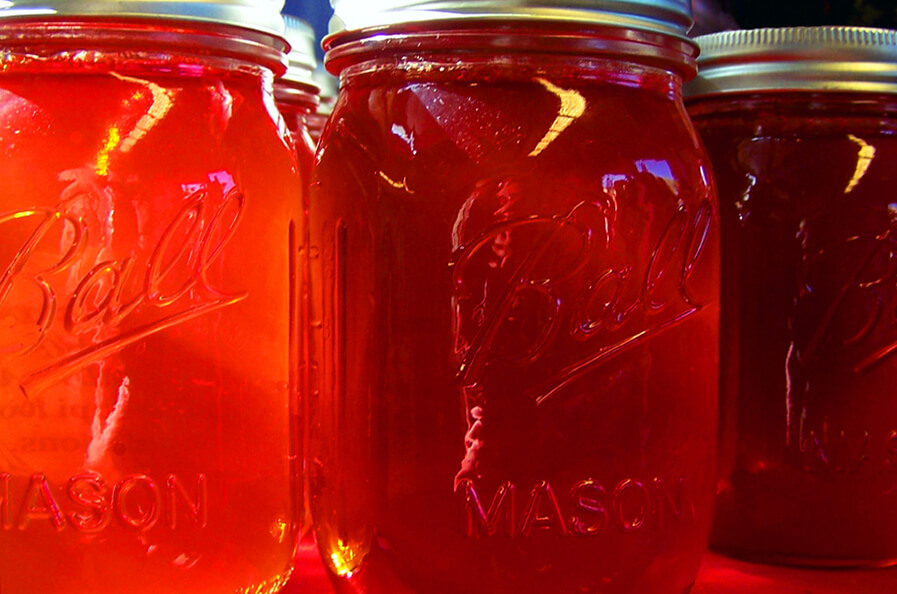
How many times it has happened that after a speech I’ve found someone thrusting into my hands a container of home-made fudge or a jar of fig preserves, saying “Take these to Carter and Anderson,” or “I beg Gloria’s never had watermelon rind preserves,” and slipping away before I could get the names? I’ve even been presented with chitlin’s (or chitterlings, and the dictionary spells it) and though anybody who knows me can testify that I’ve always been proud of my farm background, in the matter of chitlin’s, born country or not, I didn’t know what they were and wasn’t too curious to find out. I guess somethings are just meant to be forgotten, but Idid appreciate the thought. (Though not enough, you understand, to confront my wife with the chitlin’s.)
Oh, just one more thing. A story about one of my great uncles—one of the Campbells, I think. Having lost his wife (by death, I mean; she wasn’t simply misplaced) he was looking around for a replacement and in mentioning the most desired qualification, he made the following obsertion:
“The huggin’ and kissin’ don’t last forever. The cookin’ do.”