In a Pickle

Some may say the family is a nest of humanity that nurtures civility and tolerance, but you know just as well as I do that families are more often roiling hotbeds of strife and contention. If you’re lucky and manage to stay out of court most of the time, the drama is petty, like this genetic tempest in a teapot over–-of all things–-pickled peaches.

We’d been having a carefree back-and-forth online discussion on our family website about a traditional holiday meal when I oh-so-casually mentioned that a cold plate featuring stuffed celery, trimmed green onions, black olives, and pickled peaches always appeared on our table. The pit hit the fan when a younger relative professed that she had no idea what pickled peaches were, much less what they taste like, to which I expressed what they obviously considered an excessive degree of shock and dismay.

Before I could sit sideways to assess my position, I was in a pickle myself. Another young cousin called “Mr. High-and-Mighty,” another chimed in with “a snooty old fart”, and after that it was a “jump on Jesse” free-for-all. Confident in my legendary modesty and self-effacement, I managed to remain calm for about 30 seconds. Damned if I do, damned if I don’t.

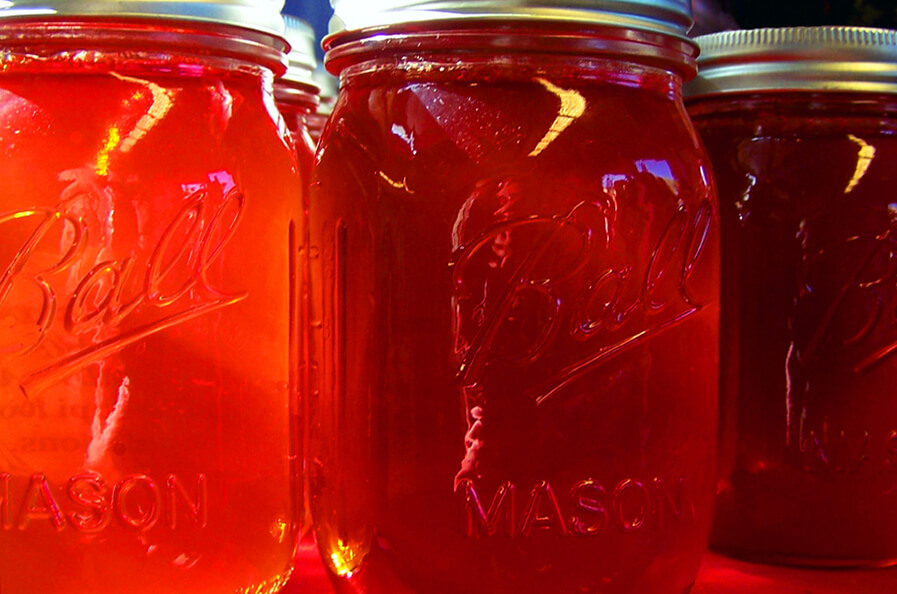
Pickled peaches are perfect for any holiday table or used as you might any canned peach in cobblers, cakes or for ice cream. Select the smallest fresh cling peaches you can find. It doesn’t matter if they’re a little bit green; in fact, you shouldn’t use peaches that are soft and ripe. Blanch and peel whole peaches. For every four pounds of peaches, combine 3 cups sugar and 2 cups vinegar, add two pieces of stick cinnamon broken into 2-inch pieces and two teaspoons whole cloves. Heat to bubbling. Pack peaches into sterilized quart jars, add hot spiced syrup (with water if needed) seal tightly, and process for 10 minutes. Wait a week before serving.

Faulkner at Churchill Downs

That Faulkner wrote about the Kentucky Derby for Sports Illustrated should come as no surprise, nor that his essay “Kentucky: May: Saturday” is not only about what happened on May 7, 1955, but a masterly  examination of the Derby as a quintessential American event and of the sport of kings itself.

The assignment was his second from the fledgling Sports Illustrated (founded by Henry Luce the previous August), his first being an exercise in dissonant apposition. That January Faulkner attended his first hockey game, one between the Montreal Canadiens and the New York Rangers, and in “An Innocent at Rinkside” wrote: “It was filled with motion, speed. … discorded and inconsequent, bizarre and paradoxical, like the frantic darting of the weightless bugs which run on the surface of stagnant pools”. The poetry of hockey eluded the Mississippian.

James Street, the Mississippi minister-turned-journalist-turned novelist, was given the original 1955 Derby assignment, but Street died the September before the race. Sports Illustrated offered Faulkner $2000 plus a week’s expenses, including a $100-a-day chauffeured limousine; the kicker was a $500 bonus if the piece turned out to be as exceptional as they hoped from the Southern Nobelist. No fool he, Faulkner accepted immediately and after a trip to New York in April and the first days of May, he left the city for Louisville, where his publisher Don Klopfer sent him a note to the Brown Hotel informing him that he had won the Pulitzer Prize for A Fable.

“It’s an easy 500 bucks for you,” Klopfer write, “and we’re all mighty pleased, although I don’t suppose you give a damn.” On the contrary, Faulkner, who considered A Fable his masterpiece, was quite pleased and those visiting the handsome, nattily-attired writer in his suite found him puffing on a briarwood pipe, smiling.

Far from rinkside in Madison Gardens, at Churchill Downs Faulkner was in his element; his father Murry had been a livery-stable owner in Oxford, he enjoyed riding as well as fox hunting and he had a fine eye for horseflesh. In an interview with The Courier-Journal, Faulkner reflected, “It’s interesting that you have tried to train blood and flesh to the perfection of a machine but that it’s still blood and flesh.”

During his stay in Louisville Faulkner was accompanied by SI’s turf writer Whiney Tower, who was instructed “to try to see that our guest did not become so preoccupied with the available whiskey that he neglected his assignment.” To ensure against that seemingly likely possibility, Faulkner was to turn over 300 words each evening of their weeklong stay in Louisville for Tower to wire via Western Union to New York.

Tower, a legend in his own right and the nephew of Lexington horse-farm owner C.V. Whitney, found Faulkner to be “thoroughly professional”. “His knowledge of horses and their bloodlines went way back,” Tower wrote, “and I think the best part of his week may have been the day we skipped away from Louisville to visit farms in Lexington.

At Claiborne Farm, he was very much taken with Nasrullah, later to become one of the all-time great stallions, and sire of, among others, Bold Ruler, another champion sire. But no horse he saw in Lexington that long day entranced Faulkner nearly so much as a beautiful gray, Mahmoud, an Epsom Derby winner, then 22 years old and galloping effortlessly in his paddock at the C.V. Whitney farm. On the way back to Louisville, Faulkner napped, but near Frankfort, he awoke suddenly, nostrils twitching above his mustache. “He sat straight up, rolled down his window and inhaled deeply,” Tower wrote. “‘I thought so!’ he exclaimed. ‘I don’t mistake that smell. There’s a distillery damn close to here.’”

As race day approached, Faulkner became more fascinated by the activity at Churchill Downs. Before his first trip to the press box, Tower wrote, Faulkner “asked in an excited schoolboyish way” whether he might meet acclaimed sportswriter Red Smith. The two proceeded to handicap the day’s races. Tower noted that Smith “relied mostly on past performance” in determining his bets, while Faulkner favored the conformation of each horse.

“Kentucky: May: Saturday” ran in the May 16, 1955 issue of Sports Illustrated. Written in five parts to accentuate the build-up of tension and excitement that exploded in the two-minute race that had drawn over a hundred thousand people from all over the world, the essay was not so much about the race itself as a—somewhat rambling; it is Faulkner, after all—meditation on what the Derby means, a piece so subjective that Faulkner didn’t even mention how “Swaps”, ridden by Bill Shoemaker, had held the lead from the start and won despite a thrilling challenge from “Nashua”.

“THREE DAYS BEFORE”, framed the event in historical perspective: “This saw Boone: the bluegrass, the virgin land rolling westward wave by dense wave from the Allegheny gaps, unmarked then, teeming with deer and buffalo about the salt licks and the limestone springs whose water in time would make the fine bourbon whiskey; and the wild men too — the red men and the white ones too who had to be a little wild also to endure and survive and so mark the wilderness with the proofs of their tough survival — Boonesborough, Owenstown, Harrod’s and Harbuck’s Stations; Kentucky: the dark and bloody ground.” He linked this past history with his own present: “And knew Stephen Foster and the brick mansion of his song; no longer the dark and bloody ground of memory now, but already my old Kentucky:​ home.”

“TWO DAYS BEFORE”, he turned to the race: “Even from just passing the stables, you carry with you the smell of liniment and ammonia and straw — the strong quiet aroma of horses. And even before we reach the track we can hear horses — the light hard rapid thud of hooves mounting into crescendo and already fading rapidly on. And now in the gray early light we can see them, in couples and groups at canter or hand-gallop under the exercise boys. Then one alone, at once furious and solitary, going full out, breezed, the rider hunched forward, excrescent and precarious, not of the horse but simply (for the instant) with it, in the conventional posture of speed — and who knows, perhaps the two of them, man and horse both: the animal dreaming, hoping that for that moment at least it looked like Whirlaway or Citation, the boy for that moment at least that he was indistinguishable from Arcaro or Earl Sande, perhaps feeling already across his knees the scented sweep of the victorious garland.”

“ONE DAY BEFORE” looked back to former races: It rained last night; the gray air is still moist and filled with a kind of luminousness, lambence, as if each droplet held in airy suspension still its molecule of light, so that the statue which dominated the scene at all times anyway now seems to hold dominion over the air itself like a dim sun, until, looming and gigantic over us, it looks like gold — the golden effigy of the golden horse, ‘Big Red’ to the Negro groom who loved him and did not outlive him very long, Big Red’s effigy of course, looking out with the calm pride of the old manly warrior kings, over the land where his get still gambol as infants, until the Saturday afternoon moment when they too will wear the mat of roses in the flash and glare of magnesium; not just his own effigy, but symbol too of all the long recorded line from Aristides through the Whirlaways and Count Fleets and Gallant Foxes and Citations: epiphany and apotheosis of the horse.”

“THE DAY” began ruminating about the horse, which once moved man’s body and goods, but now moved only his money. Food-supplying animals would, he prophesied, eventually become obsolete, but not horses, since they provide mankind with “something deep and profound in his emotional nature and need, a sublimation, a transference: man with his admiration for speed and strength, physical power far beyond what he himself is capable of, projects his own desire for physical supremacy, victory, onto the agent—the baseball or football team, the prize fighter. Only the horse race is more universal…”

“4:29 P.M.” is emotionally drained, an analytic response to spent anticipation: “We who watched have seen too much… we must turn away now for a little time, even if only to assimilate, get used to living with, what we have seen and experienced.” He focused on the dispersal of the crowds and the disgruntlement of the losing backers. “And so on. So it is not the Day after all, it is only the eighty-first one.”

Shrimp and Eggplant Curry

Once as a very young man, I walked into a health food store that was run by one of those formidable New Age earth mother types whose moral superiority in the realm of nutrition–which she considered an extension of her deep-seated beliefs in The Great Mother and Her Bosom of Beneficence–was further exaggerated by just being an asshole herself. When I asked her where she kept the curry, she literally sniffed, tilted her nose towards the tie-dyed bed sheets on the ceiling and said, “I’m sure you make your own. If you’ll give me your recipe, I’ll show you where to find the ingredients.”

So I fumbled in my pockets and mumbled something about leaving the recipe my friend Rupta had given me at home before beating a retreat and hitting the books only to discover that curry is indeed not a singular spice or seasoning, but a combination of any given number of ingredients with endless variations. Still, that experience cooled my tenuous relationship with curries–my experiences with earth mothers was more extensive, and on the whole much more . . . positive–and though I have read Madhur Jaffre’s pontifications on the subject, I’ve achieved the sophistication of making my own blend. Granted, curry isn’t a spice mixture I use very often, but I love a curried chicken, and it’s wonderful with eggplant and okra, so having a blend on hand occasionally works for me.

Peel and halve (or cut into thick slices, depending on the size) six small or two large eggplants, brush liberally with oil (I don’t recommend olive oil for this recipe, nor ghee or what passes for it in your world; if you’re picky about it–and God help you if you are–use peanut oil), dust with pepper and place in a very hot oven until browned and soft. For this recipe you’ll need about three cups of cooked eggplant. Sauté about two pounds 26-30 count shrimp with a chopped a small onion, 2 cloves garlic, and 2 small mild peppers. Don’t use a bell if you can help it; even a poblano is better. Add eggplant and season with your favorite curry. Blend with a cup to two of weak stock to the consistency of a thick gumbo . Bake in a medium (350) oven until reduced by half.

Fannye’s Pigeons

Fannye Cook was a pioneer environmentalist who championed the protection and preservation of Mississippi’s rich natural environment. She led the campaign to create the Mississippi Department of Wildlife, Fisheries, and Parks, and its educational and research arm, the Mississippi Museum of Natural Science.

Fannye Addine Cook was born in Crystal Springs, Mississippi on July 19, 1889. By that time, Mississippi like most of the South was catastrophically denuded of the great virgin forests that stretched from east Texas to tidewater Virginia. In A Turn in the South, V.S. Naipaul spoke with a woman in Jackson who said, “When I was a little girl—say in 1915—they were still clearing (the forests). They would go and chop around these mighty oaks and they would then die and they would cut them. When they were going to clear out a field they would kill the trees. I never paid any attention to it. It was what they did.”

As James Cummins notes in his Preface, “the blackland prairie of eastern Mississippi had been cultivated to less than one percent of its former size, “White-tailed deer, Louisiana black bear, American alligator, wood duck, and other species were nearly eliminated by lawless exploitation. Streams and rivers were choked with eroding soil. The idea of caring for the land and its community of inhabitants, what writer and ecologist Aldo Leopold called a ‘land ethic,’ had not taken hold in Mississippi.”

That this biography of Fannye includes in its first few pages the following vivid documentation of passenger pigeons in Mississippi strikes a strong, graceful and resounding note against a bleak lack of consideration for the natural world. The passenger pigeon was once the most abundant bird, perhaps even the most abundant vertebrate, on the planet. Audubon once watched a flock pass overhead for three days and estimated that at times more than 300 million pigeons flew by him each hour.

But these birds were slaughtered unmercifully during the 19th century, and after a description of one massacre, Audubon wrote, “Persons unacquainted with these birds might naturally conclude that such dreadful havoc would soon put an end to the species. But I have satisfied myself, by long observation, that nothing but the gradual diminution of our forests can accomplish their decrease, as they not unfrequently quadruple their numbers yearly, and always at least double it.”

From this perspective, these numbers seem incredulously inflated, yet as the slaughters continued and the forests fell–particularly the great beech woods of the Ohio Valley–the passenger pigeon declined in number with proportionate rapidity, and their extinction was sealed by the death of the last known member of the species, a female named Martha (after the first First Lady) that died on September 1, 1914 at the Cincinnati Zoo.

Though many of Cook’s specimens at the old Jefferson Street museum were destroyed by water during the 1979 Jackson flood, her documents and other materials form the core of the 18,000-volume library in the Mississippi Museum of Natural Science. It was there I sought information about the last passenger pigeons in Mississippi. A long-time librarian at the Mississippi Museum of Natural Science, Mary Stripling, provided me with this information concerning passenger pigeons in Mississippi.

“Jesse,” Mary wrote, “You are grasping at straws looking for the last one sighted in Mississippi.” She then cited several primary resources for more information, and also gave me the last sight records in their collection, adding that they appear to be handwritten by Miss Cook herself.

Year:  1848; Observer:  T. J. Pierce; Place: Brookhaven – Bayou Pierre. “One fall the pigeons came one afternoon by the thousands. There were so many and they were so thick the sun could not be seen and they darkened the sky. They flew low, many of them only 10 or 12 feet, so low that they could be knocked down with brush. They settled in the trees just on edge of grandfather’s farm and weighted them down. Many men and boys went out and shot them to eat — meat dark about like guinea. Only this one time were they seen there.”

Year : 1878; Observer: G. M. Cook;  Place: Copiah County – Utica. “Still a good many pigeons in Pearl River swamp and on hills. Daddy killed several at one shot out of a flock of about 20 in the top of a big pine tree over 100 ft. high (short leaf pine). In 1858 very large flocks so large and so low that Daddy and other school kids would run thru them with arms spread. The birds moved out of their way just far enough to keep from getting caught by the children.”

Undoubtedly straggling bands of passenger pigeons survived in Mississippi for  perhaps a decade afterwards but were likely exterminated well before the turn of the century. Yes, I was grasping at straws, but I knew where to look for the information I needed about the natural world in the state of Mississippi and thanks to Fannye Cook I found it. Whether you’re a hunter, a hiker or just someone loves Mississippi, buy this book, support local conservation groups, and care for your share of the planet, and remember Fannye when you’re out in the Mississippi wilds.

And remember Martha, always.

Luncheon Dish

Women in any given society will assemble to sip, nibble, and talk about anything they want and anyone who isn’t there. Speaking as an ardent fan of my opposite sex, I’ll be the first to say that the world is a much better place due to distaff parliaments. Civilization itself depends on feminine attentions if not to say machinations, and it’s usually in these gaggles that the most uninhibited deliberations between our sisters take place.

Men should understand and appreciate this phenomenon, since when it comes to gossip, the trickle-down theory actually works; you may not know that your boss is sleeping with your secretary, but it’s a fair bet that you have a better chance of finding out if your wife knows. And God help you if you’ve been fucking her as well. The food served at more formal klatches of this type is delicate, often to the point of fussy. You’ll find salads with cold seafood or chicken, pasta, or seasonal vegetables alongside the obligatory crustless geometric sandwiches. Sweets, with the exception of a killer cake, are dainty and plentiful as are the drinks. I’ll not go so far as to swear that food is primarily intended to buffer the effects of a Bloody Mary luncheon, but the theory has been broached.

In the South, pimento and cheese, chicken salad, deviled eggs and pound cake (lemon or poppy seed particularly) at a ladies’ luncheon seem mandatory now, but it wasn’t so long ago that holding one without serving tomato aspic would imperil your membership in the 20th Century Club, but because of recoil from the foods of the Sixties, congealed salads (like fondues) have become not only passé but proscribed. This reaction is somewhat justified; on any given month between say 1960 and 1975 in any magazine devoted to food, you’ll find tons of recipes for gelatin involving practically every ingredient in the kitchen, more often than not canned fruit, citrus Jell-O and mini marshmallows.

But we shouldn’t abandon a good recipe because it’s showing its age, and this is a great dish: light, savory, easily prepared and attractive. Let’s hope tomato aspic is going through a trial period in popular tastes before it becomes not a novel legacy but a standard for our tables.

Tomato Aspic

3 cups tomato juice
2 packets unflavored gelatin
2 tablespoons finely minced white onion
2 tablespoons finely minced celery
1 teaspoon brown sugar
1 teaspoon black pepper
1 tablespoon fresh lemon juice
Worcestershire sauce and hot sauce to taste

Warm tomato juice, add gelatin and dissolve. Stir in lemon juice, black pepper, Worcestershire and hot sauce (I like Crystal), add vegetables and chill until partially set, spoon or pour into individual (5 oz.) lightly oiled molds and chill until set. Plate and serve with boiled eggs, pickles, and olives.

The Cryptid Creole

The Creole tomato has long enjoyed a storied reputation in the South. Here is a typical paean from Howard Mitcham’s Creole Gumbo and All That Jazz:

“The large, vine-ripened Creole tomato is one of the glories of Louisiana cooker. Creole tomatoes have a pronounced acid flavor and are used to make delicious sauces, stews, gumbos, and so on. In fact, the very term, “à la Creole” usually denotes a tomato sauce of some sort, and when it’s made with fresh Creole tomatoes, its flavor will be distinctive.”

In addition to a rich, distinctive flavor, the Creole tomato has a reputation for being able to produce fruit in the intense heat and humidity of summers in the Deep South, when nighttime temperatures in excess of 70 degrees make most tomato varieties subject to blossom drop and unable to bear fruit.

Traditionally, farmers in St. Bernard and Plaquemines parishes marketed their tomatoes as Creole, claiming that tomatoes grown in the rich alluvial soil created a unique flavor that et their tomatoes apart from others. But these farmers didn’t plant a single variety, and the seeds they saved and passed along to other gardeners as “Creole” were a mélange.

In 1969, LSU AgCenter researcher Teme Hernandez released a tomato variety named Creole, but it was not a variety commonly grown in St. Bernard and Plaquemines. Hernandez described his Creole tomato as having a medium-sized, deep red fruit with some resistance to fusarium wilt. But likely because of its poor production—less than six pounds per plant—the AgCenter did not maintain a seed stock of Hernandez’s Creole.

To demonstrate the variations in Creole tomatoes, LSU AgCenter researchers grew a demonstration plot of “Creole tomatoes” in spring 2015. Creole tomato seed was sourced from 11 companies. Only seed named “Creole” or described as the 1969-released Creole was purchased. Seed was sown on January 14, 2015. Seedlings were hardened off outdoors one week prior to trans­planting.

On March 24, 2015, the Creole tomato seedlings were planted at the AgCenter Botanic Gardens at Burden. The plants continued to produce beyond July; however, data collection ended in late June in order to present information to the Louisiana Fruit and Vegetable Growers Association members at the annual field day. The top three producing Creole tomatoes were sourced from Organic Seeds Direct (Amazon), Naylor’s Hardware in Baton Rouge, and TomatoFest.

Seed sources had 88 percent, 74 percent and 82 percent marketable yields, respectively. Marketable tomatoes were free from cracks, bruises and evidence of disease, insect, or environmental injury. Individual fruit size ranged from 4.2- to 7.8-ounces. Yield per plant was poor, ranging from three to six pounds.

Though Creole has become a marketing term for any tomato grown in Louisiana as well as for many tomatoes that claim to be tolerant of high temperatures, tomatoes labeled Creole are not of the same variety, and almost certainly not sourced from St. Bernard, Plaquemines, or LSU for that matter.

And yes, I went to Ole Miss.

Melon Cocktail

Mix with each quart cubed melon one cup sliced strawberries or pineapple, the juice of one lime, a cup of light rum, a tablespoon sugar, and a lsprinkling of salt. Chill thoroughly before serving.

watermelon-cocktail-blog22.jpg

How to Write a Cookbook

Sooner or later, you’re bound to do something different and wonderful, and you owe it to yourself–and the rest of the human race, of course–to write it down and pass it on.

Do this even though once you’ve got a dish the way you want, you’re likely to find that no one will be able to replicate it to your or even their satisfaction. The secret might very well prove to be your cooking container (especially if it’s seasoned; woks are said to have their own signature) or something as ineffable as your own special touch, which might prove to be nothing more than a particular cooking method you consider unimportant enough not to write down. At very least provide base opportunity with ingredients and procedures.

By all means, include information apart from just the basics. For instance, mention if the dish was a favorite of a family member, or if you serve it every year on a particular holiday and garnish the dish with what other components were elemental, especially those involving heirlooms (your Uncle Earl’s china platter, or the centerpiece Millie made out of sewing scraps and pine cones), activities like having a breakfast on the morning presents were opened or memorable incidents (“Earl pulled a gun on Millie when she dropped the platter.”)

Such documentation not only enriches the book itself, but also provides fodder for short stories, novels, and off-Broadway plays.

Let me also encourage you to write recipes by hand in process for verrisimilitude. Handwritten pages also aspire to art when splattered with slopped liquids; it’s so Pollock. You just don’t get that with a laptop. Writing recipes by hand does require some precision, but don’t let getting caught up in the heat of the moment stop you. Later you can find another pen, more red wine, batter or chocolate syrup, and amend the entry.

As to what recipes to include, for once in your life, don’t worry about diversity. Put your best foot forward. If your forte is cakes, casseroles, or seafood, concentrate on those and don’t make any spurious attempt to fill in with recipes you simply copy from another place unless you actually try them out first. Bear in mind that this book should be as personal as you can make it, as reflective as possible of your personality and idiosyncrasies.

By all means, include recipes from friends and relatives, since those enrich your work by leaps and bounds, but always identify your contributor and provide details of them as well as a genealogy of the recipe itself. For instance, an entry in my book reveals that a recipe for chicken soup with corn and rivels came from a lady from Lancaster, Pa. who was 6’2”, a psychologist with a unibrow who got the recipe from her Quaker grandmother, the wife of a Lithuanian stockbroker.

Such seemingly irrelevant details make for richer reading than a dry recitation of ingredients and have the potential to approach the peripheries of art itself.

Derogating the Delta: An Exercise in Reverse Hubris

When I was a boy, I won an essay contest sponsored by the local library committee in my hometown in the north Mississippi hills. The speaker at the awards presentation was a lady from some literary society in the Delta.

This woman just radiated dignity and graciousness from the top of her pill-box hat cum veil to the bottoms of her sensibly modest heels. She even wore little white cotton gloves with mother-of-pearl buttons. The ladies on our library committee were just undone by this exotic creature (the local women’s apparel store sold out of teeny-tiny white cotton gloves the very next morning).

Being a brash thirteen years old, I was totally unimpressed; I just wanted to grab my $25 check and dash, but I had to sing for my supper by sitting through (poorly) selected passages from Lanterns on the Levee. Somehow, I don’t think our girls—who, I’ll remind you, played a big hand in the literary life of our little town—were listening; they had only one thing on their mind: “What all’s she got in that purse?”

But I listened, and as I did, it slowly dawned on me that this lady was proselytizing; she had set her beady, be-vailed hat towards bringing the gilded prose of Percy to us heathen hill folk with the flattest, longest, most drawn-out vowels possible with all the fervency of Luther bearing a hammer.

My Aunt Robbie Rae made me stay for the reception (cookies and Kool-Aid with a discreet splash of Evan Williams for everyone but me). The grande dame, to my mind, seemed just a tad bit patronizing to the other ladies. (They didn’t notice, of course; they were too busy pumping the old girl for the best places in Memphis to shop.) As our august speaker left, she came up to congratulate me, and even though I was as tall as she was, she patted me on the head.

To me that bit of petty patting summed up her whole attitude. By the time she left I was ready to lead the next revolt of the rednecks. I would have been willing enough to dismiss this exhibition of arrogance as an individual aberration until I met others from the Delta.

You see, I was so ignorant: I didn’t know that the Delta was as close to the celestial as geography gets and that its denizens were canonized at birth. I did not know that my forehead automatically slopes when I mention that I am from Calhoun County.

But now I know better; I know to speak of the Delta—”DAY-uhL-Tuh”–with some degree of acquiescence, and have come to acknowledge the exclusivity (if not quite the quasi/semi/demi divinity) of its children, many of whom (I hastens to add) I love with all my heart. Occasionally I slip and call them Bourbons, but they think that’s a slur on their thirst rather than their politics.

It’s not.

Red Chicken Chili

For six generous servings, sear until soft one large white onion and a big poblano chopped with a couple of cloves of minced garlic. Add about a pound of cubed boneless chicken or turkey breast, cook until done through. Mix with one 15 oz. can of great northern, navy, or cannellini beans, one of pinto,  a cup of chicken broth, and a can of Rotel. Season with cumin, oregano, and white pepper to taste. Some people add basil, but don’t. Cook on low heat, stirring occasionally, until you get a heavy consistency.  Serve with soft tacos and crema.