Brabant Potatoes

This old New Orleans side dish is different from most pan potato recipes such as hash or fritters which usually call for waxy potatoes. This one uses starchy white/baking potatoes, and the result is a pan full of golden cubes with a crunchy crust and a fluffy center.

The recipe for Brabant potatoes in The Picayune’s Creole Cookbook (1901) doesn’t include garlic, but most contemporary recipes do. And by the way, Brabant is a region in the Low Countries; how this Crescent City side came by the name is unknown. New Orleans is city of mystery.

For four servings, peel and dice two large russet potatoes. Place in a colander and rinse until the water runs clear to get rid of the surface starch. Dry thoroughly between paper towels. Heat about a half inch of vegetable oil in a skillet. I don’t recommend olive oil because it has a lower burn, and you want the oil hot to fry the cubes. Vigorously shake and the toss potatoes until cubes are uniformly brown, then drain the oil, add about a quarter stick butter and two finely minced cloves of garlic, and stir potatoes to coat. Salt and pepper to taste.

Buttermilk Spread

At the Warehouse in Oxford, we had this prep guy who was from the outlaw boonies way out toward Tula; total stoner with a hot car and a girlfriend with a great rack and a space between her teeth. He used to sell homegrown in the parking lot.

He mopped the floor, proofed the bread, switched out the soda canisters, and made a whipped spread with buttermilk and margarine. I loved watching him do it. He’d crank up our big-ass Hobart with a perforated blade the size of a hubcap and start throwing one-pound blocks of margarine straight out of the cooler into the barrel-size bowl. The chunks made a whomp-bump racket until they began to soften. Then he’d start pouring in buttermilk, and the noise became a sliding hiss as the margarine and milk began to meld. The final product was a creamy, fluffy, flavorful spread the waiters served with warm loaves of bread on cute little wooden paddles.

We used margarine and low fat buttermilk for economy, but butter and whole milk buttermilk are worth the expense. Set your mixer on low speed; use the whip attachment. Begin adding softened butter one stick at a time. After the second stick is creamy, slowly begin adding buttermilk in a dribble. You should be able to incorporate about a little over a half cup of buttermilk to a pound of butter. As the mixture begins to meld, put your mixer on high and toss in about a teaspoon of salt.  Whip until nice and fluffy. Refrigerate immediately; bring to room temperature before serving.

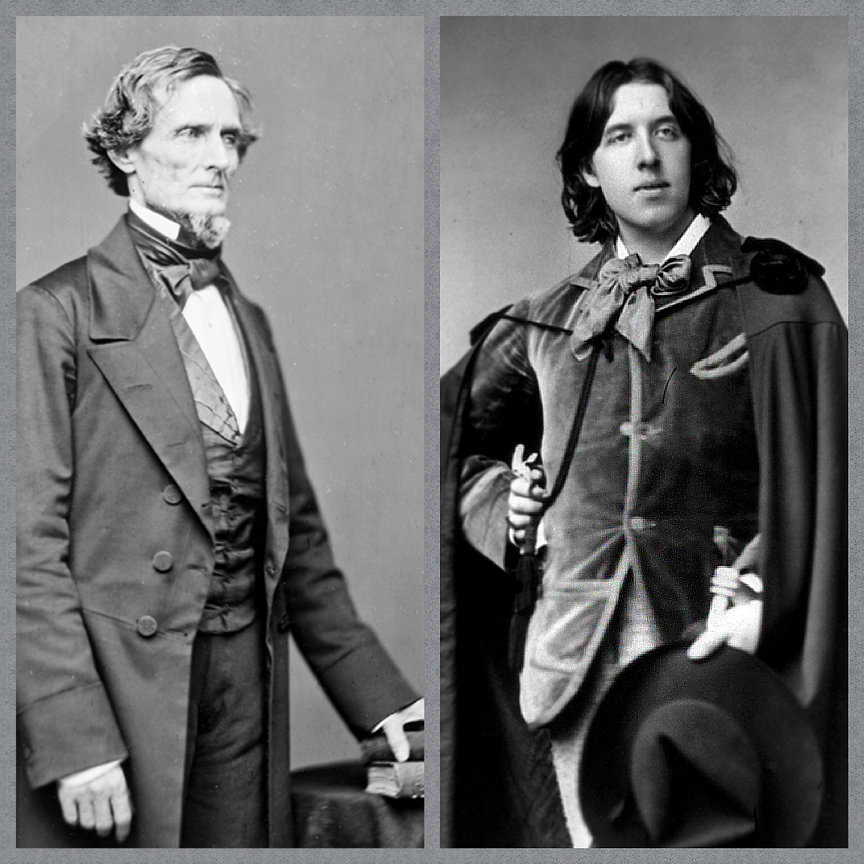
Jeff and Oscar

In what must be the most improbable encounter in Mississippi, Oscar Wilde, a giant, tragic figure, paid a visit to Jefferson Davis, the towering icon of another, greater tragedy, at Beauvoir.

This account of the meeting is from Hudson Strode’s Jefferson Davis: Tragic Hero, the Last Twenty-Five Years. The final passage is from a letter Wilde wrote a week later.

Through the winter and spring of 1882, Mrs. Davis had been reading accounts of the sensationally successful lecture tour of an eccentric young British poet named Oscar Wilde. When she learned that he was to deliver a lecture in Memphis on June 12, she regretted that it would be inconvenient for her to visit the Hayses (friends in Memphis) at that time. But Maggie Hays sent her a copy of a thin paper called Meriwether’s Weekly, dated June 17, 1882, which further excited her interest. Lee Meriwether had had an interview with Wilde in his suite at Gaston’s hotel in Memphis. His older brother Avery had said to him, “Wilde wears knee breeches and keeps a sunflower pinned to the lapel of his coat, but there’s more to him than that. Go and interview him.”

Meriwether found Wilde’s sitting room “in disorder, with magazines and photographs strewn on the floor, and on the table were the two volumes of Jefferson Davis’s Rise and Fall published the year before.” Meriwether told Wilde that he had been Mr. Davis’ neighbor in Memphis and during his childhood had known him well. “Jefferson Davis is the man I would like most to see in the United States,” Wilde said, and declared that it was remarkable that it took Northern armies numbering three million soldiers four years to whip him.” He asked where Davis lived now. Lee told him on the Gulf Coast about four hundred roundabout miles from Memphis. “That’s a long way to go to meet anyone,” said the poet-lecturer, “but not too far to go to see such a man as Jefferson Davis”

Wilde’s manager, however, had already secured an engagement in New Orleans and he arranged one in Mobile two days later. In time, Wilde wrote the ex-President a “most winning” letter, asking to be allowed to stop at Beauvoir and pay homage. Mrs. Davis urged her husband to invite him to stay the night. Davis was reluctant; he could not help but conclude that, despite his tremendous successes on the lecture platform, Wilde with his knee breeches and sunflower was a bit silly. At best, Davis did not care much for worldly people, not did he fancy people for their fame.

In the Mobile Register of June 23 Davis read an announcement that had undoubtedly been inspired by Wilde’s manager. “We understand that ex-President Davis has invited Mr. Wilde to pay him a visit at Beauvoir, his Mississippi home; and that the aesthete has accepted … It is scarcely conceivable that two persons can be more different than the ex-President of the Confederacy and the “Apostle of Aestheticism,” as known to report; and we confess sufficient curiosity to desire to know the bent of their coming, protracted interview.”

Wilde was reported by the New Orleans Picayune to have “very sensible views about the Southern Confederacy.” In an interview he spoke of his great admiration for the ex-President. He had never spoken to the Chief, he said, but had followed his career with much attention. “His fall after such an able and gallant pleading in his own cause, must necessarily arouse sympathy.” The cause of the South in the late war Wilde compared to that of contemporary Ireland. “It was a struggle for autonomy, self-government, for a people. I do not wish to see the Empire dismembered, but only to see the Irish people free. People must have freedom and autonomy before they are capable of their greatest result in the cause of progress. I look forward to meeting Mr. Jefferson Davis.”

But it is doubtful if Wilde got as much pleasure as he expected in the meeting, which took place on June 27. Though Mrs. Davis and Winnie and a visiting cousin, Mary Davis, found Wilde enchanting as a conversationalist, Mr. Davis felt something indefinablly objectionable in his personality. Even at twenty-six (Davis had turned seventy-four on June 3), Wilde’s thick, sensual lips gave him a slightly gross look. At dinner Davis let his wife and Wilde carry on most of the conversation; he remained courteous, but aloof. Pleading doctor’s orders for some temporary indisposition, Davis excused himself early. Wilde had felt restrained in the presence of this sincere man. By simply being himself, Davis had held up to Wilde a mirror which reflected an image that was not flattering.

After his host had retired, Wilde brightened perceptibly and charmed the three ladies beyond words. Mrs. Davis made a very good pencil sketch of the poet while he chatted. And he presented her with a copy of a recently published English edition of his poems and inscribed it glowingly. The four talked until after midnight. When Mary Davis, who was to grow into a proper spinster, had undressed for bed, she went to the window and stared out enraptured. There on the beach in the moonlight she beheld the tall figure of Oscar Wilde sauntering up and down the sand with a handful of pebbles, which he moodily tossed, one by one, into the shallow waves. (Mary Davis, though terribly shocked over Wilde’s subsequent tragedy, admitted later that she was “never mentally free of the man’s charm.”)

Wilde had charmed most of America, but not his American hero. After the Britisher had departed the next day, Mrs. Davis chided her husband for not being more cordial to their celebrated guest. He only said quietly, “I did not like the man,” and would give no reason. When he went out to his pavilion office, Davis found propped up on his desk a 12×10 photograph of the lecturer-poet. It was inscribed “To Jefferson Davis in all loyal admiration from Oscar Wilde, June—’82—Beauvoir.”

In a letter written on July 6, 1882 to Julia Ward Howe (American author and reformer (1819-1910, author of “The Battle Hymn of the Republic”), Wilde wrote:

“I write to you from the beautiful, passionate, ruined South, the land of magnolias and music, of roses and romance: picturesque too in her failure to keep pace with your keen northern pushing intellect; living chiefly on credit, and in the memory of some crushing defeats. And I have been to Texas, right to the heart of it, and stayed with Jeff Davis at his plantation (how fascinating all failures are!) [my italics: jly] and seen Savannah, and the Georgia forests, and bathed in the Gulf, and engaged in Voodoo rites with the Negroes, and am dreadfully tired and longing for an idle day …”
Howard’s Creole Jambalaya

This text and recipe is from Howard Mitcham’s magical Creole, Gumbo, and All That Jazz.

After gumbo, the most famous Creole-Cajun dish is jambalaya. The word is probably derived from “Jambon,” which means am in both Spanish and French. The “a la ya” is probably an African expletive which can be interpreted as either acclaim or derision. Jambalaya was a well-known dish even before Hank Williams’s Hit Parade song came along and made it nationally famous. Millions have sung the song without knowing anything about what the dish was like. The recipes herewith will give you a chance to really get on the bandwagon. Jambalaya started out as a poor man’s catch-all, utilizing any leftover meats, sausages, shrimp, or fish that might be lying around, and stretching them a long, long way with plenty of rice. If a poor Cajun family had five or six kids, it’s a safe bet they ate jambalaya several times a week. Like red beans and rice, it kept people from starving during depressions and recessions.

But the consummate artistry of Creole and Cajun cooks has lifted jambalaya above its humble beginnings to a higher plateau, and it is now served with pride and joy in the mansions of the wealthy and in high-toned restaurants. This dish is a close cousin of the Spanish paella, and it probably originated down around New Iberia, which, as its name suggests, was originally a Spanish settlement. However, there’s another town with a Spanish name, Gonzales, up near Baton Rouge, that calls itself the Jambalaya Capital of the World. Its citizens hold a jambalaya festival every year. They cook big black iron wash pots full of the stuff, and people come from all over to sample the rich and redolent fare. A real Gonzales jambalaya is so peppery hot, spicy, and rich that the uninitiated can barely cope with it, but an aficionado of the art can consume a half gallon of it and ask for more. The version of Creole Jambalaya here is lighter fare than the Gonzales product.

Melt a half stick butter in a thick-bottomed pot or Dutch oven, cook 1 pound andouille or smoked sausage (or both) until lightly browned. Stir in a heaping quarter cup of plain flour, add 3 medium white onions, chopped finely, 4 minced cloves of garlic, 6 whole scallions, chopped. Cook until onions soft and clear. Add a 16 ounce can diced tomatoes, drained, along with a bay leaf, and a teaspoon each thyme, cayenne, cumin, and black pepper. Add 4 cups broth (chicken or beef), a cup of cooked chicken, and a cup of diced ham. The liquid should cover the ingredients. Bring to a rolling boil and stir in 2 cups raw rice (let me recommend Zatarain’s long grain, jly). Cover, boil for about 5 minutes, then reduce heat and cook until rice is done. Remove lid to cook off excess liquid; “a jambalaya should be moist, but not soupy.” Salt to taste.

Theora Hamblett at Banner School

Mississippi artist Theora Hamblett was born in 1895 on a farm just west of Paris, Mississippi, a village some fifteen miles south of Oxford. She attended college at Blue Mountain, and after graduation in 1924 taught at several of the small schools in Lafayette and Calhoun Counties before moving to Oxford in 1939 and opening a boarding house, where she began painting, and died in  1977.

The appeal of Hamblett’s work was recognized as early as 1954, when she sold a painting to a New York gallery owner, Betty Parsons. She was featured in a 1955 show of new acquisitions at the Museum of Modern Art, and in the 1960s and 70s, her paintings were used for UNICEF Christmas cards and calendars. In 1972 she was part of another show at the Museum of Modern Art, this time focusing on naive art. Nelson Rockefeller and Sir Alec Guinness owned her works.

Hamblett taught at Banner School in Calhoun County from 1919 to 1921. This painting was completed in 1969 and is reproduced in Theora Hamblett Paintings (University Press of Mississippi, 1975) along with the following recollections. Hamblett did two other paintings of Banner school, which are in private collections.

My mother grew up near Banner, Mississippi, which was ten miles from our home. How we looked forward to visiting relatives there each year. When I began teaching, I longed to teach in Banner. When I did get to teach there, the school was only a “two teacher” school. I loved teaching there. When I was there in 1920, Banner School had been a good school with boarding students. Parents wanted their children to go to schools of this type. Near the beginning of the twentieth century, the small town schools began to grow smaller. Parents who could afford the price sent their children to larger boarding schools. Finally, the small boarding schools were forced to close.

The first settlers in this area built homes on the hills and cut roads up to their homesteads. Since then, a highway has been built near the foot of those hills. Our gentle horse, July, and that old top buggy went up and down those North Mississippi hills many times. When I was a young girl, we would get out of the buggy and walk up many of those rocky hills, sometimes to gather flowers, which would also give the horse a rest. When bedtime came for me, I snuggled up in bed and listened to Mama and Aunt Emma talk until ten or eleven. o clock. Many of their conversations about the community happenings are still clear in my memory.

Flower of the Dead

Red spider lilies bloom in the diminishing days of summer, springing up from drying lawns and fields as if from nothing.

A native of China, the lily (Lycoris radiata), is poisonous to most animals. Every part of the plant can induce vomiting, paralysis, even death. They’re planted in rice fields to deter rodents. When they spread to Japan, where the dead were buried without coffins, the lilies were planted to prevent vermin from disturbing grave sites. In time, the brilliant red flower became known as the corpse flower, the ghost flower, and—most poignantly—the lost child flower.

Buddhism also came to Japan from China, and the Lotus Sutra became a fundamental text for many Japanese schools. In the sutra, heavenly flowers descend from the realms of the gods, falling on the Buddha and his audience. Many devotees associate this flower – called Manjushage – with red spider lilies.

The lily blooms around the autumn equinox, Higanbana, the day the dead return to the world, and higanbana is a popular Japanese name for the flower. The flowers are said to bloom on O-higan “the other shore,” of the Sanzu-no-Kawa, a Styx-like river separating the lands of the living from the banks of carmine blossoms beckoning  spirits to life.

Tía Jesé’s Chicken Enchiladas

Poach boneless breasts of chicken in lightly salted water until tender. Shred, mince, and add to each pound of meat a four-oz. can chopped chilies (with liquid), juice of one lime, and enough sour cream to bind. You can add grated jack cheese if you like. Season with equal parts cumin, chili powder, and granulated garlic. Salt to taste. Roll in warm tortillas brushed with corn oil. Top with a rich queso.

Jo Haxton’s Cheese Böreks

The recipe n the author’s handwriting, courtesy of Emily Haxton.

This recipe from Greenville novelist Ellen Douglas (Josephine Ayres Haxton) makes dozens, depending on the size. Take a half pound each grated mozzarella and feta cheese, mix well with a pint of cottage cheese, two large well-beaten eggs, and a tablespoon or so of chopped parsley. Brush phyllo with melted butter. Cut into strips an inch or so wide, and three or four inches long. Place a spoonful of the cheese filling at the top edge of the strip and fold “like you fold a flag” into triangles or flip into squares. Pinch the edges and brush with an egg white beaten in a half cup of water. Sprinkle with sesame or poppy seeds and bake twenty minutes or so at 375.

Photo by Emily Haxton

The Imperiled Pea

Most of us know Mississippi silver hulls as a crowders, and y’all are probably as surprised as I was to find that they’re an endangered variety of field peas (Vigna unguiculata). Silver hulls thrive in the lower Mid-South; the 6″ pods carry blocky black or brown-eyed peas that “crowd” one another in the pod. Easy to shell, fresh seeds have a thin skin, giving them a cleaner flavor. Sad to say, field peas of any kind just aren’t grown much any more.

The Colonel’s Secret Is Out

I once knew a woman who claimed to know the Sanders Original Recipe of “11 herbs and spices” because she had worked in a franchise outlet in Grenada, Mississippi for three months while her husband was in the local lock-up for beating up a used car salesman.

She didn’t really know the recipe, of course; her fried chicken tasted nothing like it, though it may have had to after her bottle of vodka. But Harlan Sanders’ original recipe was finally made public in August, 2016, when the Chicago Tribune reported that a nephew by marriage–by marriage, mind you–of Harland Sanders claimed to have found a copy of the original KFC fried chicken recipe on a handwritten piece of paper in an envelope–an envelope, no less–in a scrapbook of an assuredly familial nature .

As journalists of fortitude, integrity, and no small degree of puckish abandon, Tribune staffers tested the recipe before publication, and after “some trial and error” they decided that with the addition of an unspecified amount of MSG, the following seasoning mixture produced fried chicken “indistinguishable” from the fried chicken from a Kentucky Fried Chicken franchise.

By way of covering their ass, they recommended that the chicken should be soaked in buttermilk, coated once, then fried in oil at 350 degrees until golden brown.

Mix with 2 cups white flour:

2/3 Ts (tablespoons) Salt
1/2 Ts Thyme
1/2 Ts Basil
1/3 Ts Oregano
1 Ts Celery salt
1 Ts Black pepper
1 Ts Dried mustard
4 Ts Paprika
2 Ts Garlic salt
1 Ts Ground ginger
3 Ts White pepper