In this foreword to her son Malcolm Franklin’s Bitterweeds: Life with William Faulkner at Rowan Oak, Estelle Oldham (Franklin) Faulkner recounts her life before and wedding to her second husband, written at least five years before the publication of the book in 1977, the year of Malcolm Franklin’s death.
For those who may be interested in Malcolm’s story of his close association of William Faulkner, I, his mother, feel compelled to write an unsolicited, explanatory forward. My son has written his own preface, as well as the text with follows—I use the word “text” advisedly, because fiction—imagination and literary embellishments—is completely foreign to his factual way of thinking.
Malcolm was born in Shanghai, the son of my first husband, Judge Cornell Franklin. We also had a daughter, Victoria (called Cho-Cho by her Japanese nurse-maid, and eventually by everyone but her father), a few years older than Malcolm. We were living in Hawaii when she was born, and she was still quite a mall child when Judge Franklin decided to move to China and go into the private practice of law in this flourishing international city of the Orient. A few years later Cornell and I agreed on an amicable divorce, and I brought the two children back to Mississippi.
It is not my intention to write a biography, but I feel the necessity of establishing the fact that our divorce did in no way alienate the deep affection of my former husband’s family in Columbus bestowed upon me. Visits by both families between Columbus and Oxford became frequent, mainly, perhaps, on account of the children. The train trip from Oxford to Columbus was particularly irksome—a change, and a long wait in a town called Winona. This is how Judge Franklin’s family met, and got to know, William Faulkner so well, for Bill would often drive us over, and he was very reluctant to forgo their hospitality. Their welcome was all too sincere. “Gran” (Victoria’s and Malcolm’s Franklin-side grandmother) was a charming and admittedly romantic woman, and it was she who approved and applauded my marriage to Bill. She also unhesitatingly upbraided my father for coldly insisting that I’d married a wastrel.
All this brings me to what I’ll wager was the strangest of honeymoons—one even a novelist would hesitate to invent: the groom a bachelor, the bride a divorcee with two children, and all of us having a gay, carefree time in a tumble-down old house on the Gulf of Mexico, with a colored cook loaned to us by my first husband’s mother.
It was late afternoon, the twentieth of June, 1929. My sister, Dorothy, had gone with us to College Hill, a village several miles from Oxford where there was a beautiful old Presbyterian church and an elderly minister whom we all knew, and who gladly performed the simple ceremony. At times I’ve wondered if Dr. Hedleston welcomed us to the church and married us out of pure Godly love and understanding, or was he thumbing his nose at the Pharisaical laws imposed upon divorce by the Episcopal Church? I’ll never know the answer.
Bill and I had talked over our plans for the honey-moon at some length. A friend of his had turned over a big old beach house for our use—unrentable, because at that time Pascagoula wasn’t a fashionable Gulf resort. Victoria was in Columbus with Gan, so Bill insisted that Malcolm be picked up with all our luggage, and dropped in Columbus till we’d gotten settle in our borrowed summer home. How simple it all sounded! I had left a note with Mama about taking Malcolm with us, so I thought that all we had to do was to take Dot home, gather Mac (Malcolm, jly) and the luggage, and take off for Gran’s. She was expecting us.
Mac was still such a baby that I had a nurse for him. Ethel Ruth was a fine playmate, but couldn’t read or write, or even tell the time by a clock with Roman numerals. So when Bill steered the car into our drive way, we found the child dirty, grass-stained and generally unkempt. Bill laughed, thrust Malcolm in the car, stowed our many bags, said good-bye to Dot and headed east toward Columbus.
By then it was late afternoon. We drove as far as Tupelo, and got rooms in the only hotel. I bathed Mac and gave him supper while Bill telephoned Gan that it would be impossible to travel further that night—to expect us for dinner the next day.
Books about Mississippi architecture tend to focus either on poverty-stricken African-American communities or the antebellum and Victorian-era mansions of the state’s white elite. Buildings of Mississippi puts them side-by-side, as they always have been.
“Our goal from the start was to integrate—and I use that word purposely—black and white landscapes,” said co-author Jennifer Baughn. “This book helps illustrate how the two races did interact in some ways, and in other ways were separated.”
Nine years in the making, Buildings of Mississippi is the 26th volume of the Buildings of the United States (BUS) series commissioned by the Society of Architectural Historians (SAH). This series documents state-by-state the full range of structures that are deemed of historical or architectural interest by experts in the field. Jennifer V. O. Baughn is Chief Architectural Historian at the Mississippi Department of Archives and History and the author of numerous articles on the state’s historic buildings. The late Michael W. Fazio was Professor Emeritus of Architecture at Mississippi State University and coauthor of Buildings across Time: An Introduction to World Architecture. Mary Warren Miller is the former director of the Historic Natchez Foundation and coauthor of The Great Houses of Natchez.
Illustrated with photographs and maps, and newly redesigned in a more user-friendly format, readers of Buildings of Mississippi will come to know the history of 557 sites, illustrated by 249 photographs (all but 33 taken by Baughn and Fazio) and 29 maps. Along with stately plantation houses (and their housings for slaves), the volume surveys a range of other locations such as Native American mounds and villages, 20th-century enclaves built for sawmill workers, neighborhoods that bolstered black Mississippians during segregation, and the vernacular streetscapes of small towns as well as modern architecture in Greenville, Meridian, Jackson, and Biloxi.
The buildings are grouped into twelve regions that move roughly from the southwest corner of the state to the north, the east, the center, and then south to the Gulf Coast. Buildings of Mississippi includes such wide-ranging places as Longwood and Wister Gardens, Poor Monkeys, Club Ebony, and Dockery Farms in the Delta, the Coca Cola Company in McComb, Ginntown Rosenwald School near Tylertown, Holy Child Jesus Catholic Church in Canton, Shiloh Methodist Campground and Piney Woods School in Rankin County, the fabulous St. Michaels Catholic Church (round with a clam shell roof) in Biloxi, and the oldest house in the Mississippi Valley, “Old Spanish Fort”/de la Pointe-Krebs House in Pascagoula.
Baughn said that the books in the series used to be hardback, and were more like reference works. That seemed puzzling to her, since reference books on such a specialized subject have primarily professional appeal. The new field guide format is a recent innovation, and Baughn considers it a more natural option, more appealing to a wider readership, people who might put the book in a car or backpack for a trip. Buildings of Mississippi is also the first book in the series to be all color, a welcome innovation.
“The criteria for inclusion were determined both by the SAH and our own knowledge and research,” Baughn said. “We generally focused on buildings that were on the National Register, or in the case of buildings from the 1960s through the present, we tried to identify those that were important for historical events or had won architectural awards. And once we started writing, as Michael Fazio said, the building had to have ‘a hook, a story’ that would make it an interesting entry for the reader.”
The buildings must still be standing, so there are no non-existent buildings included. They also must be accessible from a public right-of way or open to the public. “Unfortunately,” Baughn said, “that criteria excluded many rural houses that can’t be seen from a public right-of-way and aren’t public houses.”
“The Society of Architectural Historians (SAH), considers these works to have an international audience. Well, I don’t know international audiences,” Baughn said. “My audience is the average Mississippian who enjoys history and historic buildings, and who likes going out in the state, driving around their town, small or large. I thought if these people were happy with the work, then international visitors would be happy, too.”
Buildings of Mississippi is an important work that brings the research on our state’s historic architecture up-to-date. The scholarship is impeccable. The format is accessible to armchair historians and weekend travelers as well as tourists, and the illustrations—particularly the photographs—are lavish and outstanding. This book belongs in the hands of all Mississippians.
The Rivers of America is an important series of books that started in 1937 with the publication of Kennebec: Cradle of Americans by Robert P. T. Coffin and ended in 1974 with the publication of The American: River of El Dorado by Margaret Sanborn. For the most part, the editors were successful in bringing the regional folk life of America to focus through the lenses of her rivers.
Constance Lindsay Skinner, a Canadian writer and historian initially conceived the series in the early 1930s. She was also the first series editor. In an essay that was included in early volumes of the series, Skinner stated, “This is to be a literary and not a historical series. The authors of these books will be novelists and poets. On them, now in America, as in all lands and times, rests the real responsibility of interpretation.” Skinner lived to edit only six of the volumes, but her criteria for authors and the freedom she granted them—a policy continued by subsequent editors—guaranteed not only the success, but the importance of the series.
The series’ editors sought out a wide cross section of poets, novelists, historians, and illustrators to produce living literary portraits rather than historical tomes. The illustrators included many famous and soon-to-be-famous artists, including R.E. Banta, Ross Santee, John Steuart Curry, Nicolai Fetchin, John McCrady, and Andrew Wyeth. George Annand and Rafael Palacios were the series’ principal cartographers. Annand drew the maps for nearly half the forty-nine Rivers books published in the first eighteen years of the series, including the two “Mississippi Rivers” The Lower Mississippi and The Yazoo.
Skinner wanted the Rivers of America books to create popular literature reflecting the regional history of America. For Skinner, it was imperative to incorporate a Southern region into her work, partially to confirm that a distinct and vibrant population still resided in the South. As she wrote to a potential author during the series’ planning stages, “I had been sure there was this solid ‘backbone’, a sound folk-core, or the southern backcountry would have gone back to timber and wild animals.”
For the South to work in Skinner’s series, its character had to stem from the people’s relationship with nature, specifically with the natural history of the rivers of the nation. Cecile Hulse Matschat’s Suwannee River: Strange Green Land (1938) remains a best-selling volume, and Marjory Stoneman Douglas’s The Everglades: River of Grass (1947), a landmark in American environmental writing.
Of Skinner’s original vision of twenty-four volumes, three focused on Southern rivers, the Suwannee, the Arkansas, and the Lower Mississippi, designated to portray the Mississippi River south of St. Louis. (The Upper Mississippi: A Wilderness Saga, by Walter Havighurst, the second volume in the River series, was published in 1937). All told, however, only seven rivers in the South are covered in the series: the Tennessee—two books, both by Donald Davidson The Old River, (1946) and The New River (1948), inclusive of the profound changes wrought by the Tennessee Valley Authority—the Santee, the Arkansas, the St. Johns, the French Bend, and in Mississippi, the Lower Mississippi, and the Yazoo.
Skinner died in 1939. Nearly a year later, in 1940, the publisher, Farrar & Rinehart, announced the editors of the Rivers of America series, Stephen Vincent Benét and Carl Carmer. Four Rivers titles were published under their editorial guidance in 1940 (The Wabash, by William E. Wilson; The Arkansas, by Clyde Brion Davis; The Delaware, by Harry Emerson Wildes; and The Illinois, by James Gray). Three more titles followed in 1941, The Charles, by Charles Bernon Tourtellot; and the TheKaw, by Floyd Benjamin Streeter, and The Brandywine, by Henry Seidel Canby, which included the first illustrations of the young Andrew Wyeth.
The Lower Mississippi
A book on the Lower Mississippi is named on the first page of Constance Skinner’s “Rivers of America Journal,” a preliminary plan for the series, dated August 17, 1935. Written as “New Orleans & Lower Mississippi,” the author Skinner designated for the volume was Edward Larocque Tinker. Tinker today is best known as a scholar of Latin American culture, but he wrote several books about New Orleans, including Lafcadio Hearn’s American Days (1924) and Closed Shutters: Old New Orleans – the Eighties (1931), but for whatever reasons did not take on the Lower Mississippi volume.
The editors then committed to a contract with Lyle Saxon, writer and journalist who reported for The Times-Picayune in New Orleans, who had written Father Mississippi in 1927. However, Saxon apparently reneged on the project (likely because he was directing the Federal Writers’ Project Works Progress Administration’s Guide to Louisiana (1941). Carmer came to New Orleans to cancel the Farrar & Rinehart contract with Lyle Saxon for the Rivers book on the Lower Mississippi where he met a family friend, Betty Carter, wife of Greenville, Mississippi journalist Hodding Carter II. At the time, Carter was in New York City, working for the progressive newspaper, PM.
While he was at Harvard, in response to an invitation and subsequent encouragement from an editor at Alfred A. Knopf, Hodding Carter had written five chapters of a book which was to analyze the racial and political situation of the South. (Carter’s work was not accepted.) Showing Carmer the material Hodding had written for Knopf, Betty was able to interest Carmer in Hodding as the “perfect” candidate for the writing of the Mississippi work. In July, 1940, Hodding Carter signed the contract for Lower Mississippi, receiving a $400 advance. In September, he resigned from PM and returned to Greenville and his newspaper, the Delta Democrat-Times.
The Carters did much of the research for the book at the Tulane University library. In November 1940 the National Guard was called to active duty. Hodding’s regiment was moved to Florida, and he became a correspondent for the Democrat-Times. He had offers for such work from two other newspapers and from the Associated Press, but he concentrated on writing the Rivers book. Reviewing its early chapters, Carl Carmer observed that the book would be one of the two most significant volumes of the series. He advised Carter not to worry about the June 1, 1941 deadline established in the contract, noting that the book was too good to hurry. The Lower Mississippi was published in the fall of 1942 to favorable reviews.
Writing in The New York Times (Dec. 6, 1942), noted critic Horace Reynolds—who also took a strong interest in Faulkner’s first novels as well as the early publications of the Lomaxes—stated, “By responding to the realistic rather than the romantic aspect of his river, Mr. Carter has written one of the best books in the Rivers of America series. His astringent approach is fresh and welcome. He has dug below the surface ease and softness of the delta life to the savagery and pain which lie beneath them.”
“No river in America has been more over-romanticized than the Lower Mississippi,” Reynolds wrote. “Fiction, popular history and popular song have all combined to give it a personality which does not exist. The Lower Mississippi doesn’t look like the pictures or sound like the songs. It is a wilderness of muddy water and deep sky, with a thin wedge of flat land in between. Its great beauty is not easily discernible. To that beauty, which has been best described by Lafcadio Hearn, Mr. Carter is articulately sensitive. But he is no exploiter of the Southern tradition. A man of thought and conscience, he is troubled by the social problems of a section to the intensity of whose plight the phenomenon of a Huey Long is an index. His book cuts deep into the life of his valley.”
The book was illustrated by John McCrady. In a letter to the Carol Fitzgerald, author of The Rivers of America: A Descriptive Bibliography (1991), Matt Martinez, a friend of John McCrady’s widow, Mary, wrote that he had spoken to Mrs. McCrady about her husband’s role as illustrator of The Lower Mississippi: “To address your questions, Mrs. McCrady felt that Hodding Carter approached McCrady, but this was fifty years ago or so, so it’s a little hazy. Mr. Mc and Carter were boyhood friends in Hammond, Louisiana, in the late 19teens. and early 1920s…. I’m not sure of any causal information in terms of who approached who at that time, but the two men who are a big part of The Lower Mississippi had a personal history together that preceded their professional association.”
In his foreword to “John McCrady 1911-1968,” a catalog issued by the New Orleans Museum of Art in 1975, E. John Bullard, the museum’s director, observed, “During the 1930s John McCrady was recognized as the most important exponent of Regionalism working in the South. In his paintings, McCrady visually captured the unique aspects of rural Mississippi and Louisiana with the same authenticity and insight that Benton and Curry brought to their depictions of the Mid-West.” Life published a five-page spread on the artist and commissioned him to paint “the second in a series of dramatic scenes in twentieth century American history.” McCrady chose to paint the assassination of Huey Long and produced perhaps his best-known, and certainly his most controversial artwork.
The Yazoo
The second Mississippi river included in the Rivers of America Series is the Yazoo, However important the Yazoo seems to Mississippians—and the Yazoo Basin undeniably has the richest cultural heritage of any other section of the state—its choice as a subject for the Rivers series gives us some food for thought. Three other rivers, the Atchafalaya, the Tombigbee, and perhaps particularly the Red River (of the South) deserved consideration.
So why the Yazoo? The answer is Hodding Carter. Carter’s friendship—if not to say influence—with Carl Carmer, who by 1949 had become the principal editor of The Rivers of America, and would remain the series editor until the publication of the final book (The American: River of El Dorado, by Margaret Sanborn) in 1974. Carter must also have already had in mind Frank E. Smith as the author. Smith was managing editor of the liberal-leaning newspaper Greenwood Morning Call in 1946 and 1947. He was a legislative assistant to United States Senator John Stennis from 1947 to 1949 and was elected to and served as a member of the Mississippi State Senate from 1948 until 1950, when he was elected as a Democrat to the U.S. House of Representatives from Mississippi’s 3rd Congressional district.
In a June 1991 letter, Smith wrote, “I started on the Yazoo in 1947, when I was recommended to the editor by Hodding Carter, who had written Lower Mississippi a few years before. He was a friend and associate in newspaper work. I wrote two or three sample chapters, and Rinehart gave me a contract and a $1,000 advance.”
On January 7, 1948, Frank Smith signed an agreement with Rinehart & Company which called for delivery of a completed manuscript of The Yazoo in its final revised form on or before January 1, 1951. He was to receive royalties of 10% of the retail price on the first 5,000 copies sold; 121/2% on the next 5,000 copies. sold; and 15% on all copies sold thereafter. He was to be receive an advance on royalties of $750, $250 on signing the agreement, $250 on delivery of the manuscript, and $250 upon publication of the book.
“I forgot about the contract when I became involved in some personal endeavors,” Smith later wrote, “but was reminded of it in 1953, when Rinehart wrote telling me to produce the manuscript in three- or four-months’ time or return the money. I was busy at that time as a member of Congress, but I didn’t have the money to reimburse them, so I produced the manuscript, and it was published the next year with no revisions or deletions.”
Reviews of The Yazoo were overwhelmingly favorable. Reviewing in the Chicago Tribune, (May 16, 1954) Harnett T. Kane, author of Huey Long’s Louisiana Hayride: The American Rehearsal for Dictatorship 1928-1940 (1941) wrote, “The author is something of a rarity, a politician who can write. The 36-year-old Mississippi congressman had a role in the ending of Bilboism; he represents a new south. His style is non-lyric, non-emotional, almost matter- of-fact. a novelty in certain circles of regional writing.”
Fellow Mississippian Hubert Creekmore, reviewing in the New York Times (May 9, 1954) states, “Since Frank Smith is a Delta native and a Congressman, it is not surprising that his best passages are those dealing with political, and economic problems. His discussion of the sharecropper-commissary system is concise and understanding, and the survey of flood control and the touchy subject of the four dams on Yazoo tributaries is sensible.” Finally, Hodding Carter himself, in his review of The Yazoo in his newspaper, the Delta Democrat-Times (May 9, 1954), writes, “(Smith) is Mr. Yazoo, even Mr. Delta himself; attuned to and informed on its manifold problems.” Here it must be noted that both Creekmore and Carter take Smith to task, Creekmore “for the omission of a full and organized essay on the Delta planters” and Carter for Smith turning a blind eye to Parchman penal farm, “the nation’s worst such institution, where the lash, the convict trust system, and the lack of any real rehabilitation program conspire to breed worse criminals out of men who are to be returned to society.”
The illustrations in The Yazoo are by Janet Turner (1914-1988), a Missourian who graduated with distinction in 1936 with a Bachelor of Arts degree in Far Eastern History. Her first postgraduate work was done at the Kansas City Art Institute, where she studied under Thomas Hart Benton and John de Martelly, the illustrator of The Wabash (1940), the eighth book in the Rivers series. In 1941, after five years of postgraduate work, she was awarded the Institute’s diploma. She attended Claremont College for two years, studying under Millard Sheets and Henry McFee, receiving a master’s degree in fine arts in 1947.
During her artistic career, Turner had more than two hundred one-woman shows, won more than a hundred awards, and saw her works displayed in every state of the United States and in more than forty foreign countries. Her works were purchased by prestigious museums and galleries around the world, including the Victoria and Albert Museum in London, the Biblioteque Nationale in Paris, the Smithsonian Institution, the Library of Congress, and the Metropolitan Museum of Art. Seventy of her prints were purchased by the United States Information Agency for display in U.S. embassies around the world, and more than two hundred of her prints and paintings are held in some eighty college or museum collections.
In the early 1950s, Turner was living in Nacogdoches, Texas, teaching at Stephen F. Austin State College. In 1952, she was awarded a Guggenheim Fellowship to experiment with prints of Gulf Coast flora and fauna. She was primarily a printmaker at this time, utilizing different printmaking techniques in new and unique ways. Given her illustration of the Greenwood Leflore Hotel (below), it’s almost certain that Turner came to Greenwood sometime in 1953, though Smith wrote that they never met.
. . .
The first edition of The Lower Mississippi received four printings between 1942 and 1959 (1942, 1945, 1947, and 1959) ranging in price from $2.50 (1942-45), to $3.50 (1947) and $5 (1959). The number of copies printed is unknown, but according to WorldCat, the book is held in 887 libraries worldwide. Almost all are the first (1942) printing,
The Yazoo had an initial printing of 5,000 copies, and a projected reprint of another 5,000. How many copies Rinehart actually published is unknown, however WorldCat finds the 1954 edition in 507 libraries. The Yazoo was reprinted (in paperback) in 1988 by University Press of Mississippi. According to Frank Smith’s son Fred, University Press printed 1000 copies in paperback, and printed 50 special edition hardback copies, all of which were signed by Frank Smith and sold at Choctaw Books in Jackson, Mississippi.
Ronald Reagan appeared at the Neshoba County Fair in August, 1980. Many—including me—consider Reagan’s choice of an appearance in a locale with a bloody and brutal history in the struggle for civil rights as well as his speech, in which he stated, “I support states’ rights,” and promised to “restore to states and local governments the power that properly belongs to them” perpetuated Richard Nixon’s “Southern strategy,” a game plan that eventually made the Old Confederacy the Republican party’s home field.
Reagan defeated Carter by a landslide, winning every Southern state except Georgia, ushering in an era of tax cuts that enriched corporate interests and decimated the middle class with a profound recession, reduced wages, and the highest level of unemployment since the Great Depression. I seriously doubt if Nancy Reagan ever saw the inside of an oven in her life—more the pity—and this marginally homespun recipe most likely was fabricated by a giggly public relations intern. Mrs. Reagan, like her husband, had no interest in the public weal.
This recipes comes from the signature Giant Houseparty Cookbook put out by the Philadelphia-Neshoba County Mississippi Chamber of Commerce in 1981.
Cream 2 sticks softened butter with two egg yolks and a half cup sugar. Add 2 ½ cups flour to make a soft dough, and pat out to about a half inch on a buttered cookie sheet or baking pan. Bake at 350 until lightly browned. Remove from oven, cool, and top with a 10-oz jar of raspberry jelly or apricot preserves and a cup of semi-sweet chocolate bits. Top with a meringue made with 4 egg whites. Bake for another 20 minutes or until lightly browned.
Depending on the compendium of time it could have been Eudora Welty, Willie Morris’ grandmother, Marie Hull, James Canizaro, Mrs. Fred Sullins, Mrs. R.E. Kennington, Betty Edwards, or my mother who shared the aisles with them all.
Since around 1930, Jitney Jungle 14 has been a fixture in Jackson, Mississippi’s Belhaven neighborhood, providing food, conviviality, and a hub of small town news to those who shared its aisles on Fortification. While the Jitney served the culinary needs of a diversity of incomes and interests it was the equal servant of all. The price of eggs was always the same for everyone. This article will be primarily about Jitney 14 but in the course of its journey we will learn a few things about its famous corporation, early Jackson and two of its foremost families. Settle back, pour yourself a cup of Jungle Queen Coffee and enjoy shopping the aisles of our history at the Jitney.
There could have been no “14” if there had not been a “1”. That “1” was born April 19, 1919, the dream of three young men whose fortunes lay ahead of them in the risk and rewards of yesterday’s America where a man could fail and rise again to prominence and success with God’s help and a good plan. Such was the destiny of Judson McCarty Holman, William Henry Holman and William Bonner McCarty, the fathers of the little store where you could “Save a nickel on a quarter.”
A Bit of Family History
W.B. McCarty and Jud and Henry Holman were cousins who first operated a store together in September 1912, on the southwest corner of Adelle and Grayson (N. Lamar) Streets in north Jackson. Each of the cousins put up a third of the start-up cost. This business had relocated from a block north at the corner of Grayson and McTyere Streets which was torn down to build houses for the McCarty sub-division. That store was operated by W.B. McCarty, Sr. and Jud Holman and A.N. Brannon worked for him. It was a cash and carry store and had initially been operated by W.B. McCarty’s father W.H. McCarty and located in the 1200 block of N. West Street near Millsaps. It was called Jackson Mercantile Company, the name given to it by Mr. W.H. McCarty, its founder.
W.H. McCarty had moved his family to Jackson in 1905 after operating the McCarty Store in Hemingway, Mississippi in Carroll County. Jud Holman came to Jackson in 1907 after working in the grocery business for Greenwood Grocery in Greenwood and began work with W.H. McCarty in his Jackson Mercantile Store along with Anthony N. Brannan. W.H. McCarty died in 1909. W.H. Holman came to Jackson in 1910 and worked for Mississippi Motors in Jackson, run by Joe Coffee McCarty, bother of Will McCarty, until Holman and McCarty joined together in Jackson Mercantile. When Will McCarty and Jud Holman opened the first Jitney Jungle #6 on East Capitol Street in April 1919, W.H. Holman was in France during the end of WWI. He returned to Jackson in June 1919 and helped his two cousins proceed to convert their other stores from credit to cash and carry and self service with the Jitney Jungle name since that first self service store was doing more business than all the other five McCarty/Holman stores combined.
Mr. W.B. McCarty attended law school at Ole Miss in the early Jitney days and returned to continue with the operation and growth of the stores with his Holman cousins. His legal acumen came in handy with an early patent infringement suit which the Jitney stores won. Mr. W.B. McCarty continued to franchise grocery stores in those days in addition to being heavily involved in the chain’s wholesale and retail operations. In his later years, Mr. McCarty would continue to go to his office checking on sales volume as well as the back storeroom doors to be sure they were always locked or attended. Never would a Jitney store manager or worker leave the back door open lest a theft might occur. The Junior Food Mart convenience store company, JFM, Inc. is still in business today and operated by H. Russell McCarty. It had its beginnings in the supermarket franchising that W.B. McCarty started and W.B. McCarty, Jr. continued until his death in 2001. (1) A railroad strike in 1916, left credit customers in such a bind the founders decided to quit the credit business. Business improved and a second store was opened on South Gallatin Street and the McCarty Holman Store chain rapidly grew to seven including stores in Greenwood and Canton. (2)
The First Jitney
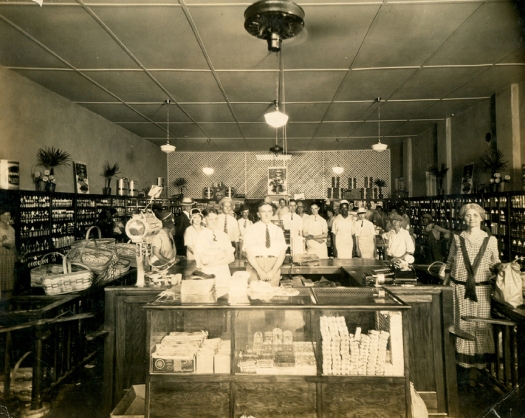
The first Jitney Jungle store was opened April 19, 1919 at 423 E. Capitol Street. A photo provided by Bill McCarty, III, grandson of co-founder William Bonner McCarty, shows the store’s interior as an open front surrounded by shelves alongside walls containing canned goods and other non-perishables. In the foreground was a glass case of tobacco products and sundries and in the rear a meat counter with glass bins displaying produce on beds of crushed ice. The prices were interesting. Bacon was 34¢/lb., salt jowls 15¢, veal steak 17¢, meat loaf 19¢ and baby beef roast 22¢. The manager was A.N. Brannon. (3)
How did Jitney get its name? According to Mr. Will McCarty, at the end of the First World War, returning soldiers would buy an old car for riding about town. They called it a “jitney”. The term “jitney” was slang for a London taxi cab and became jargon in the states for a nickel, the cost for a downtown cab ride.
Back when the establishments were McCarty-Holman Stores, it was the habit of Chancellor V.J. Stricker, who lived just up Adelle Street, to invite the three young merchants, who were living in a nearby boarding house, to his home for Sunday dinner. Mrs. Josephine Bailey’s boarding house at 343 Adelle, could be a dark and foreboding place. Mr. Will relates there was only one light bulb in the entire house and tenants would “borrow” it and pass it around from room to room. One Sunday the boys told the judge they were considering a strictly cash and carry business which would save the customer 20¢ on the dollar over their deliveries. Cash and carry could thus save “a nickel on a quarter.” The merchants asked Judge Stricker to suggest a new name for their stores. Since a cab ride to town cost a nickel, the term “jitney” became popular and it was customary for patrons to shop with “nickels jingling in their pockets.” Judge Stricker suggested the name “Jitney Jingle” but McCarty made a variation when he observed that a wide variation of stock in the new stores would make the store itself “look like a jungle of values.” The name stuck. (1)(2)
1920’s-30’s
Throughout the 1920’s, the owners added a number of stores, each with its own numerical designation which changed over the years. According to the 1930 Jackson City Directory, Jitneys were listed as:
No. 1 – 400 E. Capitol No. 2 – 1077 S. Gallatin No. 3 – 121 W. Pearl No. 4 – 2908 W. Capitol No. 5 – 209 S. State No. 6 – 423 E. Capitol (formerly No. 1) No. 7 – N. State and Fondren Ave. No. 8 – 412 W. Capitol No. 9 – 719 N. Gallatin (later 1209 N. State) No. 10 – 146 N. Farish No. 11 – 167 E. Capitol No. 12 – 850 W. Capitol No. 13 – 1241 N. West
This brings us to the birth of Jitney 14, which, according to the 1930 Directory, existed at that time. The listing contained the 904 E. Fortification Street address, a telephone number (9119) and a manager, Charles Alford. It is conjectured that the original store was small and became a “super store” some four years later. (4) Mrs. Betty McCarty Edwards, daughter of co-founder William B. McCarty, can remember when the new Jitney was just a hole in the ground. “My father had bought some cheap land around the Jefferson-Fortification Street corridor for investment. When the 1930 store was in its planning stage he offered to buy some fill dirt from a local vender. Mr. McCarty thought the price was too high and demurred. After a time the vendor went to him and said, ‘Just let me dump some of my dirt in that hole. No charge.’” Mrs. Edwards’s memories reflect back to when her brother (W.B. McCarty, Jr.) ran a Christmas fireworks stand as a youngster in front of one of the stores fronting Fortification. “He did well,” she said, “but would come home so cold on those December days he would question the wisdom of early entrepreneurship.
The new Super Jitney made a special point of catering to women. According to Mrs. Edwards, when you entered the store there was a platform area to the left for the ladies to sit and visit before they shopped. “There was a woman who taught knitting and the ladies would knit or read as they visited. It even had the first restroom for ladies in a Jackson grocery store. There were also chairs for children to sit in but keeping them still in those seats could be a problem.” There were “Jitney dresses” for sale at all store outlets. “They were not made by Jitney,” Mrs. Edwards says. “They were ‘house dresses’ as slacks were not in vogue at the time. They were good sellers but of course, no two were alike!”
As the business grew, however, more space was needed to display groceries and in time the ladies area was discontinued. (5)(6) Mrs. Edwards grew up in the Belhaven area living first on State Street at Manship, where the new Baptist Hospital building is being constructed, then moving with her family to St. Ann. Later the family moved to the Council Circle area. In the early years of her marriage while still living in Belhaven, Mrs. Edwards and her husband would walk to the store and shop. Few had cars during the war. She would bring home the perishables and her husband would bring the other groceries when he came home from work. (6)
The formal grand opening of “The New Super Jitney-Jungle Store” took place on Friday, November 10, 1933, when according to articles in the Jackson Clarion-Ledger of that year, “Jacksonians gave a hearty welcome to the newest addition to stores of the city Friday and Saturday when thousands of persons visited the new Super Jitney-Jungle at the corner of East Fortification and North Jefferson streets.” (7) (8) Back then 14 was known to the neighborhood as the “Big Jitney” and No. 9 on North State, the “Little Jitney”. 14’s manager was Charles Alford who got his start at the first store in 1919.
Mr. Alford brooked no sloppy doings. Clerks were dressed down for failure to dress up. Ties were compulsory. Alford, however, did have a sense of humor as related in Henry Holman, Jr.’s publication “Save a Nickel on a Quarter”. According to Alford, the store butcher waited on a customer late one Saturday evening who had come in to buy a chicken. The butcher reached into his case and brought out his last chicken. He showed it to the lady but she wanted to see a larger one. He put the chicken back in the case, bent over, moved his arms about, rattled the ice a little – as if looking for the right sized one – and ceremoniously came up with the same chicken. The customer replied with a satisfied smile: ‘Yes, that one is just fine. I’ll take them both.’” Oops! (5)
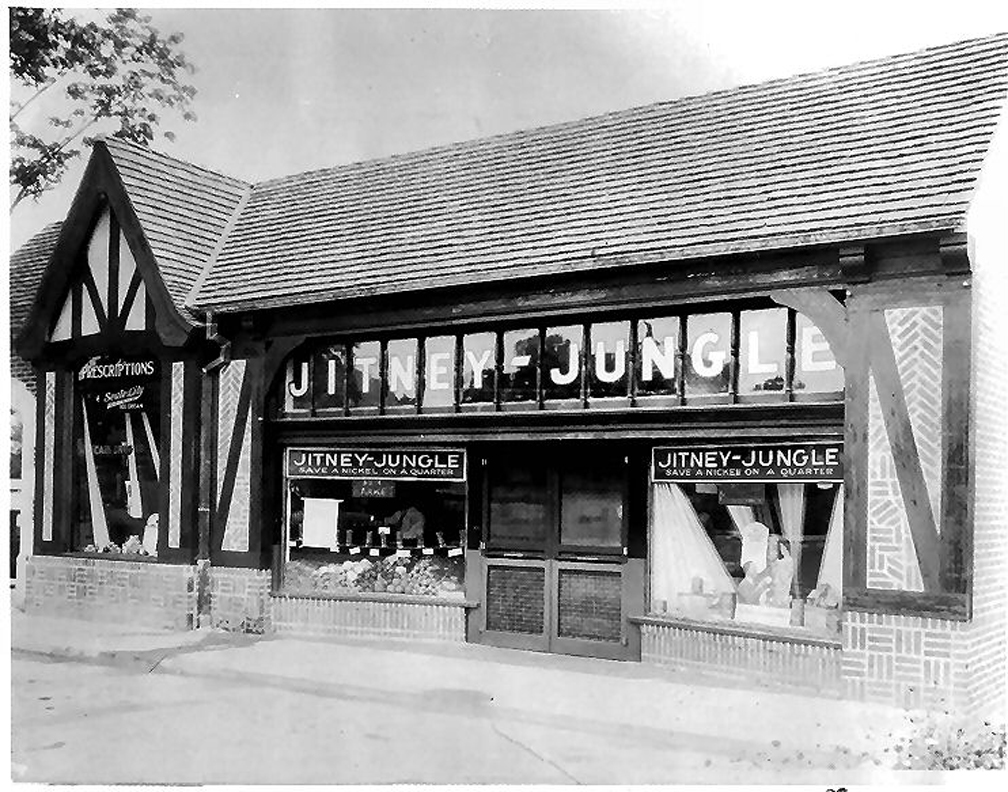
The new Super Jitney was a honey. Bill McCarty, III’s photo shows it facing two-lane Fortification with red and green awnings, tile roof and a glass front through which the shopper could see fresh fruit and vegetables displayed. The interior consisted of wooden floors, school room lighting and aisles of shelving. It contained a bakery, a refrigerated meat counter and a glass delicatessen. It became only the second grocery store in the United States and the first in Mississippi, to have air conditioning.
Its Tudor Revival style was designed by neighborhood architect Emmett Hull and contained only the grocery and the new Price Cain Drugstore at the Jefferson & Fortification corner. There was a small area for angular parking in front of the building and a loading dock and parking area around the corner on Jefferson. Belhaven was a rapidly growing neighborhood and shoppers came from throughout the area to see the new store which featured specialty items and select cuts of meat. (4)(9)
The Jitney chain had expanded rapidly throughout the “roaring twenties”, but by 1930, the Great Depression was beginning to take hold. On a typical Saturday you might drive your new $495, Ford coupe to the Jitney to shop. As you walked the aisles with your grocery basket you would notice green beans, three cans for 25¢; Wesson oil, 49¢ a quart; lemons, 12 for 20¢; cigarettes, 15¢ pack; roast beef, 19¢ lb.; bacon, 26¢ lb.; eggs, 25¢ dozen; lettuce, two heads for 15¢; sugar, 10 lbs. for 50¢; light bulbs, 20¢; fresh salmon, 29¢ lb.; mayonnaise, 29¢ pint; flour, 12 lbs. for 12¢; fryers, 35¢ lb.; Irish potatoes, 4 lb. bag, 55¢; and house coffee, 19¢ lb.
Most of these items you would carry home and place in your brand new $33.95 Ward’s refrigerator. (10) Refrigeration was just coming into play in the early 1930’s. Most people still had iceboxes. Meat was displayed in coolers on crushed ice and fresh fruits and vegetables, usually purchased from street vendors, went quickly early in the day. “Are the greens really fresh,” a housewife would keenly inquire of the store vendor in his white apron. “Yes ma’m,” he would respond. “Always.”
A trip to Jitney 14 was always a special event for the family shopper. An ad in the August 2, 1930 Clarion-Ledger announced “Your Jitney Jungle is arranged so that you can shop from front to back and from side to side without taking unnecessary steps. Your Jitney Jungle fixture arrangement not only provides a one-third more merchandise space than any other fixture plans in the world but is the most convenient. By shopping at Jitney Jungle you ‘save a nickel on a quarter’ on your grocery budget and many steps.” It was obvious these grocery stores were far ahead of their time. (11)
The 1940’s
Jitney 14 in the ’40s,photo courtesy of Bill McCarty
In 1941, Jitney Jungle 14 underwent its first expansion, enlarging eastward to include space for several small businesses. By 1942, the original grocery and adjacent drugstore had added the Beauty Lounge, Marjorie’s Shop (notions) and Snow White Cleaners. It took on the name English Village after its Tutor design. America was at war and throughout the early 1940’s, food items were scarce and rationed and neighbors pulled together and shared what they had. No one minded the sacrifice for their country and its sons overseas. On occasion there were vacancies in the store fronts and Mr. McCarty would let the Junior Red Cross use an empty space rent free to pack boxes to send to the Europeans after World War II. (4) (1)
Henry Holman, Jr. relates this story of an event at Jitney 14 during the days of food rationing. “On a certain April Fool Day, my father had one of the office force impersonate an O.P.A. investigator (rationing enforcer), who telephoned, of all people, the personable switch board operator at the store to find out why she had been getting extra sugar stamps. Since it was strawberry season, she impulsively implied it was to can strawberries – a fruit she and her family never ate! A few moments later father had the ‘investigator’ call back and say he was coming by her house that afternoon to check on her canning. Immediately she scrambled to the warehouse and bought a whole crate of strawberries, then came by to ask my straight-faced father for permission to rush home and can the fruit.” (5)
My own memories of rationing were going to the store with my mother. She would hand me a ration book with pages filled with stamps and instruct me “Billy, tear out half a sheet of tanks and a third sheet of planes.” Regardless of how much money a person had to spend, they had to produce these stamps for sugar and coffee when they were available and a host of other scarce items. Soft drinks such as Coke, Grapette soda, Orange Crush and Royal Crown Cola (twice as much drink for a “jitney”)- like bubble gum and comic books – were mostly unavailable until after war’s end in 1945. There were red meat points for steak or bacon and blue points for canned goods. Tokens, worth a fraction of a penny, were used to “make change” for sales tax. Sometimes the most respectable ladies would don an old cloth coat and slip across the Woodrow Wilson bridge off South Jefferson and into the Gold Coast where black market items such as bobby pins and local beef were available without a ration book. Few questions were asked. A lot of commerce over the years has been done “across the river”.
Jitney Jungle in the ’40s, photo courtesy of Bill McCarty
I learned to shop at Jitney 14. I used to swing on its wooden turnstiles when I didn’t weigh quite as much as I do now. I was sent down one aisle for a five cent box of salt and another for ten cents worth of baking soda. I learned the brand names of foods and how beef and poultry were weighed. I looked for cookies and ice cream cones at Cain’s and helped carry grocery bags to our neighbor’s car since we did not have one. Later on, when I was a bit older, us neighborhood kids hung out near the freight dock on Jefferson. Mr. Elliott and his staff would unload oranges and apples and lettuce and onions and throw the boxes, crates and sacks out the back door for trash pickup. The orange crates were the prize catch. Made of sturdy wood, they had a divider in the middle. We would grab a couple, take them home, stand them on end and connect them with a board. The consummate lemonade stand was born with a shelf on either side for the cash register and the lemons. Profits were spent on Hershey bars and milkshakes at the drugstore. Our mothers loved the apple crates which were used as storage boxes and ideal for new bedding plants in the spring. Of course the lemons, sugar, paper cups and straws all came from inside the store where the high lights and lesser lights came and went. All were on a mission of their own, delighting in the plethora of food and furnishings made available at war’s end. Grand times!
Us kids, however, were only familiar with the outside of the dock area. Mrs. Betty Edwards’ son Steve, who began as a bagboy at “14” knew it as an assistant store manager from the inside out. “The only unusual feature of Jitney 14,” he said, “was the tiny back room area. When the trucks came in, many of the cases of fast moving large items, such as toilet tissue or seasonal extra goods were sent by a conveyer belt to the dark cavern beneath. It was the most challenging storage room of any store in the company except the Jitney in Philadelphia, MS., regarding truck unloading, dock area and storage.” (12) Since all our readers know by now there is or was a ghost in most of Belhaven’s early digs, this one might have lived in the stock room.
Belhaven, from time to time, has been the haunts of several ghosts – most of them good. Rumor has it one lives in the water fountain at Laurel Street Park. One of these days we are going to have to look further into the adventures of these elusive creatures. Throughout the 1940’s and 50’s and into the 60’s, “the Jitney” was the neighborhood’s hub of commerce. And oh, the stories; some not always verified but all, of course, true.
One of the primary ways a young boy could make a little pocket money was to be a bag boy at a local grocery store. It didn’t pay much and was hard work, but rewarding back in the times of self-reliance and personal responsibility. Such a bagboy was Coleman Lowery who, as told by his daughter Maggie, “From the summer of 1946, when I was in the 8th grade at Bailey Junior High School, until the spring of 1951, when I graduated from Central High School, I was a package boy at Jitney 14 where Miss Eudora Welty was a regular customer.
She tipped the package boys a dime. We were making thirty cents an hour – so we fought over the ladies who tipped. Mrs. Fred Sullins and Mrs. Robert Kennington tipped a quarter! Sometimes Miss Welty did as well. “In the fall of 1951, I entered Vanderbilt University, where I graduated in 1955, and that fall in my freshman English class we read ‘Why I Live at the P.O.’ During the discussion that followed I raised my hand and said ‘I know Eudora Welty. I carried her packages at the grocery store at home.” And just to think, Miss Welty could have written “Why I shopped at Jitney 14”. (13) Perhaps someday a manuscript will be found!
Being a package boy was many a youngster’s first introduction into the business world. Both Henry Holman, Jr. and Bill McCarty, Jr. served in this capacity as they learned from the ground up the intricacies of their family business. Store manager Alford once said “All young men in Jackson should start out carrying packages for Jitney.” The Jitney Jungles back in the 1960’s published a little handbook which was given to all the newly hired boys. It began with a mission statement “The purpose of this manual is to show you in step by step fashion, what you should do to be successful in your Jitney Jungle job, and what the store needs and expects of you as one of its important employees.” (14)(5)
The manual goes on to outline instructions on neatness, promptness, making sensible decisions, care and packaging of the grocery product, courtesy and thoughtfulness and always leaving the customer with the comment “come back again and bring a friend.” It concludes “We welcome you into the organization. We hope you will like playing on the Jitney-Jungle team. The game is just beginning. We’d like to see you become a seasoned star – a veteran…you can – and will – if you do your best.” (14) What wonderful lessons for a 14-year-old boy to learn and practice. What good advice on which to enter the professional world.
Writer Willie Morris grew up in Yazoo City. He didn’t get down to Jackson often but many times when he did he visited his grandparents Mr. and Mrs. Percy Weaks who lived at 1017 N. Jefferson Street. The house left the tax rolls in 1968 and the home site has been a vacant lot since. A Tote-Sum Store once sat at the corner with Fortification with a loading area in the rear. Bill McCarty, III remembers as a child an artificial limb maker behind the Tote-Sum and several times going by with his dad at night and seeing prosthetic legs or arms reaching skyward from a pile outside. “That certainly terrified us!” Just north along the sidewalk a small, battle – scarred magnolia remains on which, according to Joanne Prichard Morris, Willie once carved his initials – but time has removed them. Willie Morris was familiar with Eudora’s Jitney. (1)(15)
Writing in his book “Homecomings” in the 1989 article A Return to Christmas Gone, the author tells of his purchase of a half dozen roses in Oxford and brought with him to the gravesites and former homes of his antecedents, the last of whom lived in Belhaven. “I retrace the Christmas journey – down Woodrow Wilson, right on North State Street past Millsaps, left on Fortification to Jefferson….My grandparents’ house is no longer there, long since a parking lot near the Jitney Jungle across the street. The magnolia is still in front, but where the house was is grim, bare asphalt, cold and wet now from the rain. ….Mamie and Percy, Maggie and Susie would be greeting us now, just beyond the magnolia where the front porch was. I close my eyes and hear their happy welcomes. Old Skip has raced beneath their feet into the house in search of turkey livers, and my great-aunts follow in their flowing black dresses.
“I stand in the parking lot where the parlor was. I feel the ripple of the lost voices. I drift back into the kitchen. Time, as one ages, is a continuum. Past and present consume themselves into the ashes. There is no good place for the last two roses. I put them on the asphalt where the dining room table was. Tomorrow someone will run over them in the parking lot. But who would disturb them today?” (16)
1960’s – 80’s
As the years approached the 1960’s, another expansion of English Village and Jitney 14 was underway. It was a massive undertaking of space increment and modernization. New businesses were Pridgens Florist, Collins Barber Shop, and the Beauty Lounge to accompany the older establishments. Cain’s had given way to Parkin’s. Other enterprises that have occupied English Village over the years included the Automatic Laundry Services (washeteria), Neal’s Barber Shop, Ben Franklin Hardware, Southern Pulmonary Clinic, the ABC Coin Laundry, the Village Inn & Pub and now Basil’s. (4) [Basil’s went out of business in early 2014, and a new restaurant, owned by Louis LaRose, is scheduled to open soon.jly] A new and enlarged parking lot was constructed to accommodate growing patronage. A major feature was a complete and enlarged bakery at the front of the store. The pungent odors of fresh bread, cookies, pies and cakes wafted through the store attracting shoppers like a magnet to the freshness and taste sensations of these delicacies.
A photo provided by Bill McCarty, III depicts modern floors and lighting, wider aisles, shelving throughout the store, frozen food cabinets, an up-to-date refrigerated meat market, two turnstiles, six efficient checkout lanes with new calculators and scales and a lunch counter near the front of the store. As a young man, Bill cut his Jitney teeth here. He tells of when he first went to work to learn the shelf stocking end of the business. “Wooden floors were under newer tile throughout the store. One of my jobs was to do shelving on the sales floor. When I stocked the orange juice, I had to put my foot beside one wheel of the cart as I loaded juice into the retail case or else the cart would roll across the aisle. This was simply the result of the wooden floor’s old age. The eastern most addition to Jitney 14, when the entrance was moved to that side from Fortification Street had concrete sub flooring throughout.
“One clear memory was the kitchen directly behind the former Fortification Street entrance where Mrs. Pitts, the deli manager, and the ladies who had cooked there for so many years used a gas burner as part of the stove to cook icings and other bakery items. I once tried to change her brand of flour but after being told that she only cooked with one brand, I went to buy that flour at the best price I could get since I knew I was not going to change her wonderful ways. Mrs. Pitts, who catered many a reception and social event with her great recipes, also had a hand in starting the development of the delicious pimento cheese still available for purchase in McDade’s deli.
Eudora Welty, photo courtesy of fanart.com
“Extra thin sliced bread was so popular we spent hours preparing it on a noisy cast iron slicing machine that was in action every time I went into the kitchen. My personal favorite was the Old Fashioned bread in the wide loaf, one of six sandwich bread items baked in the Mill Street bakery. It came in a white bag with the logo printed on it and tasted much like real homemade. During the Christmas holidays we had red and green and other colors for each holiday that followed designed to compliment party sandwiches requested by our customers. You could just about tell the holiday by the color of the bread. In addition to governors, mayors, lawyers, legislators, doctors and everyone else in town, I vividly remember Eudora Welty coming by and talking with me as I stocked shelves or ran a checkout stand. Frank Haines (former Jackson Daily News entertainment editor) asked me when we were going to get a supply of George Washington Seasoning, so I ordered some for him. One item Jitney 14 always stocked was the small glass jar of Smithfield Deviled Ham spread. I learned to love it in 1972 and special ordered it for myself until it was recently discontinued by the distributor. I remember Mrs. Noone, an elderly lady from up around Madison Street with an Australian accent who came by every day to buy Ryvita Wafers for herself and a small bag of litter and a bit of liver for her 14-year-old cat. ‘The liver had to be tender,’ she told me, ‘or my cat will not eat it.’ On occasion she returned it the next day for more tenderization.
“I recall the Jefferson Street side entrance to Parkin’s Drugstore and going in to their soda fountain as a child where I either had a banana split or chocolate malt.” (1) How many young fellows in the Belhaven neighborhood running barefoot along the hot sidewalks of summer must have done the same.”
Jitney 14 was an icon, attracting patrons from throughout the Jackson metro area and beyond. The pace was quick, the new computerized checkout stands crowded and the clerks challenged with the need for speed and accuracy. One in particular caught the attention and love of many customers: Johanna Wade. Johanna, a native of Amsterdam, the Netherlands, was a 16-year veteran of Jitney 14 when she appeared in a local newspaper article. She was a popular favorite of Jitney shoppers and as the head checker knew many on a first name basis. “I know them by name,” she told the reporter. “I know their children. I like the people. I’ve got lots of friends here in the neighborhood. They’ve always been real good to me.” This goodness came through in 1986 when her husband died. They invited her over for the holidays to relieve her loneliness and they were happy to share their family day with her. When her parents died in 1988, and she made two trips to Holland in a week, customers expressed their sympathy by helping send her. “I came back and it was all in the office- money, checks, everything.” Then store manager Sam Holley called her not only an asset to the store “but to the entire neighborhood.” Such are the rewards of a friendly smile, accommodation and knowing the rhythms of Belhaven. (17)
The 90’s
Eudora’s Jitney rolled into the 90’s with a full head of steam. The company had expanded to hundreds of stores throughout the southeastern United States. Bill McCarty III reports that “business was brisk and by 1994 the Jitney-Jungle chain had expanded to 105 stores in six states and annual sales exceeded a billion dollars. That large volume continued to produce a profit for the company through hard work and efficiency.
“Beginning in 1987, the Jitney 14 structure was completely rebuilt from the inside out with the entire building being replaced except the exterior brick facades and walls along Fortification and Jefferson Streets and the north walls and east main entrance. This preserved the historic character of brick, tile and copper exterior with big improvements to the 30,000 square foot store. The store remained open during this period and the grand reopening was October 8, 1988. Parkins Drug Store was relocated to the structure occupied by Basil’s Restaurant today.” [See note above, jly](1)
The 21st Century
Times change; new generations take over and old ways are altered by current need and circumstance. The sale of the Jitney Jungle chain was finalized in March 1996 and at that time the annual sales volume was approximately $1.2 billion. After the sale, some difficult times followed with subsequent companies. However, Greg McDade purchased the old Jitney in 2005 just before it was to be closed forever and it flourishes today at the same location. Through the 84 years Jitney-Jungle was a McCarty-Holman enterprise it was state of the art as the store remains today. Its staff was courteous and well-trained, its stock and produce of the highest quality and its reputation a solid testament to what a family business can attain with vision, hard work and careful attention to the needs of its customers. Simply put, it did the right things at the right time in the right place.
Eighty-two years after the “Big Jitney” and Price Cain’s drug store first anchored the northeast corner of Jefferson and Fortification, McDade’s Market sits proudly on the site of Jackson’s very first air-conditioned supermarket. Our neighborhood owes a great debt of gratitude to the McDades for saving our store and making it viable. Road equipment churns down the new Fortification bustling with innovative ideas and the coming aesthetics resulting from countless hours of careful planning. Twenty-first century patrons pause along the aerated bins of fresh produce and the well-trained cashiers, stockers, sackers and department managers who hustle to fill their daily needs. The world is faster now but shoppers still pause to say “good morning” and “How are things?” And the employees say the same. It remains our neighborhood grocery.
McDades Market on Fortification in a rare Jackson snowfall. (photo by Jesse Yancy)
As we shop McDade’s this Christmas season and gather together the spices and condiments of the year in anticipation of family reunited, we can reflect on Eudora’s tips to package boys and the spirit of Willie’s roses in the rain. Together they, as have we, been a part of the little store which became an exponent of the American dream as it brought its bounty to our dinner tables and conviviality to our lives. But remember also its journey. The early footsteps are stilled. The old hand-cranked adding machines have been replaced by computers. The aisles are brighter and bracketed with a plethora of universal foods, spices and specialty items. The turnstiles have given way to electronic doors. Roast beef costs a bit more than 35¢ a lb, but on sale days you can still save a nickel on a quarter. New writers and artists recreate its glorious past and its future shines like a freshly polished apple. But beneath it all, through the wooden and concrete floors clad in contemporary colors lies the ground that heard those footsteps in 1930 and above the main entrance, under the archway looking eastward into the sunrise, still stands a harbinger, a numeral that takes us from yesterday to tomorrow at Eudora’s Jitney: “14”.
Bill and Nan Harvey
Bill and Nan Harvey
Nan Ertle Harvey is a native of Yazoo County, a graduate of Mississippi College and has lived with her husband Bill in the Belhaven neighborhood since 1994. She worked in a research position in the Department of Microbiology at UMMC, retiring in 2003. Nan’s hobbies are photography, nature study and family research. She is a volunteer at the Mississippi Department of Archives and History. Bill Harvey is a native Jacksonian, living most of his life in Belhaven. A MSU Bulldog, he has had careers in journalism, education and as development director of the Andrew Jackson Council, Boy Scouts of America. Bill enjoys photography, music, writing articles for neighborhood sources and sharing experiences with friends at a local coffee shop. (Text copyright Bill and Nan Harvey, used by permission of Bill and Nan Harvey; photos of Jitney Jungle copyright Bill McCarty III, used by permission of Bill McCarty III)
Sources: (1) Conversations with Bill McCarty, III, Nov. 2012 [Details are from memory, family members and an April 3, 1962 interview between W.B. McCarty, Sr. and his son W.B. McCarty, Jr.] (2) “Lesson Learned from Strike Here in 1916 was Start of Jitney-Jungle organization” [Jackson Daily News, Oct. 1, 1950] (3) Jitney Jungle is Celebrating Start of 12th Year of Service [Clarion-Ledger, Oct. 12, 1930 (4) Jackson City Directory, 1930, 1916 (5) “Save a Nickel on a Quarter: The Story of the Jitney-Jungle Stores of America” [Address by William Henry Holman, Jr. to Newcomen Society in North America, Jackson, Mississippi, April 18, 1973] (6) Interview with Betty McCarty Edwards [Madison, Mississippi; Nov. 12, 2012] (7) Formal Jitney-Jungle 14 Grand Opening Invitation [Clarion-Ledger, November 10, 1933] (8) “New Super Jitney-Jungle Has auspicious Opening” [Clarion-Ledger, Nov. 12, 1933] (9) Registration Application/National Register of Historic Places/NPS – P. 74. (10) “Store with a thousand Items” [Clarion Ledger, June 26, 1930] (11) Store ad, [Jackson Clarion-Ledger, August 2, 1930] (12) Conversation with Steve Edwards [Nov. 14, 2012] (13) “Knowing Miss Welty: I was Miss Eudora’s Package Boy” – Coleman Lowery as told by his daughter Maggie [Lemuria Book Store blog, Aug. 9, 2012] (14) A Handbook for Package Boys (1960) (15) Conversation with Joanne Prichard Morris [October 31, 2012] (16) Homecomings by Willie Morris (University Press of Mississippi, 1989) (17) “Check Her Out” by Sherry Lucas [Clarion-Ledger, Feb. 7, 1994]
Special thanks to Mrs. Betty McCarty Edwards, Steve Edwards and particularly Bill McCarty, III who provided essential information and much-appreciated assistance. [This article was first published in 2014.]
To confirm that the Charter of Christ embraces the profane cycle of life, the early Church adopted observances of the solar calendar from many different cultures.
The most significant of these are obvious; Easter, on the spring equinox, and Christmas, on the winter solstice. Others include All Saints’ Day, the mid-point between the autumnal equinox and the winter solstice; Lammas Day, the mid-point between the summer solstice and the autumnal equinox, while May Day, in between the spring equinox and the summer solstice (Beltane in the Celtic calendar) marks a celebration of the Virgin Mary in Christian culture.
February 1-2 falls between the winter solstice and the vernal equinox, the middle of solar winter in the northern hemisphere. Called Imbolc in the Celtic calendar, Christians observe the date as Candlemas and the Feast of St. Brigid of Kildare (Ireland), named for the Celtic goddess Brigid, “whom the poets adored.”
By 1986 publishing was already wedded to celebrity so much so that the best-selling cookbook that year was by “The Frugal Gourmet”, an ordained minister who was convicted of molesting teenage boys some years later. But Smith, for all his faults, was an international media presence, while Ernest Matthew Mickler (God rest his sweet soul) who in the same year published White Trash Cooking, was a dying man with a vision.
Ernie insisted on the title, which left him an open target since his simultaneously unblinking and winking approach to the stereotype of the rural South confounded people across the country as well as people on the Redneck Riviera. The only thing even remotely resembling a precedent for White Trash Cooking was written by another Floridian, Zora Neale Hurston, whose studies in anthropology brought her back home, much as it did Mickler, who threw down a gauntlet, insisting that while the nation might profile Southerners as a whole as white trash, the behaviors that earmark anyone anywhere as decent and honorable hold sway in the American South as well, a region that is no more tragic than any other section of the country.
He also knew that people outside of the South consider us low and mean, but we are (as they are) a layered society undeserving of their unilateral condemnation; our culture, our manners, our morals all have as much a measure of civilized imprint as those of our fellow countrymen, but instead of embracing our differences, they persist in considering the South and its people worthy of their disdain.
With White Trash Cooking, Mickler opened a portal of discovery into the essential character not only of the South, but of the nation; white trash cooking uses cheap ingredients, commercially frozen, dried or canned, few seasonings, packaged mixes, plenty of salt and sugar, lard and margarine in dishes that are quick and easy to cook, unsullied by any degree of sophistication. It remains the most basic form of cooking in the nation, the cooking of people who don’t read Bon Appetit, people who work a forty-hour week (or more) at a poorly-paying job with little or no insurance, living from paycheck to paycheck, struggling to make a life for themselves and their children. They wouldn’t go to a Whole Foods store unless they lived next door and had to, which is good advice for anybody without an attitude.
White Trash Cooking celebrates a significant surface of our many-faceted country, one we should all recognize as uniquely ours and none others. Love it.
In March, 2017, Joan Didion published the notes of her jaunt forty-eight years ago through Louisiana, Alabama and Mississippi in a slender book, South and West (Knopf). We’ll take a much more in-depth look at the book in a later entry, but first let’s focus on the passage in which Didion meets with the legendary “Voice of the Rebels” Stan Torgerson, in Torgerson’s home town of Meridian, Mississippi.
Bear in mind as you read that the month is June, the year is 1970. Nixon is in the White House for his first term. The nation as a whole is in a somewhat less turbulent mode after the riotous Sixties, but no section is more complacent than the South, where the key word had become progress. This passage is in essence an examination of the ongoing homogenization of the South as seem through the eyes of a transplant from the upper Midwest (Torgerson) and told to a visitor from California.
At times Torgerson sounds like a one-man chamber of commerce espousing racial harmony, social equality and industrialization. When Stan says, “We’re not as inbred as we used to be” he’s referring not (necessarily) to genetics but instead to the influx of people and ideas from outside the South; when he says “we don’t wear crinolines any more” he’s telling Didion that Old South is gone. But though he says, “If there were elm trees hanging over the street it would be very midwestern,” as they drive through residential Meridian, the issues of race and poverty he discusses are those of the South.
This section from Didion’s work appears here in its entirety not only for the more compelling reason that it needs to be read in toto to grasp its exhaustive effect on Didion and to understand more fully Didion’s comments in context—particularly the last line—but also on a somewhat sentimental level because those many of you–as I do–remain familiar with Torgerson’s voice from his 17 years on air with Ole Miss sports might recollect his voice in the cadences of the quoted passages.
When I called Stan Torgerson for lunch at his radio station, WQIC, and asked him the best place to lunch, he said Weidmann’s, “but it wouldn’t win any Holiday Magazine awards.” In fact it had, and was not a bad restaurant, but everyone in Mississippi begins on the defensive. “I’ll be the biggest man in a green shirt to come through the door,” he advised me. He was, at lunch, wary at first. He said he didn’t think I knew what I was doing. I agreed. He refused drink, saying he wasn’t in New York City. Stan Torgerson came out of the cold North (Minnesota, I think) and headed to Memphis, where he went into broadcasting. He worked in Miami, and then, for a year, in San Diego, living in La Jolla. He felt ill at ease in La Jolla—his neighbors kept to themselves, had their own interests—and he wanted to get back south. His son had won a football scholarship to Ole Miss. He was worried about his children and drugs in California. “Excuse me,” he said, “but I just haven’t reached the point where I think pot is a way of life.”
When the black radio station in Meridian came up for sale he bought it. He also broadcasts the Ole Miss games, something he began doing when he was in Memphis. “That’s right,” he said, “I own the ethnic station, WQIC. In its thirteenth year of serving the black community here.” He programs gospel and soul, and reaches 180,000 in several Mississippi and Alabama counties, the thirty-second largest black market in the country, sixty miles in all directions and forty-three percent of that area is black. We serve a major black market, program soul music and gospel music, but what does that mean? A month ago in Billboard there was a survey pointing out that the Top 40-format stations are playing basically soul. Jackson 5 with ‘ABC.’ ‘Turn Back the Hands of Time,’ that’s Top 40 but it’s soul. Once in a while we throw in some blue-eyed soul, like Dusty Springfield with ’Son of a Preacher Man.’ We don’t play rock because our people don’t dig it. We don’t play your underground groups like the Jefferson Airplane . .. We have goodly reason to believe that ten to fifteen percent of our audience is white; some of the phone calls we get in the afternoon for dedications, they’re definitely white voices. We get thirty-six percent of the audience.”
He said I was probably wondering why he came back to Mississippi. “I came because I dearly love this state. I have a son—he’ll be a senior this fall—playing football at the University of Mississippi.”
He pointed out that Meridian was timber country, hill country. Pulpwood is the backbone of the agricultural product. He pointed out how progressive Meridian was: its three new hospitals. “In most southern cities there is a much stronger tendency to old-line money . . . Southern retailers stayed in business privately, home-owned, until very recently. In most cases the retailer has just begun to feel the competition from the chains. There’s the greatest business opportunity in the country right here in the South . . . We don’t have a McDonald’s in a city of almost fifty thousand people, don’t have any of these franchises here yet. You give one corner of one intersection in Jackson, Mississippi, or you give me the whole ball of wax right here in Meridian, I’d take the whole ball of wax and I’d put a McDonald’s on one corner, a Burger Chef on the other, a Shoney’s Po’ Boy (sic! jly) ‘cross the street . . . “
His voice kept on, weaving ever higher flights of economic possibility. “There is and must be,” he said, a “continued turning to the South by industry. The climate is certainly one reason. Another is that the South wants industry and is willing to give a tax advantage to get it. Another, of course, is that there is a relatively low level of unionism in the South. Lockheed assembles tail sections here and ships them to California for assembly . . .
“Atlanta is the magic city for the young around here, across the whole social spectrum . . . The great migration out in the past ten years has been black, they get these glowing letters, and of course they’ve got relatively liberal welfare programs in some of the northern states . . . No doubt, too, there appears to be greater opportunity in the North.”
More on the progressive nature of Meridian: “Our radio station has probably got as fine a list of blue-chip clients as any in town, black or not. We’ve got all four banks, and anyone in retailing who’s interested in doing business with the black—the black’s dollar is very important. The minimum wage was probably the most important thing to happen along these lines, and then food stamps were a good dead, I would say they added millions of dollars to the economy.”
“We are in a transitional phase. There’s a tremendous push to education on the part of young blacks. The schools here are completely integrated. Of course, neither you not I can change the older black, the forty-year old, his life patterns are settled.”
“Ole Miss has its standards to keep up. As more and more blacks get an educational advantage, you’ll see blacks at Ole Miss. There’s a feeling among some black leaders that because these kids have not had advantages they should get some kind of educational break, but basically what has to happen is the standards have to stay up and the people come up to meet them.”
We were driving through town at night, and Stan Torgerson interrupted himself to point out the post office. “There’s the post office, the courthouse where the famous Philadelphia trials were held, the trials for the so-called Philadelphia deaths.”
“If there were elm trees hanging over the street it would be very midwestern,” Stan observed as we drove through the residential district. He pointed out his $29,500 house, a two-story frame, “twenty-eight hundred square feet, with magnolia, dogwood and pecan trees.” He pointed out Poplar Drive the “Park Avenue of Meridian, Mississippi, all the houses built by the old-line families.”
Fervently, he kept reverting to the wholesomeness of life in Meridian. His daughter, who would be a high school senior in the fall, had “her sports, her outdoor activities, her swimming. It’s a quiet, pacific type of living, which is one of the reasons I wanted to come back down here. The kids are taught to say ‘sir’ and ‘ma’am.’ I know it’s very fashionable to poke fun at the South, but I’ll pit our slum area any day against the slum areas where the Cubans and Puerto Ricans live in Miami, Florida, and Miami’ll lose.”
Meridian is the largest city between Jackson and Birmingham, and there is a naval base there which means a great deal to the community. At apartment buildings largely inhabited by the navy there are cars with plates from all over the country.
Some random social observations from Stan Torgerson included: most of the local children go to college within the state, at Ole Miss or Mississippi (sic jly): the other country club, built with federal money, has a membership which includes “assistant managers of stores and some navy people’: most of the subdivisions in Meridian feature “custom houses.” Torgerson paused dramatically, to emphasize the versatility of the new blood in town: “A fabric store.”
I asked if some of the children did not leave, and he allowed that some did. “Nothing here for the kid with an engineering degree. And of course the girls go where they marry. Southern girls are notoriously husband hunting, but I guess that’s the same anywhere.” It occurred to me almost constantly in the South that had I lived there I would have been an eccentric and full of anger, and I wondered what form the anger would have taken. Would I have taken up causes, or would I have simply knifed somebody?
Torgerson was would up now, and I could not stop his peroration. “There’s been a great metamorphosis in recent years in the South, the Volkswagen dealership for example comparable in size to anything you’ll find anywhere.”
“The KKK which used to be a major factor in this community isn’t a factor anymore, both the membership and the influence have diminished, and I cannot think of any place where the black is denied entrance, with the possible exception of private clubs. We don’t have any antagonistic-type black leaders working against racial harmony. Since the advent of black pride, black power, there is a little tendency to be self-segregating. On our station, we have a program we call Adventures in Black History to point out the contributions black people have made—a black minister does it. I have blacks working in the WAIC Soul Shop, and there’s a black druggist here, a man eminently qualified, who is a local boy who went north and came back, received his training at the University of Illinois. We have a certain degree of black business, including this gas station here, which is owned by a black. The key is racial harmony, and education, and we’ll try to provide our people with both, ‘cause we’re gonna live together a long time. Every major retailer hires black clerks, Sears has a couple of black department heads, there’s a black business college here, and a black and white Careen Training Institute.
“Of course we have transplants, too, new ideas, like any other hybrid we’re generally stronger. We’re not nearly as inbred as we used to be. We’ve been withdrawn in this part of the South for many, many years, but we’ve become more aggressive, and as people come in they’ve helped us become more aggressive—we don’t wear crinolines anymore, no we don’t.”
“And about our politics, well, George Wallace got a lot of votes in Indiana, let’s face it. I’m not saying I’m going to have a black minister come home to dinner tonight, ‘cause I’m not. But things are changing. I had a man the other day, owns an appliance store, he never believed you could send a black repairman into somebody’s house. Now he can’t find a white … He asks me if I know a black man who makes a good appearance. That’s progress . . .”
Of course, there’s a tremendous lack of skilled blacks, and the problem is training and education. It’s no longer a matter of lack of opportunity, it’s a matter of lack of skills. We’re still two generations from full equality, but so are they in Chicago, in Detroit, and have you ever been in Harlem?”
Glazed by the two hours in which this man in the green shirt had laid Meridian out before us as an entrepreneur’s dream, a Shoney’s Po’ Boy (!) on every corner and progress everywhere, even at the country club, I dropped him off and drove through the still-deserted streets of the downtown. A few black women were on the streets and they carried umbrellas against the sun. It was almost five o’clock. In the middle of 22nd Avenue, the main street of Meridian, there was a man holding a shotgun. He had on a pink shirt and a golfing cap, and in one ear there was a hearing aid. He raised the shotgun and shot toward the roof of a building several times.
I stopped the car and watched him a while, then approached him. “What are you shooting at?” I asked.
“Pi-eagins,” he said cheerfully.
In this one demented afternoon Mississippi lost much of its power to astonish me.
Ever since the Expulsion man has searched for the Garden of Eden, and we shouldn’t find it at all surprising to know that among the many who claim to have found it, one was a bespectacled, God-fearing lawyer from Weogufka, Alabama, who declared in 1956 that “the Garden was in the Apalachicola Valley of West Florida.”
Elvy Edison Callaway was a man of faith who fell under the influence of Dr. Brown Landone. Among the books Landone wrote offering advice to ordinary mortals is Prophecies of Melchizedek in the Great Pyramid and the Seven Temples. Callaway describes his meeting with Landone as a “calling,” and promptly abandoned his family.
While surveying his Panhandle land, Callaway found the inspiration for his mission from Melchizedek: the Torreya yew tree, which Callaway, through the teachings of Dr. Landone and his “Teleois Key”, identified as the “gofer wood” from which Noah built the Ark.
After that revelation, everything fell in place. Abandoning his once ardent faith in Christianity, Callaway, through “teleology”, fused what he knew of evolutionary theory and Scripture and decided that “because all informed geologists admit that it is the oldest land mass on earth”, God created Adam about a mile outside Bristol, Florida. He then created the Garden of Eden along the Apalachicola River there and filled it with citruses, magnolias, hydrangeas, mountain laurel and of course the majestic gopher yew (one of the few trees in North America considered “critically endangered”).
E.E. Callaway’s Garden of Eden is protected today as part of The Nature Conservancy’s Apalachicola Bluffs and Ravines Preserve. Accessible via Garden of Eden Road, the preserve has a Garden of Eden Trail leading through the site. The scenery is spectacular; clear, bubbling streams flow through the bottoms of the steep ravines, which support rare plants and animals, some found nowhere else in the world.
Callaway’s southern Eden might not be the original–who are we, or who is anyone for that matter to say–but it’s still a little bit of paradise in this fallen world; God knows we need more of them.
“Le bon ton” references that flaky crust of society assumed to have cutting-edge style and better manners than those of us wallowing among The Great Unwashed. As such, the phrase “bon ton” has been used by a variety of businesses–particularly restaurants, of course–hoping to attract such a clientele.
One such establishment, the Bon Ton Café at 211 West Capitol Street in Jackson, opened in the early 1900s. The Bon Ton was one of the city’s finest dining establishments, and had the first electric sign on Capitol Street to better attract customers from Union Station.
Another more famous Bon Ton was established in New Orleans in the Natchez Building at 401 Magazine Street. Originally opened in the early 1900s as well, the business was revived in the early 1950s by Al and Alzina Pierce, who came to the Crescent City from south Louisiana, bringing with them their recipes from Lafourche and Terrebonne Parishes, becoming the first dining establishment in the city to stake a claim for Cajun cuisine in a city already famous for its Creole culinary tradition.
This Bon Ton’s best-known dish is its bread pudding. When I worked in the Florida panhandle, we made a similar pudding with stale croissants, but the texture was dense owing to the abundance of air pockets in the bread; a good, foamy French loaf is much better the recipe.
Here is Alzina Pierce’s original recipe, which comes via Jackson native Winnifred Green Cheney’s Southern Hospitality Cookbook (Oxmoor, 1976).
Soak one loaf of French bread in a quart of whole milk and crush with hands until well mixed. Add 3 eggs, 2 cups sugar, 2 tablespoons vanilla extract, 1 cup seedless raisins (optional), and place in a buttered “thick, oblong baking pan”. Bake until very firm, then cool. Make a whiskey sauce; cream a half cup of butter with a cup of sugar, and cook in a double boiler until thoroughly dissolved. Add a well-beaten egg, whipping rapidly to prevent curdling. Let cool and add whiskey of your choice to taste. Pour over pudding, and place in a broiling hot oven (450) until browned and bubbling. Serve warm.