I call him Sir Yancy; he comes back, in a lighthearted reference to his North Mississippi upbringing, with “Earl of Calhoun, Knight of the Linoleum Table.” But we both agree, for how he has transformed an empty urban abandonment into a both beloved and maligned oasis, that Jesse Lee Yancy III is Guerilla Gardener Extraordinaire.
 In 2007, Jesse started a corner flower and vegetable garden, cautiously low-key, on neglected property near his small apartment building. On land that he didn’t own. It’s called guerilla gardening – gardening on someone else’s property. Nothing can stop the owners of the space from taking a mower to it, any time. But for years, nothing had been done in the weedy, 5- or 6-foot wide space baking between the street curb and an unused, shaded parking lot. With a “better to beg forgiveness than ask permission” shrug, he stood up a chipped old birdbath and dug a few flowers, vegetables, and culinary herbs into the hard clay.
We crossed paths soon afterwards, following several of his somewhat pointed emails about my thoughts on the legality of what he was doing (including planting cotton other than on a real farm, forbidden by state law).
Turns out, Jesse, whose conversational face belies a fierce advocacy spirit (social issues, saving trees at a local park), is not your run-of-the-mill dabbler. He puts physical, mental, and spiritual effort into his insecure garden, just as he brings his university literature background to virtual pen in his prolific blog about…well, everything Southern, including beloved writers, classic Southern cuisine, heirloom plants, social relations, and local history and lore. What he quickly developed became as good an example of garden gallimaufry as you will find, a mulched horticopia of Southern heirloom plants and cast-off broken objets trouvé.
 From the street, as with most maverick gardens, it appears a chaotic tumble of flowers, vegetables, herbs, and tropical plants, patches of seedlings tucked between withered wildflowers whose seed are drying for next year, vine-covered arches and trellises, assorted containers including inverted tires, unkempt piles of soil, compost, and mulch, and rough little walkways winding through it all. However, after just a short chat with its creator, its long-view sensibilities are revealed.
“My little corner of the world is, as one person put it, a ‘garden of the moment’ as if there were such a thing. And while I’ve learned a lot from other gardeners, most of the best lessons I’ve discovered the hard way, by screwing up and having to correct them.”
“I started the garden after the death of my last remaining sibling left me at loose s, as a form of therapy more than anything. Over time it has helped me regain focus – gardening is a patient art, and it makes you slow down and look at things. It also helps you learn how to care, to think outside yourself. The garden grew slowly, and it’s probably better that I don’t have a truck or equipment because that has taught me to use what I can find: fallen leaves, sticks, pieces of broken concrete, discarded lumber and wire. I work with what the world provides.”
When it came to choices of where to grow plants, Jesse had three choices: Containers, dense Yazoo clay, or raised beds atop hard concrete paving.
 His pots are filled with whatever potting soil he can get help hauling. The hard clay is hand-dug as deep as practical, the hard clods broken up and mixed with leaves, bark, and compost, with each digging and planting getting easier. Atop the concrete of the parking lot, he shaped beds with logs and tree limbs, and filled in with more limbs, branches, leaves, and whatever else he could glean, topped with compost. It’s an ancient practice called hügelkultur – mound culture, which is ideal for difficult or dry sites; as these materials break down in his moist, humid climate they become decent soil. Takes time but works like a cheap charm.
As he puts it, “It’s a lot like cooking, starting with the most basic potato and gravy ingredients and building on that. I’m not a GREAT cook; worked as a journeyman chef for 14 years but I’m not one of these geniuses you read about being in the foodie press. I do, however, know what will work and won’t work in most any given situation. Same with my garden, unsophisticated with its pell-mell plants of anything hither and thither that will grow. Having said that, I am proud of its success in having even become a garden in the first place. And though my resources are quite limited, I’m very proud of my little pied a terre.”
From midwinter antique daffodils to late Autumn asters, Jesse grows an astounding menagerie of unusual plants, both tall and short. Black castor bean and brown cotton lock in a season-long pas de deux amidst the swirling ballroom of burgundy okra, bright red roselle, edible greens – mustards, turnips, Brussels sprouts, kale and collards, and colorful lettuces – and all-season wildflowers. He also provides a safe refuge for faded poinsettias, Easter lilies, and other cast-off holiday plants, often creating seasonal hedges with them. It’s partly possible because, tiny as the garden is, Jesse knows exactly where the sunny areas stay moist longer than others, how much shade is acceptable for sun plants and how much sun shade plants can tolerate.
“I’ve discovered to start big annuals like cosmos, peppers, and sunflowers in small containers and transplant rather than scatter-sowing and thinning. It gives the spring flowers time to bloom out and give up some room. And when the cold comes I cover cardoon and fledgling hollyhocks, since they’re in the path of the rolling frost that flows down Peachtree street and leaps over the hill into my garden. I’ve come to the belated conclusion there THERE’S NO HURRY. I mean, good grief, we have 9 month growing season here, and I’ve finally stocked the space with enough pretty perennials (however run-of-the-mill they might be) not to have to worry about getting the annuals in when the daffodils bloom. It’s a constant struggle, finding room for everything and making room for new. Not to put too fine a point on it, anything that’s in my bed for six months and doesn’t put out simply has to go!”
The plants in Jesse’s garden are curious phenomenon in the bigger picture as well. It’s an informal corner-of-the-world test plot for what the international Slow Food Foundation calls the Ark of Taste which collects and celebrates the sometimes-obscure food plants that help define cultures. Southerners, think “moon and Stars” watermelon and its pickles, white-fleshed Nancy Hall sweet potato, and white velvet okra. Jesse showcases and shares some of these prized culinary rarities as a way of helping stem the ebbing away of the extraordinary traditions of which they are part.
 To highlight just one, there’s his unknown garlic he calls Pocahontas. “When a friend from Pocahontas dropped off his garlic for my garden all these many years ago, he piled the dried knobby stems in a haybale near the parking lot wall, and ever since then I’ve had Pocahontas garlic coming up there. In the late winter the leaves, all lovely to behold, nod like old men in a spring sun. It’s a tough plant, always late no matter where you plant it (at least it is for me) but keeps going and is prolific.”
“My corner garden is very much a passalong garden, not only because I don’t have a lot of money but also because the garden was designed from the beginning to be a “mother ship” for neighboring gardens. People can pass by and browse, and they share plants and seeds. Most times this simple act of sharing is the beginning of a friendship, and more often than not the friendships last longer than the plants.”
Jesse shares much of his largesse with neighbors, helping newbies get started, and donating extra plants to local plant sales. But in a determined nod to keeping on the good side of everyone, he takes it a step farther. Jesse’s community has informal libraries – colorful weatherproof stands where neighbors freely drop off and borrow books from one another. But for years Jesse has pioneered the “little corner herbary” concept in which he carefully places culinary herbs where neighbors can snip a little rosemary, oregano, or whatever they need.
“Height and color are primary visual objectives when it comes to street traffic, but scents, and something good to eat, can quickly pull pedestrians in and get hooked. Especially children.”
“It’s not entirely altruistic, just to keep these plants and practices alive with new people; if I don’t make the corner a neighborhood resource then there’s every chance of losing it to someone’s vapid idea of a ‘neighborhood improvement’ project. The more people touch and eat from my garden, the more learn to love it.”
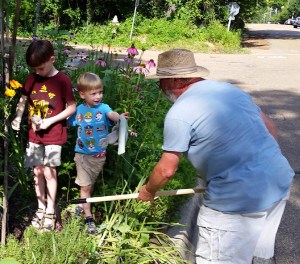 “I come from a small town in north Mississippi where people are habitually friendly and cordial. But here in the city, people walking their dogs or strolling their kids don’t greet me while I’m puttering in the garden. A few passersby will stop and chat a bit, but many just nod or wave, maybe tarry a bit to watch me digging, weeding or pruning, without saying a damn thing, just stand there and stare at me. Some discuss what I’m doing between themselves as if I were some sort of deaf automaton. I find this very strange; am I crazy?”
“Also, a lot of earnest folks who come by give advice, want to micro-manage the garden for me, and I’m grateful for sure. Luckily it’s easy for me to feign that I had no idea that “four-o’-clocks or goldenrod can get away from you in a heartbeat.” I have to smile and agree, then go on with what I was doing. They also give me art to put in place, gnomes and pretty rocks and old trellises and all sorts of sundry things. I’ve had to find a place for everything, because they’re going to come looking for whatever they gave you one day.”
“Roger Swain, the Boston native and host of the Victory Garden, once said, ‘Mississippi IS a garden.’ And he was right. The problem is, it’s not being cared for. I simply found a piece and started caring for it. It wasn’t my piece of Mississippi, but that’s what guerilla gardening is all about: Gardening on someone else’s property. If the city ever decides to rework the neighborhood street, my garden might be paved. It’s been fun, but sic transit gloria mundi (thus passes the glory of the world). Meanwhile, things grow apace. You know of my vast plans, conquering what I can one foot at a time. It’s been a lot of effort; my old body is displaying aches unknown for many years, but frankly I feel the better for it, as evidence of physical competency if nothing else.”
“I’m determined to let things run their course, grow and flourish as they will and should, and I’ve already concocted new projects that will make the most use of it.”
(from the book, Maverick Gardeners, by Felder Rushing (UPressMS: March 2021)