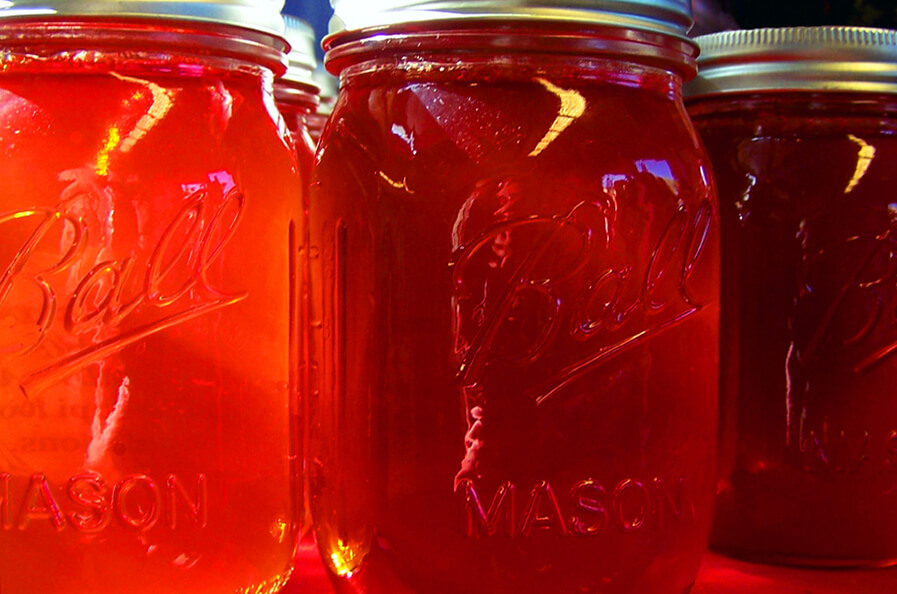
Stewed Greens

Cut, strip, and tear three bunches of turnip and two of mustard greens. If you like, peel and cube/dice turnip roots. Put greens in a clean stoppered sink, sprinkle with salt, cover with water, and agitate to knock off sand and other debris. Repeat until thoroughly clean. Drain and load into a pot along with roots, a quart of water or light stock, a chopped white onion, and a half pound of sliced bone-in ham or smoked turkey tail. After greens have reduced, cut heat to low and cover. Stew, stirring occasionally, for at least two hours. Add liquid as needed. Adjust salt, pepper to taste, and let sit uncovered a half hour before serving with pepper vinegar.

Pickled Eggs

Any time you enter a beer joint in Mississippi, you’re likely to find a big jar of pickled eggs on the counter next to the beef jerky, the pieds de porc à l’écarlate and all the other Bubbas that belly up to the fast food Southern sideboard.

Such eggs are sour, rubber shadows of those properly pickled, which are a great side with cold meats, poultry or game, also good in–and with–tuna, chicken, or vegetable salads. A recipe from a Junior League-type cookbook published in the 1930’s claims that they’re “ever so good chopped into hash, and provide just the right touch bedded on greens with a dressing of sharp, spicy goodness.” Craig Claiborne included a pickled egg recipe in his New York Times Cookbook (wouldn’t he just?).

The white of a pickled egg should be firm, not tough or rubbery, the yolk moist and creamy, not crumbly. The eggs should also have a light, balanced tangy/sweet flavor as a platform for other seasonings: I like a couple of slit hot peppers, a slice or two of garlic and a bay leaf to flavor mine–which are, admittedly, unsuitable for any occasions requiring plates, much less silverware–but dill, caraway or even cloves figure among attractive possibilities for the eclectic.

For pickling, boil a dozen medium eggs until just done; you can easily fit a dozen large in a quart glass jar. Then stuff the (peeled) eggs into the jar along with whatever accompaniments you like (jalapenos, onion, garlic, bay leaf, etc.). Fill the jar with a mixture of white vinegar and water (4:1) just to the top; jiggle the jar to burp bubbles. Pour vinegar mixture into a saucepan along with a tablespoon of salt, a tablespoon of sugar and a tablespoon of pickling spices. (If you miss the barroom rose, use beet juice.) Heat to almost boiling and pour back over the eggs; if there’s not quite enough liquid to cover them entirely, add a little more water. Seal the jar and store for at least a week before putting them out at your next kegger.

Mickler’s Revolt

By 1986 publishing was already wedded to celebrity so much so that the best-selling cookbook that year was by “The Frugal Gourmet”, an ordained minister who was convicted of molesting teenage boys some years later. But Smith, for all his faults, was an international media presence, while Ernest Matthew Mickler (God rest his sweet soul) who in the same year published White Trash Cooking, was a dying man with a vision.

Ernie insisted on the title, which left him an open target since his simultaneously unblinking and winking approach to the stereotype of the rural South confounded people across the country as well as people on the Redneck Riviera. The only thing even remotely resembling a precedent for White Trash Cooking was written by another Floridian, Zora Neale Hurston, whose studies in anthropology brought her back home, much as it did Mickler, who threw down a gauntlet, insisting that while the nation might profile Southerners as a whole as white trash, the behaviors that earmark anyone anywhere as decent and honorable hold sway in the American South as well, a region that is no more tragic than any other section of the country.

He also knew that people outside of the South consider us low and mean, but we are (as they are) a layered society undeserving of their unilateral condemnation; our culture, our manners, our morals all have as much a measure of  civilized imprint as those of our fellow countrymen, but instead of embracing our differences, they persist in considering the South and its people worthy of their disdain.

With White Trash Cooking, Mickler opened a portal of discovery into the essential character not only of the South, but of the nation; white trash cooking uses cheap ingredients, commercially frozen, dried or canned, few seasonings, packaged mixes, plenty of salt and sugar, lard and margarine in dishes that are quick and easy to cook, unsullied by any degree of sophistication. It remains the most basic form of cooking in the nation,  the cooking of people who don’t read Bon Appetit, people who work a forty-hour week (or more) at a poorly-paying job with little or no insurance, living from paycheck to paycheck, struggling to make a life for themselves and their children. They wouldn’t go to a Whole Foods store unless they lived next door and had to, which is good advice for anybody without an attitude.

White Trash Cooking celebrates a significant surface of our many-faceted country, one we should all recognize as uniquely ours and none others. Love it.

Orange Spice Cake

Cream 2 cups sugar with 2 sticks softened butter until light and fluffy. Beating well, add 5 eggs one at a time. Sift 3 cups plain flour with a teaspoon each of cinnamon, nutmeg, and ground cloves. Add to butter with a cup of milk, a half cup of orange juice concentrate, and a teaspoon of vanilla extract . Mix thoroughly, pour into an oiled and papered  9″ loaf pan, and bake at medium high (375) until toothpick dry. Slice, toast, and drizzle with honey.

Rodney’s Chicken Sausage

Grind 5 pounds chicken meat–I boned thighs and threw in a couple of boneless breast halves–with skin through a ¼” plate into a large bowl. . Add two tablespoons salt, a tablespoon ground black pepper (more if you want), and a quarter cup each of fresh chopped sage, thyme, and parsley,. Some people add cayenne, but don’t; it kills the herbs. Blend in a half cup fresh chopped green onion along with a half cup cold chicken broth.

Mix very well and refrigerate before stuffing loosely into casings. You’ll need about 12 feet. Twist sausages into about 6-inch links, and refrigerate overnight to let the seasoning work through the meat. This chicken mixture can also be cooked as patties, but will not keep well raw; freeze if you’re not going to use it the following day.

Louvain’s Grillades

My friend Rick Louvain from New Orleans loves going to supermarkets “to see what the Great Unwashed are consuming,” and insists on dragging me to my little neighborhood store for a scathing inventory when he’s in town.

On a recent outing he declared the entire produce aisle nothing more than a compost heap. His withering assessment of the floral department brought a tall bald queen around the corner clicking his nails like a scorpion. Rick had to buy a dozen roses to save us both from getting bitch slapped and owning it.

After declaring every can in the store a ptomaine grenade, we hit the meat section.

I was jittery because the butcher on duty was my buddy Charlie, who has the build of a Sumo wrestler and the disposition of a lamb. After a sweeping forensic analysis of the meat section as a whole, we came to the discount section where he grabbed a flat pack of thin round for two bucks and grinned.

Big Charlie was right next to him, humming to himself and marking down hamburger. Rick slapped Charlie on the shoulder. “Hey! Is this round steak?”

I tried to die three times. “It surely is,” Charlie said with the most bountiful smile in the known universe.

“Great!” Rick said. “Run three pounds fresh through the tenderizer for me. We’re gonna get some stuff in the deli, we’ll be back in a couple of minutes.”

Charlie winked at me when we got the meat, and I think he was thanking me for the customer, but I’m not sure. He goes out of his way to cut me t-bones to order, and if you ask me, I think he’s flirting. And that’s a big okay.

Once out of the store, Rick said, “We’re going to make grillades. This is what my gammy uses. She breads it, fries it, makes a roux in that, throws in some garlic and onion, bell pepper and celery, diced tomato, cooks it down in a casserole in the oven. Food of the gods, and you’re cooking.”

“You’ll never let up on me, will you, Rick?”

“You’re one lucky hoss, Jess.”

Queen Cakes

In cake aristocracy, we have the Lady Baltimore (His Lordship has one, too), the Regent, the Prince of Wales, and of course King Cakes. Then there are Queen Cakes, somewhat larger than cupcakes, which are traditionally baked in ribbed “patty-pans,” which modern-day paper cupcake liners faithfully replicate.

The recipe is like a pound cake’s, but an essential traditional ingredient is currents. Currants were popular in this country up until the early 20th century when their production and shipment were banned under federal law in 1911 because the plants were unjustly tagged as vectors for a timber blight. The ban was later relegated to local jurisdictions, but it’s unlikely you’ll find currants–fresh, frozen, or dried–in markets. You might find  Zante currants, which are actually dried seedless grapes, which on most days I call raisins. Me, I cut to the chase and use Sun-Maid.

Queen Cakes

Cream 2 cups softened butter with 2 cups sugar, then beat in 8 eggs one at a time. Mix the batter very well, then add a teaspoon vanilla; a half teaspoon mace, and 2 tablespoons brandy or rosewater are traditional, but optional. Sift a teaspoon baking powder with 4 cups cake flour. Mix very well until stiff, but not dry.  Add your “currants” liberally, but toss them with a bit of corn starch first, since they tend to clump. Use softened butter to grease your “patty-pans” (cupcake pans to us commoners) and paper liners. Fill cups a little over half-way with batter, and bake at 350 on the middle rack until golden and springy. Allow to cool completely before removing from pans. Feel free to top with royal icing.

My Baby Skillet

The most cherished and versatile element of my batterie de cuisine is a well-seasoned 6” cast iron skillet I inherited from my sister Cindy, who called it her baby skillet. Now, Cindy called anything of a diminutive nature  “baby”; a hand spade was a “baby shovel.” I swear I once heard her call little old Massachusetts the baby state.

“Cindy,” I said, “It’s the Bay State.”

“That’s not what I said,” she replied with a sharp glance. I let it drop; I’d learned you can’t win an argument with a big sister.

This skillet is just the thing you need to use for baking in small amounts. This little honey is perfect for good half-dozen (or four catheads). It’s also ideal for a pan of cornbread that will feed at least four easily, and a meat loaf that will feed three. When it comes to baked pasta, I would dearly love to have three more of these skillets to use for a manicotti party, one pan of four for every two people.

Mock Oysters Rockefeller

Every recipe you’ll for this old buffet dish uses chopped frozen broccoli and cheddar, which makes you wonder why anyone would call it any kind of a Rockefeller in the first place, even a mock one. While this version lacks the definitive Pernod/Ouzo/Anisette (nothing to keep you from adding a slash or so) it does have spinach and parsley, which seem to be the only ingredients that most deem essential for an honest oysters Rockefeller.

Sauté 4 cups chopped spinach with 1 bunch chopped green onions and a cup of chopped parsley in a stick of butter. Cool, add a cup of Parmesan, and about a half cup of crumbled bacon. Mix well, salt and pepper to taste. Remove stems from portabella caps; you can mince these and add them to the spinach mix if you like. Brush caps with olive oil, sprinkle with salt, and place on a baking sheet. Spoon spinach mixture on caps, top with more crumbled bacon and Parmesan, and bake at 350 until cheese is toasted.

Jackson Cookbooks

The culinary literature of any given city (or region) reflects the character of its peoples, and taken altogether, this selection, which I submit as the “best of the best”, shows Jackson as richly cultured, with an enduring commitment to the commonweal. Among its citizens have been talented cooks who were writers of surpassing ability. These books encompass an extraordinary amount of cultural history, contain the highest order of culinary exposition, and taken altogether could work as a syllabus for any tutorial on Southern cooking.

Allison’s Wells: The Last Mississippi Spa
(Muscadine Press: 1981)

In 1981, proprietor Hosford Fontaine—doubtless at the urging of countless friends—published Allison’s Wells: The Last Mississippi Spa. The book is a treasure-trove of history, with profiles of the people who kept the resort functioning as well as other unforgettable characters, musicians and artists such as Till Caldwell, Inez Wallace, Ted Faires, Marie Hull and others. Many of these people contributed to the illustrations, which are augmented by dozens of charming vintage photos including a poignant image of Hosford standing amid the charred ruins. Best of all, The Last Mississippi Spa also includes a sprawling section on recipes for almost anything to put on the table: hors d’oeuvres, soups, salads, dressings, breads, meats, seafood, vegetables, breakfast and brunch dishes, desserts, candy and cookies, all “tried and true” from the La Font kitchens. The book includes a warm and heartfelt Forward by Charlotte Capers and a brief introduction by Eudora Welty.

The Jackson Cookbook
(Hederman Brothers: 1971)

This cookbook could well be held up as an archetype of a Southern ladies’ cookbook; it’s stiff with tradition and understated elegance. Indeed, in a note “About the Cover,” the editors explain that Artist Carl Davis translated Welty’s comments about “the era of the Madeira tea napkin,” into a work of art using an heirloom tea napkin “hand embroidered by Miss Irene Anderson,” with Jackson’s monogram “J”. This note follows a short essay by the Women’s Editor of The Clarion-Ledger, Mary Alice Bookheart, “The Aesthetics of Eating,” which states in part, “This is not necessarily a cookbook of old Jackson recipes. … What (the cookbook committee) has attempted to do in compiling this book is to achieve a happy blend of old and new …” This book also includes some restaurant favorites, such as the “Edwards House (King Edward Hotel) Chicken”. The recipes are simple and use familiar ingredients as well as commercial items, and provide recipes for any occasion, ranging across the menu. The Jackson Cookbook is a wonderful addition to any kitchen library, but what sets it apart, raising it to a level no other cookbook in Mississippi can hope to achieve, is the Forward, “The Flavor of Jackson,” a jewel of exposition by Welty.

 The Southern Hospitality Cookbook
Oxmoor House: 1976

Simply put, Winifred’s The Southern Hospitality Cookbook is not only a groaning board of splendid recipes, but as a whole nothing less than an illuminating documentation of upper-class cooking in the mid-20th century South. The recipes are rich and varied, the ingredients often expensive and times for preparation are usually considerable. Indeed, the most frequent critiques of the book involve how “fussy” the recipes are, many calling for minute amounts of several various ingredients and elaborate stage-by-stage instructions on their preparation. But this is the way Winifred and the women of her class and generation cooked; they had plenty of time on their hands, and more often than not enough money to spend on costly and hard-to-find ingredients. Many of the recipes are true heirlooms from Virginia and the Eastern Seaboard. She also includes recipes from dozens and dozens of friends and neighbors. The Southern Hospitality Cookbook is a milestone in the culinary history of Jackson, but what takes it to a higher level is a short essay by her editor at The National Observer, David W. Hacker (“Savoring Miss Welty’s Wit at a Special Seafood Lunch”) and a preface by Eudora herself (“A Note on the Cook”).

Standing Room Only
Hederman Brothers: 1983

“With Narratives by Eudora Welty and Beth Henley,” announces the marquee on New Stage’s truly superb “Cookbook for Entertaining”. Henley’s short essay on theatre parties is quite fun, and Welty’s “A Note about New Stage” is the definitive article on this beloved Jackson institution. The posters and playbills, along with the accompanying texts, that separate the divisions are also marvelous diversions, but the true stars here are the recipes. This is hands-down my favorite Jackson cookbook because the recipes are sumptuous, clearly presented, and a lot of them are just damned fun. Most of them are written for more than four servings and are captioned with “can double”. Also included are the invaluable sections, “Buying Guide for 50 Guests” and “Setting a Bar for 50 for One Hour”. SRO throws in an herb and wine guide as curtain calls.

Southern Sideboards
Wimmer/JLJ: 1978

The most distinguished cookbook in this selection, and winner of the prestigious Southern Living Hall of Fame Award, Southern Sideboards is THE right cookbook for traditional Southern recipes before the “foodie revolution” of the 1980s. These recipes aren’t designed for health or with an eye to fussy ingredients, so if you’re the type of person who wouldn’t be caught dead in a checkout with a can of Cream of Celery soup, then it’s certainly not for you. But if you’re one of those hide-bound traditionalists who want to know EXACTLY how Granny made that Southern Cornbread DRESSING, then this is your book. Sure, the recipes are often complex and some do take a little time, but you know what? Time and preparation are keys to good cooking and good eating. The game recipes are truly superb, as are the desserts, particularly the cakes. Southern Sideboards is distinguished by a splendid, heartfelt essay by Mississippi native Wyatt Cooper, an author, screenwriter, and actor better known as Gloria Vanderbilt’s (fourth) husband.

The Sweet Potato Queens’ Big-Ass Cookbook and Financial Planner
Three Rivers Press: 2003

Despite what you may think, I am not including Jill Conner Browne’s cookbook in this list because I’m afraid that if I didn’t, I’d in the very near future have a magenta sequined bootie up my patootie. No, I honestly think the Big-Ass Cookbook is absolutely fabulous. Not only does it have lots and lots of great—albeit indulgent—recipes, it also has reams of practical advice: “Hormones are serious juju, and if you don’t get them sorted out, you might find that you need money for things like lawyers and bail.” I think it’s Jill’s best book, though I must profess a weakness for cookbooks. Here you’ll find satire without (much) malice or rancor, some of the best writing—flat-out writing—to come out of Mississippi, and humor that’s deliberately  earthy without being crass or (too) coarse. Of course, I’ll never be deemed worthy to sew a single sequin on an SPQ outfit, but I adore them from afar.