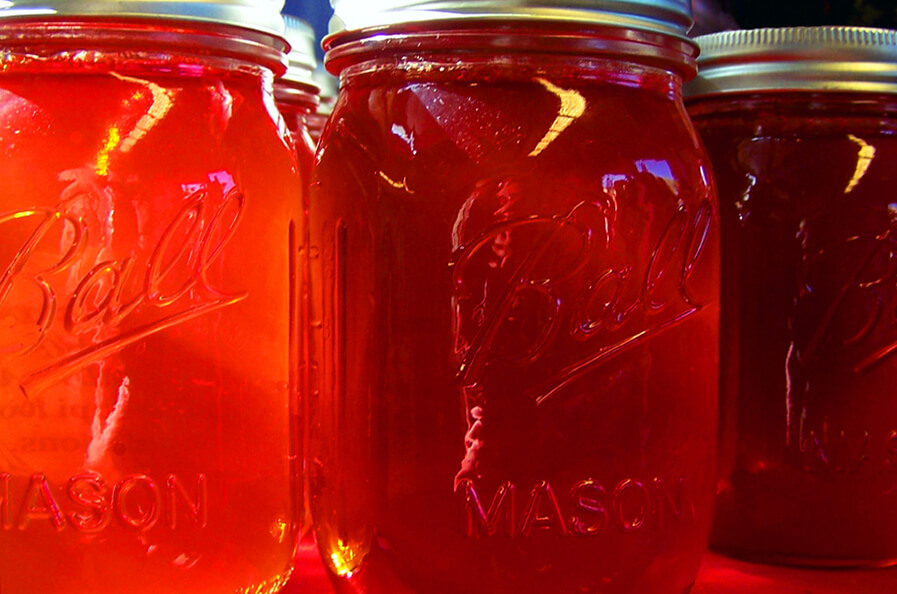
This recipe comes from Teresa Bullard, who lives near my old hometown in Calhoun County, Mississippi. Both Teresa and her husband Jerry are fine cooks. Teresa also provided the great photo.
5 lbs tomatoes 5 lbs pickling cucumbers 2 lbs onions 2 heads of garlic 1 large bunch fresh dill (optional ) 5 quarts water 1/2 cup granulated sugar 1/2 cup fine sea salt 3/4 cup distilled white vinegar 10 Tablespoons sunflower oil (1 Tablespoon per jar)
Wash and dry your canning jars. I used 10 jars, 8 wide mouth quart jars and 2 half gallon wide mouth jars.
Wash the cucumbers and tomatoes. If your cucumbers are a little soft, you can crisp them up by letting them soak in really cold water for 15-30 minutes. Slice the cucumbers into approximately 1/2 inch circles. Slice the onions, about 1/4 inch slices and quarter the tomatoes. Peel the garlic. Place a few sprigs of fresh dill on the bottom of each jar, and then add 2-4 garlic cloves. Layer the onions, cucumbers and tomatoes in 2 layers in each jar.
Meanwhile, in a large pot, bring the water, salt and sugar to a boil, mixing until all the sugar and salt dissolve. Off the heat, pour in the vinegar. Ladle the hot marinade mixture over the vegetables in the jar, all the way to the top. Add about a tablespoon of sunflower oil to the top of each jar. I add a little bit less than a tablespoon to the quart jars and a little more than a tablespoon to the half-gallon jars.
Place the jar lids in boiling water and let the lids stay in the boiling water for 10-15 minutes also, off the heat. Place a clean towel or dishcloth on the bottom of a large pot, and fill it with water. Bring the water to a boil, Place the filled jars in the boiling water, on top of the towel, cover them loosely with the lids and cook, at a simmer, for 10-15 minutes. Take the jars out of the water and close the lids tightly. Repeat with all the jars.
The salad is ready to eat in 1-2 days. Store opened jars in the refrigerator, the rest are shelf stable at room temperature.
As incredible as it may sound to us now, in the 1940s the Old Warren County Courthouse in Vicksburg was under threat of destruction from the very city itself.
The building is perched on the highest point in Vicksburg on land given by the family of the city’s founder, Newitt Vick. Construction began in the summer of 1858 on what was then to be a new Court House for Warren County. Contractors were the Weldon Brothers of Rodney, Mississippi, who used 100 highly skilled artisans to make the brick and erect the building, which was completed in 1860 for a cost of $100,000. During the War, the building dominated the city’s skyline and was the target of much Union shelling but suffered only one major hit. It was here on July 4, 1863 that the Stars and Bars were lowered and the Stars and Stripes were raised as General U.S. Grant reviewed his victorious army.
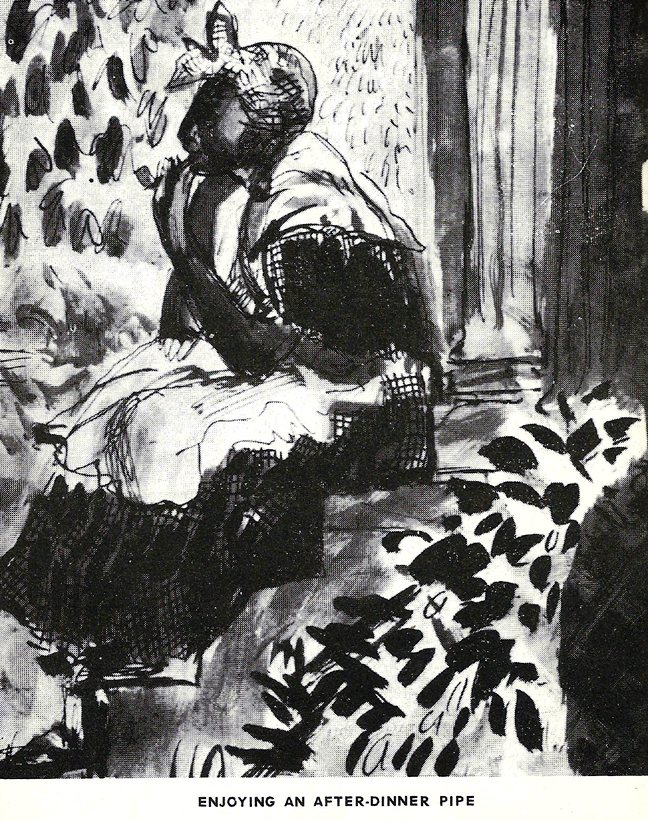
Enjoying an After-Dinner Pipe-Bucci
With the construction of a new Warren County Courthouse in 1939, the Old Courthouse stood practically vacant for years, and there was talk of its demolition. What was possibly planned to take its place on the highest point in the former Gibraltar of the Confederacy goes (perhaps mercifully) unrecorded.
But a local activist, Mrs. Eva Whitaker Davis, realized the significance of the building and established the Vicksburg and Warren County Historical Society for the purpose of preserving the structure. In 1947 she was elected president of the society and with the help of volunteers began cleaning the building and collecting artifacts.
On June 3, 1948 the museum opened its doors, where she continued to work on a volunteer basis for many years. Eva Davis was a local celebrity; she had a daily radio show, “Court Square”, which was a feature of WQBC in Vicksburg for many years. She put out two cookbooks, Court Square Recipes and Mississippi Mixin’s, both likely in the 1950s, though neither book is dated. A grateful public added the name Eva W. Davis Memorial to the Old Courthouse Museum several years before her death in 1974.
Fishing in the Mississippi-Bucci
Mississippi Mixin’s was illustrated by her fellow townsman and renowned Mississippi artist, Andrew Bucci. Sadly, Bucci’s art is reproduced in black and white, but the impact of the images is still powerful, perhaps even somewhat enhanced. Most of Bucci’s artwork in the book is comprised of small images for chapter headings, doubtless resized from larger works, but two large images are printed full-page (5.5×7). Again, dating these works has so far been unsuccessful and it is not known whether the original artwork still exists.
At least one image is by artist Suzanne Wilder, who was a student in the Mississippi Art Colony at Allison’s Wells, a popular resort in Way, Mississippi that was established in 1889. The Mississippi Art Colony was founded at Allison’s Wells in 1948, and Bucci along with noted Jackson artist Mildred Wolfe taught there until 1963, when the resort was destroyed by fire, then relocated to Utica, Mississippi.
Toss chicken legs in vegetable oil seasoned with equal amounts of black pepper, paprika, sage, and salt. Drain and cook on a rack at 300 for about an hour, turning to brown evenly.
The Ark of Taste is an online catalogue developed and maintained by the Slow Food Foundation that records small-scale quality productions of foodstuffs belonging to the cultures, history and traditions of our world. The Ark grows day by day, gathering alerts from people who see the flavors of their childhood disappearing. This is a selection of the foods in the catalogue tagged with Mississippi. Native Mississippians will find many familiar, some surprising, and likely a few objectionable. As a Calhoun County native, I’m proud to include two sweet potato varieties.
All butter beans are limas, but not all limas are butter beans.
Actually, it’s a lot more complicated. While lima beans and butter beans are usually thought of as two different types of beans, they are both varieties of Phaseolus lunatus (literally “moon bean”), which has a very long and complicated history in Meso/South America.
As a rule, large, yellow/white/speckled/purple limas are generally known as butter beans, while the smaller, green varieties are called, well, limas. The smallest may even be called “baby” limas. However, I have been told that “they call limas butter beans up North,” which if anything they call limas.
Lima beans are a warm-weather crop and come into season sometime around mid-June. Second field crops in late July and early August, keep fresh beans in in season well into October. Among the most popular varieties grown in Mississippi are ‘Thorogreen’ and ‘Henderson,’ both small green bush types; ‘Jackson Wonder,’ also a bush variety, is small and brown or speckled; ‘Florida Speckled’ is a larger pole variety, and the hard-to-find ‘Willow Leaf,’ a white pole variety, has a cult following. Butterpeas are also limas.
Fresh beans should be smooth and plump, somewhat tacky to the touch. Fresh beans should be washed and picked over for damage, dirt, or detritus, washed, and set to cook in water 2:1; fresh beans don’t need as much water as dried, and they don’t need pre-soaking. As with most American bean recipes, fatty pork is a classic addition. Bring beans to a boil, then lower heat to simmer and cover until beans are soft. I always use white pepper instead of black to season, and rarely use anything more until the beans are cooked, at which point they become the basis for any number of wonderful dishes.
Every summer I make baked limas in sour cream. For a pound of cooked limas with about a half cup of the liquid, add a quarter cup of brown sugar, and a cup of sour cream mixed with a teaspoon corn starch to keep it from separating. Flour will work in a pinch. Mix well. Bake in a low oven until set. This dish goes with anything at all.
Our grocery deli serves these potatoes—along with rice and two kinds of grits—as sides on its breakfast buffet. Cube red potatoes and parboil until just firm. Drain, dust with seasoned salt and pepper, then pan fry until soft through and crusty.
A primary function of Mississippi Sideboard is to provide access to documents of specific interest in danger of being lost. Hosford Fontaine’s Allison’s Wells: The Last Mississippi Spa (Muscadine Press: 1981), certainly qualifies. This wonderful work was printed only once, and, according to Fred Smith of Choctaw Books, the press plates were melted.
When Allison’s Wells was destroyed by fire in January, 1963, the event was considered a major calamity for the city of Jackson, since the resort functioned as a significant event venue for the city as well as a popular weekend getaway and the site of a thriving artists’ colony, but the spa had a long history of appeal throughout the Mid-South. Periodicals from the 1890s through the 1920s are filled with reports of people traveling to Allison’s, and advertisements were run in papers across mid-America both by the hotel itself and by the Illinois Central Railroad whose small depot at Way, Mississippi (nine miles north of Canton) was only about a mile away. An Illinois Central notice promoting five resorts, including Allison’s, located along its line ran in many newspapers in 1902.
The New Orleans Times-Picayune in 1921 advertised I C RR rates from New Orleans to Allison’s Wells as $8.65. It was $26 to St. Louis and $33 to Chicago. The healthful benefits of the mineral water at Allison’s were an important attraction. An Allison’s Wells ad in the 1921 Times-Picayune stated that: “Time for a vacation? Here’s the place. Rest and Recreation, Hot Sulphur Baths for Skin Disorders and Unsurpassed Mineral Water for Malaria.” The November, 1953 issue of Lincoln-Mercury Times described it as: “A hotel, a resort, an inn, a spa, home, grandma’s house, a weekend at a wealthy friend’s — it combines the best of all of these.” A 1921 description of Allison’s Wells from the Grenada Sentinel could just as easily describe the Gray Center which now occupies the site of the old resort. It is “…an ideal place to commune with nature and to forget for a short while the turmoil and rush of a busy world.”
Foreword By Charlotte Capers
It is hard for me to realize that Allison’s Wells has to be explained, for it was such a special part of Mississippi life in the forties and fifties. The prospect of a weekend at Allison’s was enough to sustain me through the week; a thirty-mile drive from Jackson on twenty-five cent gasoline led to another world. There at the end of a winding gravel road off old Highway 51 the rambling resort hotel sparkled in summer with its seasonal coat of white paint, and in the kitchen an ancient black cook produced culinary marvels on a fragrant wood stove. The old well house was a reminder of the magical properties attributed to its healing waters; waters temporarily healing and more palatable were available in the Fishes’ Club. The Pavilion was the focal point of constant activity, from snapping beans to painting portraits, and the heart of Allison’s was the dining room, dim and cool, where dignified family servants served memorable meals to diners from Jackson, Canton, the Delta, the hills, and metropolitan areas as far away as Memphis. Presiding over the whole production with grace and charm were John and Hosford Fontaine, the hereditary proprietors, who dressed for dinner because dinner was worth dressing for, and expected you to do the same.
Perhaps it should be noted that Allison’s Wells was not for everybody. There were and are those who might prefer a Holiday Inn. It is true that at Allison’s there was a good deal of uncertainty. Allison’s regulars learned to expect the unexpected, and that was part of the fun. For example, it happened upon one occasion that the dreamy youngster at the registration desk assigned two honeymoon couples to the same bedroom. When the Art Colony was in session experimental art might appear mysteriously in the guest rooms, the plumbing was always independent, and for several seasons chicken wire was much in favor for decorating effects. Mattresses and springs varied in quality from room to room, and old friends might be quickly switched from A-grade accommodations to an A-minus room if an A-plus dignitary of church or state hove into view. No matter, this is the stuff conversation is made of, and no planned activities were necessary so long as the guests had the other guests to talk about.
In a laudable effort to cool the dining room one hot Mississippi summer, an ingenious window fan was rigged up, which was supposed to blow through wet straw, thus cooling the air in the dining area and producing an early version of air conditioning. The straw was to be kept wet by a hose, which ran from a tub of water on the porch to the straw packed in the window. On the occasion of a July birthday party, soap bubbles suddenly burst upon the startled diners. At first, the dinner guests were simply amazed. They later compared notes, and reported that they all saw spots before their eyes at the same time. After much slapping at the air, the spots were identified as soap bubbles, which burst impartially into the soup, the salad, and the entree. It seems that the hose had inadvertently been immersed in the laundry tub, thus producing the unexpected visual effects. Was Hosford daunted by this phantasmagoria? Not at all. When a sudsy guest complained she smiled sweetly and said, “Darling, isn’t it wonderful? Where but at Allison’s could this have happened?”
As has been shown, Hosford was an early exponent of positive thinking. She could be seen any cold morning in early spring or late fall strolling gracefully toward the ice-cold swimming pool, fed by waters which must have originated in a glacier. Without changing pace, she would step lightly into the pool, do a few brisk laps, and float out, with never a sign to indicate that the temperature of the water was below freezing. This attitude enabled her to convince newcomers to the spa that shelling peas was fun, darning old table linen an art, and dredging leaves out of the swimming pool a game. Regulars knew better, but all had to serve their apprenticeship.
The ultimate reward for being a good guest was an invitation to “the Retreat.” This meant a drink before dinner with John and Hosford in their bosky hideaway beneath their own apartment. A basement space had been screened and floored with bricks; outside a cornfield pressed close, and vines of various denominations clung to the screens. Inside there was candlelight and conversation. If there should be a lull in the conversation, which was unlikely, you might hear an owl hoot or a dove mourn. The Retreat’s furnishings were eclectic, and so were the guests. John and Hosford might gather together a collection of artists and writers, clergymen and cotton planters, bridge players and ordinary people, provided they all seemed to be guests of good will. If their will was not good when they entered the retreat, it was usually good when they left. A white-coated waiter brought ice and real napkins, two drinks, no more, no less, were served, tall tales were told, and the stories got funnier with the second drink.
Allison’s Wells burned to the ground in 1963, shortly after John’s death. John’s water colors, Hosford’s oils, as well as papers, books, silver, antique furniture, and souvenirs of almost fifty years were lost in the fire. Many of us who belonged to the Allison’s enclave lost more than that. We lost a special place that had preserved for us a special time and enhanced our lives.
These random memories, perhaps inaccurate, may serve to suggest the spirit of the place. I hope so. Allison’s was worth a book, written by John with Hosford as the heroine. As it has fallen Hosford’s lot to write the book as well as play the lead, I’m sure she is equal to the task.
History of Allison’s Wells before the Sam Wherry and Latimer Families
In 1899 my Grandfather, Sam Wherry, a horticulturist, who shipped from Durant the first carload of strawberries from the state of Mississippi, bought the property of Allison’s Wells from Mrs. Mary B. Allison, a widow originally from New Orleans.
Mrs. Allison first lived on the Original Natchez Trace where the gullies are. When the road was opened off of Highway 51 a main road to Way to the Illinois Central Railroad, she moved to Allison’s with her family. In 1879 Parson Hargon dug a well for the Allison’s and discovered this strange tasting water – medicinal. This health-giving water brought people to come and drink the water and buy it. It was of particular value in the treatment of malaria, a purgative as well as a tonic water, with all the minerals. So it was necessary to build the cottages on the hill for health seekers who came for weeks and months, as well as to enlarge the original home for guests.
When Sam Wherry, my grandfather bought their place the Allison’s moved about a mile away toward Way, which became known as the Allison’s House. Mrs. Allison’s son, Matt, spent his entire life time searching for the supposedly buried gold in the gullies off the Natchez Trace during the Civil War. A life time of digging, but he never found it. The Allison’s Water was from a shallow well pumped by hand — a red pump and it was sparkling, bubbling, ice cold and quite palatable at the well, but harder to drink when allowed to settle, because the heavy minerals had a slightly oily film which developed. Such a shock to attempt to mix an alcoholic drink with this ice-cold water for it turned the drink black from the content of the sulphur.
ANALYSIS OF THE 1879 WATER by W.T. Hand, State Chemist
The flow, the quantity, the mineral content never changed through the years.
.A History of ALLISON’S WELLS from 1890 to 1938
In 1900 under Sam Wherry, Allison’s was a convivial health and pleasure resort, first famous for the heavy mineral water — Allison’s Water, so called – which was a tonic as well as a purgative. The resort developed with my father first a partner – Latimer and Wherry. Then Wherry sold his interest to P.H. Murphy, his son-in-law, W.H. Jeffers, a contractor, who was in charge of all the extensive building — the men’s row changed to the annex with a real bath house for the men who took the sulphur baths and massages.
The spa stayed in the Wherry connections until Latimer became sole owner in 1909: Latimer & Jeffers until 1909 and from then until 1963, D.C. Latimer & Co. In the continued search for pure drinking water the sulphur well in the lawn was discovered and the curative power of it heated helped to relieve tension and was found to be a real aid in curing any skin trouble. A bath house for men and women was built on the lawn and massages given first just for the men. The emphasis continued under the various partners to be health first with the value of the sulphur baths combined with the real cure of the Allison’s water. Of course, the massages by a trained masseuse was a part of the treatment. Dr. Taylor, a woman osteopath, trained the masseuses. She gave osteopathic treatments and the entire family really enjoyed having a treatment — Mother particularly after a busy day in the kitchen – so relaxing.
Allison’s was a busy, happy place buzzing with action from May through September. The horse drawn bus met the trains for guests at Way four times a day, and the wagon took the water to the station to ship and bring back the trunks of the guests. They came to stay for a month with their families particularly from the Delta, New Orleans and Memphis. It was fun to see the new guests arrive at Allison’s and hear Charlie Plez, the Porter, describe them. The days were filled with the pleasures of the time – horseback riding, buggy riding, hay rides, walks to the gullies, taking pictures in the gullies, tennis, croquet, euchre and auction bridge with expensive, elaborate prizes, music by Bud Scott’s orchestra from 10 to 11 in the pavilion every morning. Bud played for luncheon and dinner every day and the dance every week night with a ball on Thursday night.
An early memory is hearing my grandfather and his two sons rattling the small glasses filled with ice, sugar and bourbon about 10 a.m. – a cold toddy. My first taste later of the remains of the cold toddy – ice, sugar and bourbon.
Allison’s was noted for its fine food. It was such a personal operation by the family that it was really impossible to get anyone who could run the kitchen. My mother, Norma Wherry, managed the kitchen with first chefs from New Orleans and Memphis, but later tenants from the place were trained. My grandmother, Candace Barger Wherry, preceded Mother in running the kitchen. Allison’s menu was developed from cooking from scratch – home grown vegetables, fresh fruit from the orchard, wild muscadines brought from the swamp; even quail and wild ducks occasionally; hams, stuffed sausage, bacon cured in our smoke house. A Jersey herd furnished yellow heavy cream, fresh churned butter and buttermilk; cream of cheese dripped from a sack. Squabs were also served from our own pigeons. All cooking was done from two big black stoves with wood only for fuel until 1955 when an electric stove was added for baking cakes.
Tea time in the Pavilion, 1950s.
Health, gaiety, joy of living was uppermost – silver epergnes filled with fresh fruit and flowers, finger bowls, butter served in high silver compotes with small individual silver plates. The head waiter and white coated men waiters added the right touch of formality and welcome.
Wherry and Latimer operated with vision far ahead of their time. They were the first to have gas lights, then generated their own electricity: Electric lights, running water, toilets indoors and bathroom at the end of the halls and later in each room.
Allison’s was a farm for seven months out of the year and five months a health and pleasure resort. The Opening Ball was the 20th of May usually when Ole Miss ended the semester, and the closing ball around Labor Day. Farming was a real activity, cotton, corn, cattle, pigs, pastures and ponds. The Allison’s water was shipped by the 5-gallon jugs, which was a year-around operation. Regularly a car load of jugs of water would be shipped to and sold by a drugstore in Athens, Georgia. These jugs, if you can find one now, sell for $75.00, if perfect.
My father Douglass Colquhoun Latimer and my mother, Norma Wherry, had a certain formality. Guests dressed for dinner and the dance that followed. Father often called the Virginia Reel and Square Dance at night. Men had to wear coats in the dining room; but if you did not have a coat, he had hooks outside of the dining room with coats on them, which you could borrow. All of the family dressed before they left their bedroom. Mother always looked lovely. She was beautiful – brunette with brown hair and brown eyes and a skin you loved to touch. Daddy called her “Young Lady”. She was ever a Young Lady. She died at age 53.
Flowers were her hobby, along with sewing and embroidery. One year the front was filled with enormous chrysanthemums and the Maréchal Niel roses all across the front – a mass of yellow roses — so fragrant. When everyone dressed for dinner in the evening, my one desire was to look as lovely as the young ladies. So, one day, at the age of 7, I wore several dresses and a pair of red slippers. It did not work.
After being dressed one afternoon in white, which was normal, we children all went plum hunting. Of course, it was muddy. We came in bedraggled and Mother immediately put us to bed without dinner. Daddy was very stern, but very soft hearted. He fixed our dinner himself – a thin broiled steak like veal, fresh tomatoes and buttered hot rolls — and brought it to us. Mother had punished us, so she really did not mind. On went the music outside of our room – Bud Scott at his best – probably feeling sorry for us in bed.
School days — a public school of one room, where we had to have five pupils. The two Allison girls along with the three of us, Thelma, Sam and me. We walked to the end of the Men’s row, so called, to the Fishes Club for our schoolroom. This had been the room where the men gambled. A professional gambler usually spent the summer at the Wells.
Later we caught the train at Way to go to school in Canton usually driven to the station by our Uncle Harvey Latimer, who lived with my grandmother, Angelena Lancashire Latimer, born in London, England. The property was bought in 1905 and my father built the home, now Gray’s Center an Episcopal Center, for my grandmother and Uncle Harvey. I lived with them for a year when I was seven years old.
We had three modes of transportation every school day. At first either horse and buggy or carriage and then a car to catch the train at Way – No. 33 to Canton. We then walked from the Canton station a mile to school and perchance if we forgot our lunch and left it on the train, we walked to town to Mosby’s Drug Store to charge 50 cents and buy an oyster loaf for lunch. The money was charged to Allison’s and probably no bill was sent until after the Fourth of July, which was the financial cure for Allison’s.
Douglass, the youngest, who never wore shoes or a hat to school, frequently had the train passengers taking up a collection to buy him shoes. No, he did not take the money, but instead got real mad. When Douglass was in the first grade in the Canton School, he missed his train one winter afternoon, and when he did not arrive at Way, a frantic search for him began. Winter dark rapidly coming — cold — and where was the little boy? The stark terror when Daddy realized that Douglass must be walking home on the railroad track. Visions of seeing him crushed by the on-coming trains. The blessed relief to rush to meet this tiny sobbing child that had walked ten miles to get home.
Strawberries were grown commercially and we children picked some and were paid extra for it. I sold The Commercial Appeal—a source of income—as a child. Douglass Latimer was a great gardener and we had a large vegetable garden as well as flowers—worked in and managed by Daddy. He rose early, worked in the garden and oversaw the milking of the Jersey herd. We sold butter in Canton.
When he appeared for the day Daddy had on a Manhattan shirt starched by the laundry. One of his joys as he ran the office was the usual afternoon set back or poker game on the porch outside of the office with close friends. He had many – from all walks of life. We all adored him and though over 50 years have passed, he is an ever-present personality. He was ever filled with sternness and deep warmth and love for humanity and especially for his wife, “Young Lady”, and his children.
ALLISON’S from 1938 to 1963
As 1938 opened with John and Hosford coming home to Allison’s it brought back memories of life in Boston and how Allison’s was remembered there with such nostalgic memories that when the radio would play “Take Me Home Again Kathleen” I would burst into tears, though quite happy in Boston. And John and my son Doug would laugh. I talked about Allison’s as I went through life – a period filled with happiness, dancing, playing dolls, playing bridge, euchre and early and late dates, with the great love of my mother and father and family. When I think of it today it is like another world. As children and young ladies, we were never presented with the problems, but of course there must have been problems.
John was first advertising manager of The United Drug Co. and next the vice-president of The United Drug Co. His most inventive bit of advertising was The Rexall Train, which traveled all over the United States displaying Rexall products. Mr. Liggett, the President, was aboard and they had a big party at each big city where they stopped for tours.
Home again with the unloading of the big van from Boston with part of our possessions at Allison’s and the rest on Lookout Mountain, Tenn., Chattanooga, where John was connected with Nelson Chesman Advertising and later a partner. In the winter we lived on Lookout Mountain, and in the summer, I ran Allison’s with John and all the employees’ help. John drove down twice a month – an eight-hour trip and spent his vacation at Allison’s.
When John and Hosford bought the Latimer heirs out — Sam, Douglass and Norma — the emphasis continued on high living and health, joining the National Spa Association, going to the meetings – one at Hot Springs – and having the national group at Allison’s. The Saratoga Springs Group gave a cocktail party in the rose garden at the gazebo with Ellis and Preston serving them in white coats – a not to be forgotten moment in time — moonlight, roses and jasmine.
Allison’s Wells, c. 1944
Emphasis on unusual and good meals, beauty, landscaping; flowers everywhere in and out, large arrangements done by Parthenia in the living room as well as fresh flowers on every table in the dining room. These were often done by my Aunt, Mrs. S.D. Wilson of Tupelo. Ed O’Leary, the gardener and an ardent Catholic, hated to see Evy have so many of the flowers picked. Evy was a real designer with flowers, but she liked a mass of blooms the best. She won many prizes. Bowls of fresh sweet peas on each table in the dining room an Allison’s tradition.
A continued feature of Allison’s was the delicious food along with the art activities, as well as the many, many retreats and workshops and meetings. Everything was cooked on two big black stoves with wood brought up steep steps to the kitchen. Allison’s was written up in a number of magazines as “Off the Beaten Path,” which after sixteen years an inquiry comes: “How to reach Allison’s? I wish I knew How.” Duncan Hines included Allison’s and a feature article by Wendreoth Saunders, the artist, was published in The Lincoln-Mercury Times in November and December 1953.
Allison’s, which had been leased to Dr. Brown after the death of my mother and sister Thelma, needed a real face-lift and a return of the sparkle of living with emphasis on beauty, comfort and today’s feeling of life. This meant landscaping, rebuilding. As you entered, the bare clay hill was planted in peas to enrich the soil – so eventually out came the beautiful rose garden with the gazebo.
This presented a real challenge to my husband John, who was an engineer, an architect, a writer, a fine watercolorist and an advertising executive. He brought the joy and beauty and fun of living back to Allison’s. The redecorating continued when John retired and was an account executive with Godwin Advertisers in Jackson. Son John III is chairman of the board there now. Bathrooms were added to most of the rooms, the men’s sulphur bathrooms had a face-lift. The tops of the old toilet tanks became metal planters with flowers at the entrance. The artists painted them – “Realism” in today’s language; in yesterday’s language, “An old reality of time gone by object.” The ladies’ sulphur bathrooms were moved upstairs where Parthenia reigned supreme with the great massages.
The entrance was moved from the lower gate to the upper gate, a pleasing brick entrance planted with flowers, clumps of wisteria trees – shrubs marking the entrance and to the right the beautiful rose garden with Latvian touch to the gazebo. Beds of roses divided by brick walks — running roses in the background — perennials in beds around the center rose beds. Douglass Latimer, my brother, was bringing a bride home, Leigh Barret from Texas, so the first major rebuilding was a bridal suite for them in the annex upstairs last rooms where it overlooked the rose garden as well as the pool and grounds – beautiful view.
With the arrival of our displaced Latvians, Janis and Leontine Lazdin, John had a real engineer Janis to help with the continued improvements, the gazebo and featured seat in the rose garden, the boat house and seats down by the pond down the hill from the garden, which was also a feature in the nature trail, which was developed by “The Canton Garden Club” with the aid of the County Forester, who also marked the trees in the woods. Yes, I was and am a member.
The most important building was in true Latvian style the studio – at first and then the Chapel – Episcopal, because the artists outgrew it the first year. Another building, the enclosure of the pavilion with a small kitchen added for the priests — Catholic retreats. Always decisions should we have a lake or a pool — the pool won and what a big pool – reinforced concrete – there to stay forever — it’s still there. Scrubbed down every Saturday and refilled. Another renovation was the sulphur bathrooms for the women over the dining room—Parthenia’s domain.
1945 and 1946 War years brought our baby sister Norma Latimer Watkins back to Allison’s while Tom was in the service in the Philippines with her two girls Norma and Mary Elizabeth.
John renovated for them a bedroom and sitting room upstairs. Norma was in charge of Allison’s and her third daughter Sydney was born on the 2nd of January 1946 – in Jackson and then back to the Wells for the winter. Allen, our man of all work looked after getting Norma to school by bus to Pickens and of course Mary Elizabeth tagged along about a block to the big road to catch the school bus. Allen built the fires, cooked the children’s breakfast and served it in the sitting room in the early morning light — practically black, and took Norma to the big road.
Allison’s had many firsts: First American Bridge League Tournament in Mississippi … First Art Colony in Mississippi… First Continuous Exhibition of Paintings with a Tea … This is a few of them. From Allison’s to La Font at Pascagoula where the Art tradition continues a fall Workshop every first Tuesday in November for five days. There is a continuous Exhibition of paintings.
Doug and his wife Bertha continue with the same fine cuisine with emphasis on fine seafood. Landscaping and flowers are important. Fresh flowers on the table—as at Allison’s. Art continues to be important. Nothing dies—realities live.
Dear Ones, summer has come, so you must brush up on cucumber sandwiches. These dainties are among the noshes mandated for those incredibly fussy high teas you read about in rapacious Edwardian novels. Similarly, we serve cucumber sandwiches for gatherings where ostensible decorum rules; social luncheons, a formal patio cocktail hour, and of course the inevitable funeral. (Note: cucumber sandwiches at a kegger are the epitome of gauche.) Do not use those bloated green zeppelins from the local grocery; go to the farmers’ market and select good fresh cukes. If you can find a firm yellow one, cherish it’s sweetness. Partially peel fruit, refrigerate for an hour, and drain well before use. Trim bread–no crusts, please–and cut to size. Top with a spread of cream cheese and mayonnaise 3:1, seasoned with lime or lemon juice, white pepper, and salt. Add thinly sliced cucumber and cool before serving.
While researching the history of Mexican cornbread (the U.S. version,) I discovered our “Southern” cornbread in several Mexican cookbooks. Called–somewhat unsurprisingly–pan de maiz, this recipe seems to have found a place on tables in southern Mexico, Guatemala, and Honduras. One recipe I found on a Mexican website claims to have come by way of Maine and even employs buttermilk. While such things aren’t inconceivable, I suddenly felt as if the Culinary Improbability Drive had been activated, and I’d turned into an enormous zucchini hush puppy and about to plunge into a roiling intergalactic catfish fryer. I felt much the same way about Malaysian grits.
The origins of what passes as Mexican cornbread in the U.S. are obscured in a cloud of articles in “women’s magazines” containing oodles of specious speculation “women’s magazines.” The dish has all sorts of atrocious variations; extreme examples include any number of beans and meats, cacti, seeds, flowers, and a California aberration with blue tofu that ranks high on my Improbability Algorithm. For my part, I’ve devised a recipe that might be very close to Ur-meal bread. Add whole kernel corn, peppers and queso in equal proportions to a good stiff cornbread batter. I use thin-walled mild peppers 1:1 with thinly-sliced jalapeno. Drop by spoonfuls into a well-oiled skillet, brown on both sides, and place in a single layer on a cookie sheet in a low oven to crisp. Top with salsa, sour cream, and/or guacamole.
Older recipes for this king of summer soups include bread melded early on with oil, salt and garlic into sort of a cold roux for body. This recipe doesn’t include bread at that juncture, but I like crumbling dry cornbread over the bowl at table. I don’t recommend hot peppers; this is a cooling dish, and should be refreshing, not pungent nor heavy; starchy vegetables such as corn or peas seem out of place as well.
Mince two or three cloves of garlic very, very finely and mash in the bottom of a glass or enamel bowl with a teaspoon of salt and about a half a cup of vegetable oil. Add in fine dice one small onion, three very ripe summer tomatoes, two peeled cucumbers, two ribs celery (with leaves), and a ripe pimento pepper. Add a teaspoon of powdered cumin, a quarter cup each of chopped fresh basil and parsley, and a teaspoon of ground black pepper. Mix with two cups V8. Refrigerate overnight. An hour before serving, add V8 to consistency, adjust the salt and pepper, and top with a slosh of olive oil.