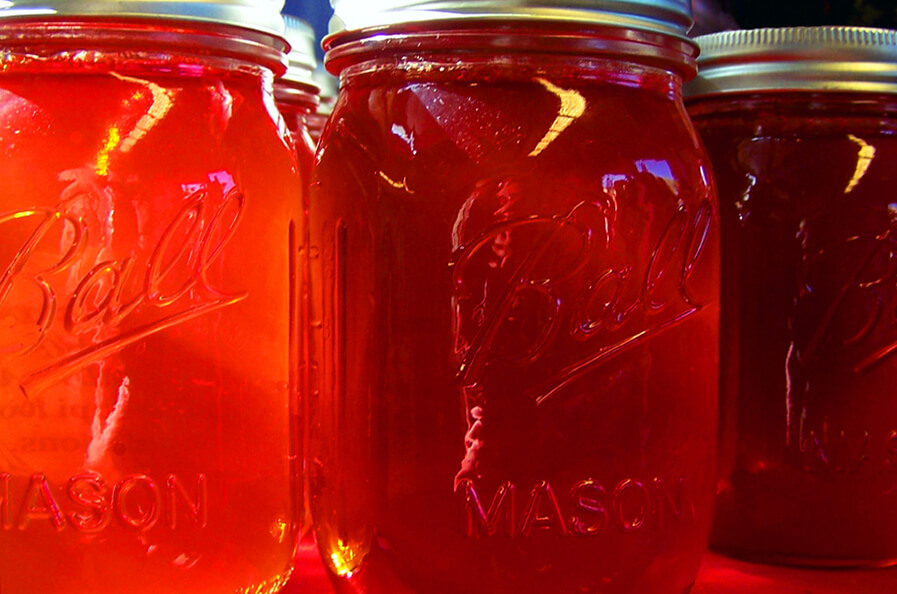
Homemade Sno-Cones

Bring to boil one cup of water, stir in one and a half cups sugar and a package of Kool-Aid. I like banana. Cool and refrigerate. A few drops of vanilla or almond extract–depending on the flavor–and a jigger or so of rum are suggested options. The syrup will thicken as it cools. Pour over finely crushed or shaved ice. Serve immediately.

Yancy’s Potluck Casserole

At some point in your life you’re going to impress the wrong person the right way and find yourself invited to a potluck supper, obliging you not only to be presentable and reasonably polite for up to two hours, but to bring food that is sure to please most everybody and won’t put the cheese tray in a bad light.

This dish fits the bill, doesn’t take a lot of time or money to make, works just as well for second weddings or canasta nights, and is always a big hit at cemetery homecomings. You’ll bring home an empty Pyrex whatever the occasion; it’s colorful, rich, buttery and, it must be said, “freezes beautifully”. This recipe provides a dozen or so 6 oz. servings.

Cook 1 pound extra-wide egg noodles, drain, drizzle lightly with vegetable oil, toss, and place in a large bowl. Add 2 cups diced and blanched celery and carrots, 2 cups frozen green peas (you can add these right to the mix), 3 cups shredded chicken (canned white is really good for this) and 2 cups diced ham. Toss with 1 stick melted butter and 2 cups freshly-grated Parmesan cheese. Bake in a casserole at 300 for about 20 minutes.

My Neighbor Wil

Wil lived around the corner from me in a sedate residential neighborhood in downtown Jackson, Mississippi. More than anyone I’ve ever known, Wil embodies the American Dream of work rewarded and a life well-lived. Here is his story for the world; it matters.

Wil as a toddler in Jackson, MS

I was born September 26, 1939, in a shotgun house on Farish Street in the heart of the black community. The neighborhood had four barbers, three restaurants, and two fast food restaurants for hamburgers, pig ears, smoked sausage, and sandwiches. We had our own grocery store, a cleaner, a shoe repair shop, a laundry, an ice cream parlor, and movie houses on Farish and Amite. We also had two funeral parlors, a bike shop, and a bus company that brought people from the country to sell their produce. Three doors from my house was a pool hall and a cab stand, and all my friends lived within a few blocks.

My aunt always told me I should try to make some money on my own, so I got a job at a beauty parlor on Capitol Street. It was owned by a guy named Baldwin, one of the biggest jerks who ever lived. He said he’d give me six dollars a week to shine shoes, but I couldn’t take tips. I was supposed to make six dollars a week, but he would give me five one week and four the next.

It went on like that for a while until I finally got tired of it and told my aunt. She said, “We’re going to go down and get your money.” She put her pistol in her purse, and we went to the beauty parlor. “Mr. Baldwin,” said my aunt, “you owe this boy six dollars, and you need to pay him.” Baldwin said, “Well, I’m not going to give him anything. He’s fired.” My aunt reached into her purse and pulled out her pistol, walked around the chair where he was standing and said, “You need to pay him his money.” And he did.

Our house at 518 Farish backed up on an alley across from Rodger’s Tailor Shop. Up the alley lived a lady bootlegger named Cara Lee, whose daughter was a whore. All kinds of trouble went on up there on Friday and Saturday nights, and, because my bed was under a window, I heard things I hoped I’d never hear again. Sometimes the police raided Cara Lee’s place, and one night a policeman shot our little cocker spaniel just because he was barking. At that, my aunt came out of the house with a Winchester rifle and told the policeman she might blow his brains out. A long, tense moment passed, and I was sure someone was going to get shot, but finally another officer came over and said, “Please ma’am, Lord to God, he was wrong to shoot your dog, and I’m sorry.” The policeman apologized, and my aunt huffed back into the house.

After all that, my aunt decided it was time for me to get back with my mother.  She said, “Son, you know I love you more than life, but if you stay here, either I’m going to be killed or you are. I think it’s time for you to go be with your parents.” Correspondence went back and forth, and in the summer of 1954, I left Jackson and went to Madison, Wisconsin, where my mother and stepfather rented a house in South Madison. The neighborhood was called “The Bush” and was made up entirely of blacks and Italians. I was surprised because every one got along fine.

My new school was Edgewood Sacred Heart Academy, where I was the sixth black among five hundred students. I didn’t do well in school; it was hard for me to concentrate because of the trouble I had at home. My stepfather was an alcoholic, and he couldn’t stand to see my mother and I growing close.

In 1958, I graduated from Edgewood with a C-minus average. Luckily, I was a good athlete and got an offer from Bishop College in Marshall, Texas. I played ball for them over a few semesters, when, out of the blue, my real father sent me a train ticket to come out to Los Angeles. I liked being with my father and planned to go to L.A. City College in the fall, but my grandmother died, and my mother insisted I come back to Farish Street for the funeral. My father begged me not to go, but I had to. I never saw my father again.

By 1961, I was living in Madison again. One snowy day, I was walking down Park Boulevard when two of my buddies and a woman drove by in a Volkswagen bug. I asked, “Where are you going?” They said, “We’re going to New York City.” I said, “Hold on, drive by the house, let me pick up some stuff!” That’s how I got to New York.

I’ll never forget standing on 6th Avenue thinking, “I’m in New York! I’m in the Village!” I moved into a little flea-bag hotel on 43rd Street and found a part-time job right around the corner. Everything was fine until I started going out with a woman who worked in the same place. It wasn’t long before our relationship got to a point where I felt trapped. I wanted to be free, but didn’t know what to do.

One morning, I was looking at the travel section of The New York Times when something caught my eye: a Yugoslavian freighter was due to sail out of Brooklyn for Tangier and Morocco, and you could get passage for $141. As soon as I saw that notice, I remembered the night back in L.A. when my father shook me awake. I said, “What’s the matter?” He said, “Dorothy’s in the kitchen.” I said, “So what?” He said, “She’s boiling water to make tea, and she don’t drink tea. Get dressed–we’re going to your sister’s.”

That was it. If you want to get free, all you have to do is leave. A few days later, I was on that Yugoslavian freighter bound for the Straits of Gibraltar.

The voyage lasted nine days. I had my own room, the food was excellent, and I got so drunk off slivovitz, I’ll never drink another drop of it. When I got off the boat in Morocco, a little Berber kid offered to carry my luggage. Now, I’d just gotten off the boat from New York, where you do NOT give someone your luggage. When I hesitated, the kid looked at me an said, “What’s wrong with you, black man? You’re home now!”

In Tangiers, I rented a room for seventy-five cents a day in a hotel near the Casbah. A few days later, I went to an American bar and was introduced to Mark Gilbey, who owned Gilbey’s Gin. We talked and had some drinks, and after a while, he invited me to a Christmas party. He had a fabulous place overlooking the Atlantic Ocean with a red room, a blue room, and so on.

I stayed in Morocco nine months, in Tangier, Affairs, Rabat, Casablanca, Marrakesh, and Showan. When I finally decided to leave, I crossed the Mediterranean to Spain. I loved the Spanish people, but when I got into France, I ran into problems. I didn’t speak French, and the natives were nasty about it. From Nice, I took a train into Rome. I was sitting on the Spanish Steps when a guy came up to me and said, “My name is Wilpert Bradley, I’m from Chicago, and I’m gay.” I shook his hand and said, “My name is Wil Cunningham, I’m from New York, and I’m straight.” He laughed and said, “Wil, you’re the first American I’ve met who didn’t take offense at that.” I said, “I’m travelling and living my life. Ain’t no problem.”

Bradley had come over with the “Cleopatra” film company. He had a big place over on Via Seccalle and let me a room in the back. That’s where I stayed for a year and a half.

A publicity photo of Wil in Italy

I did a little modeling, and I was in some spaghetti Westerns, made up as a Mexican bandito. I got fifty dollars a day to stand around and wait for them to shoot me and fall off the horse. It was fun–fifty dollars a day for doing nothing. When I’d made a little money, I’d go up in the Scandinavian countries. I just travelled, met people, travelling was cheap, I could get on the train and be in Paris in just a few hours. But Rome was my home. I could go away for four or five days and come back, and I had a place to stay.

Some friends were showing my Portfolio around to movie companies in Rome when my mother called with bad news. My step father was in the hospital with cirrhosis of the liver, and the doctors feared he would not make it. I thought it was time I should go home for a while–I could get back to Europe after the crisis was over. As it turned out, it would be years before I returned.

When I got back to New York, I stayed with a friend from UW and waited for instructions from mama. The friend was from New Rochelle, New York; that week-end, there was a party up there, and he asked me if I would like to go. That was one of the best things that ever happened to me, for it was at that party I met my wife-to-be. We had a great time together, and we fell in love.

Her father gave us good advice: “Get out of the city,” he told us. “Get out of New York. You’ll never make it there.” My stepfather was in a Madison hospital, and my mother was having a hard time. I talked it over with Beverly, and she said, “Let’s do it. Let’s go to Wisconsin.”

I fought my demons and finally reconciled with my stepfather. As for Bev, my mother thought of her as a daughter until the day mama died. Eventually, Bev and I found jobs, and in no time, we had our own place. That September, we went back to New York and got married.

I attended community college to see if I could get my grade average high enough that a university would accept me. Meanwhile, I got a job at a clothing store called “No Hassle.” The guy liked me a lot because I was very fashion-oriented, I had just come back from Rome, and I knew a lot about clothes and shoes. What I really wanted, though, was to open my own business.

After a year at the community college, I qualified to enroll at the University of Wisconsin, but the desire to open my own business was too strong, and I only stayed one semester. I reached out to a friend of mine, Lamont Jones from Mobile, Alabama, who had just gotten his MBA, and we wrote up a business plan for a woman’s shoe store.  He would handle the money, and I would be the buyer, something my time at “No Hassle” had prepared me for.

The problem was, Lamont and I had just two thousand dollars apiece and little credit. The Small Business Administration loaned us nine thousand, and in 1969, we finally opened our shoe store–“Compared To What”–on State Street in Madison, about three blocks from the university campus. Then we had another problem: we simply couldn’t get a credit line with any of the suppliers. When they sent us the shoes, we had to send them the money. We were selling shoes like mad, but we didn’t have a cash flow.

After five years, Lamont and I realized we had a losing proposition. We just couldn’t get ahead, and we still owed Small Business nine thousand dollars. We went down there to pay them off, and the guy said, “We can’t take cash.” I said, “You’re going to take cash today, and I want a receipt.” I counted out nine one-hundred-dollar bills, then Lamont and I split up the remainder: two thousand dollars each, same as we started with.

I decided I’d have to set aside my father-in-law’s advice and return to New York. I had contacts among shoe buyers and suppliers, and through them, I met the general manager of Thayer-McNeil, a division of Florsheim Shoes, in Manhattan. He made me manager of a store at 73rd Street and 3rd Avenue. I had been at Thayer-McNeil/Florsheim a year when a guy told me about a job with Converse. At that time, Converse had an office on the eighty-first floor of the Empire State Building. As soon as I walked in the door, the general manager said, “You’re hired. I like the way you walked in.” (I always dressed well as a salesman.) When the paperwork was finished, I was told my territory would be Brooklyn, a part of New York I knew nothing about.

They gave me a company car with a trunk-load of samples. Next day, the valet parked it in the garage while I went up to the eighty-first floor to check with the general manager. When I got to the car again, I drove across the Brooklyn Bridge and down Flatbush Avenue to my accounts. My first stop was a store that sold Converse; I went in and gave the manager my card. Luckily, business was slow, and the manager was glad to have someone to talk to. I went out to the car to get my samples from the trunk . . . and they were gone! I drove straight back to Manhattan, had the valet park my car, went up eighty-one stories, and said to the general manager, “Irving! I went to a store on Flatbush Avenue, went in to see the manager, came out to get my samples–and they were gone!” Irving closed his eyes for a moment, then said, “Earlier this morning, you parked in the garage downstairs, right?” I said, “Yes.” He said, “Next time, when you give the valet your keys, take the trunk key off the ring.” That was my first lesson on the new job.

Irving Cole taught me a lot when I was at Converse. My first time out with him, for example, he taught me to listen. We went into a store in Brooklyn, and before I could unpack my bags, the store manager started complaining about how hard it was to work with our company. He went on for a long time, using language that made me uncomfortable. Meanwhile, Irving never said a word, just let the guy vent. Finally, when the manager calmed down a little, Irving said “Let me apologize for the problem you have getting this shoe in your store.” Then he took out a notepad and asked what colors and sizes the guy needed, and how soon he would need them. When he had the information, he went to the store phone, called our customer service, and arranged for everything to be shipped next day.

After we left the store, Irving asked, “What were you thinking in there?” I told him the guy scared me, and if I’d been by myself, I probably would have walked out. “You got to listen,” Irving said. “The whole time we were in there, the guy never once said he didn’t want our product–he was mad because he couldn’t get it when he needed it. The secret to making a sale like that is not to overreact, but listen to what the guy really needs and see that he gets it. The most important thing you can do is listen.”

Will with Jimmy Conners, NYC

In November, 1975, I moved to the sporting goods division, which is where I should have been in the first place. My territory was all five boroughs of New York City. It was a ten-million-dollar account, and I made that and above. In addition, I was given the responsibility of signing pro athletes for Converse; I had the Jets, the Giants, the Knicks, the Jets, and the Yankees (I would go to spring training with the Yankees and make sure they had everything they needed.) Famous guys like Reggie Jackson, Larry Bird, Bernard King, and Larry Johnson would call me at home. Yogi Berra called once, and Spring, my youngest daughter, said, “Yogi the Bear is on the phone!”

I worked that job for twenty-nine years, trying to make a difference. Then, in 2000, I made up my mind that Converse was going nowhere. New owners were taking over, and they were looking to flip the company to the highest bidder. I knew I was not part of their plan, so I took my retirement. It was all right with Bev; she knew it was time.

After my stepfather died in 1996, my mother went home to Jackson, and I talked to Bev about moving down there to look after her. Bev was all for it; she loved mama and was like a daughter to her. We owned five acres in Madison County, and I had the dream of building a big house where all of us could live. In 2001, we moved south, back to the town I started out in. Before long, I realized my dream of building a big house in the country was not going to happen. First, every contractor we spoke to quoted a price way out of our range. Second, I discovered that, no matter how much two women might love each other, each wants her own place.

Bev and I ended up buying a beautiful little house on Kenwood Street in Belhaven. The neighborhood is old and peaceful, and I looked forward to reconnecting with people I’d known as a teenager. As it turned out, this was another dream that, if not lost, was deferred.

One day I brought my oldest friend to the house we had bought. When we got out of the car, I noticed he was hanging back a little, as if he were confused. “Why did you buy a house here?” he asked.  “We never came over here when we were kids. Who do you know lives here?” I said, “I was told there’s only one other black owns a house in Belhaven. Now there’s two.” He had nothing to say after that. Another time, Bev and I invited about ten people over for coffee. The men were uncomfortable, and the women sat with their purses in their laps and said little or nothing. These people will always be friends of ours, and we hope that, one day, whatever discomfort they felt will be a thing of the past.

Farish Street is empty now; all the life is washed out of it, and it will never again be like it was when I was a kid. We can’t return to the past, and often it’s hard to catch up to the present, yet, after eighty years, I find myself looking down the road to bridges I’d like to cross. All I can say now is what I said to Wilpert Bradley on the Spanish Steps so many years ago: “I’m travelling and living my life. Ain’t no problem.”

Vanilla Lemonade

Juice and peel a lemon. Stir a cup of white sugar into a cup of water, add the lemon peel, and bring to a boil. Reduce heat, add a tablespoon of vanilla extract or two vanilla beans, and simmer for a minute or two.  Stir into six cups of water with the strained lemon juice.  Chill before serving.

Welty, the WPA, and Mississippi Food

This text is from a pamphlet that Eudora Welty wrote for and was distributed by the Mississippi Advertising Commission in 1936. Bearing that in mind, the simplicity of the recipes and the appeal to “Old South” sensibilities are better understood. This essay was selected by the Federal Writers’ Project only a short time before the publication of A Curtain of Green in 1941, a work that established Welty as a leading light in American letters, a position she still holds.

Stark Young, in his book Feliciana, tells how a proud and lovely Southern lady, famous for her dinner table and for her closely guarded recipes, temporarily forgot how a certain dish was prepared. She asked her Creole cook, whom she herself had taught, for the recipe. The cook wouldn’t give it back. Still highly revered, recipes in the South are no longer quite so literally guarded. Generosity has touched the art of cooking, and now and then, it is said, a Southern lady will give another Southern lady her favorite recipe and even include all the ingredients, down to that magical little touch that makes all the difference. In the following recipes, gleaned from ante-bellum homes in various parts of Mississippi, nothing is held back. That is guaranteed. Yankees are welcome to make these dishes. Follow the directions and success is assured.

Port Gibson, Mississippi, which General Grant on one occasion declared was “too beautiful to burn,” is the source of a group of noble old recipes. “Too beautiful to burn” by far are the jellied apples which Mrs. Herschel D. Brownlee makes and the recipe for which she parts with as follows:

JELLIED APPLES

Pare and core one dozen apples of a variety which will jell successfully. Winesap and Jonathan are both good. To each dozen apples moisten well two and one-half cups of sugar. Allow this to boil for about five minutes. Then immerse apples in this syrup, allowing plenty of room about each apple. Add the juice of one-half lemon, cover closely, and allow to cook slowly until apples appear somewhat clear. Close watching and frequent turning is necessary to prevent them from falling apart. Remove from stove and fill centers with a mixture of chopped raisins, pecans, and crystallized ginger, the latter adding very much to the flavor of the finished dish. Sprinkle each apple with granulated sugar and baste several times with the thickening syrup, then place in a 350-degree oven to glaze without cover on vessel. Baste several times during this last process.

Mrs. Brownlee stuffs eggs with spinach and serves with a special sauce, the effect of which is amazingly good. Here is the secret revealed:

STUFFED EGGS

12 eggs
1 lb. can of spinach or equal amount of fresh spinach
1 small onion, cut fine
salt and pepper to taste
juice of 1 lemon or ½ cup vinegar
½ cup melted butter or oil
1 large can mushroom soup.

Boil eggs hard, peel, and cut lengthwise. Mash yolks fine. Add butter, seasoning, and spinach. Stuff each half egg, press together, and pour over them mushroom soup thickened with cornstarch, and chopped pimento for color.

Last of all, Mrs. Brownlee gives us this old recipe for lye hominy, which will awaken many a fond memory in the hearts of expatriate Southerners living far, far away.

LYE HOMINY

1 gallon shelled corn
12 quart oak ashes salt to taste
Boil corn about three hours, or until the husk comes off, with oak ashes which must be tied in a bag—a small sugar sack will answer. Then wash in three waters. Cook a second time about four hours, or until tender. -An all day job: adds Mrs. Brownlee.

One of the things Southerners do on plantations is give big barbecues. For miles around, “Alinda Gables,” a plantation in the Delta near Greenwood, is right well spoken of for its barbecued chicken and spare ribs. Mr. and Mrs. Allen Hobbs, of “Alinda Gables,” here tells you what to do with every three-pound chicken you mean to barbecue:

BARBECUE SAUCE

1 pint Wesson oil
2 pounds butter
5 bottles barbecue sauce (12 ounce bottles)
1/2 pint vinegar
1 cup lemon juice
2 bottles tomato catsup (14 ounce bottles)
1 bottle Worcestershire sauce (10 ounce bottles)
1 tablespoon Tabasco sauce
2 buttons garlic, chopped fine salt and pepper to taste

This will barbecue eight chickens weighing from 242 to 3 pounds. In barbecuing, says Mrs. Hobbs, keep a slow fire and have live coals to add during the process of cooking, which takes about two hours. The secret lies in the slow cooking and the constant mopping of the meat with the sauce. Keep the chickens wet at all times and turn often. If hotter sauce is desired, add red pepper and more Tabasco sauce.

Mrs. James Milton Acker, whose home, “The Magnolias,” in north Mississippi is equally famous for barbecue parties under the magnificent magnolia trees on the lawn, gives a recipe which is simpler and equally delightful: • Heat together: 4 ounces vinegar, 14 ounces catsup, 3 ounces Worcestershire sauce, the juice of 1 lemon, 2 tablespoons salt, red and black pepper to taste, and 4 ounces butter. Baste the meat constantly while cooking.

Pass Christian, Mississippi, an ancient resort where the most brilliant society of the eighteenth century used to gather during the season, is awakened each morning by the familiar cry, “Oyster ma-an from Pass Christi-a-an!” It would take everything the oyster man had to prepare this seafood gumbo as the chef at Inn-by-the-Sea, Pass Christian, orders it:

SEAFOOD GUMBO

2 quarts okra, sliced
large green peppers
1 large stalk celery
6 medium sized onions
1 bunch parsley
½ quart diced ham
2 cans #2 tomatoes
2 cans tomato paste
3 pounds cleaned shrimp
2 dozen hard crabs, cleaned and broken into bits
100 oysters and juice
½ cup bacon drippings
1 cup flour small bundle of bay leaf and thyme
salt and pepper to taste
1 teaspoon Lea & Perrins Sauce
1 gallon chicken or ham stock

Put ham in pot and smother until done. Then add sliced okra, and also celery, peppers, onions, and parsley all ground together. Cover and cook until well done. Then add tomatoes and tomato paste. Next put in the shrimp, crabs, crab meat and oysters. Make brown roux of bacon dripping and flour and add to the above. Add the soup stock, and throw into pot bay leaves and thyme, salt and pepper, and Lea & Perrins Sauce. This makes three gallons of gumbo. Add one tablespoon of steamed rice to each serving.

The chef at Inn-by-the-Sea fries his chickens deliciously too. He uses pound or pound-and-a-half size fowls. Dressed and drawn, they are cut into halves and dipped into batter made of one egg slightly beaten to which one cup of sweet milk has been added, as well as salt and pepper. The halves of chicken are dipped and thoroughly wetted in the batter and then dredged well in dry, plain flour. The chef fries the chicken in deep hot fat until they are well done and a golden brown. He says be careful not to fry too fast.

Two other seafood recipes from the Mississippi Coast come out of Biloxi, that cosmopolitan city that began back in 1669, and where even today the European custom of blessing the fleet at the opening of the shrimp season is ceremoniously observed. “Fish court bouillon” is a magical name on the Coast, it is spoken in soft voice by the diner, the waiter, and the chef alike; its recipe should be accorded the highest respect; it should be made up to the letter, and without delay:

FISH COURT BOUILLON

5 or 6 onions
1 bunch parsley
2 or 4 pieces celery
4 pieces garlic
6 small cans tomatoes
1 or 2 bay leaves hot peppers to taste

Cut up fine, fry brown, and let simmer for about an hour, slowly. Prepare the fish, and put into the gravy. Do not stir. Cook until fish is done. This will serve 8 to 10 people; for 10 or more double the ingredients. To prepare fish, fry without cornmeal, and put in a plate or pan. Pour a portion of the gravy over it, and let it set for a while. Just before serving, pour the rest of the hot gravy over the fish.

Another valuable Coast recipe which comes from Biloxi is that for Okra Gumbo.

OKRA GUMBO

2 or 3 onions
½ bunch parsley
5 or 6 pieces celery
1 small piece garlic
4 cans of okra, or a dozen fresh pieces
1 can tomatoes
1 pound veal stew, or 1 slice raw ham

Cut all ingredients in small pieces and fry brown. Let simmer for a while. If shrimp are desired, pick and par-boil them and add to the ingredients the shrimp and the water in which they were boiled. If oysters or crab meat is desired, add to gumbo about twenty minutes before done. Add as much water as desired.

Aberdeen, Mississippi, is a good Southern town to find recipes. Old plantations along the Tombigbee River centered their social life in Aberdeen as far back as the 1840’s, and some of the recipes that were used in those days are still being made up in this part of the country.

Mrs. C. L. Lubb, of Aberdeen, uses this recipe for beaten biscuit:

BEATEN BISCUIT

4 cups flour, measured before sifting 3/4 cup lard 1 teaspoon salt 4 teaspoons sugar enough ice water and milk to make a stiff dough (about Y2 cup). Break 150 times until the dough pops. Roll out and cut, and prick with a fork. Bake in a 400-degree oven. When biscuits are a light brown, turn off the heat and leave them in the oven with the door open until they sink well, to make them done in the middle.

Mrs. Bicknell T. Eubanks, also of Aberdeen, prepares Spanish rice this way.

SPANISH RICE

4 tablespoons oil
1 cup rice
1 onion, sliced
1 green pepper, chopped
1 quart canned tomatoes
2 teaspoons salt, a little less than ½ teaspoon pepper

Heat 2 tablespoons oil in large frying pan and add rice. Cook until brown, stirring constantly. Cook remaining 2 tablespoons oil with onion and green pepper until the onion is yellow and tender. Combine with rice. Add tomatoes and let it simmer until the rice is tender, stirring constantly. Add a little hot tomato juice if the rice seems dry. Add seasonings. Serves 6.

Vicksburg, in the old steamboat days Mississippi’s wicked, wide-open town, lived high with all the trimmings. Perched on the bluffs overlooking the Mississippi, it is famous still for its excellent catfish. The disarmingly simple recipe for preparing it is here given: Take a catfish weighing 12 pound. Season well with salt and pepper, and roll in cornmeal. Use a pot of deep fat with temperature of 360 degrees. Place the fish in the pot and fry until done. Serve very hot.

To go along with the fish, the Hotel Vicksburg serves a wickedly hot potato salad, prepared as follows:

1 quart sliced potatoes (cooked)
6 pieces chopped crisp bacon
3 chopped hard boiled eggs
1 minced large green pepper
2 minced pimentos
4 tablespoons mayonnaise
2 tablespoons prepared mustard
salt and pepper to taste

Mix and serve with quartered tomatoes, sliced dill pickles, mixed sweet pickles, and quartered onions.

A collection of recipes from the Old South is no more complete than the Old South itself without that magic ingredient, the mint julep. In the fine old city of Columbus, in the northeastern part of the state, hospitality for many years is said to have reached its height in “Whitehall,” the home of Mr. and Mrs. T. C. Billups. “The drink is refreshing,” says Mrs. Billups, needlessly enough, “and carries with it all the charm of the Old South when life was less strenuous than it is today; when brave men and beautiful women loved and laughed and danced the hours away, but in their serious moments, which were many, aspired to develop minds and souls that made them among the finest people this old world has known.” The “Whitehall” recipe is as follows:

MINT JULEP

Have silver goblet thoroughly chilled. Take half lump sugar and dissolve in tablespoon water. Take single leaf mint and bruise it between fingers, dropping it into dissolved sugar. Strain after stirring. Fill the goblet with crushed ice, to capacity. Pour in all the bourbon whiskey the goblet will hold. Put a sprig of mint in the top of the goblet, for bouquet. Let goblet stand until FROSTED. Serve rapidly.

Who could ask for anything more?

Kennedy’s Salsa Cruda

“You will find this sauce on Mexican tables at any time of day, for it goes well with breakfast eggs, with roasted or broiled meats at lunchtime, or tacos at evening, and there are people who put a spoonful of it into their frijoles de olla. It is marvelously crunchy and refreshing served just with tortillas. The Sinaloa version calls for some scallions and lime juice in place of the onions and water, and the Yucatecan version substitutes Seville orange juice for the water.

Finely dice fresh ripe tomatoes, onion, and serrano peppers with seeds in equal amounts. Mix well with fresh chopped cilantro, add liquid and salt to taste. Although this can be made up to three hours ahead, it is best made at almost the last minute, for it soon loses its crispness and the coriander its sharp flavor.”

Red Rose Sausage

You’ll find imitation smoked sausages sold in ropes across the Lower South, most often in the freezer section. In central Mississippi, our signature brand is Red Rose, which was originally produced by the Jackson Packing Company in 1945. Polk’s Meat Products (“Picky People Pick Polk’s”) in Magee purchased the brand in 1990. Two landmark restaurants in Jackson, the Beatty Street Grocery and the Big Apple Inn on Farish, offer Red Rose, and Polk’s gets plenty mail orders from expatriated Mississippians who loved and remember Red Rose on the table.

Of Fish and Fists

Grabbling is the most unsophisticated form of angling. Fly fishing seems downright effete in comparison; forget fussing with those artsy little hand-tied flies, forget about the L.L. Bean creel, forget about the custom-made rod, just stick your hand down in a hole under the water. It’s breathtakingly fundamental.

When grabbling, it goes unsaid that you’re fishing for catfish, which tend to hole up in hollow logs or under stumps in the spring. Unlike suicidal salmon that exhaust themselves in long-distance spawning, the sensible Southern catfish conducts a more sedate courtship by making a bed and putting out a red light.

In the old days, grabblers used to sink hollow logs in selected places before the fish begin spawning in April in order to lure the catfish into them, but nowadays most folks use man-made beds. I talked to one guy who said you can use big tires, too, but the disadvantage to that is that the fish can scoot around inside the tire, making them devilishly hard to catch. The location of these beds is a guarded secret among serious grabblers who sink them in the fall and come back when the water has warmed up in the spring.

Grabbling might well be the ultimate expression of angler machismo as well. It takes true grit to stick your bare hand in a hole under water. After all, there’s no guarantee that what you’re going to grab is a catfish. We grow some mighty big snapping turtles in Mississippi that can easily nip off a finger or two if tempted to do so, and it takes little to tempt a snapper, especially when he’s holed up in a sunken hollow log or a catfish box with minnows on his mind.

We also have a nasty variety of pit viper here called a cottonmouth moccasin. I’ve heard it rumored all my life that grabblers aren’t afraid of cottonmouths because these snakes aren’t supposed to be able to open their mouths under water, but bear in mind their scientific name, piscivorus, means “fish-eating.”

Fortunately for those of us who simply lack the opportunities to haul protesting fish out of the water with our bare hands, there are easier ways to get catfish. Mississippi is, after all, the buckle of the Catfish Belt. We can get fresh or “fresh frozen” (love that term) catfish in your local grocery any time.

Elitists deride catfish but, to quote Twain, “The catfish is a good enough fish for anybody,” and I fall back on that high word. In the South, catfish, like almost any other sort of meat, is most often fried, and there’s nothing better than a platter of fried catfish and a litter of hush puppies. But however rewarding, frying catfish is just as messy and time-consuming as frying chicken. And while simply baking or broiling fish is easy and healthy, it’s also boring.

So what I’m going to give you here is a simple sauce recipe for baked or broiled catfish that takes it to another level. Beurre blanc is a classic emulsion, as are mayonnaise and Hollandaise, but “white butter” is far less tricky and far more stable. It’s a cold emulsion, like mayo, but it doesn’t involve an agglutination of proteins. Buerre blanc is simply butter whipped with wine, shallots and herbs.

Catfish with beurre blanc

One 8-oz. fillet of catfish per person. Score the fillets lightly, brush with a bit of (unsalted) butter; bake in a hot oven until done through. Beforehand, reduce 1/2 cup good white wine and two tablespoons lemon juice by about half. Add three tablespoons of very,very finely minced shallots, a dash of white pepper and a pinch of salt. Then gradually whip in 1/4 pound of unsalted butter over very low heat until thoroughly incorporated. Tarragon and dill (though I don’t recommend using them together) are most often used for flavor, and parsley is always appropriate. Slather sauce on fish and serve.

Menu for a Delta Wedding

Food–unlike guns, whoring, or horses–rarely plays a significant role in fiction; most often food works as an aspect of character.

Adam Gopnik lists four kinds of fictional food: “Food that is served by an author to characters who are not expected to taste it; food that is served by an author to characters in order to show who they are; food that an author cooks for characters in order to eat it with them; and, last (and most recent), food that an author cooks for characters but actually serves to the reader.”

As an example for a writer who uses food in fiction to illuminate character (and they seem predominant) Gopnik serves up a soupcon of Proust. “Proust will say that someone is eating a meal of gigot with sauce béarnaise, but he seldom says that the character had a delicious meal of gigot with sauce béarnaise—although he will extend his adjectives to the weather, or the view. He uses food as a sign of something else.”

Similarly, Welty, in Delta Wedding, employs food to signify the collective character (social status) of the families as well as to highlight individuals. Though three main meals are described–a rehearsal supper, the wedding feast itself and a picnic afterwards–people are eating all the time on almost every page of Welty’s book. This listing could very well be offered as a textbook example of foods served in a well-to-do household in the South during the Coolidge administration.

Coconut cake, sugared almonds, cold biscuits with ham, sugar cane (likely left on the porch for the children to peel and chew), homemade fudge, wedding cake (made in Memphis), chicken salad, “Mary Denis demanded a cold lobster aspic involving moving the world . . . of course we moved it”, stuffed green peppers, hoe cakes and ash cakes, chicken broth, Coca-Cola, barbecue (most likely pork), the patty cake gift for George Fairchild (made with white dove blood, dove heart, snake blood and other things; he’s to eat it alone at midnight, go to bed and his love will have no rest till she comes back to him), licorice sticks, crusted-over wine balls, pink-covered ginger Stage Planks, bananas and cheese, pickles, a mousse (probably chocolate), chicken and ham, dressing and gravy, black snap beans, greens, butter beans, okra, corn on the cob, “all kinds of relish”, watermelon rind preserves, “that good bread” (likely yeast bread), mint leaves “blackened” (bruised) in the tea, whole peaches in syrup, cornucopia (horns of pastry filled with cream or fruit), guinea hen, roast turkey and ham, beaten biscuits (an “aristocratic” Eastern seaboard recipe: i.e. blistered biscuits), chicken salad, homemade green and white mints, fruit punch, batter bread and shad roe, ice cream, chicken and turkey sandwiches, caramel and coconut cakes, lemon chiffon pie, watermelons and greens.

As much as I want to call this a complete list of a Mississippi sideboard, it’s likely not. When it comes to Welty, who is subtle, understated, and knows food as few writers do, it’s easy to miss things, which is an excellent excuse (should you need one) to read Delta Wedding again, if not for the first time.

A Guerilla Garden in Mississippi

Until we begin colonizing the moon and Mars—and eventually we will—this big blue marble is all we’ve got. Some smart person with a lot of time on his hands took what figures he could find about arable land on the planet and figured out that if there were an allotment, for now at least, everybody on the planet would get about one acre of land.

But there is no allotment; most people don’t have any land, and the people who own the most land aren’t gardeners or farmer or even people. Most land is owned by governments and corporations.


Sometime near the end of the first World War, Winston Churchill, who was minister of munitions at the time, told the soldier-poet Siegfried Sassoon, who was opposed to the conflict, that war was the natural occupation of mankind. Sassoon asked him if he was sure about that, so Churchill said, “Well, war—and gardening.” Churchill, a wealthy aristocrat, had plenty of land at Chartwell for gardens. They’re still maintained today.


But the rest of us don’t, and this is where war and gardening meet. I say this is a solution for urban emptiness, and that’s the way I see it. Guerrilla gardening is one solution for the inevitable barrenness and ugliness of urban, even suburban and ofttimes rural existence.


Simply put, guerrilla gardening is the illicit cultivation of someone else’s land. That guy is my brother. In spirit. That logo of the hand holding the rose is the symbol of the Democratic Socialists of America, a movement that many people have compared to Roosevelt’s “New Deal” and Johnson’s “Great Society”, but more like Eugene Debs’ Socialist Party of America which in 1912 received 6% of the presidential vote. “Guerrilla” itself means “little war” and was coined to describe the Spanish resistance fighters against Napoleon’s troops during the Peninsular War of 1807-1814. This is Goya’s Los fusilamientos del tres de mayo (“The Shootings of May Third”) painted in 1808.


Che Guevara was as militant as we get, but even he admitted that, “It is tractor and tank at the same time breaking down the walls of the great estates…” Latino cultures across the western hemisphere have adopted guerrilla gardening tactics. Some of you may have seen The Milagro Beanfield War, a 1988 American directed by Robert Redford based on a novel by John Nichols. The film is about one man’s struggle as he defends his small beanfield and his community against much larger business and state political interests I’ll bet you never thought you’d see Mao in a cotton patch, but there he is. Mao—oddly reflective of Churchill—said, “There is no profound difference between the farmer and the soldier.”


In America, our most famous guerrilla gardener was a nut named John Chapman who became known as Johnny Appleseed. This guy is an icon now, but he was actually a religious nut who planted apples that were only good for making hard cider and applejack. Then we have Lady Bird, who perpetuated the spirit of guerrilla gardening, but was about as far from a guerrilla gardener you can get. If you were married to LBJ, you could damn near get away with anything.


But the true founder, the mother of what we know of as guerrilla gardening, the woman who coined the phrase is Liz Christy. In 1973, she spearheaded the creation of the Bowery Houston Community Farm Garden, working with the Green Guerillas, a community activist group who improved abandoned open spaces and worked to establish community gardens in New York City. Between 1974 and 1981 she hosted the “Grow Your Own” radio program in New York City, covering such topics as urban forestry, community gardens, community design and planning, and the environment.


Here’s the garden’s beginning. Looks like a typical trashy lot in any city. Jackson has hundreds of them right downtown.


And here’s a view of the garden almost fifty years later. The Liz Christy Bowery Houston Garden is the first and oldest community garden in New York city. Located at the corner of the Bowery and Houston Street in Manhattan and running across to 2nd Avenue.


When Richard Reynolds began planting flowers secretly at night outside his tower block in South London he had no idea he was part of a growing global movement committed to combating the forces of neglect, land shortage and apathy towards public spaces. But his blog GuerrillaGardening.org attracted other guerrillas from around the world to share their experiences of the horticultural front line with him and become a focal point for guerrilla gardeners everywhere.


His book, On Guerrilla Gardening is a lively colorful treatise about why people illicitly cultivate land and how to do it. Now it’s an international movement. This is a screenshot of the organization’s homepage. The site includes a lot of information you’ll find in the book as well as updates on happenings around the globe and lots of news and photos.


And then we have Jackson. These are some shots I took downtown, and they look the same now, except the King Edward has been cleaned up.


In 2009, I began a garden on a deserted street corner in Jackson. Here’s what it looked like in the beginning.


And here’s what it looked like in 2022, before I had to leave Jackson.


I really want to emphasize that I did all this work myself, with very little help, not to brag so much as to warn you that undertaking a project like this takes a lot of dedication. I also didn’t have a car, and certainly don’t have much money. About the fifth year, I began getting pass-along plants from others, and that was a constant source of joy as well as fellowship. I got pots and other sorts of containers, bamboo stakes and other stuff, but I’ve made it a point of never soliciting anything unless it’s for a particular project, like the cast-off poinsettias and Easter lilies or used hummingbird feeders.

The corner garden has since been destroyed and there’s nothing I could have done to save it. But for a while, something wonderful happened. There’s so much more that can be said, but this will do. Now, get out there and find a place to take action. Make something beautiful.