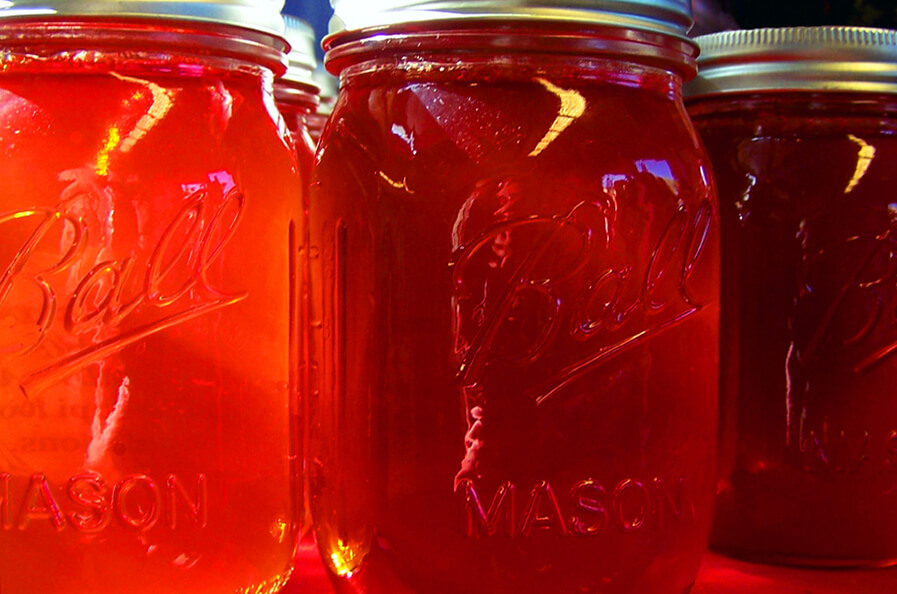
Lemon Ice

Stir well a cup of sugar, a half cup lemon juice, and a teaespoon of vanilla into a quart of finely crushed ice. Freeze for an hour or so before serving with ginger snaps.

Poppy Seed Pound Cake

A friend from Texas—east Texas, mind you—now living in Maine said their neighbors considered pound cake “Southern” because the ingredients are cheap and the recipe–a 16 ounces each of sugar, flour,, milk, and eggs, is comprehensible to illiterate shit kickers. Well, dear hearts, those are the very reasons Americans from any turf have baked this cake well before Burr shot Hamilton. This recipe is a felony with fruit, a mortal sin with ice cream.

Preheat oven to 350 (a crucial step). Grease, line, and set aside a 10-inch loaf pan or Bundt. Cream 2 cups sugar with a cup of softened butter. Stir in two tablespoons of poppy seeds, a cup of buttermilk, 4 beaten eggs, and at least a tablespoon of vanilla extract. Sift 3 cups of plain flour with a teaspoon each of baking powder and soda. Gradually blend with liquid mix until smooth. Bake for an hour, then turn the oven off and leave the cake in until the oven has cooled. Rest on a rack at least an hour before slicing.

Broiled Catfish

Score whole fish and pat dry; this is an important step. Slather with softened butter flavored with thyme, pepper, and paprika. Place in a well-oiled pan, add  lemons with juice, and put in a hot oven until fish flakes to the bone. Add a final squeeze of lemon  with pats of butter before serving.

Wolf Songs

“Cantaloupe” in the Deep South mostly sounds something like “canna-lope,” without a hint of a ‘t’, but Bill Neale saw it spelt “CAN’T ELOPE” on a roadside sign in North Carolina, and a buddy of mine calls them “Romeos and Juliets”. This appellation brings us to an Italian communi near Rome, one of several Italian towns called “Cantaloupo,” (“song of the wolf” or literally “sings wolf”) where this variety of melon arrived in Europe from (of all places) Armenia in the early 18th century. The cantaloupe didn’t become a commercial crop in the US until the early 20th century. The earliest popular variety was ‘Rocky Ford’, but nowadays  ‘Ambrosia’ and ‘El Gordo’ dominate the market.

Incidentally, the European cantaloupe, Cucumis melo var. cantalupensis, is lightly ribbed with a gray-green skin; the American cantaloupe, C. melo var. reticulatus, has a webbed skin. It’s worth noting that the name “musk melon” comes from the pronounced aroma of the uncut fruit; a related group of scentless  melons including honeydews, Canary, and Santa Claus are termed inodorata.

Docteur Magnol

Pierre Magnol was born in 1638 to an apothecary’s family in Montpellier. He enrolled as a medical student at the University of Montpellier in May 1655.

By Magnol’s time, Montpellier was an important, long-established commercial and educational center. Montpellier was the first university in France to establish a botanic garden for medicine and pharmacology. After receiving his degree (MD) in 1659, Mangol’s attention shifted to botany. In 1687, he became Demonstrator of Plants at the botanic garden. Magnol was appointed Director of the Montpellier botanic garden in 1696, later Inspector of the Garden until his death in 1715. Magnol’s most important contribution is the concept of plant families. He developed 76 tables, which not only grouped plants into families but also allowed for easy and rapid identification, an important step towards a tree of life.

Magnolia in botanical nomenclature first appeared in Charles Plumier’s Genera (1702) for a flowering tree in Martinique. Much closer to home, William Sherard, who studied botany under Tournefort, a pupil of Magnol, adopted the name Magnolia in the taxonomy of Mark Catesby’s Natural History of Carolina, Florida and the Bahama Islands (1730) for another flowering tree. Linnaeus likely never saw a specimen of Plumier’s Magnolia, if one even existed, and took it—quite despite the yawning geographic disparity—for the same plant described by Catesby.

Things eventually ironed out. Initially, Linnaeus described a monotypic genus, with the sole species being Magnolia virginiana—which we know as the sweetbay magnolia—and assigned it five varieties. He later raised these to species status. The Madagascan plant Plumier described is now known as Magnolia dodecapetala. The name Magnol now adorns a genus with anywhere from 210 to 340 species (we have 8 in the southeastern US), a family (Magnoliaceae) with two genera, Magnolia and Liriodendron (tulip trees), and division (Magnoliids) with more than 10,000 species.

Pudding Bananas

Listen to Jesse. When you make banana pudding, you must use ripe bananas. If the fruit has even the merest tinge of green on the ribs, it will be firm and bitter, which is not what you want.

If you find ripe bananas in the grocery, they’ll be severely marked down; I think the public has been conditioned by years of buying green bananas that any banana with a dark spot is spurned. So most often, you have to buy them a bit green. Fortunately, bananas are climacteric, ripening after picking. My daddy, who was stationed in the Pacific during WWII, knew quite well how a ripe banana tasted, and put bunches on top of the refrigerator–where as an added plus his children couldn’t reach them–to ripen.

Put green grocery bananas in a paper sack–plastic doesn’t let the fruit breathe–and give it a good twist to keep out fruit flies. In two or three days, when the fruit is soft and aromatic you’re ready to make banana pudding. Or banana pound cake. Or peel and eat.

The Dragon Peach

The sun was well up, blaring over the trees when I parked in front of Rick’s apartment building. He stepped out of his door wearing a straw fedora and linen jacket, worn chinos, and canvas loafers, the very picture of a dirt road dandy gone to seed.

Watching him wrangle his legs down the steep stairs, Ricky suddenly seemed frail to me, and I felt a pang in my chest. I’d known hm for less than five years, but in those years, I’d come to love him like a brother; he’d filled my losses, propped me up, and pushed me back into a life I could lead on my own. He claimed to be sixty-eight, but he said a lot of things I didn’t question.

He clambered into my old truck and we headed to Linda’s market north of downtown. The market sits far back from traffic under a long tin roof, a colorful oasis in a dull, hot desert of asphalt surrounded by cars parked without regard to space or bearing. As we drew closer, we could hear the shuffling rattle of a homemade pea sheller.

Under the roof, our eyes adjusted to the shade and found melons mottled and striped, green-upon-green, blazing red cayennes, motley purple peas, and speckled beans. We paused over the corn, looking for fresh ears with tight shucks, green stem ends, and sweet-smelling tassels. We chose cucumbers that were slightly under-ripe, firm, and shading to jade.

The tin roof popped as the sun bore down. Ricky walked over to the peaches, rows of baskets filled with Chilton County Elbertas, saffron blushing to carmine, some with stems and leaves. Over these he lingered, walking back and forth, occasionally reaching down to brush one with his fingers, picking another up, holding it to his nose, and putting it down.

I brought him a paper sack and shook it open with a pop. “What do you look for?” I asked.

Ricky snapped out of his reverie, looked at me and smiled. “A dragon,” he said.

“Jackson, Mississippi is nowhere near Middle-Earth, Ricky.”

“Yancy, listen for once,” he said. (As if I didn’t always.)

“The world is full of magical and wonderful things. A few of them amaze you so much you can’t get rid of them,” he said. “Those are the dragons, the ones you keep looking for. I remember this peach from a basket in Tupelo. When I bit into it, suddenly I couldn’t see, I couldn’t hear. That peach just sucked everything out of me, and all I could do was eat that peach, and I’ve spent the rest of my life buying lousy peaches chasing that dragon.”

We loaded our sacks in the truck. As we were pulling onto the highway, Ricky reached into the back, rummaged around and pulled out a peach. He wiped it with the handkerchief he kept in his back pocket, turned it around in his hand, and took a bite. I looked at him expectantly. He smiled and shook his head, rolled down the window, and threw it out.

“I’ll find it one day,” he said, and my heart broke.

Peach Melba

For sheer succulence, few fruits on earth can match a ripe-on-point peach fresh off the tree, and Escoffier affirmed the fruit’s supremacy when he created a superb yet simple dish to celebrate Dame Nellie Melba.

A skilled pianist and organist as a youngster, Helen Mitchell did not study singing until in her twenties. She made her operatic debut as Gilda in Verdi’s Rigoletto in 1887 at Brussels under the name Melba, derived from that of the city of Melbourne. Until 1926 she sang in the principal opera houses of Europe and the United States, particularly Covent Garden and the Metropolitan Opera, excelling in Delibes’s Lakmé, as Marguerite in Gounod’s Faust, and as Violetta in Verdi’s La traviata. She was created a Dame of the British Empire in 1918. She returned to Melbourne in 1926.

Melba was not known as a Wagnerian singer, although she occasionally sang Elsa in Lohengrin, which she did to acclaim in 1892, at Covent Garden. The Duke of Orléans gave a dinner party at the Savoy to celebrate her triumph. For the occasion, Escoffier created a new dessert, and for display he used an ice sculpture of a swan, which is featured in the opera. The swan carried peaches topped with spun sugar which rested on a bed of vanilla ice cream. In 1900, Escoffier created a new version of the dessert for the occasion of the opening of the Carlton Hotel, where he was head chef. Escoffier topped the peaches with sweet raspberry purée.

Incidentally, in 1897, Nellie, who was “slimming,” complained that her bread was much too thick and sent it to Escoffier in the Savoy kitchen. The chef returned to her table with a thinly sliced piece of toasted bread and promptly named it Melba toast in her honor.

The original dessert used simple ingredients: “tender and very ripe peaches, vanilla ice cream, and a purée of sugared raspberry”. Escoffier said that any variation on his recipe “ruins the delicate balance of its taste.”

Doe’s Eat Place: the Beginnings

The following is an excerpt from Paul V. Canonici’s The Delta Italians, a two-volume work published by the author in 2013, “a compilation of stories and experiences of early Italian settlers in the Arkansas and Mississippi Delta. Some of the content is documented history, but most consists of bits and pieces of family stories that have survived the test of time and memory.”

Salvadore Signa said in a 1976 interview that he was born in 1902 in a small shotgun house, St. Michael’s Parish, Louisiana, across the Mississippi River from Donaldsonville. His father Carmelo Signa worked in the sugar cane fields. When Salvador was still an infant, Carmelo moved his family to Vicksburg and worked in a fruit stand at the corner of Clay and Washington Streets. In 1912, when Salvador was ten years old, Carmelo Signa moved to Greenville and opened a grocery store at the corner of Hinds and Nelson Streets. The Signa family lived in a small house behind the store in a predominantly African-American neighborhood.

Carmelo Signa and his wife Mattea Maucelli had twelve children: Lena, Carmelo, Jr., Frances, Dominic E., Antonia, Josephine, Sarah, Paule, Rosalie, Frank, Santo and Lucille. Son Salvador had a career with the post office. Dominic work for the Corps of Engineers but on weekends off and off-time he joined his wife Mamie in helping out in his father’s business. “Papa’s Store”, as it was known, thrived in the community until 1927. That year the Great Flood pushed the Mississippi River out of its banks and consumed much of the riverside community that Papa’s Store was located in and depended on. The community around Nelson Street was eventually rebuilt. Carmelo decided to open a honky tonk in the front part of the store. The honky tonk became a popular gathering and entertainment place for the black community surrounding Nelson Street.

In the back of the old store there was a small kitchen where Carmelo’s son, Dominic “Big Doe” Signa and his wife Mamie prepared food such as buffalo fish, catfish and chili for patrons of the honky tonk. On weekends Dominic prepared meals for a group of professionals—doctors and lawyers—who got together and bought him a specially-made grill, and in 1941 someone gave Mamie a partial recipe for traditional Delta-style hot tamales. She improved on the recipe and began selling them at the honky tonk. This was the beginning of Doe’s Eat Place.

Big Doe relied on the help of family and friends to keep up with the demands of his thriving new restaurant. Eventually he closed down the honky tonk to expand and stay focused on the Eat Place. The added space allowed Big Doe and Mamie to prepare a full course meal for their patrons including Mamie’s marinated salad and fresh cut French fries prepared in a cast iron skillet. Despite the added space, the eat Place’s growing popularity never allowed for the dining tables to be removed from the kitchen where several remain to this day. Mamie passed away on November 5, 1955. Dig Doe Signa retired in 1974 and turned the Eat Place over to his sons Charles and Dominic “Little Doe” Signa. Big Doe passed away on April 29, 1987.

Though time has taken its toll on the old building once known as Papa’s Store, the tradition of the family Eat Place hasn’t changed. Today, when you walk in the front door of the former honky tonk on Nelson Street, you’ll be greeted in the front kitchen where Little Doe cooks steaks for the locals, as well as travelers who have gone miles out of their way to make the pilgrimage to this icon of the South. He uses the same grill that was specially made for Big Doe. There’s nothing fancy about it. It’s simply good people carrying on the delicious Delta tradition of mouthwatering steaks and hot tamales.

Photo by Euphus Ruth

Little Red Ribs

Cut two pounds of meat and end bones from a rack of pork ribs into more or less bite-sized pieces. Mix a half cup each hoisin and brown sugar, stir in a quarter cup each rice/cider vinegar, vegetable oil, and lite soy. Add a toe of grated ginger, and a teaspoon (or so) red food coloring. Mix very well with rib meat, and marinate for at least an hour. Drain, spread meat onto a sturdy well-oiled pan, and roast on low heat until crisp. Boiled Irish potatoes are an appropriate option, fresh sliced onion an absolute must.