This delightfully warm and rambunctious account of a political barbecue in Mississippi was submitted to the Federal Writer’s Project in the early 1940s. It’s not such a stretch to imagine that the excoriating political jargon may well have been patterned after one of T.G. Bilbo’s more vituperative speeches. Finding that the cook and I share a surname was a pleasant surprise, but entirely coincidental.
Just as sure as taxes come due before the year is out, politics comes of age in Mississippi ere fall settles down. Our crop has been made and, plow-weary as the soil itself, we take to politics like some folks take to drink. It’s the only sure-fire emotional outlet we know.
An office seeker with his nose to the wind senses that this is the time to ply his trade. Being one of us he knows that the voting fruit is now growing in bunches and ready for the plucking. ware, too, that the common run of old-time picnics is as dead as last year’s boll weevil, he gathers his, cohorts about the conference table, calls for a pooling of resources, and schemes up a barbecue. For, voting year or not, Mississippi politics takes on the nature of an epidemic and we rely on the mass eating of barbecued meat as a counter-irritant.
Even the novice candidates are invited to show what they can do, but the cook and the principal speaker should be old hands, famous for miles around, for we have a long way to come and the fare must be to our liking. Certainly, if the candidate for high office is one of our most famous and able villifiers, and if the pit artist is Bluebill Yancy, we’ll be there.
Bluebill is a black man with a head like a cypress knee. They call him blood brother to the Ugly Man, but if he’s short on looks, he’s long on cooking, and barbecue meat is his specialty. Bluebill and his henchmen are hard at work when we arrive on the grounds so we know that the weather, at least, is favoring the candidates. For Blue bill works according to the stages of the moon and has been known to call the whole thing off at the slightest show of thunder on cooking night. We pass the time of day with Dicey, Bluebill’s wife, who isn’t allowed within smelling distance of the pit until she sees Bluebill sharpen up his knives for the carving; the meat can’t “breathe freely” with a woman cook around.
We pay our respects to Uncle Si Curtis who has already nailed a plank between two trees for his lemonade stand. Uncle Si is one of the best singing school leaders in the county, and when he swings into “Mercy’s Free,” where it says “Swell, oh, swell, the heavenly chorus,” he can be heard as far away as the old burnt schoolhouse. Using the same technique to drum up trade for his spring-water lemonade, he leans against a tree and opens up:
“Ice cold lemonade!
Made in the shade,
Stirred with a spade,
Good enough for any old maid!”
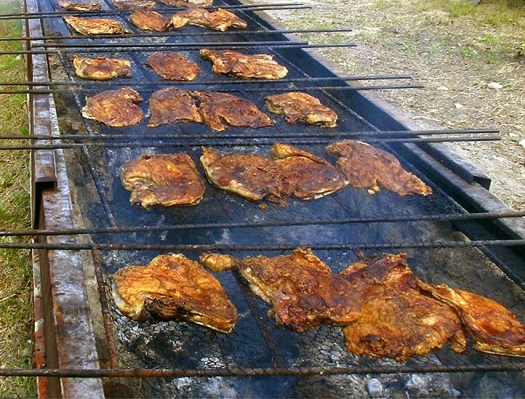
Uncle Si’s crowd thins out as the preliminary speaking begins. We listen to the soaring oratory with one ear and the sizzling of Bluebill’s meat The beef has been cooking all night over the embers of green hickory wood and its peppery odor has had our nose twitching since we first drove up. Bluebill’s pit is a ten-footer with wire mesh stretched over a fire coaxed down to smokeless coals. We pace the pit with him on one of his endless rounds — up one side to turn the meat, down the other to baste it with his mopping sauce. As the moist, brown hunks of beef approach perfection, Bluebill continues his rounds, proud as a monkey with a tin tail.
While the main speaker is warming up, we move from one group of friends to another. The sonorous voice damns the tariff and the Republican party. We nod our head. He touches on the sacredness of the ballot, the virtues of Southern womanhood, and we are in accord. He promised to fight, bleed and die to keep the ship of state a float and we say “amen.”
He pauses for dramatic effect, and after mopping his perspiring brow, starts in to rant, abuse, belittle and attack the opposition. We edge closer because this is what we came to hear. The speaker describes his opponent as a “shallow-brained, slack-jawed liar; a bull ape of Mississippi politics; a grave baboon cavorting like a fat pony in high oats.” We push a bit nearer the speaker’s stand, anxious to hear every word, hoping he’ll let the hide go with the horns and the tallow.
“Like a parasite of the highest rank,” the candidate roars, “he has been feeding from the public trough for twenty years, fattening the bosom of his trousers. It is time that the voters of this commonwealth rise up in indignation and turn him out to pasture and elevate to office men who won’t jump down their throats and gallop their insides out.”
Whether we agree with the speaker or not, we admit it’s pretty pert language, We figure maybe he is right, but for the moment the mention of feeding has suggested something and soon we take ourselves over to the pits to see how Bluebill is getting along with the beef, which has been roasting over the hickory fire for fourteen hours. Taking his cue from the orator, Bluebill dabs on more hot stuff, dressing it down with the same vigor the candidate uses on his opponent.
There is always an outsider who doesn’t know any better than to ask Blue bill for his mopping sauce recipe. His answer is as evasive as it is voluble. He recites it like a grocery list: vinegar, bay leaves, lemon, paprika, pickling spice, onions and garlic. To make it “good and delicious” Bluebill says go heavy on the garlic and paprika. If he is really annoyed by the questioning, he will recommend the generous use of a butter substitute as the base for his concoction. If only mildly so he will suggest cow butter. Catch him off guard when things are going well in the pits, and Bluebill will admit that he, himself, uses nothing but chicken fat.
Bluebill, having made what he calls his “politeness” turns to mopping his beef, and the bewildered recipe-seeker has to listen once more to the politician who, at this time, is working up to the climax punch. In a moment he will let us have it with both fists and leave us groggy and hanging on the ropes. Recoiling from the political punches, a neighbor asks us to have a drink of his best corn liquor, and we don’t care if we do. The candidates, wilted and weary from their efforts on the speakers’ stand, likewise have a good stiff one back in the bushes.
Meanwhile there is a mass movement toward the long table. Dicey paddles over from the edge of the clearing and gets there just as Bluebill draws a blade across the first outside piece. Some of our own women lay off cooing at the babies and line up behind the table to make the same woman-noise over the cakes and potato salad. For our part, we pass up all such trimmings. Armed with a slice of bread and a hand quicker than Bluebill’s knife, we aim for the outside piece, and make it.
The crowd gives way a little for the speakers to be served. After having bethumped each other with hard words, the candidates chat over their food as though it had miraculously brought them to terms. We ourselves share a dipper of spring water with a man we never liked and politics for the moment is forgotten. Even a Mississippi man just can’t keep on devouring barbecued beat and political speeches without gradually losing appetite. But we sorta have to stick around in the afternoon to hear our neighbors who are running for local office. We sit back to watch their antics and stay ready to have a good time if they work up a spat about something. Actually, what’s on our minds is the need for getting along home to see about the stock. It’s a far piece and we want to be there before first dark.